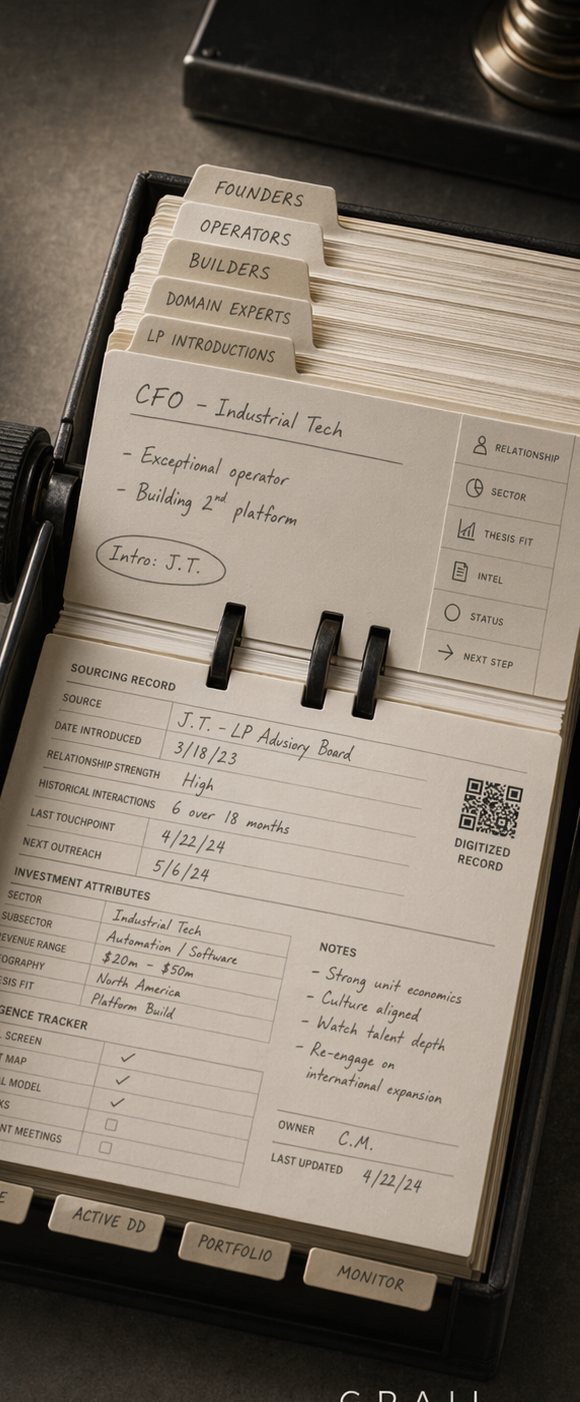
Your Deals, Your Fund, and the Partner You Cannot Replace
Your proprietary deal flow is thinning. Your last DDQ ran three weeks. Your best partner is five years from the sabbatical conversation. Three problems that look separate, but are actually one. A briefing for commercial leaders at mid-market PE and VC firms.
You have seen this on your deal floor
Every Head of Origination at a mid-market European PE firm has had the same Monday morning. Three deals closed in your sector last quarter. You had early eyes on one and the process ran to auction before you could move; you lost on price. One you never saw coming. It went to a firm you do not respect, and the founder told you later they had been talking for six months about a specific operating thesis for the category. One you walked away from in diligence because your sector map read the tailwind weaker than the deck did. Your best partner mentioned the word sabbatical on Friday. Your IR lead forwarded you a DDQ from a sophisticated European LP. Question fourteen asked you to describe your systematic sourcing process with examples from the last twelve months.
You have done this job for fifteen years. The model used to be simple. Build your network. Develop your sector view. Win the LP relationships. Hire principals who could originate. Do the deals. The carry compounded. Your fund size stepped up. The business was understandable.
Something shifted in the last eighteen months. Your proprietary ratio is lower than it was three raises ago. Your auction win rate is stable but the competition is arriving better prepared. The LPs that used to ask about track record are now asking about systematic process with specific examples. Your DDQs are running three weeks instead of one because every response is written from scratch. Your sector map lives in two partners' heads and one of them is starting the retirement conversation. Your best portfolio value-creation thinking is repeated work every time, because nobody ever wrote down what actually moved TVPI last fund.
This is not a you problem. It is an industry problem and a function problem, happening at the same time. Most commercial leaders are treating them as two. The ones who see them as one are going to own the next fund cycle.
This briefing covers what is happening in your industry, what it means for your origination team, your IR function, and your portfolio operations, and the three questions your partnership should answer before the next fund close.
Mid-market PE just lost the answer that ran LP pitches for twenty years
For twenty years the LP answer was simple. Track record, partner tenure, sector reputation, and a deck of case studies was enough for a sophisticated LP to write a cheque at target fund size. That answer still works at the top end of the market and it still works when the raise is oversubscribed. At the mid-market, in a year when allocators are writing fewer and larger tickets, the answer has stopped working. The sophisticated LP now asks one question your predecessors never faced: what is systematic about your edge, with examples from the last twelve months.
The ones that have a credible answer are pulling away. Predictive sourcing firms are reporting auction success rates roughly a third higher than peers. DDQs turn in four days instead of three weeks. The LP sees an auditable process, not a pitch about the team. The fund raises at target or above target. Terms hold. The management-fee base for the next seven years compounds. The ones without a credible answer get the LP meeting, then the second meeting, then the polite email that the allocation is going elsewhere this cycle. The delta between the two is compressing your mid-market in real time.
The LP no longer wants to hear about your team's track record. They want to see a system that makes your team consistently better. That is the evidence of edge the 2026 allocator is underwriting.
The deal-flow side of the same shift is less visible in the LP conversation and more painful in the weekly pipeline review. Competitors are running thematic-sourcing infrastructure that monitors founder signal, refinancing activity, bank debt, new hires in the C-suite, and capex patterns across the sector. By the time a banker picks up the phone, the competitor has had three conversations with the founder about a specific operating thesis. You get the CIM. They already had the relationship. The proprietary ratio in your last fund will not hold in your next one if the infrastructure gap is unaddressed.
Your deal team, your IR team, and your portfolio operations are feeling it every day
Your origination. Your deal team tracks the companies in your sector map the way it has for a decade. A partner covers a segment, reads the trade press, works the banker network, and surfaces names at Monday's pipeline meeting. The signals that would flag a founder readiness window, a refinancing pressure point, or a competitor-driven divestiture opportunity are scattered across sources nobody has time to monitor systematically. When a deal appears intermediated, the partner was three months late to the founder relationship. When a competitor beat you to a deal, the competitor had been building the thesis for six months while you had not yet put the company on the list.
Your IR function. The DDQ from last month took three weeks because every answer was written from scratch against a past fund's marketing materials. The LP's question about systematic sourcing was answered by describing the team. The LP's question about portfolio value-creation methodology was answered by describing past deals. The LP did not push back in the meeting. The LP passed on the allocation and you heard about it from the placement agent six weeks later. Your IR lead knows the answers need to be systemic, not anecdotal. They do not have the infrastructure to make them so.
Your portfolio operations. Every time a platform deal closes, the 100-day plan starts from a blank page, or from the partner's memory of the last three deals they ran. What actually moved TVPI in the last fund was never documented. The cross-portfolio benchmarks that would show which CFO move correlated with multiple expansion, which commercial-function intervention correlated with faster organic growth, and which management-team replacement actually created the return, are not computed because the data is scattered across board decks, exit diligence files, and quarterly investor letters. Portfolio operations re-learns the same playbook every fund.
Your best partner. Your sector coverage sits in one or two senior partners. They carry the founder relationships, the pattern recognition of which management teams actually deliver, the reading of which sector tailwinds are durable versus cyclical, and the judgment of when to walk away from a deal that looks good on paper. They built this over fifteen to twenty-five years. It has never been written down. Two of them are over fifty-five and one has mentioned sabbatical. When they leave, your sector coverage decays over the next twelve to twenty-four months, and the next LP meeting walks in on the key-person question without an answer.
The winners are already running one commercial system
Your industry is compressing because LPs are underwriting evidence of systematic edge, not team biography. Your function is compressing because your partners have information problems the existing tool stack was never designed to fix. Same force, two altitudes. But there is a third thing happening that most commercial leaders have not named yet, and it is the one that matters most.
Look at the firms pulling ahead. Origination, IR, and portfolio operations are running as one commercial motion, not three separate functions. The same proprietary history that trains the next origination call is training the next DDQ response and the next 100-day plan. The LP-facing narrative and the deal-team pipeline are referencing the same evidence base. The portfolio-operations benchmarks flow back into the sector theses the origination partners carry into founder conversations. One data asset, three operating fronts, one commercial motion.
Most commercial leaders are still running three teams with three plans. A sourcing tool for origination. A DDQ template for IR. A portfolio-monitoring platform for ops. Eighteen months later nothing compounds, because the three plans never met. The LP writes the smaller cheque. The auction keeps going to the firm that was three months earlier. The partner retires and the sector coverage decays on schedule.
Your firm is sitting on the most valuable training data in mid-market PE. Three to five years of IC memos, board decks, founder calls, DDQ responses, exit analyses, and partner notes. Most of it is being discarded every quarter. The competitor that organises it first has an eighteen-month head start on the fundraise question that is now table stakes.
You have twelve to twenty-four months. The AI-adoption debate is over. Your question now is whether you lead the commercial architecture yourself, or your CIO brings in a consultancy to define it for you.
What most firms are doing. What the winners are doing instead.
Every commercial leader has had the AI conversation by now. Most are making the same four decisions. A smaller group is making different ones. The difference is whether AI is a tool to buy or the set of levers that reshapes how the firm operates.
| The default path | The winners' path |
|---|---|
| Run origination, IR, and portfolio ops as three teamsThree plans that never meet. A sourcing tool, a DDQ template, a monitoring platform. | Run one commercial motion across all threeOne proprietary data asset feeding origination, IR, and portfolio ops. Shared evidence base. Compounds every quarter. |
| Buy a PE-tech platform and call it a systematic edgeEvery competitor has the same platform within a year. The tool is the commodity. | Build the intelligence your firm actually usesTuned to your sectors, your theses, your portfolio history. Yours to keep, compounding with every deal your team runs. |
| Tell LPs your edge is the team and the track recordThe sophisticated LP has heard this from every GP. The allocation goes to the firm with the auditable process. | Show LPs an auditable systematic process with evidenceThe DDQ turns in four days with cross-referenced examples. The LP sees the system works. The cheque lands at target. |
| Wait for your best partner to retire, hope coverage holdsThe sector relationships decay twelve to twenty-four months later. | Capture their sector map now, while they are still thereThe pattern recognition moves into firm infrastructure. Sabbatical becomes a zero-impact event. |
Same technology. Same twelve months. Opposite outcomes. The difference is the operator, not the AI.
Deals. Terms. Partners.
Three questions every commercial leader in PE is tracking. None of them used to be the same question. They are now.
Why are we not seeing deals we should be first on?
The deal went to a firm you do not respect. They did not outbid you. They had been in the founder's conversation for six months while you were still working from last quarter's sector map. Your proprietary ratio is slipping. The competitors pulling ahead are running thematic signal across founder activity, refinancing patterns, and competitor moves. Your partners are not losing talent. They are losing the preparation race.
Why did we give up terms in the last raise?
The sophisticated LP asked you to describe your systematic process with examples. Your answer was the team's track record. The LP passed. The MFN clause and the fee step-down went to the firm whose DDQ read auditable. Your fund-size and the management-fee base for the next seven years got compressed in the first second meeting you ever lost on the systematic-edge question. The answer the LP wanted was evidence of infrastructure, not another pitch about the team.
What happens when our best partner steps back?
Your sector coverage sits in one or two partners' heads. You have never found a way to transfer what they know to the rest of the team. The founder relationships, the management-team pattern recognition, the reading of which tailwinds last. Once they step back, the sector decays twelve to twenty-four months later. There has never been a way to capture what they know. There is now. The sabbatical conversation is already on your calendar.
What the firms winning this play are actually doing
Four concrete moves any commercial leader in PE can start this quarter. Each touches one function. Pulled together, they fuse your firm into one commercial system.
Origination: get your partners into the founder conversation earlier
The partner who walks in knowing the founder's hiring pattern, the refinancing clock, the competitor pressure, and the board dynamics converts at roughly sixty-five percent. The partner who walks in cold converts at twenty-five. Agentic signal across founder activity, C-suite moves, bank debt, and competitor M&A routes prioritised opportunities to the right partner in fifteen minutes of directed reading, not three hours of assembly. Your best partners already do this mentally. The rest of the team needs the infrastructure.
IR: build DDQ infrastructure that turns evidence of systematic edge into the default answer
Every past DDQ, PPM, investor letter, and LP side-letter becomes structured evidence. When a new DDQ lands, agents draft the first eighty percent in your firm's own language, cross-referenced to specific deals and portfolio outcomes. Your IR lead spends their hours on the twenty percent that is genuinely bespoke. Turnaround compresses from three weeks to four days. More importantly, the process itself is now the evidence the LP wanted. The systematic-edge question has an auditable answer.
Portfolio operations: make your value-creation methodology firm infrastructure
Every IC memo, 100-day plan, board deck, and exit diligence file becomes training data. The next platform deal gets a first-cut 100-day plan matched against the library of past playbooks, with evidence of which levers worked at which scale. Cross-portfolio benchmarking runs continuously. Which operating move correlated with multiple expansion, which management-team change actually delivered, which sector bet played out as modeled. The playbook stops being the partner's biography and becomes the firm's balance sheet.
Knowledge: capture what your senior partners know, before they step back
Every senior partner carries fifteen to twenty-five years of sector intelligence in their head. Founder networks, management-team patterns, competitive near-misses, the tells of a deal about to go bad. It has always been biographical, which is why a departure is a twelve to twenty-four month blackout for coverage. The extraction is structurally possible in 2026 for the first time. Longest lead time of the four moves. Start now, while they are still there.
The only firm that joins the partner conversation to the working tools
The commercial leader in PE has four places to go for help in 2026. None of them can do what we do, each for a specific reason.
Data-room and CRM vendors sell deal-management and diligence platforms to operations teams as a tool decision. They do not sit down with you and talk about what a sophisticated LP actually wants to see, and they do not build custom agents that run across proprietary signal they do not own. They sell platforms.
The big strategy firms will write you a two-million-euro operating-model diagnostic. They cannot put a working sourcing agent in your partners' hands in three weeks because their cost structure requires them to bill analyst hours. You can have their deck or their tool. You cannot have both.
Specialist sector-intelligence subscriptions sell information access by the seat. Useful at the screening layer. They do not build firm-specific intelligence that compounds with every deal your team runs. The edge they sell is the edge every competitor also pays for.
PE-tech platforms with embedded AI want an eighteen-month implementation that installs intelligence inside their platform. Their business needs you dependent on that platform as system of record. That is not our business.
The market offers four things you have already said no to. GRAIL is the fifth option.
- Senior advisory that speaks deal-floor, not strategy-deck
- Working agents your partners use the same week
- Infrastructure built on your sectors, your theses
- The start of a firm-specific intelligence graph
- No platform lock-in at any phase of the engagement
- Founded by operators who have built and sold companies
- Business first, technology second
- Three weeks from first meeting to working tools
- Your team keeps the tools, you own the IP
- Every next step earned by what just shipped
Three sessions with your partners. Working tools from week one.
We start with your partnership because the change cannot outrun the partners' personal understanding of what is possible. Three workshops. Each delivers standalone value. Each earns the right to the next.
How to think
Walk through what is happening in your industry and in your firm. Build the first working agent in the room: a thematic-sourcing signal run for a sector one of your partners owns, against a real target list. Your partnership leaves with a shared view of what to do next and the first working tool in their hands.
Your team's tools
A half-day activation. Each partner leaves with five to ten working agents tuned to their sectors, their theses, their current targets. Founder-signal monitoring. Pre-meeting prep. DDQ acceleration. Portfolio value-creation benchmarking. Agents your team is using the same week, not slides about tools.
Ready for the raise
Refined tools based on real use. The rollout plan to your wider deal team and IR function. The knowledge-capture plan for your senior partners. The systematic-edge narrative for your next LP meeting. And the CIO conversation with numbers they can check, not a deck they cannot argue with.
Three weeks. No IT project. No board approval needed to start. The tools your team is already using when we finish.
For your next partner meeting
The questions where your partnership cannot agree on an answer are the ones worth an hour on the agenda. Ask these honestly.
Of the last ten deals you were outpositioned on, how many went to firms that had the founder relationship earlier, not the better price? If you do not know, how would you find out?
The last time a sophisticated LP asked you to describe your systematic sourcing process with examples, what did you actually say? What would you want to be able to show them in the next meeting?
If your two most senior partners took a six-month sabbatical next quarter, what would happen to your sector coverage? What have you actually transferred to the rest of the team in the last twelve months?
Where is your average principal spending their Monday morning today, and where would they need to spend it to surface one more proprietary conversation per month?
Which of your principals is already doing what the rest of the deal team will need to do by 2027 to keep the proprietary ratio where your LPs expect it? What would it take for that behaviour to be the default across the team?
If any of these produces a disagreement at your next partner meeting, that is the conversation worth having before the next LP asks.
Continue reading
Sources and limitations
This briefing draws on GRAIL's engagement experience with leadership teams and on public company disclosures. Figures are illustrative unless a source is named beside them. A sourced edition is in preparation.