What's Changing on Your Distribution Floor
Binders are going to carriers you have never panelled. Renewals are slipping on speed, not price. Your best senior underwriters are five years from retirement. Three problems that look separate, but are actually one. A briefing for commercial leaders at specialty insurers and MGAs.
You have seen this on your distribution floor
Every commercial director at a mid-market specialty carrier in Europe has had the same Monday morning. Your London wholesale broker placed a mid-sized cyber binder on Friday with a carrier you have never panelled. They did not under-price you. They quoted in four hours. You were going to quote on Tuesday. The same broker has two renewals with you in April and May. Your senior cyber underwriter is sixty-one. Your CEO wants to know why specialty hit ratio is down three points year-on-year.
You have done this job for fifteen years. The pattern used to be simple. Hire underwriters and BDs who had the right market feel. Coach them. Keep the broker relationships warm. The best stood out in three years. You built the book around them. You won your share, you lost some, you held rate in hard markets and you wrote through soft ones. The business was understandable.
Something changed. Your BDs are working harder and quoting slower than the new entrants. Your senior underwriters are spending afternoons on exposure data and appetite letters instead of reading risks. Your renewal retention is slipping on classes where speed and certainty now decide. Your broker-facing reps are walking into placement meetings where the broker has already received a quote from a carrier you cannot match on turnaround. And your best senior underwriter is five years from retirement, and two decades of loss-experience judgment is about to walk out with her.
It is not a you problem. It is an industry problem and a function problem, happening at the same time. Most commercial leaders are treating them as two. The ones who see them as one are going to own the next decade of specialty insurance.
This briefing covers what is happening in your market, what it means for your distribution floor and your BD team, and the three questions your leadership team should answer before the next board cycle.
Specialty insurance just lost the cost-and-speed floor it ran on for forty years
Every technology wave specialty insurance absorbed in the last four decades left the basic economics alone. Electronic placement, modelling platforms, catastrophe analytics, policy administration systems, data-enrichment services. All of them made underwriters more productive. None of them changed the fact that a mid-market carrier and a new entrant started on roughly the same cost base when pricing a risk. The business ran on underwriting judgment, broker relationships, and disciplined claims management. Your book has run on that combination for forty years and it never once broke.
AI does not behave the same way. AI-native MGAs have entered with licensed capacity, specialty appetite, and cost bases a fraction of yours. They are quoting in hours on classes where you quote in days. They are binding risk in specialty corners where the broker used to come to you first. For the first time in forty years your cost-and-speed floor is actually sliding, and the brokers have noticed.
Your brokers' placement teams now run initial submissions through carriers that quote in hours. Your quote turnaround is measured against the fastest carrier on the panel, not against the market average.
The competitors in your segment are not waiting. Major specialty carriers have committed real budget to AI underwriting in the last twelve months. The ones moving first are already quoting more submissions while writing no more loss volume. Their BDs are walking into brokers with appetite the broker has already read. The broker-side shift is the other half of the story. Placement teams now run initial market research through AI-assisted tools that shortlist two or three carriers before the submission goes out. In most mid-market submissions, at least one of those carriers is already the broker's preferred quote-first pick. Your BD walks in to confirm, not to lead. If you were not in that broker's consideration before the submission went out, you are not in the binder.
Your distribution floor, your BD team, and your submission ops are feeling it every day
Your binders. Your BDs walk into broker meetings where the submission has already been priced somewhere else. The ones who prepared arrive with the broker eighty percent decided in their favour. The ones who did not are starting from forty percent. Hit ratio on the first group is roughly double the second. The BDs who prepare also hold rate. The discount conversation is lost in the quote turnaround, not in the rate negotiation at bind.
Your BD and marketing team. The broker-consideration playbook changed in a single year. Trade-press placement is softer than it was. Brokers research carrier appetite in AI-assisted tools before they call your BD. If your carrier does not show up in those pre-submission answers, you are not in consideration. The leading carriers are shifting BD-marketing from appetite letters to authority in the broker's research layer. Named underwriter voices in the specialty trade press. Original loss-experience research the placement teams cite. Senior underwriter presence in the forums where brokers compare carriers privately. Marketing's job is moving from producing appetite letters to making sure you are already the preferred pick before the submission is drafted.
Your submission operations. The function that used to run submission triage, quote turnaround, and renewal-calendar reporting is becoming the architecture of your entire distribution engine. The tools every BD uses. The data that flows between underwriting and distribution. The agents that capture what your best underwriters know. The metrics that prove the combined-ratio case to the CFO. All of it runs through submission ops and rev ops. Most commercial leaders still treat this layer as reporting. The ones pulling ahead are repositioning it as the architecture that ties underwriting, BD, and claims advocacy into one system.
Your BDs' week. Broker follow-up, appetite letters, exposure data pulls, submission triage, renewal pipeline tracking. Six to ten hours a week of work that used to be the cost of being a broker-facing professional. That work can now be done in thirty minutes when your team is set up for it. Your best BDs are using the freed time to win more binders. Your middle BDs are using it to do the same things they did before, which is now not enough.
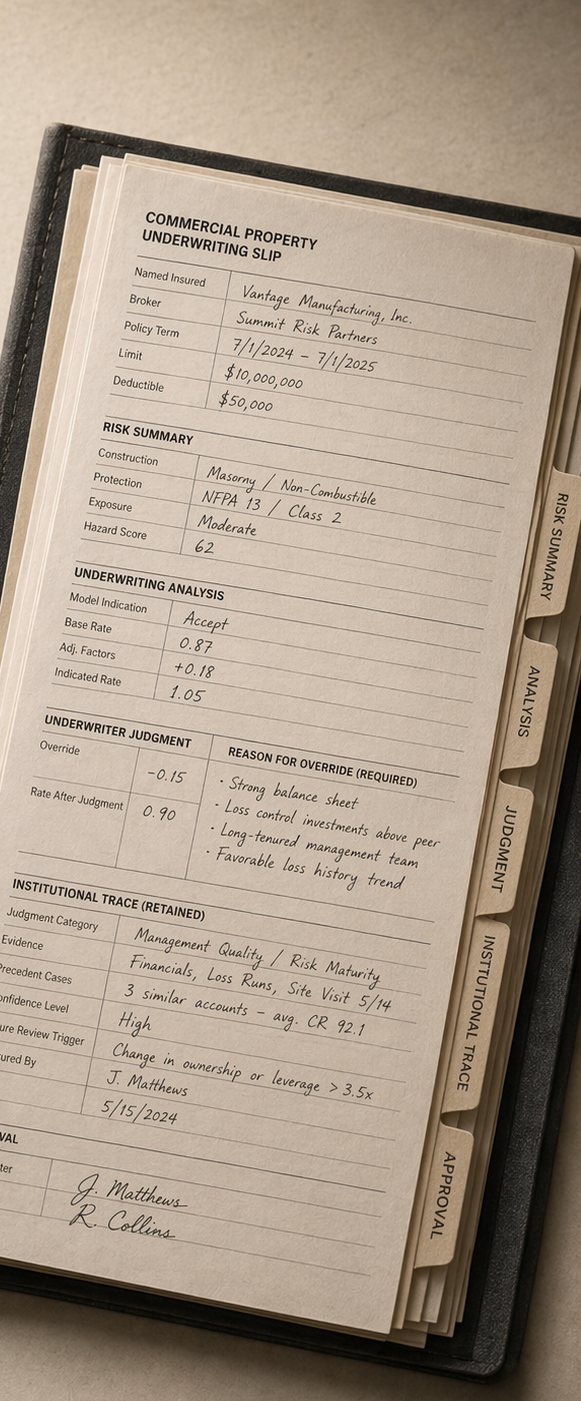
Your best people. Your top three specialty underwriters and your top two broker-facing BDs carry between twenty and forty percent of the book. They built it on fifteen to twenty years of loss experience, override discipline, and broker trust, none of it written down. When your best senior leaves, the judgment leaves. The book's rate adequacy slips in the twelve to eighteen months that follow. Two of your top three are over fifty-five. The retirement conversations are already happening. You know which ones.
The winners are already running one distribution system
Your industry is compressing because AI takes hours out of underwriting production. Your function is compressing because your BDs have free time they did not have before, and your brokers show up pre-informed. Same force, two altitudes. But there is a third thing happening that most commercial leaders have not named yet, and it is the one that matters most.
Look at the carriers pulling ahead. Underwriting, distribution, and submission ops are running as one motion, not three separate functions. Underwriters are in the weekly BD pipeline review. Submission ops owns the quote-turnaround clock and reports it daily. BDs feed back the brokers' real questions so the next appetite piece targets what the placement team is actually asking. The data flows between the three functions. The tools are shared. The combined-ratio metrics and the hit-ratio metrics sit on the same dashboard. Everyone is working the same system.
Most commercial leaders are still running three teams with three plans. A copilot for the BDs. A quote-triage tool for submission ops. A modelling refresh for underwriting. Twelve months later nothing compounds, because the three plans never met.
Your competitors who get this will quote specialty binders in four hours that used to take three days. Their BDs walk in with everything yours does not. Their carrier brand is the preferred pick before the submission drops. Their submission ops has captured what the best underwriters know and made it available to every BD. Three things compounding into one. This is what the next eighteen months look like if you do not move.
You have eighteen to twenty-four months. The AI adoption debate is over. Your question now is whether you lead this from the commercial seat, or the CFO hires someone who will.
What most carriers are doing. What the winners are doing instead.
Every commercial leader has had the AI conversation by now. Most are making the same four decisions. A smaller group is making different ones. The difference is whether AI is a tool to roll out, or the set of levers that reshapes how distribution operates.
| The default path | The winners' path |
|---|---|
| Run underwriting, BD, and submission ops as three teamsThree plans that never meet. A copilot for BDs, a triage tool for ops, a model refresh for underwriting. | Run one distribution motion across all threeUnderwriters in the pipeline review. Ops owns quote turnaround. Shared data, tools, and hit-ratio metrics. |
| Buy a quote-and-bind platform and call the AI strategy doneEvery competitor has the same platform within twelve months. The platform is the commodity. | Build the tools your team actually usesTuned to your appetite, your brokers, your specialty classes. Yours to keep, compounding with every submission. |
| Push BD for more submissions in the doorMore broker visits, more appetite letters, more pipeline reports. Hit ratio falls because the broker already chose a carrier. | Build carrier authority where brokers actually researchNamed underwriter voices in trade press. Loss-experience research placement teams cite. Preferred pick before submission. |
| Wait for your senior underwriters to retire, hope the handover worksThe book's rate adequacy decays twelve to eighteen months later. | Capture what they know now, while they are still thereThe judgment moves into a system every BD and junior underwriter uses. Retirement becomes a zero-impact event. |
Same technology. Same twelve months. Opposite outcomes. The difference is the operator, not the AI.
Binders. Retention. Retirement.
Three questions every commercial leader is tracking. None of them used to be the same question. They are now.
Why are we losing binders we should be winning?
The binder went to a carrier the broker never named before. They did not under-price you. They quoted in four hours. They were in the broker's consideration before the submission went out. Their BDs walked in knowing things your BDs had to ask. This is happening more often than a year ago and the trend is in one direction. Your BDs are not losing talent. They are losing the quote-turnaround race.
Why are our renewals slipping on speed, not price?
A third of the renewals in your book this quarter went after a carrier you have never panelled got back to the broker in hours. The renewal was not lost on rate. The renewal was lost on certainty and turnaround. Two to five points of retention per specialty class walks out of the book every year. It is not a rate problem and it is not a broker-loyalty problem. Your BDs are outgunned on the speed the broker now expects.
What happens when our senior underwriters retire?
Your top three specialty underwriters carry a third of the book between them. You have never found a way to pass what they know to the next generation. Two of them are over fifty-five. Once they leave, the book's rate adequacy slips twelve to eighteen months later. There has never been a way to capture what they know. There is now. The retirement conversations are already on your calendar.
What the carriers winning this play are actually doing
Four concrete moves any commercial leader can start this quarter. Each touches one function. Pulled together, they fuse your distribution floor into one system.
Senior underwriters: release their afternoons back to the risks worth overriding
Your senior underwriters spend 40% of their time on exposure pulls, appetite letters, quote formatting, and compliance documentation. None of that is underwriting. The AI layer absorbs the production. They get their afternoons back for the ten risks per month that actually need override judgment. Rate discipline improves because the seniors are finally looking at the risks, not the paperwork.
BD and marketing: become the preferred name before the broker sends the submission
The broker's shortlist is set before the submission goes out. Named senior underwriters in specialty trade press. Loss-experience research the placement teams cite. Preparation packs before every significant broker visit. Your carrier becomes the broker's quote-first pick on the classes you want to own, instead of the third-quote courtesy you are becoming on classes you used to lead.
Submission ops and rev ops: move from reporting to architecture
The team that used to run quote-turnaround dashboards is the new centre of your distribution engine. They own the tools every BD uses, the data flowing between underwriting and BD, the agents capturing what your best seniors know, and the hit-ratio and retention metrics the CFO cares about. The hardest move to hire for and the one with the most pull on every other number. Without it, the other three moves stay siloed.
Knowledge: capture what your senior underwriters and BDs know, before they retire
Every senior carries fifteen to twenty years of loss judgment and broker trust. It has always been biographical, which is why your ramp for new senior hires is two to three years. AI now extracts that judgment from underwriting files, loss runs, override notes, and broker correspondence, into a system every BD and junior underwriter uses. Ramp compresses. When the retirement lands, the judgment stays. Longest lead time. Start now.
The only firm that joins the broker-floor conversation to the working tools
The commercial leader in 2026 has four places to go for help. None of them can do what we do, and each of them for a specific reason.
Insurtech platforms and quote-and-bind systems give you a better policy-admin layer and a faster quote form. They do not sit down with you and talk about what to do with the judgment sitting in your senior underwriter's head, and they do not build the tool that puts your best underwriter's override discipline in every junior's hands. They sell platforms.
The big strategic consultancies will write you a two-million-euro combined-ratio reduction deck. They cannot put a working quote-preparation tool in your BDs' hands in three weeks because their cost structure requires them to bill analyst hours. You can have their deck or their tool. You cannot have both.
The global carriers' internal AI teams are possible at Zurich scale. Not at yours. The capability gap is structural, not political. Hiring a forty-person internal AI function inside a mid-market carrier is a three-year programme that ends where the globals already are.
The AI-native MGAs will happily partner with you on the classes you used to own. That deal rents out your distribution and ends with them owning the broker relationship you spent twenty years building.
The market offers four things you have already said no to. GRAIL is the fifth option.
- Senior advisory that speaks distribution-floor, not strategy-deck
- Working tools your BDs use the same week
- Custom agents built on your appetite, your brokers, your classes
- The start of a judgment system your senior underwriters feed
- No vendor lock-in at any phase of the engagement
- Founded by operators who have sold and led commercial teams
- Business first, technology second
- Three weeks from first meeting to working tools
- Your team keeps the tools, you own the IP
- Every next step earned by what just shipped, never assumed
Three sessions with your commercial leadership team. Working tools from week one.
We start with your commercial leadership team because the change cannot outrun the team's personal understanding of what is possible. Three workshops. Each delivers standalone value. Each earns the right to the next.
How to think
Walk through what is happening in your market and on your distribution floor. Build the first working tool in the room: a pre-submission preparation agent for one of your BDs, on one of your real brokers, for one of your real specialty classes. Your leadership team leaves with a shared view of what to do next and the first working tool already in their hands.
Your team's tools
A half-day activation. Each member of your commercial leadership team leaves with five to ten working tools tuned to their brokers, their specialty classes, their appetite. Pre-submission prep. Quote-draft agents. Renewal-defence triage. Broker-relationship briefings. Appetite authority tools. Tools your BDs and underwriters are using the same week, not slides about tools.
Ready to roll
Refined tools based on real use. The rollout plan to your wider BD and underwriting teams. The knowledge-capture plan for your senior underwriters. The rate-discipline playbook for your BDs. And the CEO, CFO, and board conversation with numbers they can check, not a deck they cannot argue with.
Three weeks. No IT project. No board approval needed to start. The tools your team is already using when we finish.
For your next leadership team meeting
The questions where your leadership team cannot agree on an answer are the ones worth an hour on the agenda. Ask these honestly.
Of the last ten binders you lost, how many went to carriers that quoted faster, not cheaper? If you do not know, how would you find out?
What is your average quote turnaround across your top specialty classes, and how does it compare to the fastest competitor on the broker panel? Which of your BDs hold rate the best, and what do they do differently?
If your top three senior underwriters retired next year, what would happen to the rate adequacy of the book they built? What have you actually transferred to the next generation in the last twelve months?
Where is your average BD spending their Monday morning today, and where would they need to spend it to win one more binder per month?
Which of your BDs is already doing what the rest of your team will need to do by 2027 to keep winning binders? What would it take for that behaviour to be the default across the team?
If any of these produces a disagreement in your leadership team, that is the conversation worth having before the board asks.
Continue reading
Sources and limitations
This briefing draws on GRAIL's engagement experience with leadership teams and on public company disclosures. Figures are illustrative unless a source is named beside them. A sourced edition is in preparation.