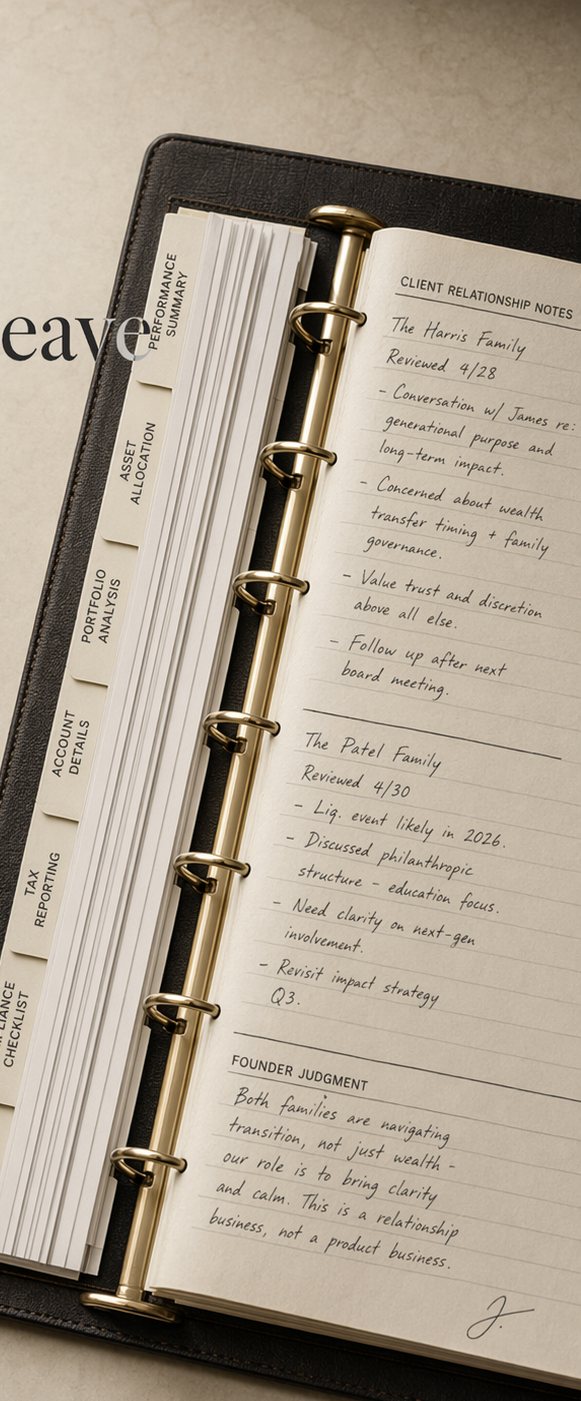
What's Changing on Your Advisory Floor
Your top advisors are five years from retirement. Your senior people spend afternoons on reports instead of with clients. Your firm's value at the next capital event is tied to both. A briefing for Heads of Advisory at wealth management firms.
You have seen this on your advisory floor
Every Head of Advisory at a mid-market European wealth manager has had the same Monday morning. Your senior partner mentioned his retirement date on Friday. He is sixty-two. The plan on paper is to introduce Anna, the junior partner, over the next eighteen months. The real plan is to hope the largest families do not move the mandate when he leaves. Two other senior names are past sixty. Net-new money last quarter was half what it was two years ago. Referral flow is concentrated on three names. And your CEO wants to talk about the PE conversation at next year's board.
You have done this job for fifteen years. The pattern used to be simple. Hire advisors who had the right stuff. Let them build a book. Pair them with a strong paraplanner. The best stood out in five years. You built the firm around them. Succession was a conversation about introductions and handshakes. The business was understandable.
Something changed. Your senior advisors are spending forty percent of their week on research synthesis, portfolio reporting, and compliance documentation rather than with the clients who pay for their judgment. Your junior advisors are carrying the production load but cannot yet carry a relationship. The referral flow depends on three names who will all retire within a decade. And the handover pattern your firm has always run, where the senior introduces the junior, the client accepts, and the book transfers, is delivering a sixty-five percent retention rate against a ninety percent benchmark at firms doing this differently.
This is not a you problem. It is an industry shift and a function shift, happening at the same time. Most Heads of Advisory are treating them as two. The ones who see them as one are going to own the next decade of private wealth.
This briefing covers what is happening in your industry, what it means on your advisory floor and in your marketing team, and the three questions your leadership should answer before the next partner meeting.
Wealth advisory is facing its first generational handover with the playbook broken
Every technology wave your industry absorbed since the 1980s left the senior advisor's seat untouched. Performance reporting platforms made quarterly statements cheaper, so clients got more of them. Portfolio construction software made asset allocation richer, so mandates got more detailed. Compliance platforms made KYC and MiFID documentation traceable. Every wave added production capacity. None of them touched the conversation in the advisor's office.
The two forces hitting your industry in 2026 are different. The founding generation who built most Nordic and European boutique wealth firms is reaching the retirement window at the same time. Accenture's Q1 2026 data has only twenty-three percent of financial firms past the AI pilot stage. The firms that move first build an institutional record of senior-advisor judgment before their seniors leave. The firms that wait lose that record when the retirement conversations land. That window is closing on a timeline the founder chose, not the firm.
Your clients arrive at quarterly meetings having already run their portfolio questions through ChatGPT. Your senior advisor still walks in with last week's research pack. The advisory conversation is now starting ten minutes behind the client.
The client-side shift is the other half of the story. HNWI clients now research investment questions, tax considerations, and cross-border structures through AI-assisted tools before the quarterly meeting. By the time your advisor sits across from them, the client has a working model of what they want to ask and often what they expect to hear. The advisors still bringing the research-heavy presentation are arriving with the work the client already did. The advisors who arrive with judgment the AI cannot give are the ones holding the relationship. Behavioural coaching. The family-dynamic read. The tax-and-succession call that requires knowing who actually makes the decision. The conversation is moving up one level of abstraction. Your advisory floor needs to move with it.
Your advisory floor, your marketing team, and your succession bench are feeling it every day
Your senior advisors. Forty percent of their week goes to research synthesis, performance reporting, compliance documentation, and drafting client communication. That is forty percent of senior advisor time spent on work a paraplanner could have done ten years ago and an agent can do now. The advisors who read this honestly know their afternoons have drifted from client rooms to spreadsheets. The book has not shrunk. The time with the book has.
Your marketing and business development. The referral engine that used to run on named-partner relationships is slowing. Referrals still come, but from a narrower set of sources, and net-new money last quarter is below plan. Marketing is producing thought leadership that nobody reads and that does not appear when an HNWI asks an answer engine about multi-family office options in the Nordics. The buyers who matter are now researching wealth managers the way they research any other service, and your firm is not showing up in their answers. More articles will not fix that. Your marketing job is moving from brand awareness toward authority placement where the HNWI buyer is actually researching.
Your junior advisors and paraplanners. The layer that used to be the bench has been repurposed into a production function. Juniors are not shadowing senior client meetings anymore because they are running the research packs the senior wanted yesterday. Succession is supposed to be coming from this bench. It is not, because the juniors are not getting the judgment-development time they would need. The firms already running the AI infrastructure are freeing juniors back to sit in the client room, which is the only place advisory judgment has ever been learned.
Your best three advisors. The people who carry twenty to thirty percent of your book between them. They have fifteen to twenty years of family political maps, life-event histories, and investment philosophy sitting in their heads. It has never been transferable. When the first of them retires, retention on the book they owned runs sixty to seventy percent, and the family offices that leave go with what they remember. Two of your top three are past sixty. You know which ones.
The winners are already running one advisory system
Your industry is compressing because the founding generation is retiring into a window it has never faced before, with clients arriving more informed than the quarterly meeting was designed for. Your function is compressing because senior advisor capacity is trapped in production, junior advisors cannot get the room time that builds judgment, and the succession bench is thinner than the firm's growth plan requires. Same force, two altitudes.
Look at the firms pulling ahead. The senior advisors, the marketing team, and the succession bench are running as one advisory system, not three separate teams. Marketing is in the advisor planning session every month. The senior advisor is reviewing the succession record rather than dictating it. Junior advisors are sitting in the family meeting because the production work is running somewhere else. The client record is shared. The judgment is shared. Everyone is building the same institutional memory.
Most Heads of Advisory are still running three teams with three plans. A reporting upgrade for the advisors. A content refresh for marketing. A shadowing programme for the juniors. Twelve months later the book still walks out the door at the first retirement, because the three plans never met.
Your competitors who get this will retain ninety percent of a senior's book at handover against your sixty-five percent. Their senior advisors will see twice as many clients. Their juniors will be ready because they were in the room. Three things compounding into one firm that can go through a retirement without losing value, and through a transaction at a premium. This is what the next twenty-four months look like if you do not move.
You have eighteen to twenty-four months. The firms that move first build the institutional record. The firms that wait watch the record walk out with their seniors.
What most firms are doing. What the winners are doing instead.
Every Head of Advisory has had the AI conversation by now. Most are making four similar decisions. A smaller group is making different ones.
| The default path | The winners' path |
|---|---|
| Run advisors, marketing, and succession as three teamsThree plans that never meet. A reporting upgrade for advisors, a content refresh for marketing, a shadowing rota for juniors. | Run one advisory system across all threeMarketing in the advisor planning. Juniors in the client room. A shared institutional record every advisor builds into. |
| Buy a reporting platform and call it the AI strategyEvery peer has the same platform within a year. The dashboard is the commodity. The senior's judgment is not in it. | Build the tools each senior actually usesTuned to their book, their clients, their voice. Yours to keep, compounding with every client meeting. |
| Push marketing for more thought leadership volumeMore articles, more webinars, more LinkedIn. Nothing lands because HNWI buyers research through AI answers, and your firm is not in them. | Build authority where HNWI clients researchOriginal research answer engines cite. Specific outcomes, named situations. Your firm becomes the preferred name before the referral happens. |
| Wait for the senior advisor to retire, hope handover worksSector average sixty-five percent retention on the book. The family offices that leave take the AUM. | Capture what they know now, while they are still thereThe record moves into a system every advisor uses. Retention on handover runs ninety-plus. Retirement stops being a revenue event. |
Same technology. Same twelve months. Opposite outcomes. The difference is the operator, not the AI.
Retention. Capacity. Value.
Three questions every Head of Advisory is tracking. None of them used to be the same question. They are now.
What happens to the book when our senior retires?
Your top three advisors carry roughly a third of the book between them. The sector average retention on a senior-advisor handover is sixty to seventy percent. The firms with structured client-intelligence infrastructure run ninety plus. Two of your top three are past sixty. The retirement conversations are already on your calendar.
Where is our senior advisor time actually going?
Forty percent of senior advisor time is on research synthesis, performance reporting, compliance documentation, and drafting communication. That is paraplanner-era work charged at senior-advisor economics. Release half of it back to the relationship and your firm gains the equivalent of eight advisors without a single new hire.
What is our firm worth at the next capital event?
Partner-owned wealth firms trade at two to four times recurring revenue when the book lives in partner heads. Six to ten times when judgment is firm infrastructure. On a fifty million revenue firm, that is the difference between a hundred and fifty and four hundred at the exit. The decision gets made years before the transaction.
What the firms winning this play are actually doing
Four concrete moves any Head of Advisory can start this quarter. Each touches one function. Pulled together, they fuse the firm into one advisory system.
Senior advisors: release their afternoons back to the relationship
Research synthesis, performance reporting, compliance documentation, and communication drafting can run on AI tuned to your firm's investment thesis and each client's history. Forty minutes of letter drafting compresses to five minutes of review. Over a senior's week of eighty clients, this is the largest single capacity release in the function. The senior keeps the judgment. The production falls away.
Marketing: become the preferred name before the referral happens
Your HNWI buyers are researching wealth managers through answer engines and peer forums your marketing team is not measuring. More articles will not fix that. Move the spend into authority placement where the buyer is actually looking. Original research that answer engines cite. Specific client outcomes in named situations. Senior voices on the record where peer HNWIs read. Referral-flow recovery starts here, not in the content calendar.
Junior advisors: upgrade the bench from production to judgment
The junior layer that was running the research packs goes back to sitting in the client meeting. They use AI to produce what the paraplanner used to deliver in half the time, then they get the hours they need in the family conversation, the investment committee, the life-event call. Advisory judgment has always been built in the room. The firms that put juniors back in the room are the firms with a real bench at the next transition.
Firm: capture what your seniors know, before they retire
Every client meeting, every investment memo, every handled objection, every life-event response gets captured into an institutional record. When the senior retires, the junior opens the record for every family and sees the twenty years of advice, tax considerations, and political sensitivities. The handover runs on transferred context, not on handshakes. The firm's valuation at the next capital event depends on this.
The only firm that joins the advisory conversation to working tools
The Head of Advisory in 2026 has four places to go. None of them do what we do.
Wealthtech platform vendors sell you a reporting and portfolio-construction platform. Their business needs the platform as system of record. They commoditise the dashboard. They do not capture what your senior knows about a family.
The big consulting firms will write you a five-hundred-thousand-euro strategy deck. They cannot put a working research-synthesis tool in your senior advisor's hands in three weeks because their cost structure requires billing analyst hours.
The internal AI team at a wirehouse is the move the big American wealth names can afford. Sixty people, two years of build. Not available to a mid-market boutique. The gap is structural.
Independent advisor AI startups sell you a meeting copilot or note summariser. Point tools born inside the old motion. Your seniors try them, stop in a quarter, go back to the old pattern.
The market offers four things you have already said no to. GRAIL is the fifth option.
- Senior advisory that speaks advisor-floor, not strategy-deck
- Working tools your seniors use the same week
- Custom agents built on your book, your clients, your voice
- The start of an institutional record your firm builds into
- No platform lock-in at any phase of the engagement
- Founded by operators who have built and led commercial teams
- Business first, technology second
- Three weeks from first meeting to working tools
- Your advisors keep the tools, you own the IP
- Every next step earned by what just shipped
Three sessions with your advisory leadership. Working tools from week one.
We start with your advisory leadership because the change cannot outrun the team's personal understanding of what is possible. Three workshops. Each delivers standalone value. Each earns the right to the next.
How to think
Walk through what is happening in your industry and on your advisory floor. Build the first working tool in the room: a pre-meeting research agent for one of your senior advisors, on one of their real family books, for their next actual quarterly review. Your leadership team leaves with a shared view of what to do next and a tool already in their hands.
Your team's tools
A half-day activation. Each senior advisor leaves with five to ten working tools tuned to their book, their investment voice, their client communication style. Pre-meeting research. Portfolio memo drafting. Compliance file-note synthesis. Client letter preparation in their voice. Tools their clients never see, that they review and send.
Ready to roll
Refined tools based on real use. The rollout plan to the junior layer. The knowledge-capture plan for your retiring seniors. The marketing authority programme for specification-stage positioning. And the CEO and partner-meeting conversation with numbers they can check, not a deck they cannot argue with.
Three weeks. No platform implementation. No board approval to start. The tools your advisors are already using when we finish.
For your next partner meeting
The questions where your partners cannot agree on an answer are the ones worth an hour on the agenda. Ask these honestly.
If your top three advisors retired in the next five years, what percentage of their book would stay at the firm? If you do not know the number, how would you find it out?
What percentage of your senior advisors' week is actually spent with clients versus on research, reporting, and compliance work? Which three seniors would you ask first, and what would the honest answer be?
When an HNWI in your home market types a question about multi-family offices into an answer engine today, does your firm appear? If not, what is your marketing actually producing?
Where are your junior advisors spending their Mondays today, and where would they need to be by 2027 to carry a senior's book when the handover lands?
What is the firm worth at the next capital event if the institutional record exists, versus if the founding partners still carry it in their heads? Which side of that is the current trajectory?
If any of these produces disagreement in your partner meeting, that is the conversation worth having before the board asks.
Continue reading
Sources and limitations
This briefing draws on GRAIL's engagement experience with leadership teams and on public company disclosures. Figures are illustrative unless a source is named beside them. A sourced edition is in preparation.