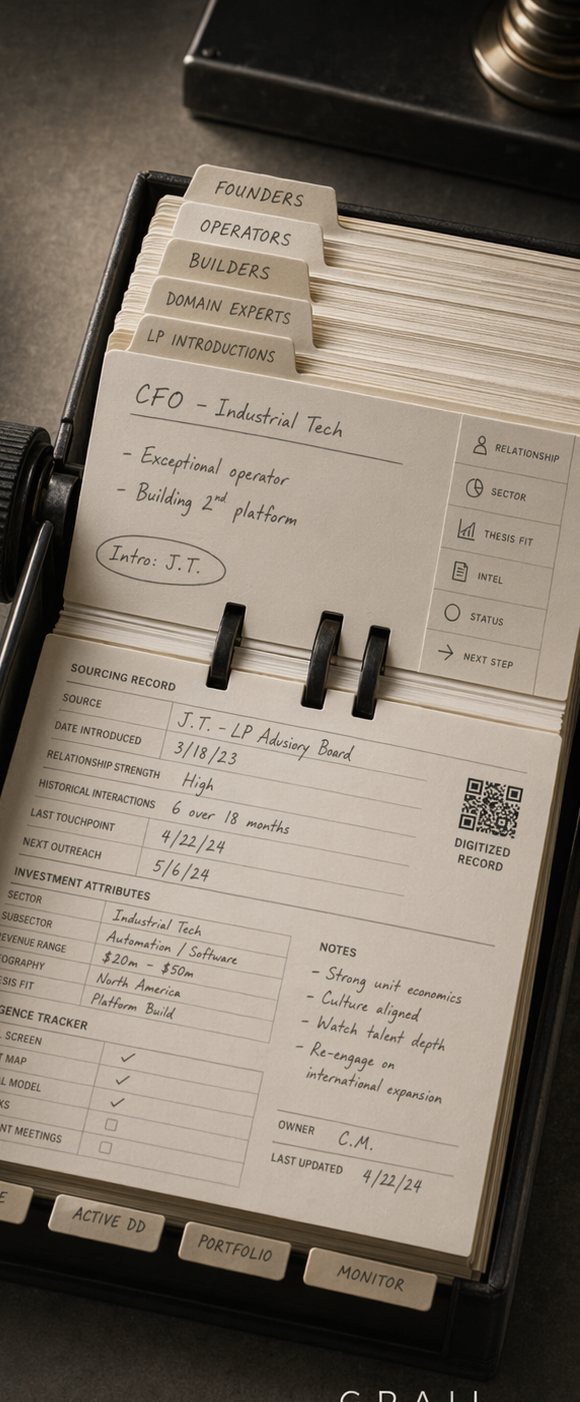
What's Changing in the Deal Team You're Building
Your analyst class is reading every AI tool you ship. Your principal pipeline is breaking quietly. Your next-fund LP narrative pivots on whether your edge is systematic. A briefing for Chief Human Resources Officers and Heads of People at mid-market European Private Equity and VC firms.
Monday, 8:42 a.m.
Every CHRO at a mid-market European PE or VC firm has had the same Monday. Four things in the inbox. Your Head of Talent forwarded Friday's resignation from your best second-year associate, the one who modelled the last three platform deals. She went to an AI-native sourcing shop with a smaller carry pool and a lighter modelling load, and is bringing two friends from the analyst class. Your IR Head forwarded a question from a Nordic LP allocator due-diligence team: what is your firm's documented approach to AI in sourcing, diligence, and portfolio operations, and how does the analyst class learn judgment when the modelling work runs on agents.
Your phone shows two more. The CHRO at portfolio-company TopCo emailed at 11 p.m. Sunday. She is about to quit. The CEO has been deploying AI tools across the workforce without HR in the room and the works council opened framework consultations she did not know about. Your Managing Partner forwarded a Bloomberg article about Klarna's reversal with a single-line note: "are we sure we are not doing this."
You have held this seat for three years. The pattern used to be simple. Hire from target schools. Build the analyst pipeline. Promote the best to associate, the best of those to senior associate, the best of those to principal. The fund cycle gave you time. The work was understandable.
Something changed. Your analyst class is reading every AI-modelling tool the firm rolls out as a signal about whether the firm wants them to learn or wants them to ship. Your principal-promotion list for 2030 has six names on it. At least three came through deal-modelling work agents have already absorbed, and you have not replaced the pathway. Your portfolio operating partners are running thirty separate AI-and-workforce conversations with thirty portfolio-company CHROs. Your IR team is being asked LP questions about your AI strategy that the firm has not formally answered. You do not have a deal-team problem. You have an authorship problem, at two altitudes at once. Your fund's people strategy is being written every week in decisions you were not invited to. Your A-players, your portfolio CHROs, and your next-fund LPs can all read the handwriting.
This briefing covers what is happening in your sector, what it means for the people function you run, and the three questions your partnership should answer before the next operating-partner offsite.
Mid-market PE just lost the apprenticeship that ran it for thirty years
For three decades, the economic architecture of a mid-market sponsor ran on a familiar exchange. Analysts and associates built the models, ran the comparable analyses, sat through the data-room marathons, and assembled the management presentations. Senior partners and principals exposed them by osmosis to the judgment that became the apprenticeship: which deals matter, which managers can build, which sectors run cold. Over six years the best associates became principals. Over ten more, the best principals became partners. The firm's investment engine compounded across fund cycles. Every Nordic and European mid-market sponsor runs on a version of this exchange.
The Level 1 production work is now running on agents at the firms ahead of you. Market mapping, comparable analysis, financial modelling, document review, KPI dashboards, DDQ responses are all in production at firms with the engineering budget. AI-native sourcing platforms claim a thirty-four percent higher auction success rate. The Unity Advisory and DiligenceSquared shape is arriving in advisory-adjacent diligence with cost reductions north of ninety percent. The replacement structure has a name in the public commentary: senior judgment at the top, an agent layer underneath, no middle. Every mid-market fund is making the same quiet decision about the analyst layer this year. Almost none are rebuilding the pathway that produced the principals you will need in 2030.
Your apprenticeship ran for thirty years on Level 1 modelling work that is no longer yours to give. The question is whether the pathway gets rebuilt before the 2030 partner promotion has no internal candidate.
LP allocators are sharpening the question at the same time. Sophisticated investors want documented systematic process, not stories about past returns. The fund that walks into the next fundraise with an AI-augmented playbook closes faster, at better terms, with higher-quality LPs. The fund that says "we have great people" is competing on faith in a market where faith no longer pays. With direct-secondary capital available and AI lowering the cost of going independent, your strongest principals are reading every quarter for a signal about whether the firm is being redesigned around them, or without them.
Your fund's people function is feeling it every day
Your talent acquisition. Your best second-year associate resigned on Friday. Your best lateral last quarter came from an AI-native sourcing shop that read your firm's hesitation as opportunity. Your analyst recruiting from target schools is holding, but the strongest candidates are asking in second-round interviews what the firm's AI strategy is, and "we are working on it" is not an answer that wins them. A-players do not quit on the spot. They start looking quietly. By the time retention moves on the dashboard, they have already decided.
Your L&D. Your firm has no formal L&D function. Apprenticeship was your L&D. The associate built the model under the principal's supervision; the principal coached on the deal call; the partner reviewed the IC memo. Agents now build the model in hours instead of weeks. Two populations are forming inside your deal team whether you designed it or not. The top decile is using AI daily and building judgment about which deal patterns matter. The rest are letting the agent draft and treating the output as the answer. Both groups are becoming who they practice being.
Your compensation architecture. Carry allocation, vesting, and bonus structure were designed for a six-year associate-to-principal arc. Agents have compressed the contribution curve. Your principals see the math earlier than your founding partners do. With direct-secondary capital available and AI lowering the cost of independence, your strongest VPs and principals are reading every carry run for a signal about whether the firm rewards the work they actually do, or the work the architecture was built for. The Sunday call about whether someone's carry slice matches their actual contribution is now a quarterly conversation, not an annual one.
Your employee relations and portfolio orchestration. Your fund has fewer than fifty people; works-council exposure is at the portfolio level, not the fund level. The portfolio CHROs are running thirty separate AI-and-workforce conversations, often without HR in the room when the deployment ships. Three portfolio companies opened framework-agreement consultations last quarter on AI deployments that the fund's operating-partner team approved without HR review. The regulatory load on portfolio HR has stacked: AI literacy documentation, high-risk recruiting and performance-management systems, works-council framework agreements, data-minimisation in agentic tools. The CFO sees fund-level cost. Each portfolio CHRO sees their own company's exposure. Nobody is orchestrating across.
Your workforce planning and succession. Your 2030 principal-promotion list has six names. At least three came through Level 1 deal-modelling work that agents have already absorbed. You have not replaced the pathway. The external lateral senior-MD hire in 2030 will cost a thirty to fifty percent premium, eighteen months to integrate, and bring the previous firm's deal patterns transplanted into your fund. On a long enough horizon, the CHRO who watched the analyst-class budget get cut in 2025 is the CHRO the partnership blames for the 2031 partner opening with no internal candidate.
The apprenticeship was always the architecture
Your sector is repricing because the Level 1 deal-modelling layer is compressing. Your fund's people function is stretched because every tool deployment, every carry run, every portfolio operating decision is a fragment of a workforce strategy that somebody is writing and you are not always in the room when they do. Same force, two altitudes. There is a third thing happening that most mid-market fund CHROs have not named yet.
Your fund's people strategy is being written every week, at two altitudes at once. The deal-team altitude: each AI tool the firm rolls out is decoded by your analyst class as a signal about whether they are being trained or being replaced. The portfolio altitude: thirty portfolio CHROs are running thirty separate AI-and-workforce conversations, often without HR in the room, each ending in a separate consulting bill. Your A-players read the handwriting last quarter. Your portfolio CHROs are decoding it right now. Your next-fund LP allocators are watching to see whose handwriting the answer is in.
The US Navy reconstituted its fighter-pilot apprenticeship in 1969 because the kill ratio in air combat had collapsed to roughly even, despite vastly superior aircraft. The diagnosis was not technical. The Replacement Air Group was teaching procedures, not judgment. Topgun's fix was structural: take the top tactical pilots, sequester them with the next class for nine weeks, force daily real combat exercises against a dissimilar adversary squadron, debrief every flight to the second, publish judgment-based graduation criteria. The kill ratio recovered to thirteen-to-one. The Navy did not buy faster aircraft. It redesigned how a pilot learns. That move is available to your fund now, because agents make it affordable to put the associate next to the partner inside every judgment call, instead of next to a model the partner will skim before the IC.
You can tell which fund will compound across cycles from one question. Of the principals on your 2030 list, which ones came through deal-modelling work that still exists? Most mid-market funds cannot answer. The ones that can have already rebuilt the pathway.
You have twelve to eighteen months to write the answer deliberately, or the cost-reduction conversation in the next fund-budget review writes it for you. Same fund. Same analyst class. Different outcome depending on whose handwriting the answer is in.
What most funds are doing. What the winners are doing instead.
Every CHRO at a fund has had the AI conversation. Most funds are making the same four decisions. A smaller group is making different ones.
| The default path | The winners' path |
|---|---|
| Cut the analyst class for next year's fund overheadCheaper budget in Q1. Empty principal bench by 2031. External MD lateral at a premium the LP-narrative cannot absorb. | Ship one diligence triad redesigned with agentsPartner, principal, associate, plus agent layer as one unit. Associate sits inside every judgment call from week one. Apprenticeship clock compresses six years to three. |
| Restrict AI tools across the firm for complianceSixty-nine percent of the deal team uses AI anyway. A-players read restriction as mistrust and start taking secondary calls. | Publish three rules by deal stage that defend real trustWhat an analyst can do without asking. What requires partner review. What never goes to an agent. Defended at the IC when an experiment fails. |
| Let thirty portfolio CHROs run thirty separate AI conversationsThirty consulting bills. Thirty different works-council positions. Zero playbook that a future fund can audit. | Launch the Portfolio CHRO Council with shared playbookQuarterly cadence. Shared agent library. Shared framework-agreement template. Operating Partner model applied to People. |
| Wait for the LP question, then hire a Big Four diagnosticThe audit-relationship conflict is sharpest here. Six-month engagement. Generic benchmark. Smooths what is differentiating. | Publish the firm's people-and-AI memo in your first 100 daysTwo pages. Signed by all founding partners. Referenced every quarter. The LP question becomes a closing argument. |
Same fund. Same twelve months. Opposite outcomes. The difference is whose hand is on the pen, and at which altitude.
Talent Gravity. Capability Compounding. Succession Readiness.
Three questions every fund CHRO is tracking. None of them used to be the same question. They are now.
Are your A-players staying because of you, or despite you?
Your best second-year associate resigned on Friday to an AI-native sourcing shop. Your best lateral came from the same place. Your analyst recruiting is holding, but the strongest candidates are asking what your AI strategy is in second-round interviews. A-players watch which way you lean the first time something goes wrong. The ones who start looking quietly have already decided.
Is your deal team sharper this quarter than last?
Two populations are forming in every fund. The top decile is using AI daily and building judgment about which deal patterns matter. The rest are letting the agent draft the model and treating the output as the answer. Your firm has no formal L&D budget. Apprenticeship was your L&D. The funds pulling ahead are making the principal-tier workflow the analyst's default workflow.
Of your 2030 principal list, how many came through work that still exists?
Your principal-promotion list has six names. At least three came through Level 1 deal-modelling work that agents have already absorbed. You have not replaced the pathway. The external MD lateral in 2030 costs a thirty to fifty percent premium, eighteen months to integrate, and brings the previous firm's deal patterns. The apprenticeship gets rebuilt now or gets inherited as a gap.
What the funds winning this play are actually doing
Four concrete moves any fund CHRO can start this quarter. Each addresses one sub-function. Pulled together, they become one answer the firm compounds on across fund cycles.
Talent: publish the firm's people-and-AI memo in your first 100 days
Two pages. Signed by all founding partners and the CHRO. What this firm believes humans are for inside a deal team. Which deal-team investments are being made. Which roles are being redesigned around judgment and agent partnership. What happens to someone whose role changes materially. Referenced every quarter. Every AI tool deployed after that gets decoded against the memo. The next LP-narrative question becomes a closing argument.
L&D: ship one diligence triad redesigned with the agent layer this quarter
Partner, principal, associate, plus agent layer as one inseparable diligence unit. The associate operates the agent layer in front of the principal on live target calls from week one. The principal architects the diligence thesis with the associate in the room. The partner reviews judgment calls. The associate's exposure to senior judgment goes from one hundred fifty hours a year on the old apprenticeship to fifteen hundred on this one. Apprenticeship compresses from six years to three. Start with one platform deal. Template the next three.
Succession: launch the Portfolio CHRO Council with shared playbook
Quarterly council of portfolio-company CHROs. Shared playbook. Shared agent library for task-level role-decomposition, works-council framework drafting, employee communications. Shared peer review on AI deployments before they ship. Operating Partner model applied to the People function. Thirty separate conversations become one fund-level playbook with portfolio-level customisation. The fund-level CHRO becomes the orchestrator the LP narrative needs.
Trust: publish three rules by deal stage, one escalation, one red line
Three rules about what the deal team can do with AI without asking. One rule about what requires partner review before it leaves the firm. One rule about what never goes to an agent. Calibrated to deal stage rather than tool. Published. Defended at the IC when an experiment fails. Your A-players watch which way you lean the first time something goes wrong. Three published rules calibrated to deal stage create real capability. A thousand small, sensible no's create the illusion of control and the reality of drift.
The only firm that joins fund authorship to working infrastructure
The fund CHRO has four places to go. None can do what we do.
The PE-specialist talent and search firms (Heidrick, Spencer Stuart, Russell Reynolds, Egon Zehnder, JM Search) sell relationships and a Rolodex. They place laterals; they do not redesign the apprenticeship.
The Big Four human-capital practices and PE-portfolio specialists (Deloitte Human Capital, EY People Advisory, PwC Workforce, Mercer, Korn Ferry) run survey-benchmark models. The audit-relationship conflict is sharpest here: half of these firms also run audit relationships with the LPs you are fundraising from.
The HR-tech vendors and people-platforms (Workday, SuccessFactors, Eightfold, Personio, Hibob, Lattice) sell platform software. Carry allocation, vesting, partner comp, and analyst pathway are the most defensible assets of the partnership. Building them on a vendor stack licenses them back.
The PE operational consultancies and value-creation specialists (Bain PEG, Alix Partners, Berkeley Research, EY-Parthenon Operations) sell value creation playbooks for portfolio companies. Their fee comes from the portfolio. The fund's own deal-team architecture is not their product.
The market offers four things you have already said no to. GRAIL is the fifth option.
- Senior advisory that speaks IC and LP, not HR-deck
- Working infrastructure your team uses the same week
- One diligence triad redesigned with the agent layer
- A people-and-AI memo all founding partners co-sign
- No vendor lock-in at any phase of the engagement
- Founded by operators who have carried operating-partner seats
- Business first, technology second
- Three weeks from first meeting to working infrastructure
- Your team keeps the infrastructure, you own the IP
- Every next step earned by what just shipped, never assumed
Three sessions with your partnership. Working infrastructure from week one.
We start with your founding partners and CHRO together because the change cannot outrun the partnership's personal understanding of what is possible. Three workshops. Each delivers standalone value. Each earns the right to the next.
How to think
Walk through what is happening in mid-market PE and inside your fund's people function. Draft the first page of your people-and-AI memo in the room, with founding partners present. Your partnership leaves with a shared view of what the firm believes humans are for inside a deal team, and the first draft of the document all founding partners will co-sign.
Your fund infrastructure
A half-day build. Your CHRO, IR Head, and operating-partner lead each leave with working infrastructure tuned to their function. Diligence-triad task-mapping agent. Portfolio CHRO Council facilitation architecture. LP-narrative documentation library. Three-rules-by-deal-stage trust document. Infrastructure your team is using the same week.
Ready to run
Refined infrastructure based on real use. The first diligence triad redesigned with the agent layer on a live platform deal. The published people-and-AI memo, co-signed. The Portfolio CHRO Council kickoff agenda. The LP-narrative numbers your CFO can check: external-MD-lateral premium math, principal-promotion forecast, fundraise-cycle compression.
Three weeks. No IT project. No partner vote needed to start. The infrastructure your fund's people function is already running on when we finish.
For your next operating-partner offsite
The questions where your partnership cannot agree on an answer are the ones worth an hour on the agenda. Ask these honestly.
If you asked three of your best associates privately tomorrow whether the firm's AI strategy is being done for them or to them, what would they say? Do you know the names, and can you describe the evidence for what they would say?
Walk me through one diligence triad in your firm that has been redesigned at the task level in the last twelve months. Who did the redesign, what did it change, and what does the associate inside it do with their week that they did not do before?
Of the six names on your 2030 principal-promotion list, how many came through Level 1 deal-modelling work that agents have already absorbed? What is replacing the pathway for the ones whose pathway is gone?
Your fund's people strategy is being written this quarter in tool deployments, carry runs, and portfolio operating decisions. How many of those fragments are you the author of, and how many are you decoding after they ship?
Of your portfolio CHROs, how many are running their own AI-and-workforce conversation, and how many separate consulting bills is the fund paying as a result of nobody orchestrating across?
If any of these produces a disagreement in your partnership, that is the conversation worth having before the next fund close.
Continue reading
Sources and limitations
This briefing draws on GRAIL's engagement experience with leadership teams and on public company disclosures. Figures are illustrative unless a source is named beside them. A sourced edition is in preparation.