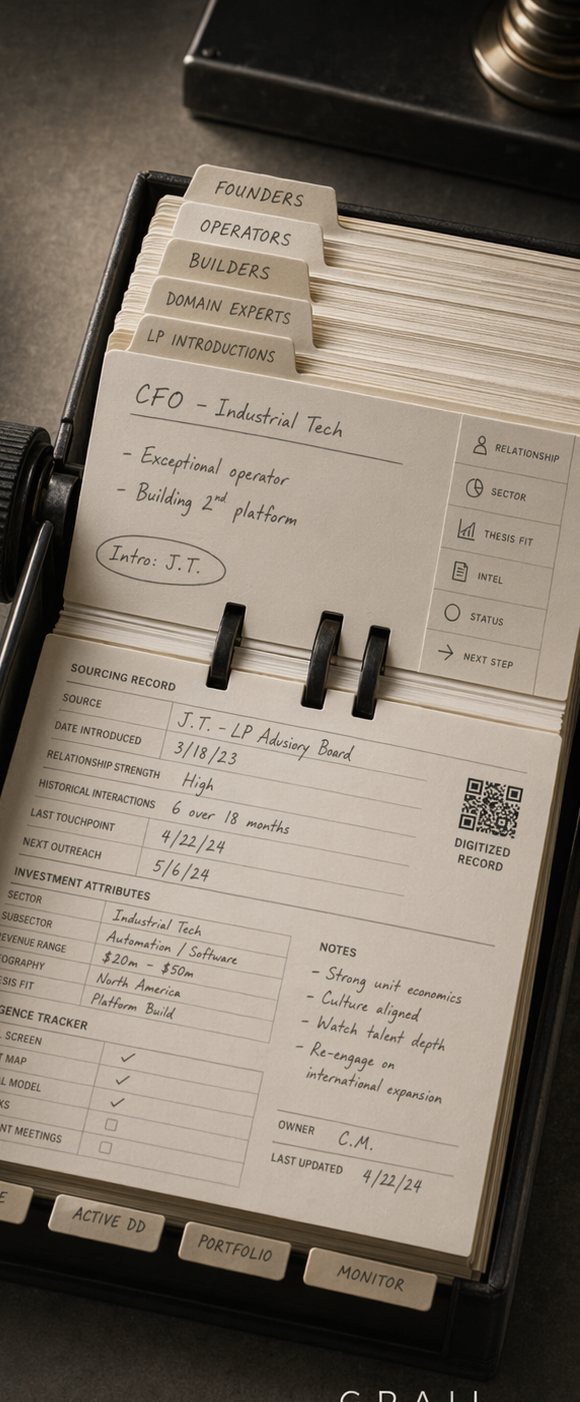
The Edge Became Personal
Your fundraising deck describes a repeatable investment process. If an LP spent a week inside your firm, would they see one? The gap between narrative and operational reality is where the next fundraise is won or lost.
What changes for the PE firm as AI enters its industry
Mid-market private equity built its competitive position on three assets: proprietary deal flow through personal relationships, pattern recognition accumulated across investment cycles, and value creation playbooks refined through operational experience. All three are personal. They live in the heads of a handful of senior partners and investment professionals. When those people leave, the assets leave with them.
LPs are noticing. Sophisticated allocators increasingly ask what is proprietary about your sourcing, what is systematic about your diligence, and what is repeatable about your value creation. The GP who answers with references to the team's track record and network is losing ground to the one who demonstrates documented, AI-augmented process that survives personnel transitions. The fundraising environment is punishing the gap between narrative and reality.
For the managing partner of a mid-market PE firm, this is not a technology question. It is a revenue question, a profit question, and a valuation question. Revenue, because management fees depend on fund size and fund size depends on LP conviction. Profit, because carried interest compounds faster when value creation is systematic rather than partner-dependent. Valuation, because the GP stake itself is worth more when the institutional edge is demonstrable rather than personal.
The strategic move is not to add AI tools to the back office. That is the default path and it changes nothing about the LP narrative. The move is to make deal sourcing, diligence, and value creation systematically better than any individual partner could achieve alone, and to make that systematic edge visible in LP materials before the next fundraise.
This briefing is about what that move looks like, and how a GP team gets it done before the next fundraising cycle begins.
Deal intelligence was personal. LPs now demand it be institutional.
Private equity has always been a relationship business. The best deals came through networks built over decades. The sharpest diligence came from partners who had seen enough cycles to recognize patterns. The most effective value creation came from operators who had done it before in similar contexts. None of this was written down. It did not need to be. The people were the process.
Two forces are converging to break that model. First, LP due diligence has become materially more rigorous. Allocators are running their own AI-augmented analysis on GP track records, attribution, and process consistency. They can see when returns cluster around one partner. They can identify when deal sourcing depends on two relationships. The opacity that protected personality-driven firms is dissolving.
Your LP pitch says your edge is systematic. Your operations say it is personal. That gap is where the next fundraise is won or lost.
Second, the intelligence layer of the investment process is compressing. Market mapping, company screening, financial analysis, comparable benchmarking, DDQ responses, and portfolio monitoring can all be systematized with AI. The firm that builds this infrastructure does not just save analyst hours. It creates a demonstrable, auditable process that survives partner transitions. The LP narrative stops being a story about people and becomes evidence of a machine. That is the shift. Not AI as a tool. AI as proof that the edge is institutional.
Revenue. Profit. Valuation.
Under the old model these three questions had three different answers. AI ties them together. Build the institutional edge and you move all three at the same time.
What happens to fund size when LPs audit your process?
Management fees are a function of committed capital. Committed capital is a function of LP conviction. LP conviction increasingly depends on whether your sourcing, diligence, and value creation are demonstrably systematic or visibly personal. The firm whose process survives scrutiny raises a larger fund. The firm whose process depends on three partners raises a smaller one.
How much carry depends on one partner's judgment?
Carried interest compounds when value creation is consistent across the portfolio, not concentrated in the deals one partner touches. Systematic diligence catches risks earlier. Systematic portfolio monitoring intervenes faster. The carry math improves when the process is the asset, not the person. Partner-dependent carry is a concentration risk LPs are learning to price.
What is the GP stake worth if the founding partners step back?
The GP stake is an asset. Its value depends on whether the firm can sustain returns through a generational transition. Personal edge in three heads is a discount. Institutional edge encoded into sourcing infrastructure, diligence process, and value creation methodology is a premium. Same fund, same track record, very different GP valuations depending on one architectural question.
Two columns. Every function in the firm sorts itself between them.
The pattern is consistent across every function in a PE firm. Market mapping, financial screening, comparable analysis, DDQ assembly, and portfolio reporting are all compressing toward commodity. The work that appreciates is judgment: knowing which founder is ready to sell, reading a management team in the first meeting, sensing when the data is hiding something, and navigating a difficult board conversation when things go wrong.
- Market mapping and company screening
- Financial modeling and comparable analysis
- DDQ responses and LP reporting
- Portfolio KPI dashboards and benchmarking
- Standard operational improvement playbooks
- Sensing when a founder is ready to transact
- Reading management teams beyond the data room
- Creative value creation in novel situations
- Navigating board dynamics when things go wrong
- Building LP trust across fundraising cycles
Whichever column the GP team trains the firm into over the next three years is the firm it becomes. The decision is not whether AI affects the investment process. It is which side of the line the partners deliberately move the organization toward.
Two paths. Same technology. Opposite outcomes.
The same AI technology, deployed into the same firm, produces opposite outcomes depending on what the GP team chooses to build.
| The default path | The repositioning path |
|---|---|
| AI as back-office toolMemo drafting, deck cleanup, meeting notes. Saves analyst hours. Changes nothing about the LP narrative. | AI as institutional edgeSystematic sourcing, diligence, and monitoring. Visible in LP materials. Demonstrably better than any one partner alone. |
| Deal flow stays personalTwo partners hold the key relationships. One departure costs three live deals. | Deal flow becomes infrastructureThematic sourcing, predictive triggers, relationship mapping. The pipeline survives personnel changes. |
| Value creation stays artisanalEach portfolio company gets the partner's personal playbook. Quality varies. Consistency is impossible to demonstrate. | Value creation becomes systematicDocumented methodology. Consistent application. Measurable across the portfolio. LPs can audit it. |
| LP narrative is a storyTrack record, team bios, case studies. Compelling but unverifiable. | LP narrative is evidenceProcess documentation, attribution data, systematic edge. Auditable and differentiated. |
Same technology. Opposite outcomes. The difference is the positioning decision, not the AI decision.
The growth levers that compound when used together
Repositioning is not a single decision. It is four levers, each available to the firm right now, that compound when pulled together. Used in isolation, any one produces a modest gain. Used together, they build an institutional edge that survives partner transitions and wins LP commitments.
Systematize deal sourcing before the next fundraise
Thematic market mapping, predictive deal triggers, and relationship intelligence that does not depend on two partners' contact lists. The sourcing infrastructure should produce proprietary deal flow that LPs can see as a process, not a personality. Build this twelve months before the fundraise, not during it.
Document value creation methodology in auditable form
Not a slide deck describing what the firm does. Operational methodology documented in enough detail that a new partner can execute it, an LP can audit it, and a portfolio company can follow it without requiring the specific partner who led the last deal. The playbook becomes the firm's asset, not the partner's.
Build AI-augmented diligence that outperforms individual judgment
The goal is not faster spreadsheets. It is pattern recognition across the entire deal history: which management team profiles predict outperformance, which market signals precede sector turns, which operational indicators in month three predict year-three outcomes. The institutional memory should exceed what any single partner carries.
Make the systematic edge visible in LP materials
The edge only matters if LPs can see it. Process documentation, attribution analysis, systematic sourcing data, and portfolio-wide value creation evidence belong in the fundraising materials. The firm that shows institutional capability wins commitments at better terms than the firm that tells a good story about past returns.
Business first. Technology second.
GRAIL is an AI-native management consultancy. We help European mid-market leadership teams figure out the one or two things that fundamentally change about their business as AI enters their industry, and then build the capability to act on it before competitors do. For private equity specifically, we work at the GP level, not the portfolio level. The conversation that matters is not how AI improves a portfolio company's operations. It is how AI changes what the firm itself is worth and what it can credibly promise LPs.
The market offers two things: vendor lock-in dressed as transformation, and consulting reports dressed as strategy. GRAIL delivers a third option: working AI capability that you own.
- Senior advisory direct to the GP team
- Working AI capability the firm owns from day one
- Custom agents built around your investment process
- Outcomes in weeks, not quarters
- No lock-in at any phase of the engagement
- Founded by operators, not technologists
- Business-first strategy, technology second
- Context architecture, change management, workflow design
- Results before you commit to scale
- Each next step earned, never assumed
Three sessions with your GP team. No IT involvement. Working tools from week one.
GRAIL starts with the management team because organizational transformation cannot outrun the leadership team's personal understanding of what is possible. Three workshops. Each delivers standalone value. Each earns the right to the next.
How to think
The strategic foundation. Where AI creates real value in the investment process and where it is noise. The personal-to-institutional thesis. The LP narrative pressure-test. Your GP team leaves with a shared frame for the rest of the work, and the first working agent built live in the room.
Your AI team
A half-day activation. Each member of the GP team receives a personal suite of five to ten custom agents. Deal sourcing intelligence. Portfolio KPI monitor. Competitive landscape tracker. DDQ automation. LP reporting synthesizer. Working tools from week one, not slides about tools.
Competitive edge
Refinement from real usage. Agents upgraded based on how the team actually used them. The systematic edge roadmap. The LP narrative upgrade. The recommendation for what comes next, earned by what just shipped.
Three weeks. No IT involvement. No investment committee approval needed to start. The sharpest strategic conversation your GP team will have this year, backed by working tools they are already using.
What to ask in your next partners' meeting
The questions where the GP team cannot agree on an answer are the ones worth a longer conversation. Ask these honestly. The point is not the polished response. The point is whether the answer would survive an LP's operational due diligence visit next quarter.
If your most active deal originator took a six-month sabbatical, what percentage of your proprietary deal flow would continue unchanged?
When an LP asks what is systematic about your investment process, is the answer a documented methodology or a description of your team's experience?
What fraction of your value creation approach is documented well enough that a new partner could execute it without the person who developed it?
If a competing fund demonstrates AI-augmented sourcing and diligence in their next LP materials, how does your fundraising narrative respond?
What is the GP stake worth today, and what would it be worth if the founding partners could demonstrate the firm runs without them?
If any of these questions land somewhere uncomfortable, that is the conversation worth having.
Continue reading
Sources and limitations
This briefing draws on GRAIL's engagement experience with leadership teams and on public company disclosures. Figures are illustrative unless a source is named beside them. A sourced edition is in preparation.