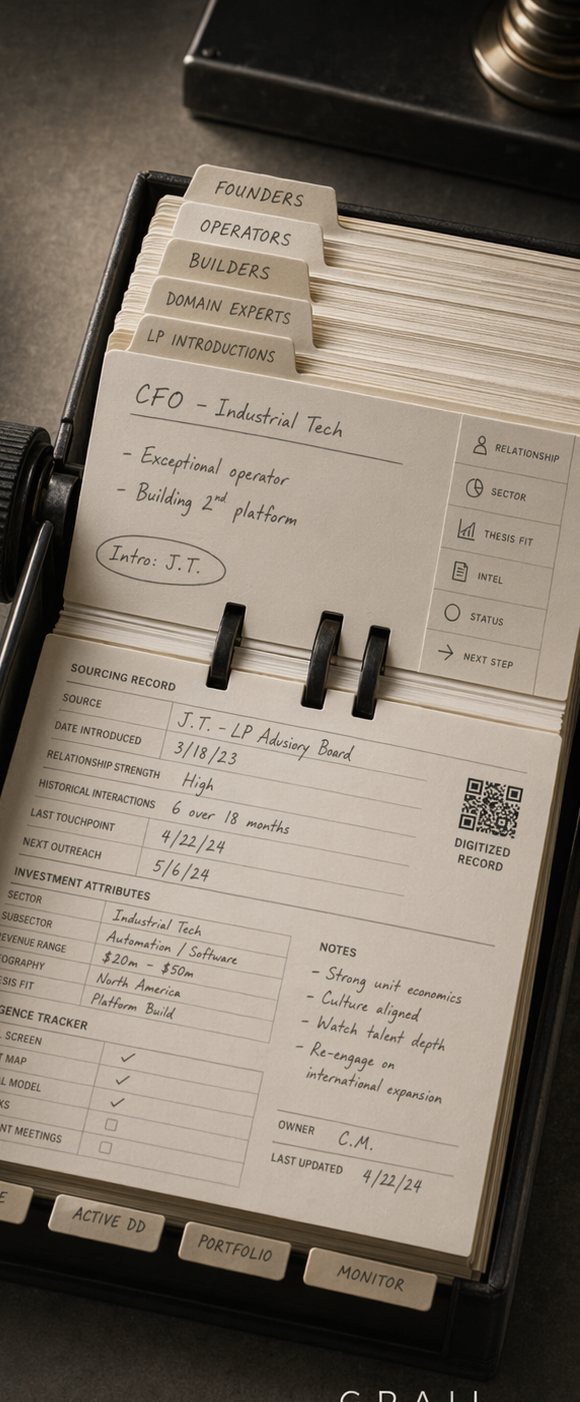
What's Changing in the Infrastructure You Ship
Your fund-operations stack commoditises in eighteen months. The data underneath it compounds for the life of the fund. A briefing for Chiefs of Technology, Chiefs of Product, and Heads of Platform at mid-market European PE and VC funds.
Tuesday 9:40, partner meeting
Every fund CTO at a mid-market European sponsor has had the same Tuesday. The DDQ for the next fund raise came in Monday at fifty-two pages, with a new operational section on AI adoption and data governance. Your deal team has Harvey live on the last three memos and the associates are asking for Hebbia on the diligence stack. Your Head of Portfolio Operations wants a common KPI graph across the twenty-four portfolio companies, with no shared data model underneath it. Your SS&C Intralinks renewal is up in six weeks, and the AE has sent an AI-features addendum with a new per-seat price. Your Managing Partner forwarded the Nordic Capital release this morning: "They announced their proprietary diligence platform. Worth discussing before Q2 planning."
You have run fund technology for a decade, or you are the first person at the GP to hold the seat. Either way the pattern used to be simple. Keep the data room up. Keep the LP portal current. Renew the fund-admin contract. Handle the IT tickets the Managing Partner forwards. The scorecard was platform uptime and vendor-contract management.
Something changed. Every alts-tech vendor you talk to is shipping AI features at quarterly cadence. SS&C Intralinks, eFront, Allvue, Carta, iLEVEL, Chronograph all race the same roadmap. By Q4 2026 any fund paying market rates to these vendors gets roughly the same AI features as any other fund paying the same vendors. The differentiating asset is not the feature layer. It is the data underneath it. And the fund that has not started building that layer this quarter is negotiating its 2028 fundraise with the same operational infrastructure the sponsor down the street is renting.
Every fund in your cohort is about to own the same AI-powered fund-operations stack. That is the problem, not the progress. What the fund owns when the feature parity arrives is the layer underneath: the data rights renegotiated into the next 24 months of portfolio contracts, the research corpus accumulated across the last two vintages, the integration depth published into the top fifteen portfolio-company systems, the proprietary deal-room history the rival sponsor cannot buy. The vendor stack commoditises. This layer compounds.
This briefing covers what is happening in mid-market alternatives, what it means for the fund technology function you run, and the three questions your team should answer before the next Investment Committee.
Fund-operations technology just lost its feature moat
Distributions globally are running at fourteen percent of NAV, the weakest since 2008-09. Hold clocks are shortening. The LP operational due diligence section has grown fifty-plus percent across the last three fundraise cycles. Every mid-market sponsor is claiming systematic edge. The allocator who runs eight of these questionnaires a quarter has learned to tell the difference between a narrative claim and an audit trail, and the audit trail is increasingly a technology question. The LP is asking what you built, who owns the data, and whether the process the next fund is raised on survives if two partners leave.
The alts-tech vendor stack is shipping AI at quarterly cadence. SS&C Intralinks ships AI-enhanced data rooms. eFront ships AI-reconciliation features. Allvue ships AI-assisted valuation workflows. Carta ships AI-generated cap-table intelligence. iLEVEL and Chronograph ship AI KPI rollups. Harvey and Hebbia are live on deal teams at every sponsor that runs a competitive diligence process. Dealcloud, Ontra, Canoe, Addepar, Dynamo all race the same roadmap. Every vendor is honest about the play. By Q4 2026 any fund paying market rates gets roughly the same AI features as any other fund paying the same vendors. That is rental parity. That is the default outcome of buying the stack.
Your fund-operations stack is on an eighteen-month obsolescence curve against the rival renting the same vendors. The data underneath it and the integration depth into your portfolio are the assets that do not ship to anyone else.
The 2026-2028 fundraising cycle separates funds that can show process evidence at DDQ depth from funds that still cannot. The Managing Partners who built systematic GP-level infrastructure in the 2015-2018 window ran their 2020-2023 raises on the asset they built. The ones that stayed on spreadsheets spent the cycle writing narrative into the deck. In 2026 the next shift is compounding faster because the AI layer is ready, and the funds that move first are already visible in LP materials. Nordic Capital announced their proprietary diligence platform this quarter. Whoever ships the next named deliverable wins the narrative the 2027 fundraise is raised on.
Your fund technology function is feeling it every day
Your build engine. You have two engineers at the GP. Or six. Or zero and the Managing Partner is asking whether to hire. The deal team has Harvey and Hebbia running on the last three memos with nobody managing data rights or governance. The vendor AEs have three renewals on your calendar this quarter, each one an IT line that is structurally a capital-allocation decision. Without the in-house discipline the fund defaults to buying every function from the stack. The vendor roadmap becomes the fund roadmap by Q3.
Your platform and data. Your data room, your LP portal, your fund-admin feed, and your portfolio-KPI rollup each live on a different vendor platform. Each one is shipping AI features quarterly. None of them talk to each other. The proprietary layer underneath (data rights with portfolio companies, research corpus across the last two vintages, integration depth into the top fifteen portfolio systems) either sits with the fund or sits nowhere. Today it sits nowhere at most mid-market sponsors. The rival fund renting the same stack produces the same output. That is the problem.
Your product thesis. The Managing Partner asked for the fund's one-line technology thesis last quarter. The answer was vendor consolidation. The competing sponsor's answer was a proprietary diligence platform. Neither was wrong in isolation. One compounds over three vintages. The other is a procurement exercise. The LP reading the DDQ asks which is which. Your product thesis names what the fund ships that the vendor stack cannot sell to the rival. Without it, every renewal conversation collapses into the vendor's framing.
Your R&D bench. The best fund CTO candidates in Europe right now are portfolio-company CTOs whose exits are eighteen months out and fund-admin product leaders who have shipped to LPs. Nordic Capital, EQT, and Cinven hired ahead in 2024-2025. The mid-market is deciding now. If you do not claim the talent this quarter, the rival sponsor creates the seat next quarter and the candidate goes there. The portfolio-CTO-to-fund-CTO pathway is the most direct route, and the window to run it closes when the sector has filled the obvious seats.
Your board-level authority. The €3M portfolio-monitoring platform decision on your Managing Partner's desk is yours to author or yours to sign. Those are different things. Authoring means alternatives analysis against a proprietary build, against a continuation of the current stack, against a consolidation play. Signing means the vendor's framing becomes the fund's framing. The boundary with the COO, the Head of Portfolio Operations, and the Head of IR is written in Q1 or written by default. Your Q1 written agreement lands before the next renewal, not after.
The moat sits underneath the feature layer, in the data the fund owns
Your sector is repricing from above because LPs are reading process evidence instead of track record. Your fund technology function is stretched because the diligence tooling, the LP-reporting pipeline, the portfolio-monitoring stack, and the portfolio-CFO orchestration are each running on a separate vendor platform, each drafted by a different team. Same force, two altitudes. But there is a third thing happening that most mid-market fund CTOs have not named yet.
The fund-operations stack commoditises in eighteen months. The data underneath it compounds for the life of the fund. The features the vendors ship reach parity on a quarterly cadence. Harvey on every deal team. Hebbia across diligence. SS&C Intralinks with AI-enhanced data rooms at every sponsor paying market rates. What does not commoditise: the data rights renegotiated into the next 24 months of portfolio contracts, the proprietary research corpus accumulated across deal archives, the integration depth published into the top fifteen portfolio-company systems, the deal-room history the fund owns and the rival cannot buy. A two-partner rival renting the same vendors cannot produce that layer because they do not have the data it is built on. You do. The window closes in roughly eighteen months. That is the time between now and when the alts-tech vendors have ingested enough cross-sponsor signal that the rental-parity gap narrows further.
A generation ago a different pair of firms fought the same fight on a trading-floor terminal. In 1981 one had the news, the feature lead, and the installed base. The other shipped a proprietary data layer and an integration depth into every workflow the client ran. Both kept shipping features. The features reached parity in five years. The data layer and the workflow depth compounded for thirty. By 1995 one terminal was an institution. The other was competing on renewal discounting. The job had not changed. The unit of judgment had moved underneath the product.
You can tell which camp a fund is in from a single question. If the rival sponsor down the street signed the same vendor contracts you signed, would their fund-operations stack produce the same LP-pack, the same DDQ answer, and the same portfolio-CFO playbook as yours? Most mid-market funds cannot honestly answer no. The ones that can are the ones the 2027 LP is already auditing.
You have twelve to eighteen months. The CTOs who claim the authorship of the proprietary layer in Q1 author the decade. The ones who wait until the next renewal arrives sign the vendor's roadmap, inherit a fund-operations architecture indistinguishable from the rival renting the same stack, and walk into the 2028 fundraise with the same systematic-edge claim every competing sponsor is making.
What most funds are doing. What the winners are doing instead.
Every fund CTO has had the AI conversation. Most are making the same four decisions. A smaller group is making different ones.
| The default path | The winners' path |
|---|---|
| Renew every vendor, take the AI addendumAE handles integration. Features ship on time. By Q4 your stack matches every sponsor paying the same rates. | Build the proprietary layer underneath the vendorsData rights, research corpus, integration depth. The asset the rival renting the same stack cannot buy. |
| Sign the €3M platform requisition as an IT lineVendor framing becomes fund framing. Roadmap authorship moves to the vendor AE. Authority migrates by Q3. | Route the €3M through capital-allocation disciplineAlternatives analysis against proprietary build, continuation, consolidation. The CTO authors. The asset compounds. |
| Let the deal team run Harvey and Hebbia unmanagedFast memos this quarter. Data rights unnegotiated. No proprietary corpus. The next DDQ reveals the gap. | Stand a governed diligence layer on the deal-team toolingHarvey plus Hebbia plus a proprietary corpus the fund owns. Memos ship fast. Evidence audits cleanly. |
| Wait for the next fundraise to create the CTO seatPortfolio-CTO candidates go to the rival this year. Seat filled reactively in 2028 at a premium the fund cannot absorb. | Hire or second the fund CTO this quarterThe talent window is open now. The portfolio-CTO-to-fund-CTO pathway works once. Act before the rival does. |
Same vendor stack. Same twelve months. Opposite outcomes. The difference is whether the fund builds a proprietary layer the rival cannot rent.
R&D Capital Allocation. Build Velocity. Product Defensibility.
Three questions every fund CTO is tracking. The third is the crux. The first two are how you earn the right to answer it.
Is our technology capex a vendor-renewal line or a capital-allocation decision?
The €3M on your Managing Partner's desk is either an IT requisition or the fund's largest single technology call this vintage. Plateau capital renews the vendor stack. Compounding capital builds the proprietary layer underneath. On one hurdle rate plateau wins every quarter because the renewal pays for itself. The fund that routes technology capex through capital-allocation discipline authors the asset the next fundraise is won on.
Is our fund-operations speed shipping audit-ready output, or vendor-generic speed?
DDQ turnaround, IC memo speed, LP-pack production, portfolio KPI rollup. The vendor stack promises quarterly feature gains. The output is only as defensible as the data architecture underneath it. A fund that ships fast memos on rented diligence tools still answers a rival-sponsor-identical LP question. Velocity without ownership is commodity velocity.
What does our fund ship that the rival renting the same vendors cannot match?
By Q4 2026 every sponsor paying market rates to SS&C Intralinks, eFront, Allvue, or Carta gets rough feature parity. Rental parity is the default. Defensibility lives in the data the fund owns, the integration depth into portfolio companies, and the research corpus that accumulates per deal. A two-partner rival renting the same stack cannot reproduce it. That is the 2028 asset.
What the funds winning this play are actually doing
Four concrete moves any mid-market fund CTO can start this quarter. Each addresses one sub-function. Pulled together, they become one architecture the fund builds on.
Build engine: stand up in-house technology discipline before the next renewal
Name the technology authority at the GP. Fund CTO, Head of Platform, or VP of Technology reporting to the COO. The seat runs a quarterly technology-capex review on the investment-committee cadence. Every vendor renewal reviewed as a capital-allocation call against a named alternative. The plateau-vs-compounding split published on the technology budget. The in-house bench does not replace the vendor stack. It defines the boundary, owns the data rights, and authors the proprietary layer.
Platform and data: build the layer underneath the vendor stack
Three programmes that stack over eighteen months. Data rights renegotiated into the next 24 months of portfolio contracts (data-processing addendum, model-access rights, IP on the research corpus, named audit trail). An integration-depth graph published across your top fifteen portfolio-company systems, maintained as structured metadata the deal team and the LP operational due diligence desk can both query. A model-agnostic research corpus accumulated from deal archives and diligence memos, portable across model providers. The vendor stack commoditises. This layer compounds.
Product thesis: ship one proprietary deliverable this fund cycle
One named asset the vendor stack cannot sell and the rival sponsor cannot rent. Three candidates. A sector-specific diligence copilot trained on the fund's deal archive and research corpus. A portfolio-KPI graph that reconciles bottom-up CFO data to the LP-pack in real time. A DDQ response engine grounded in the fund's own audit-ready evidence layer. One of the three, shipped on protected technology P&L, named in the next LP pitch. The DDQ answer and the next fund teaser both reference this deliverable by name, and the LP's operational due diligence team can verify it.
R&D bench: secure the technology talent before the rival does
The fund CTO role is being created across the sector in 2026-2027. Nordic Capital, EQT, and Cinven hired ahead. The mid-market is deciding now. The best candidates are portfolio-company CTOs whose exits are 18 months out and fund-admin product leaders who have shipped to LPs. Hire or secondment. The portfolio-CTO-to-fund-CTO pathway works once per candidate. Run it this quarter or watch the rival run it next quarter at a premium the fund cannot absorb.
The only firm joining fund-tech to working discipline
The mid-market fund CTO has four places to go. None can do what we do.
The big tech-transformation practices ship a standardised AI-governance framework calibrated for asset managers at twenty times the fund's scale. Their cost structure requires sector-book reusability. The output is governance theatre on the fund's idiosyncratic deal-team reality.
The alts-tech SaaS vendors have a quote on your desk. SS&C Intralinks, eFront, Allvue, Carta, iLEVEL, Chronograph, Dynamo, Canoe, Addepar, Dealcloud, Ontra. Their product is the rented stack itself. Telling you to build a proprietary layer underneath their stack is structurally impossible.
The hyperscaler professional services arms price the engagement as enablement for cloud consumption. Their business model forces platform lock-in, and every build-or-buy decision routes through their pricing for three years.
An in-house or fractional CDO or CAIO splits the seat. Strategy CAIO is thesis-measured. Platform CTO is delivery-measured. One person cannot hold both. Two-thirds of newly-appointed CAIOs spend year one compiling AI inventories instead of setting direction.
The four options you have already looked at. None can author the proprietary-layer decision the seat requires. GRAIL is the fifth.
- Senior advisory that speaks fund-operations real, not transformation-deck
- Working infrastructure your team uses the same week
- Custom agents built on your deal archive, your portfolio, your stack
- The start of a proprietary data-and-integration layer you own
- No vendor lock-in at any phase of the engagement
- Founded by operators who have carried CPO-adjacent seats
- Business first, technology second
- Three weeks from first meeting to working infrastructure
- Your team keeps the infrastructure, you own the IP
- Every next step earned by what just shipped, never assumed
Three sessions with your fund technology leadership. Working infrastructure from week one.
We start with your fund technology leadership because the change cannot outrun the team's personal understanding of what is possible. Three workshops. Each delivers standalone value. Each earns the right to the next.
How to think
Walk through what is happening in your sector and inside your fund technology function. Build the first piece of infrastructure in the room: a technology-capex agent that takes your real vendor roster and your next-renewal calendar, splits plateau from compounding, and runs the alternatives analysis against a proprietary build. Your leadership team leaves with a shared view and the first working artefact already in hand.
Your fund infrastructure
A half-day build. Your deal team, your Head of Portfolio Operations, your Head of IR, and your fund finance lead each leave with five to ten pieces of working infrastructure tuned to their function. Diligence copilot scaffolding. DDQ-response agent tuned to your own evidence layer. Portfolio-KPI rollup prototype. Data-rights renegotiation playbook. Working infrastructure your team is using the same week, not decks about infrastructure.
Ready to run
Refined infrastructure based on real use. The board document that splits fund technology capex into two instruments with two hurdle rates and two kill criteria. The boundary agreement with the COO, Head of Portfolio Operations, and Head of IR. The published named deliverable the next LP pitch references. The eighteen-month proprietary-layer build plan.
Three weeks. No IT project. No board approval needed to start. The infrastructure your fund technology function is already running on when we finish.
For your next partner meeting
The questions where your fund technology leadership cannot agree on an answer are the ones worth an hour on the agenda. Ask these honestly.
Is your fund technology capex today one instrument or two? If one, what does the Managing Partner see that splits plateau from compounding, and what is the kill criterion on each?
If the rival sponsor down the street signed the same SS&C Intralinks, eFront, Allvue, and Carta contracts you signed, would their fund-operations stack produce the same LP-pack and the same DDQ answer as yours?
Name the proprietary asset your fund ships that the vendor stack cannot sell. If you cannot name it, that is the first thing the briefing changes.
Your deal team is running Harvey and Hebbia on the last three memos. Where are the data rights, and who owns the research corpus the drafts are grounded in?
The fund CTO seat is being created across the sector in 2026-2027. Nordic Capital, EQT, and Cinven have hired ahead. Is your Q1 plan to hire, to second a portfolio-company CTO, or to wait until the next fundraise forces the decision at a premium?
If any of these produces a disagreement in your fund technology leadership, that is the conversation worth having before the next LP asks.
Continue reading
Sources and limitations
This briefing draws on GRAIL's engagement experience with leadership teams and on public company disclosures. Figures are illustrative unless a source is named beside them. A sourced edition is in preparation.