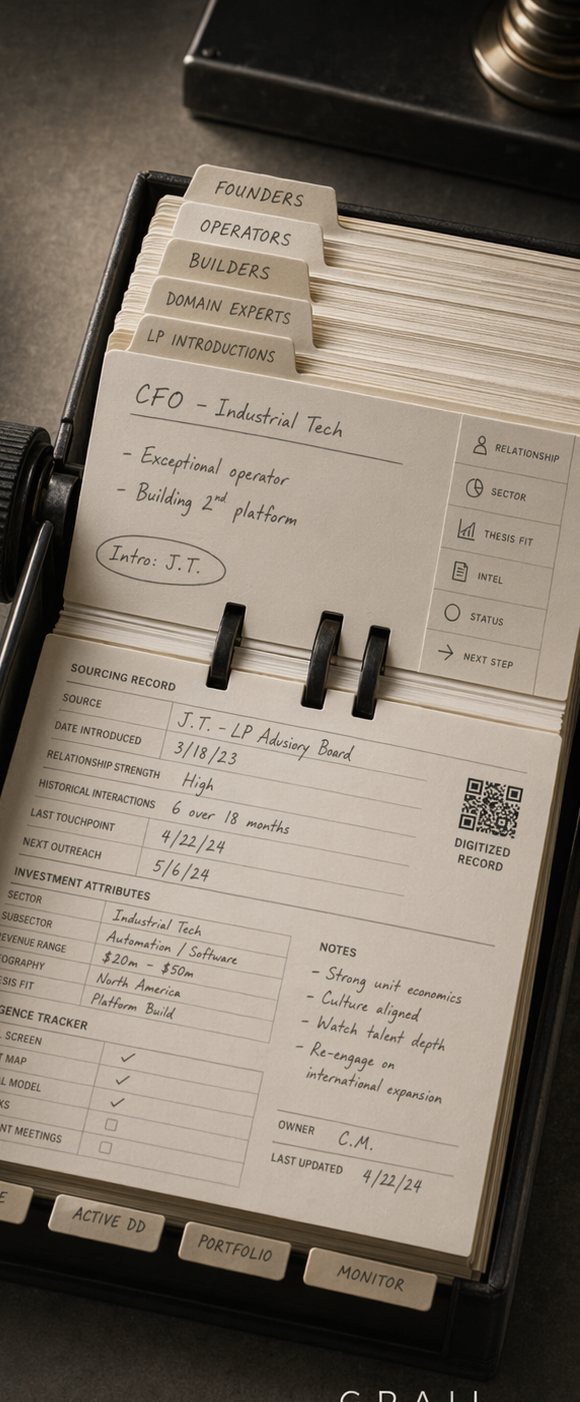
What's Changing in How You Source and Scale
Your best deal originator just left and took three live relationships. Your due diligence is the same for a software platform and a services firm. Your portfolio playbook lives in the partner who closed the deal, not the fund. Three problems that look separate, but are actually one.
You have seen this on your deal floor
Every Chief Operating Officer or VP Operations at a mid-sized European PE firm has had the same Monday morning. A Partner calls to say they are leaving to start their own fund. Two deal conversations that partner was leading go quiet within sixty days. The new partner you hire is talented but spends the first eight weeks building the sourcing map your last partner had in their head. You are also running the numbers on your last three acquisitions and realising your portfolio company onboarding playbook is not repeatable. Each one got sequenced differently depending on who led the deal. And at the Fund Committee, an LP asked what is systematic about your sourcing process. Your answer was "we have great people." So did thirty other funds pitching in the next round.
You have run this function for ten years. The pattern used to be simple. Hire strong operational partners. Trust the deal sourcing network they bring. Manage by quarterly KPI updates. The fund model worked because the value proposition was clear: smart partners + good capital = better returns than public markets.
Something has shifted. Your deal sourcing cycle is eight to twelve weeks when leading competitors are closing at four to six. Your due diligence looks the same for a software-as-a-service play and a manufacturing services firm even though the due-diligence questions are completely different. Your best portfolio playbook lives inside the head of the partner who led it, and you lose money every time a new partner invents a different version. And you know that at the next fundraising cycle, your LPs are going to ask whether your edge is personal or institutional.
This is not an operations problem. It is a fund-model problem and a sourcing problem, happening at the same time. Most PE COOs are treating them as two. The ones who see them as one are going to own the next decade of European mid-market PE.
This briefing covers what is happening in your sector, what it means inside your operations, and the three questions your fund committee should answer before the next cycle.
PE sourcing just lost the edge that created a generation of returns
For thirty years, PE advantage came from partner networks. A partner with relationships deep enough to hear about a deal before an intermediary brought it to market had what every LP wanted: deal flow that competitors could not access. Asymmetric information equals better entry multiples. Better multiples plus good operations equals outperformance. The edge was personal. The edge was durable. The model worked.
Three things have shifted. First, deal flow has moved from personal to intermediated. The number of banker-led processes has doubled since 2015. Your partner's network matters less than a banker's distribution list. Second, LP sophistication has exploded. Your LP review used to accept "we have great people and a strong track record." Now it requires: "here is what is systematic about our sourcing, here is what is systematic about our due diligence, here is why our playbook is repeatable." The fund that answers with "our partners are well connected" is losing allocations to the fund that shows documented, systematic process.
Third, and largest: AI has reached the point where it can systematise the sourcing and diligence intelligence layer without requiring human creativity. The funds that are moving first (EQT, Nordic Capital, Verdane) are not replacing partners. They are operationalising what their partners know. Market mapping, sector screening, founder signal detection, financial analysis, red-flag pattern matching. The intelligence layer that used to require a Partner spending fifteen hours a week on deal research is now a repeatable system.
The fund that demonstrates systematic sourcing and diligence in LP materials wins allocations the fund that shows personal relationships no longer can.
The market impact is visible in fundraising. LPs increasingly discriminate on "systematic process" when evaluating GP commitments for their next vehicle. A fund that can document repeatable deal sourcing, systematic diligence checkpoints, and codified value-creation playbooks is auditable in a way that "smart partners" is not. That auditability converts into larger checks and better terms in a competitive fundraising environment.
Your operations lose momentum when a partner leaves
Your sourcing engine. Deal sourcing depends on the network of three to four active partners. When a strong partner leaves, the fund loses access to the deal flow they brought, and it takes the new partner nine to twelve weeks to rebuild a sourcing pipeline that approaches the predecessor's volume. Two quarters of lost deal flow while the market moves. Most of your sourcing is not repeatable because the relationship channel lives in the partner, not the fund.
Your due diligence discipline. Due diligence questions are the same for a SaaS acquisition, a manufacturing services firm, and a professional-services business, but the relative weight is completely different. Your diligence team runs the same checklist on all three. Conviction on management quality is subjective and partner-dependent. Red flags that appeared in three portfolio companies have never been systematised into a universal checklist. Senior conviction is personal judgment, never codified.
Your portfolio operations. Your strongest portfolio company value creation came from a Partner who ran a specific integration playbook: week-one onboarding, KPI setup, monthly board rhythm, intervention timing. That Partner moved to another fund. The next portfolio company that came in got integrated by a different partner at a different pace with a different cadence. The playbook was never written down. Some portfolio companies hit their plan faster than others, but you cannot explain why except "this partner was better at it."
Your LP narrative. Your fundraising deck talks about systematic edge and repeatable value creation. Your LP review materials show track record and partner credentials. Your actual process is: smart partners + good capital + luck. When an LP asks "if I spent a week inside your firm, would I see a repeatable sourcing process?" the honest answer is no. You have ad-hoc processes that work when the right partner is in the room.
Your competitive position. Your deal sourcing cycle is eight to twelve weeks from lead to IC decision. The funds that operationalised their sourcing intelligence are at four to six weeks. Same diligence quality. Better conviction. Faster capital deployment. More deal flow from the same partner bandwidth. You know which camp is winning more deals.
The funds winning are building one piece of infrastructure
Your sector is compressing from below because systematic sourcing means less personal time per deal sourced. Your operations are compressing from above because your playbooks live in individual partners and walk out when they do. Same force, two altitudes. But there is a third thing most PE COOs have not named, and it is the one that matters most.
You do not have three problems. You have one. The operational knowledge and judgment that makes your fund valuable has never been separated from the person who carries it. When a Partner leaves with the sourcing network, conviction framework, and integration playbook, the fund loses capability even though the capital is still there. The inefficiency compounds: new partners take weeks to ramp, sourcing cycles lengthen, portfolio decisions slow, LPs note the inconsistency.
Look at the funds pulling ahead. Deal sourcing, diligence conviction, and portfolio velocity are not three separate programmes. They are one piece of infrastructure. Every deal makes the intelligence sharper. The partner who rotates leaves the system smarter. The new partner moves faster because the framework is written down. The portfolio company onboarding is consistent because the playbook exists independent of personality.
You can tell which camp a fund is in from a single question. When a strong partner leaves, is the deal sourcing capability that leaves with them or does it stay in the fund?
Most funds lose it. The ones that keep it are already winning in fundraising and deal sourcing. You have eighteen to twenty-four months before this becomes table stakes.
What most funds are doing. What the winners are doing instead.
Every PE COO has had the portfolio-optimisation conversation. Most are making the same four decisions. A smaller group is making different ones. The difference is architecture, not tooling.
| The default path | The winners' path |
|---|---|
| Hire more partners to scale sourcingBigger team, longer ramp, more carry drain before the revenue appears. | Operationalise what you already knowThematic sourcing, market screening, founder signals codified. Partners focus on relationship and conviction bets. |
| Due diligence is judgment-dependentStrong partner leads the assessment. New partners assess differently. Conviction varies. | Diligence has checkpoints, not just hunchesRepeatable framework, sector-adjusted questions, red-flag patterns codified. Partner adds judgment, not invents framework. |
| Portfolio playbooks invented per-dealPartner who closed the deal leads integration. Next partner does it differently. | Playbook is institution propertyOnboarding, KPI setup, intervention cadence codified. New partner follows the system, not invents it. |
| Partner departure means knowledge lossNext sourcing partner rebuilds the map. Diligence criteria shift. Portfolio rhythm changes. | Partner departure means transition, not knowledge lossSourcing map, diligence framework, value-creation sequence live in the fund. New partner inherits running system. |
Same fund, same partners, same capital, same market. Opposite speed and conviction. The difference is whether the playbook lives in a person or the institution.
Deal Capture Efficiency. Diligence Conviction. Portfolio Velocity.
Three questions every PE COO is tracking. None of them used to be the same question. They are now.
Why does sourcing take twelve weeks when competitors close at six?
Your sourcing cycle runs on Partner networks and ad-hoc screening. Market mapping, thematic signal detection, founder-readiness signals are invisible until a banker calls. You hear about ninety percent of deals when a banker already has them distributed. The funds sourcing faster are not smarter. They are systematic.
How confident is your IC conviction really?
Due diligence runs the same playbook for a SaaS play and a manufacturing business. Conviction on management quality is subjective. The Partner has a feeling based on tenure in the sector. Red flags from three portfolio companies have never been systematised into forward signal. An LP audit of your diligence process would reveal it varies by Partner, not by risk.
Why do some companies hit plan and others drift?
Your best portfolio outcomes came from a Partner with a repeatable onboarding cadence, KPI structure, and intervention rhythm. That Partner moved on. The next company got integrated by a different Partner at a different pace. Same fund, different outcomes. The best playbook stayed in the Partner's head.
What the funds winning this play are actually doing
Four concrete moves any PE COO can start this quarter. Each touches one part of the fund operations. Pulled together, they become one architecture the fund runs on.
Sourcing: codify the thematic screening and market mapping that Partners do informally
Your Partners scan sectors and read founder signals without a structured framework. List the thematic filters, market signals, and founder indicators each Partner uses. Codify them as repeatable checklists. New partners use the checklist. Markets get scanned systematically. When a Partner leaves, the sourcing framework stays.
Diligence: extract the conviction framework from your best assessments
Your strongest due diligence came from Partners who asked the same questions in the same sequence. Document that sequence per asset class. What questions distinguish a strong founder from a weak one? What red flags have appeared in three portfolio failures? What financial red lines do you always ask? Make those questions systematic. Management assessment stays a Partner judgment. The framework holding that judgment becomes institutional.
Portfolio: write down the value-creation playbook as the integration standard
Your strongest portfolio outcomes followed a Partner who had a week-one onboarding rhythm, a KPI setup template, a board cadence, and an intervention timing. Write that down. That becomes the standard. Future companies get integrated to that cadence. A new Partner executing the playbook delivers faster than a strong Partner inventing from scratch. Consistency compounds.
Transition: make partner departures zero-impact events, not knowledge hemorrhages
Every time a partner leaves, the fund loses sourcing relationships, diligence logic, and portfolio sequences that walked out with them. Treat those as fund assets under active maintenance. Sourcing network documentation. Red-flag patterns from portfolio history. Value-creation playbook. When the Partner leaves, the fund keeps running.
The only firm joining fund operations to working intelligence infrastructure
Most PE firms are making the mistake of trying to hire their way out of this problem. A COO can go to four different places for help. None of them can do what GRAIL does.
The big consulting firms sell a €500K to €2M diagnostic delivered by a Partner and team billing hours. They produce decks on your sourcing methodology. They cannot build the working infrastructure because their revenue model is hours, not outcomes.
The venture software platforms (Carta, PitchBook, AngelList) will sell you data and tools. They cannot have the "systematise your conviction framework" conversation because it would cannibalise their own narrative about how PE works.
Your internal team knows the fund inside out. They are busy running operations. They do not have the pattern recognition to see what is systematic in your best Partners' approaches.
The market offers three things you have already said no to. GRAIL is the fourth option.
- Sourcing frameworks codified from your best Partners' approaches
- Diligence checkpoints extracted from your strongest assessments
- Portfolio playbook written as the integration standard
- Working system the fund owns and runs independently
- No platform lock-in or ongoing licence fees
- Founded by operators who have run fund operations
- Business logic first, technology second
- Three weeks from discovery to working frameworks
- Your fund keeps every piece of infrastructure we build
- Next steps earned by what ships, never assumed
Three workshops. One operating system. Your fund's next decade runs on it.
Workshop One: "See the Opportunity." Three days. Investment Committee + Operations lead. We walk the Fund through the sourcing-conviction-velocity intersection. We show you where the opportunity sits. We produce three baseline metrics on your current deal cycle, diligence quality, and portfolio-integration speed. You leave knowing what winning looks like and why the current approach leaves speed on the table.
Workshop Two: "Build the Framework." Five days. A subset team (Sourcing lead, Diligence lead, Portfolio manager, one strong Partner). We extract the patterns from your best deals. We codify sourcing thematic filters, diligence checkpoints, portfolio onboarding playbook. We produce working templates that your team can use on deal #1 in week three. We wire it into your tools and your IC process.
Workshop Three: "Prove It Works." Four weeks post-launch. We measure your first three deals against the new playbook. Sourcing cycle time. Diligence conviction strength. Portfolio onboarding velocity. We refine the framework from real usage. We produce an operating playbook that is now yours. The fund runs it, GRAIL steps back.
Outcome: Three metrics that move. A sourcing and diligence framework your team owns. A portfolio onboarding system that survives partner rotation. An LP-ready process narrative. Speed and conviction that used to depend on individuals now lives in the fund.
Where to start this quarter
1. Sourcing reality check: Can you point to one repeatable sourcing signal that does not depend on one Partner's network?
2. Diligence conviction: If three Partners assessed the same founder, would their conviction analysis look identical or completely different?
3. Portfolio playbook: Does your value-creation playbook live in a Partner's head or in a system your team can execute?
4. Transition risk: If your strongest Partner left tomorrow, what capability walks out with them?
5. LP narrative: Can you show an LP a systematic sourcing process or do you show them track record and Partner credentials?
Where the Fund Committee cannot agree on the answer is the conversation worth an hour on the agenda.
Continue reading
Sources and limitations
This briefing draws on GRAIL's engagement experience with leadership teams and on public company disclosures. Figures are illustrative unless a source is named beside them. A sourced edition is in preparation.