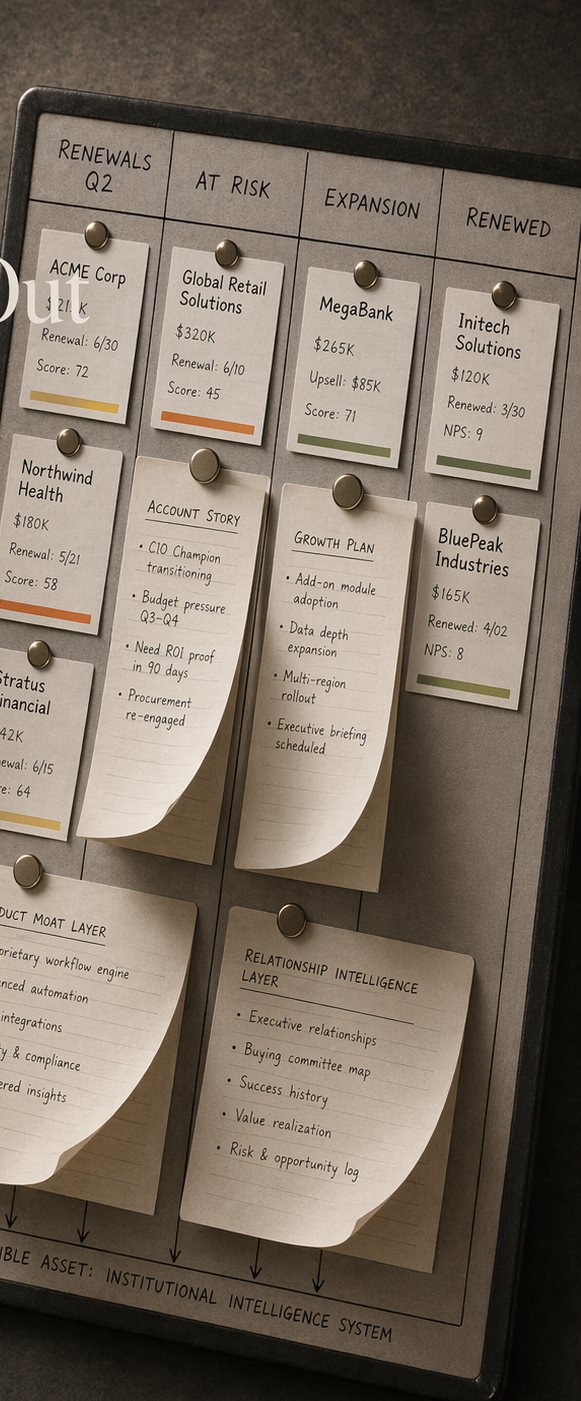
Your Moat Is Walking Out the Door
Your product knowledge and customer intelligence sit in a handful of heads. Both are being actively recruited away. What happens to your competitive position when they leave?
What changes for the enterprise SaaS company as AI enters its industry
A well-funded AI-native startup just demoed functionality that took your team three years to build. They did it in fourteen months, with a fraction of the headcount, on a modern architecture with no legacy constraints. This is not an isolated event. It is the new competitive reality for every enterprise SaaS company with $200K+ ACV and a decade of accumulated product complexity.
Enterprise SaaS built its moat on three pillars: integration depth, switching costs, and a feature set that took years to replicate. AI has collapsed the third pillar. Foundation models have made features that were once differentiators (intelligent search, workflow automation, predictive analytics) into table stakes. The integration moat is weakening as AI-native entrants invest in migration tooling. What remains is the accumulated intelligence behind the product and the customer relationships.
That intelligence exists in two distinct, equally fragile places. Customer success knowledge (why accounts bought, what they actually use, renewal risk, political dynamics) is entirely personal, not in CRM. Product knowledge (why the data model works this way, regulatory constraints, architectural reasoning) lives in three to five founding engineers. Both are being actively recruited by AI-native competitors offering equity in faster-growing companies.
The enterprise SaaS company that encodes this dual intelligence into institutional infrastructure before departures force the conversation will defend its renewals, accelerate its roadmap, and command a premium valuation multiple. The company that does not will discover, one resignation at a time, that its moat was personal all along.
This briefing maps the dual knowledge fragility crisis, frames it through the three lenses that matter to the CEO (revenue, profit, valuation), and identifies the four compounding levers that rebuild the moat on institutional foundations.
The moat migrates from product to intelligence. Both halves are walking out.
For a decade, enterprise SaaS companies competed on product depth. Complex implementations, deep integrations, and years of accumulated configuration created switching costs that protected renewals and pricing power. AI has changed the build-versus-buy calculus. Features that used to be differentiators are now commodity capabilities available through foundation models.
The speed mismatch is structural. AI-native entrants build from scratch with no legacy, reaching feature parity in twelve to eighteen months. The enterprise SaaS company with complex procurement, eighteen-month roadmap cycles, and institutional inertia cannot match that speed. The threat arrives faster than the organization can respond through traditional means.
The feature race is unwinnable. The entrant has no legacy. They will always ship faster. The question is what you defend instead.
What the entrant cannot replicate is the accumulated intelligence behind the product. Why the data model handles edge cases this way. What the regulator actually enforces versus what they publish. Which customer workflows depend on configurations that took years to optimize. That knowledge is the real moat. It is also concentrated in a handful of people who are increasingly attractive to AI-native competitors offering founder-level equity. When they leave, the company loses both its current product advantage and its ability to respond competitively. The crisis is dual: customer intelligence and product knowledge are both personal, both fragile, and both under active recruitment pressure simultaneously.
Revenue. Profit. Valuation.
Under the old model these three questions had three different answers. AI ties them together. Move the intelligence architecture and you move all three at the same time.
What happens to NRR when the account story lives in one person's head?
Expansion ARR now accounts for 40% of new ARR. Expansion depends on CSMs who understand the account deeply enough to spot opportunities. When a senior CSM leaves, account health degrades within 90 days. Portfolio NRR looks healthy while individual accounts are quietly eroding. The renewal cohort will show it, but by then the problem is months old.
Are you funding a feature race that compresses your own margin?
Competing on feature velocity against AI-native entrants with no technical debt squeezes margin from both sides. Their cost of delivery is lower. Your pricing power erodes as feature parity narrows the gap. Every engineer hired to keep pace accelerates the margin compression. The intelligence strategy inverts this: institutional knowledge compounds value without proportional cost growth.
Does your moat survive a founding team transition?
Investors price personal intelligence at a discount because it introduces key-person risk. Institutional intelligence encoded into systems, workflows, and organizational infrastructure commands a premium. The same ARR, at very different multiples, depending on whether the moat is personal or structural. This is the architectural choice that determines the equity story.
Two columns. The whole industry sorts itself between them.
Every capability in the enterprise SaaS organization is migrating. Some are depreciating as AI makes them commodity. Others are appreciating as they become the only defensible ground. The companies that invest in the appreciating column build a moat that compounds. The rest are defending territory that shrinks every quarter.
- Standard feature implementation and code generation
- Onboarding playbooks and QBR preparation
- Documentation, testing, and CI/CD workflows
- Proposal drafting and competitive analysis
- Standard configuration and migration tooling
- Architecture decisions and data model reasoning
- Political dynamics and renewal risk sensing in accounts
- Regulatory constraint knowledge and product vision
- Multi-stakeholder navigation and pricing creativity
- Complex integration architecture and workflow design
The critical pattern: the depreciating column is visible and measurable. The appreciating column is often personal and undocumented. The companies that win will make the appreciating column institutional before the people who carry it walk out.
Two paths. Same technology. Opposite outcomes.
Every enterprise SaaS leadership team faces this choice, whether they make it consciously or by default. The technology is the same. The strategic intent behind it determines whether the company compounds or commoditizes.
| The default path | The repositioning path |
|---|---|
| Feature velocityAdd AI features to match entrants. Ship faster. Hire more engineers to keep pace. | Intelligence encodingEncode product knowledge and customer intelligence into institutional infrastructure that survives departures. |
| NRR defenseProtect renewals through account management. Hope CSM knowledge stays personal. | Intelligence-led expansionBuild institutional customer intelligence that drives expansion from evidence, not personal relationships. |
| Margin compressionCost grows with headcount. Pricing erodes as entrants close the feature gap. | Margin compoundingIntelligence infrastructure compounds value without proportional cost. Knowledge scales across the organization. |
| Key-person riskThe moat depends on who stays. Every departure degrades competitive position. | Institutional resilienceThe moat is structural. The company's intelligence outlasts any individual tenure. |
The default path is not a strategy. It is the absence of a decision. The companies that choose the repositioning path do not need to win the feature race. They need to build the intelligence infrastructure that makes the feature race irrelevant.
The growth levers that compound when used together
Each lever creates modest value in isolation. Together, they rebuild the enterprise SaaS moat on foundations that survive personnel transitions, resist competitive displacement, and command premium valuation multiples.
Encode both customer intelligence and product knowledge into institutional infrastructure
The dual fragility requires a dual response. Customer intelligence for renewal defense: why the account bought, what they actually use, where expansion opportunities sit, who the political decision makers are. Product knowledge for competitive response: why the data model handles edge cases this way, what the regulatory constraints actually require, what architectural decisions cannot be reversed. Both must move from personal to institutional before departures force it.
Shift competitive identity from feature set to customer intelligence depth
The firms that demonstrate they understand their customers' actual operations better than any competitor defend renewals and drive expansion from evidence. This means structured relationship intelligence, not just usage data. The account story must be institutional: reconstructable by anyone on the team, not dependent on the CSM who built the relationship.
Accelerate the roadmap through AI-augmented development
Close the speed gap with AI-native entrants not by hiring more engineers but by making existing engineers operate with the accumulated architectural knowledge that currently lives in a few heads. When the reasoning behind every design decision is encoded and accessible, the entire engineering team ships with the judgment of the most senior architects.
Reprice the equity story around institutional intelligence, not feature count
The valuation conversation with investors changes when the moat is demonstrably institutional. Key-person risk drops. The competitive defense becomes structural rather than personal. The same ARR, priced at a premium multiple, because the intelligence that powers the moat survives any individual departure. This is the board conversation the CEO needs to be ready for.
Business first. Technology second.
GRAIL is an AI-native management consultancy. We help European mid-market leadership teams figure out the one or two things that fundamentally change about their business as AI enters their industry, and then build the capability to act on it before competitors do. For enterprise SaaS, the fundamental change is that the moat migrates from product to intelligence, and both halves of that intelligence are currently personal rather than institutional.
The market offers two things: vendor lock-in dressed as transformation, and consulting reports dressed as strategy. GRAIL delivers a third option: working AI capability that you own.
- Senior advisory direct to the CEO and GMT
- Working AI capability you own from day one
- Custom agents built around your business logic
- Outcomes in weeks, not quarters
- No lock-in at any phase of the engagement
- Founded by operators, not technologists
- Business-first strategy, technology second
- Context architecture, change management, workflow design
- Results before you commit to scale
- Each next step earned, never assumed
Three sessions with your management team. No IT involvement. Working tools from week one.
GRAIL starts with the management team because organizational transformation cannot outrun the leadership team's personal understanding of what is possible. Three workshops. Each delivers standalone value. Each earns the right to the next.
How to think
The strategic foundation. Where AI creates real value in enterprise SaaS and where it is noise. The augmentation framework. The dual intelligence thesis. Your leadership team leaves with a shared frame for the rest of the work, and with the first working agent built live in the room.
Your AI team
A half-day activation. Each member of the management team receives a personal suite of five to ten custom agents trained on their workflow, their decisions, their competitive landscape. Board preparation. Tender analysis. Pricing simulation. Working tools from week one, not slides about tools.
Competitive edge
Refinement from real usage. Agents upgraded based on how the team actually used them. The intelligence infrastructure roadmap. The customer intelligence encoding plan. The recommendation for what comes next, earned by what just shipped.
Three weeks. No IT involvement. No board approval needed to start. The sharpest strategic conversation your leadership team will have this year, backed by working tools they are already using.
What to ask in your next leadership meeting
The questions where the room cannot agree on an answer are the ones worth a longer conversation. Ask these honestly. The point is not the polished response. The point is whether the answer would survive contact with a major client three months from now.
If your VP of Engineering left tomorrow, how many months would it take to reconstruct the reasoning behind your core architectural decisions?
When your best CSM resigned last year, could the team reconstruct the account-level story of what changed in each of their accounts within 30 days?
An AI-native competitor just raised a funded round and is targeting your three largest accounts. What do you offer that they cannot replicate in eighteen months?
Your NRR declined last quarter and the post-mortem could not explain it at the account level. How much of your customer intelligence is in systems versus in people's heads?
If an investor asked today whether your moat would survive a complete founding team transition, what evidence would you present beyond the ARR number?
If any of these questions land somewhere uncomfortable, that is the conversation worth having.
Continue reading
Sources and limitations
This briefing draws on GRAIL's engagement experience with leadership teams and on public company disclosures. Figures are illustrative unless a source is named beside them. A sourced edition is in preparation.