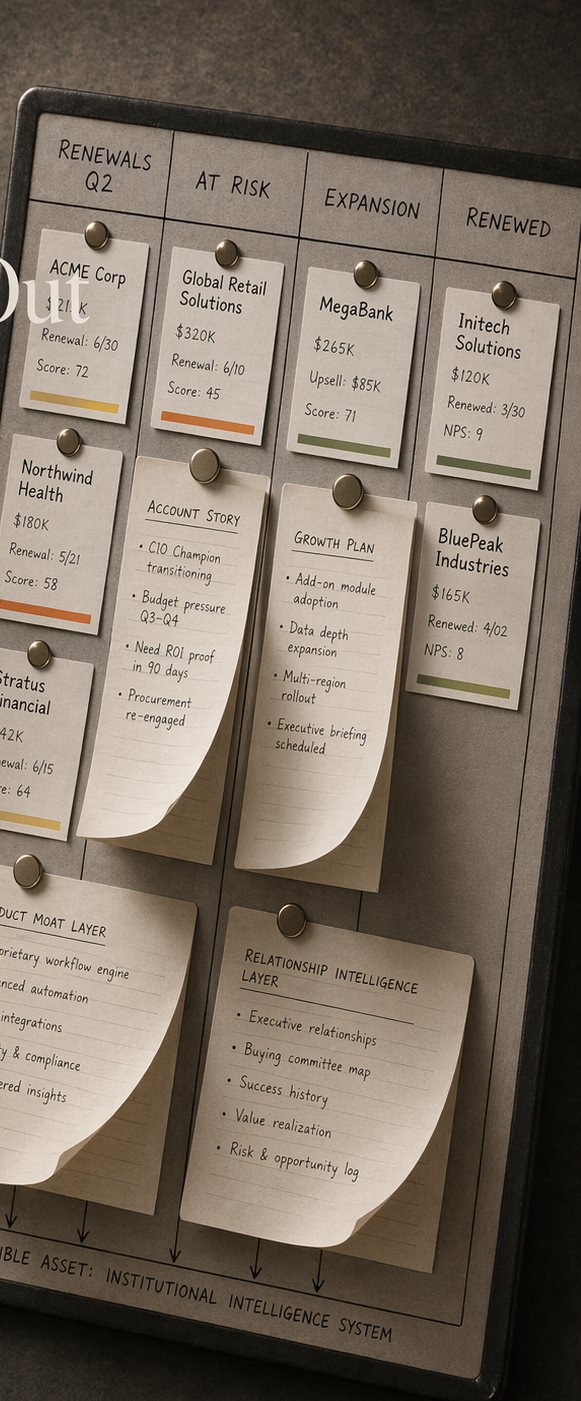
Your Renewals Are Walking Out of Someone Else's Office
Pipeline looks healthy. Expansion is 40% of new ARR. Your best CSM gave notice on Friday. Three things that look separate, but are actually one. A briefing for CROs and VPs Sales at mid-market enterprise SaaS firms.
You have seen this on your Tuesday morning
Every CRO at a mid-market enterprise SaaS firm in Europe has had the same Tuesday. Pipeline coverage is comfortable. Marketing's inbound is up. Expansion ARR printed at 38% of new ARR last quarter. And when you open the renewal forecast, $14M is suddenly at risk. Three accounts that were green sixty days ago are now yellow. The common factor: your best CSM resigned at the end of last quarter to join an AI-native competitor.
You have run this function for twelve years. The pattern used to be simple. Hire AEs who had the right stuff. Build a CS team that cared about the customer. Train, coach, retain. The best people stood out in two years. Renewals compounded. Expansion followed. The business was understandable.
Something changed. Buyers arrive at first calls already decided. Procurement walks in AI-armed to the specification meeting. Your marketing team is producing more MQLs your buyers no longer need. Your top enterprise AEs are getting recruiter calls from AI-native startups every month. Your senior CSMs carry the political map of your biggest accounts in their heads, and one of them just gave notice. And your CEO is asking you to hit the new-ARR number and the NRR number in the same year.
This is not a you problem. It is an industry problem and a function problem, happening at the same time. Most commercial directors are treating them as two. The ones who see them as one are going to own the next decade of enterprise SaaS growth.
This briefing covers what is happening in your industry, what it means for your pipeline and your CS team, and the three questions your leadership team should answer before the next board cycle.
Enterprise SaaS just lost the feature moat that ran it for fifteen years
Every software wave your category absorbed in the last fifteen years rewarded the same move. Ship a harder-to-copy feature. Win a reference customer. Compound the account-management motion until your NRR crossed 120. The competitive moat was the integration depth, the configuration complexity, the switching cost of ripping out a system that was already wired into the customer's workflow. Your company did this well. You are sitting on the outcome of that motion.
AI does not behave the same way. Intelligent search, workflow automation, predictive analytics, natural-language reporting. The features that used to differentiate your product are now table stakes on any foundation model. AI-native entrants reach feature parity in twelve to eighteen months, building from scratch, because they are not carrying a decade of legacy architecture. Your feature moat is evaporating, and the speed at which it is evaporating is faster than your roadmap can respond.
Your buyers are already past the feature demo. They did the research in an answer engine before they booked the call. Your AE is not there to persuade. They are there to confirm, or to lose.
The buyer side has shifted just as fast. 94% of B2B buyers now use generative AI in the buying process. 92% start with at least one vendor in mind, and 41% have a single preferred vendor already selected before formal evaluation. Procurement teams walk into your specification meetings with AI-powered benchmarking, competitive analysis, and pricing models your sales team has never seen. Your AEs show up with last year's battlecards. The tender is decided in the pre-sales research phase now, not in the negotiation. If your brand was not already in the answer engine's shortlist, your AE is not in the tender.
Your pipeline, your CS team, and your rev ops are feeling it every day
Your pipeline. Inbound is up, conversion is down. Your AEs are closing fewer deals per quarter on a bigger pipeline because buyers arrive already decided. Your SDRs are producing MQLs your buyers no longer use. The ones winning walk in at the specification stage, not the introductory call. They hold pricing because the buyer picked them before the demo. Your middle AEs are working last year's playbook on a buying motion that has already moved.
Your CS team. This is the knowledge fragility nobody has named yet. Your top three CSMs carry the political map of your biggest accounts in their heads. Who the champion is, which buyer just got promoted, which contract is politically unstable, which renewal needs the CEO on a plane. None of it is in the CRM. When one of them leaves, account health degrades inside ninety days in ways your dashboards cannot surface. Expansion ARR is 40% of your new ARR. You are one senior resignation away from two points of NRR walking out.
Your rev ops. The team that used to run CRM hygiene, forecast cadence, and quarterly dashboards is becoming the architecture of your entire commercial engine. The tools every AE uses. The data flowing between marketing, sales, and CS. The agents that capture what your best CSMs know. The metrics that prove the transformation to the CFO. Most CROs still treat rev ops as reporting. The ones pulling ahead are repositioning the VP Rev Ops as Chief of Staff to the CRO. This is the quietest change in the function and the one with the highest return.
Your marketing team. The lead-generation playbook changed in a single year. Organic search is falling on the pages that used to convert. Buyers research in ChatGPT, Perplexity, and Gemini before they hit your site. If your brand does not show up in those answers, you are not in consideration. More MQLs do not fix this. The leading firms are shifting marketing from lead factory to authority engine. Original research the answer engines cite. Senior voices in trade press. Customer stories the buyer finds in their peer forums.
Your best people. Your top AE closes $3M a year. Your bottom AE closes $800K. Training has never moved the distribution. Your top three CSMs carry half your at-risk renewals. AI-native startups are recruiting both groups aggressively. Two of your senior CSMs are already in conversations with recruiters you do not know about. You know the ones.
The winners are already running one commercial system
Your industry is compressing because AI takes the feature moat out of your roadmap faster than you can build around it. Your function is compressing because your AEs and CSMs hold knowledge that AI-native competitors are recruiting away. Same force, two altitudes. And there is a third thing happening that most CROs have not named yet, and it is the one that matters most.
Look at the firms pulling ahead. Sales, marketing, CS, and rev ops are running as one commercial motion, not four separate teams. Marketing is in the pipeline review every week. The VP Rev Ops is in the tender strategy meeting. CS is in the pre-sale conversation because expansion is now 40% of new ARR. Data flows between the four functions. Tools are shared. Metrics are shared. Everyone is working the same system.
Most CROs are still running four teams with four plans. A copilot for AEs. A campaign refresh for marketing. A renewal dashboard for CS. A new reporting stack for rev ops. Twelve months later nothing compounds, because the four plans never met.
Your competitors who get this will hold 118% NRR when yours slips to 108. Their AEs walk in designed-in. Their CS team captures what their best people know before the recruiter call lands. Their marketing is the answer-engine preferred pick. Their rev ops runs the system that ties it all together. Four things compounding into one. This is what the next eighteen months look like if you do not move.
You have eighteen to twenty-four months. The AI adoption debate is over. Your question now is whether you lead the architecture yourself, or the CFO hires someone who will.
What most firms are doing. What the winners are doing instead.
Every CRO has had the AI conversation by now. Most are making the same four decisions. A smaller group is making different ones.
| The default path | The winners' path |
|---|---|
| Run sales, marketing, CS, and rev ops as four teamsFour plans that never meet. Four budgets. Four dashboards. Four vendor pitches. | Run one commercial motion across all fourMarketing in the pipeline review. CS in the pre-sale. Rev ops as the architect. Shared data, tools, and metrics. |
| Buy a sales copilot and declare the AI strategy doneEvery competitor has the same copilot within six months. The tool is the commodity. | Build the tools your team actually usesTuned to your accounts, your pricing, your buying committees. Yours to keep, compounding with every call your team runs. |
| Push marketing for more MQL volumeMore campaigns, more leads, more dashboards. Convert worse every quarter because the buyer chose before the funnel. | Build authority where buyers actually researchOriginal research the answer engines cite. Customer stories with outcomes. Your brand is the preferred pick before the tender drops. |
| Wait for your senior CSMs to leave, hope the handover worksThe political map goes with them. NRR slips ninety days later. The dashboard cannot tell you why. | Capture what they know now, while they are still thereThe account graph moves into a system every CSM uses. Resignation becomes a zero-NRR-impact event. |
Same technology. Same twelve months. Opposite outcomes. The difference is the operator, not the AI.
Pipeline. Retention. Productivity.
Three questions every CRO is tracking. None of them used to be the same question. They are now.
Why is our pipeline up and our conversion down?
Inbound looks healthy. Pipeline coverage is comfortable. Your close rate on tier-one deals slipped six points year-over-year. The buyer did the research in an answer engine and arrived already decided. Your AEs are meeting buyers who picked a different vendor before the intro call. The preparation race is decided before your rep walks in.
What happens when our best CSM resigns?
Your top three CSMs carry the political map of half your enterprise accounts. None of it is in the CRM. When one leaves, account health degrades inside ninety days in ways your dashboards cannot surface. Expansion ARR is 40% of your new ARR. You are one senior resignation away from two points of NRR walking out and nobody able to tell you why.
Why can't we close the gap between our top AE and our bottom AE?
Your top AE closes $3M a year. Your bottom AE closes $800K. Training has never moved the distribution. SDR-to-AE promotion fell from 34% to 16%. In 2026 the top-to-average gap becomes closeable for the first time, because the knowledge that made your top AE a top AE can be extracted from their deals and served to every AE at the moment of need.
What the firms winning this play are actually doing
Four concrete moves any CRO can start this quarter. Each touches one sub-function. Pulled together, they fuse your function into one commercial system.
Sales: get your AEs designed-in, not evaluated late
The AE who walks in with the buyer's tech stack, the buying committee's last six LinkedIn posts, a feature-fit analysis, and the competitor's last win in that segment closes at two times the rate of the AE who walks in cold. They also hold pricing. Three to four hours of AE prep compresses to fifteen minutes of review on an AI-produced pack. Your top AEs do this mentally. The rest need the tool.
Marketing: shift from MQL volume to answer-engine authority
Your MQL pipeline is degrading because the playbook is ten years old. Buyers research in answer engines, peer forums, and analyst commentary, most of which your marketing team does not track. Build authority where the buyer is researching. Original research the answer engines cite. Customer stories with outcomes. Senior voices in trade press. Your brand becomes the answer-engine preferred pick before the buyer books a call.
CS: capture the account graph before your senior CSM leaves
Every senior CSM carries the political map of five to ten enterprise accounts in their head. Who the champion is, which exec just moved jobs, which contract is politically loaded, which renewal needs the CEO. None of it is in the CRM. AI extracts this from QBR notes, call transcripts, and email threads into a structured account graph every CSM uses. Resignation becomes a zero-NRR-impact event. Longest lead time. Start now.
Rev ops: move from reporting to architecture
The rev ops function that used to run CRM hygiene and forecast dashboards is the center of gravity for the commercial engine. In the leading firms, rev ops owns the tools every AE uses, the data flowing between marketing, sales, and CS, the agents capturing what your best people know, and the metrics the CFO watches. This is the hardest move to hire for and the one that pays back the most. Without it, the other three moves stay siloed.
The only firm that joins the pipeline conversation to the working tools
The CRO in 2026 has four places to go for help. None of them can do what we do, and each for a specific reason.
Conversation-intelligence vendors record your calls and give you dashboards. They do not sit down with you and talk about what to do with what they recorded, and they do not build the tool that puts your best CSM's account graph in every CSM's hands. They sell the dashboard.
The big consulting firms will write you a two-million-euro GTM transformation deck. They cannot put a working pre-meeting prep agent in your AEs' hands in three weeks because their cost structure requires analyst hours. You can have the deck or the tools. Not both.
Your CRM platform's AI wants an eighteen-month implementation inside their platform. Their business needs you dependent on that platform. We put the intelligence in your people's hands, independent of the CRM.
Point AI sales-tools will sell you another tool. Your team already has four. Your AEs will not use the fifth. You have seen this before.
The market offers four things you have already said no to. GRAIL is the fifth option.
- Senior advisory that speaks CRO, not deck
- Working tools your team uses the same week
- Custom agents built on your accounts, your deals
- The start of an account graph your best CSMs feed
- No vendor lock-in at any phase of the engagement
- Founded by operators who have carried a SaaS commercial seat
- Business first, technology second
- Three weeks from first meeting to working tools
- Your team keeps the tools, you own the IP
- Every next step earned by what just shipped, never assumed
Three sessions with your commercial leadership team. Working tools from week one.
We start with your commercial leadership team because the change cannot outrun the team's personal understanding of what is possible. Three workshops. Each delivers standalone value. Each earns the right to the next.
How to think
Walk through what is happening in your industry and in your pipeline. Build the first working tool in the room: a pre-meeting prep agent for one of your enterprise AEs, on one of your real accounts, for one of your real deals. Your leadership team leaves with a shared view of what to do next and the first working tool in their hands.
Your team's tools
A half-day activation. Each member of your leadership team leaves with five to ten working tools tuned to their accounts, their renewals, their deals. Pre-meeting prep for AEs. QBR-capture for CSMs. Pipeline-quality scoring for rev ops. Authority-content generation for marketing. Tools your team uses the same week, not slides about tools.
Ready to roll
Refined tools based on real use. The rollout plan to your wider sales and CS teams. The account-graph capture plan for your senior CSMs. The pricing-defence playbook for your middle AEs. And the CEO and CFO conversation with numbers they can check, not a deck they cannot argue with.
Three weeks. No IT project. No board approval needed to start. The tools your team is already using when we finish.
For your next leadership team meeting
The questions where your leadership team cannot agree are the ones worth an hour on the agenda. Ask these honestly.
Of your last ten tier-one deals lost, how many went to vendors the buyer had already picked before the intro call? If you do not know, how would you find out?
What is your average discount from list price on deals over $500K, and how does it compare to two years ago? Which AEs discount least, and what do they do differently in the room?
If your top three CSMs resigned next month, what would happen to the accounts they carry? What have you actually captured of what they know in the last twelve months?
Where is your average AE spending their Monday morning today, and where would they need to spend it to close one more tier-one deal per quarter?
Which AE or CSM on your team is already doing what the rest will need to do by 2027 to keep winning? What would it take for that behaviour to be the default across the team?
If any of these produces a disagreement in your leadership team, that is the conversation worth having before the board asks.
Continue reading
Sources and limitations
This briefing draws on GRAIL's engagement experience with leadership teams and on public company disclosures. Figures are illustrative unless a source is named beside them. A sourced edition is in preparation.