What's Changing in Your Capital Story
Your next €10M of capital. The forecast you sign after a senior architect resigns. The thesis your board recites back when an AI-native entrant reaches feature parity. A briefing for CFOs at mid-market European enterprise SaaS firms.
Thursday morning, board pack due next Thursday
Every CFO at a mid-sized European enterprise SaaS firm has had the same Thursday morning. Four things on the screen at 8:30. Expansion ARR landed at 108% against a 118% plan, the second consecutive quarter below. Your best senior CSM, who carried five of your top-twenty accounts, resigned ten days ago and two of those accounts have gone quiet since. Your CTO wants €4M next quarter to rebuild the core module on a foundation-model architecture, and his one-page says "AI infrastructure investment." Your VP Engineering mentioned in the last 1:1 that two senior architects are interviewing at AI-native competitors. Your sponsor forwarded the Bloomberg Klarna story yesterday with a single line: "curious to hear your thinking on AI and headcount before Monday."
You have signed fifteen forecasts for this board. The pattern used to be simple. Hold the rate card, hold the forecast, grow into the plan. Close the quarter clean. Keep the auditor happy. The business was understandable.
Something changed. Expansion ARR is drifting and your team cannot reconstruct the account-level story because the best signal lived in one senior CSM's head. Your AI capital is running through the IT budget as a productivity line. AI-native competitors are reaching feature parity on your core module in eighteen months, and procurement teams at your best accounts are running comparison quotes. Your Controllers are closing faster than ever, and the audit committee is asking about traceability on the agentic tooling. The close is clean. The story underneath it is not.
The job has not changed in fifty years. The bar has risen on every measure of doing it, simultaneously, and the contradictions you have been navigating since you took the seat are suddenly re-openable. The CFOs who treat them as engineering problems run the offensive play. The ones who treat them as permanent trade-offs lose capital-allocation authority to the CTO within eighteen months.
This briefing covers what is happening in your sector, what it means for the finance function you run, and the three questions your team should answer before the next board pack.
Enterprise SaaS just lost the assumption that priced it for a decade
Your moat used to be integration depth, switching costs, and the accumulated customer-specific configuration that made it structurally expensive for a buyer to leave. All three still matter. None is enough. AI-native entrants in your segment are building from scratch with no legacy, reaching feature parity on your core module in twelve to eighteen months with a fraction of your engineering headcount. Procurement teams at your best accounts are running comparison quotes at renewal. Your per-seat number sits next to their per-outcome number. Across your installed base the mechanical difference is showing up in expansion ARR prints that come in below plan in a way last year's post-mortem did not predict.
Your competitors are not waiting. Visma acquired thirty-two firms in a single year and the pattern is repeating at enterprise scale across Nordic, DACH, and Benelux. The firms moving first are buying AI-native entrants as tuck-ins rather than trying to rebuild from the inside. Some are encoding their accumulated customer-success intelligence before the next senior CSM resigns. A smaller set, quieter and more patient, are capturing the reasoning behind every architectural decision before their VP Engineering takes a call from an AI-native startup. They are the quiet compounders. The rest of the sector is shipping copilots into the product at no incremental price and wondering why expansion is compressing.
Your integration depth is still real. The reasoning behind it lives in three founding engineers' heads. If the reasoning walks out, the moat thins inside two quarters and the firm cannot replace it by hiring.
The sector is repricing underneath everyone at the same time. Microsoft's Copilot bundling is a slow-burn threat on your high-ACV seats. Enterprise NRR holds at 118% in the headline, but the portfolio metric masks an account-level reality where a single senior CSM departure degrades renewal health across five seven-figure accounts within ninety days. The mid-market sits in the squeeze. The firms that treat this as a customer-success problem rather than a capital-intelligence problem are walking into a board conversation they will not win.
Your capital, your forecast, and your narrative are feeling it every day
Your capital allocation. Your CTO's €4M AI-native rebuild request is sitting in the IT budget, routed through the same mechanism you use to sign off on laptops and software licences. It is not a tooling request. It is the largest single capital-allocation decision you will make this decade, and it deserves the same discipline you bring to M&A. The finance seats that ship this as a capital line to the board, with alternatives analysis and an ROIC hurdle, keep the authorship for the next ten years. The ones that sign the requisition hand the authorship to the CIO and the CTO by default.
Your forecast. The team built the annual plan on 118% expansion ARR. Q3 came in at 108%. Your Head of FP&A cannot reconstruct the account-level story because the relationship intelligence for your top-twenty accounts lived in a senior CSM's head, not in the CRM. She resigned. Three top accounts have gone quiet. The signal sits in CS notes that were never written down, in product usage patterns your finance team has never seen, and in procurement benchmarks that sit outside your pipeline system. The plan is not wrong because the forecast was aggressive. It is exposed because the data architecture underneath it was built for portfolio reconciliation, not for account-level reconstruction.
Your product-knowledge fragility. Your VP Engineering and two senior architects carry the reasoning behind every architectural decision your product is built on. Why the data model was designed this way. Which regulatory constraints shaped the sub-ledger. Where the scaling bottlenecks sit. When they leave for AI-native competitors, the firm loses not just productivity but the capability to respond competitively to feature challenges. This is a capital-allocation question every CFO is currently treating as an HR retention question, and every retention conversation is losing.
Your controller and FP&A bench. The journal entries, reconciliations, standard variance decomposition, and first-draft board-pack generation that used to train a junior controller into a Senior Controller into a VP Finance are now running on agents. The Q1 headcount win is real. The 2031 succession bench is empty. The finance function that cuts the junior layer without rebuilding the entry pathway has a cheaper quarter this year and no internal CFO candidate in five.
Your economic thesis. Your board has asked for the strategy-day preview. Your sponsor has asked for the AI-and-headcount note. Your chair has asked how the firm stays ahead of AI-native competitors reaching feature parity in eighteen months. Three audiences, three different documents, each drafted by a different team. None of them are anchored in the same data. The CFOs pulling ahead write the thesis once and let the three audiences draw from the same architecture. The ones behind them are editing three decks and hoping the numbers match.
You do not have three scorecard problems. You have one.
Your sector is repricing from below because AI-native entrants reach feature parity in eighteen months on the module that used to take your team three years. Your finance function is stretched because forecast credibility, capital-allocation authority, and the economic thesis are each being managed as a separate programme, each drawing on a different data layer, each drafted by a different team. Same force, two altitudes. But there is a third thing happening in enterprise SaaS specifically, and it is the one that matters most.
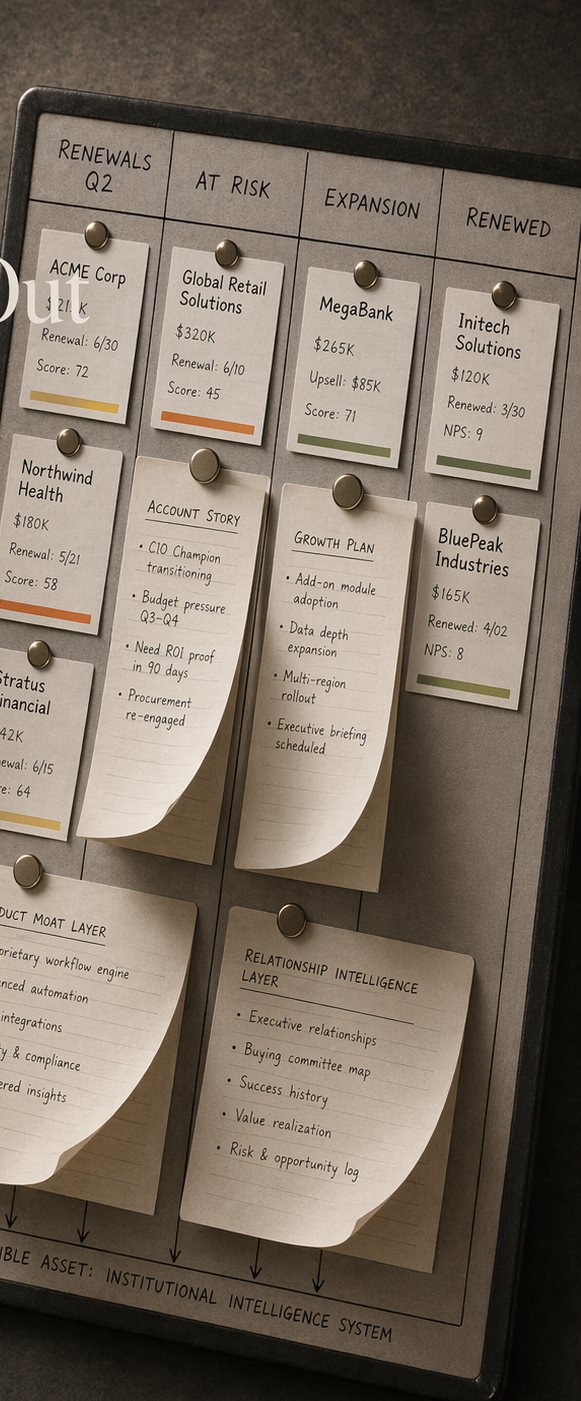
Your moat is a dual intelligence asset. Customer-success intelligence that degrades when a senior CSM resigns. Product and architectural reasoning that walks out when a founding engineer takes an AI-native offer. Capital allocation without that intelligence encoded somewhere the firm owns is guessing. Forecast credibility without it is scorekeeping. A narrative without it is marketing. The finance seat that holds all three holds one integrated asset, not three separate programmes. Every capital-allocation question, every forecast-credibility gap, every narrative weakness is a symptom of the same missing layer: the capital-intelligence infrastructure that encodes customer relationship knowledge AND architectural reasoning before the next resignation turns both into competitive-response loss.
This is the ERP decision of this decade. Every CFO in your cohort is making it right now, whether they see it or not. The ones who personally owned the 1993-1998 ERP decision kept capital-allocation authority for the next twenty years. The ones who signed the IT requisition because "that was an IT decision" watched the CIO take a board seat and the next CFO hire come from outside. The shape is the same. The asset under decision is different. The cost of getting it wrong in 2026 is compressed into eighteen months instead of five years, because that is exactly how long it takes an AI-native entrant to reach feature parity.
You can tell which camp a firm is in from a single question. If your VP Engineering resigned tomorrow, how many months would it take to reconstruct the reasoning behind your core architectural decisions? Most enterprise SaaS firms answer in years. The ones that answer in weeks have already made the shift.
You have twelve to eighteen months. The CFOs who own this decision personally run the offensive play. The ones who do not become the CFO the board replaces when the successor walks in with a thesis.
What most firms are doing. What the winners are doing instead.
Every enterprise SaaS CFO has had the AI conversation. Most are making the same four decisions. A smaller group is making different ones.
| The default path | The winners' path |
|---|---|
| Route AI capital through the IT budgetSign the CTO's €4M requisition. Productivity line in the plan. CIO owns the roadmap within eighteen months. | Route AI capital through the M&A hurdleAlternatives on one page. Rebuild, knowledge-encoding, tuck-in, working capital, buyback. One capital line, five options. |
| Treat knowledge fragility as an HR problemRetention bonuses for senior architects and CSMs. Exit interviews when they leave anyway. The reasoning walks out with them. | Capitalise the knowledge-encoding programmeArchitectural reasoning and account intelligence encoded before the next resignation. Funded through capex, not HR. |
| Run the forecast on a rolling spreadsheetMonthly cadence. Three scenarios take a week. Below-plan quarters produce no account-level story until the post-mortem. | Rebuild the forecast as a live driver graphDraws on CS telemetry and product usage. Ten scenarios in an afternoon. Account story in the same board meeting. |
| Cut the controller layer for the Q1 winHeadcount down fifteen to twenty-five percent. Empty succession bench in 2031. External CFO hire the year after. | Redesign the junior pathway around judgmentNew hires pair with agents on scenarios, capital exposure, governance. Bench rebuilds faster than it would have grown. |
The default path shows a cleaner Q1. The winners' path has visible friction for three quarters and compounds from month fifteen. The difference is whether the CFO is authoring the capital or administering it.
Capital Allocation. Forecast Credibility. Value-Creation Narrative.
Three questions every enterprise SaaS CFO is tracking. The first is the crux. The other two are how you earn the right to answer it.
Where does the next €10M actually compound?
AI-native rebuild? Knowledge-encoding infrastructure for CS and engineering? Tuck-in acquisition of an AI-native entrant? Working-capital extension for a longer enterprise sales cycle? Share buyback? Today's default: the CTO asks, the IT budget funds, the requisition gets signed, and the capital-allocation authority slides away from the seat. The question is not which tool. The question is whose decision this is.
Why did expansion ARR print below plan, and what is the account-level story?
Your board voted on 118% enterprise NRR. Your firm is printing 108%. Your Head of FP&A cannot walk the audit committee through the account-level story because the relationship intelligence for your top-twenty accounts lived in a senior CSM's head. She resigned. Three top accounts have gone quiet. Three scenarios used to take a week. They now run in an afternoon. The bar has risen on what credible means.
What does this firm do that compounds faster than peers?
Your board wants the strategy-day preview. Your sponsor wants the AI-and-headcount note. Your chair wants the how-we-stay-ahead answer when an AI-native entrant reaches feature parity in eighteen months. Three audiences, three documents, three teams, and the numbers do not match. The CFOs pulling ahead write the thesis once and refresh it continuously from the same data architecture that runs the forecast.
What the firms winning this play are actually doing
Four concrete moves any enterprise SaaS CFO can start this quarter. Each addresses one lever. Pulled together, they become one capital-intelligence asset the firm runs on.
Capital: route the AI-native rebuild through the M&A hurdle, not the IT requisition
Your CTO's €4M request is a capital-allocation decision. Treat it like one. Present the alternatives on one page: AI-native rebuild, knowledge-encoding infrastructure, tuck-in of an AI-native entrant, working-capital extension, share buyback. ROIC-scored against the same five-year horizon you use for M&A. Name what you are choosing not to fund to protect the thing you are funding.
Forecast: rebuild the forecast as a live driver graph, not a rolling spreadsheet
Your expansion-ARR model should draw from live pipeline, live product usage, live CS health data, and live procurement-benchmark signals, as one graph rather than five spreadsheets stitched together. Three scenarios compress from a week to an afternoon. Below-plan quarters produce the account-level story in the same board meeting, not in the post-mortem.
Treasury: capitalise the dual-knowledge encoding programme
Architectural reasoning lives in three founding engineers' heads. Customer relationship intelligence lives in a handful of senior CSMs. Both are actively recruited by AI-native competitors. Fund the encoding work through capex, not HR. Architectural decision documentation, regulatory-constraint mapping, scaling-reasoning capture, per-account relationship telemetry. The moat becomes firm-owned infrastructure rather than biography.
Narrative: write the economic thesis once, refresh continuously
Three sentences on one page. What does this firm do that compounds faster than peers when AI-native entrants reach feature parity in eighteen months? What capital gets starved to protect it? What gets fed? Refresh the thesis continuously off the same driver graph that runs the forecast. Sponsor-monthly excerpts the thesis. Audit-committee prep excerpts the thesis. Strategy-day deck excerpts the thesis.
The only firm that joins capital authorship to working infrastructure
The enterprise SaaS CFO has four places to go. None can do what we do.
The big finance transformation practices will sell a twelve-to-twenty-four-month close-acceleration programme staffed by a partner and analysts billing hours. Their audit arm constrains their governance advice. Their billable-day model requires selling substrate that agents commoditise. They ship a tighter close, not authorship of the moat.
The finance-tech vendors will sell platform licences and a long implementation. Your moat has to sit on firm-owned infrastructure or it becomes a vendor asset at renegotiation. The CFO who builds capital intelligence on a vendor stack builds it for the vendor.
The FP&A and planning specialists will sell a point solution for one layer. None can run the capital-allocation-plus-knowledge-encoding-plus-narrative conversation the seat requires.
The AI-native finance-agent startups will sell substrate tooling where depreciation is steepest. Buying them does not address who authors the capital-allocation decision. A cleaner close, the same authorship gap.
The market offers four things you have already said no to. GRAIL is the fifth option.
- Senior advisory that speaks board-room, not deck-room
- Working infrastructure your team uses the same week
- Custom agents built on your cap table, your book, your data
- The start of a capital-intelligence layer your FP&A owns
- No vendor lock-in at any phase of the engagement
- Founded by operators who have carried CFO-adjacent seats
- Business first, technology second
- Three weeks from first meeting to working infrastructure
- Your team keeps the infrastructure, you own the IP
- Every next step earned by what just shipped, never assumed
Three sessions with your finance leadership. Working infrastructure from week one.
We start with your finance leadership team because the change cannot outrun the team's personal understanding of what is possible. Three workshops. Each delivers standalone value. Each earns the right to the next.
How to think
Walk through what is happening in enterprise SaaS and inside your finance function. Build the first piece of infrastructure in the room: a live driver agent on your real expansion-ARR model, running against your real pipeline, CS, and product-usage data. Your leadership team leaves with a shared view of what to do next and the first piece of working infrastructure in their hands.
Your finance infrastructure
A half-day build. Your Controller, Head of FP&A, Treasurer, and Head of IR each leave with five to ten pieces of working infrastructure tuned to their function. Close-cycle agents. Continuous scenario generation. Account-health intelligence feeding the forecast. Board-pack narrative drafting. Infrastructure your team is using the same week, not decks about infrastructure.
Ready to run
Refined infrastructure based on real use. The rollout plan to the wider finance organisation. The capital-allocation-thesis document for the next board meeting. The knowledge-encoding roadmap for the CS and engineering teams. And the CEO and sponsor conversation with numbers they can check: ROIC alternatives, scenario ranges, moat measurement.
Three weeks. No IT project. No board approval needed to start. The infrastructure your finance function is already running on when we finish.
For your next forecast review
The questions where your finance leadership cannot agree on an answer are the ones worth an hour on the agenda. Ask these honestly.
Your CTO wants €4M for an AI-native rebuild. Is it in the IT budget as a productivity line, or on the capital page as one option among four? If the former, what would it take to move it before the next board cycle?
If your VP Engineering resigned tomorrow, how many months would it take to reconstruct the reasoning behind your core architectural decisions? What would the same question answer about the five senior CSMs who carry your top-twenty accounts?
Your board voted on 118% enterprise NRR. Your print is 108%. Can your team walk the audit committee through the account-level story in the same meeting, or does it take a post-mortem? If the latter, what data architecture is missing?
Your sponsor, your chair, and your CEO have each asked for a different AI-and-strategy document in the last ninety days. Are they excerpting the same thesis, or are your teams drafting three documents that do not reconcile?
Of the junior controllers and FP&A analysts you are cutting to agents this year, how many are the people who would have made your 2031 succession bench? What are you doing instead to build that bench?
If any of these produces a disagreement in your finance leadership, that is the conversation worth having before the board asks.
Continue reading
Sources and limitations
This briefing draws on GRAIL's engagement experience with leadership teams and on public company disclosures. Figures are illustrative unless a source is named beside them. A sourced edition is in preparation.