What's Changing in the Workforce You're Building
Your senior engineers are reading offers from AI-native startups. Your senior CSMs are walking out with the renewal intelligence. Your works council just opened consultations on three internal AI tools. A briefing for Chief Human Resources Officers at mid-market European enterprise SaaS firms.
Tuesday, 10:42 a.m.
Every CHRO at a mid-sized European enterprise SaaS company has had the same Tuesday. Three things in the same hour. Your VP Engineering walked into your office with two resignation letters. Both senior IC engineers, both going to an AI-native startup that just closed a $200M Series B. One of them is your principal on the data-model team and carries the reasoning behind the multi-tenant architecture decision your firm made in 2019. Your CRO Slacks: your senior CSM in DACH resigned on Friday, three of her seven-figure accounts go to renewal in Q3, and none of the renewal intelligence is in the CRM. Your CTO emails: he shipped an internal Copilot-style code-completion tool to engineering this morning. Your works council in Munich has already filed a request for framework-agreement consultations. He did not know HR needed to be in the room.
You have held this seat for four years. The pattern used to be simple. Hire well, retain well, keep the works council in the loop, refresh the equity grid every two years. The business was understandable.
Something changed. Your senior engineering bench is being approached individually with equity offers from AI-native startups your CEO has never heard of. Your customer success organisation runs on relationship intelligence that lives in five or six senior CSMs' heads. Your professional services delivery layer is the part of your company most exposed to AI compression, and you have not redesigned the role yet. Your CFO is reading the same Mercer thriving report your CEO is reading.
You do not have a senior engineer retention problem. You have an architectural-reasoning portability problem. Your firm's workforce strategy is being written every week in decisions you were not invited to. The question is not whether to have one. It is whose handwriting the one you already have is in. Your senior engineers read it last month. Your works council is decoding it right now. Your 2030 VP Engineering bench is being shaped by decisions that look like budget items and are actually architecture.
This briefing covers what is happening in your sector, what it means for the people function you run, and the three questions your leadership team should answer before the next GMT.
Enterprise SaaS just acquired a second knowledge fragility
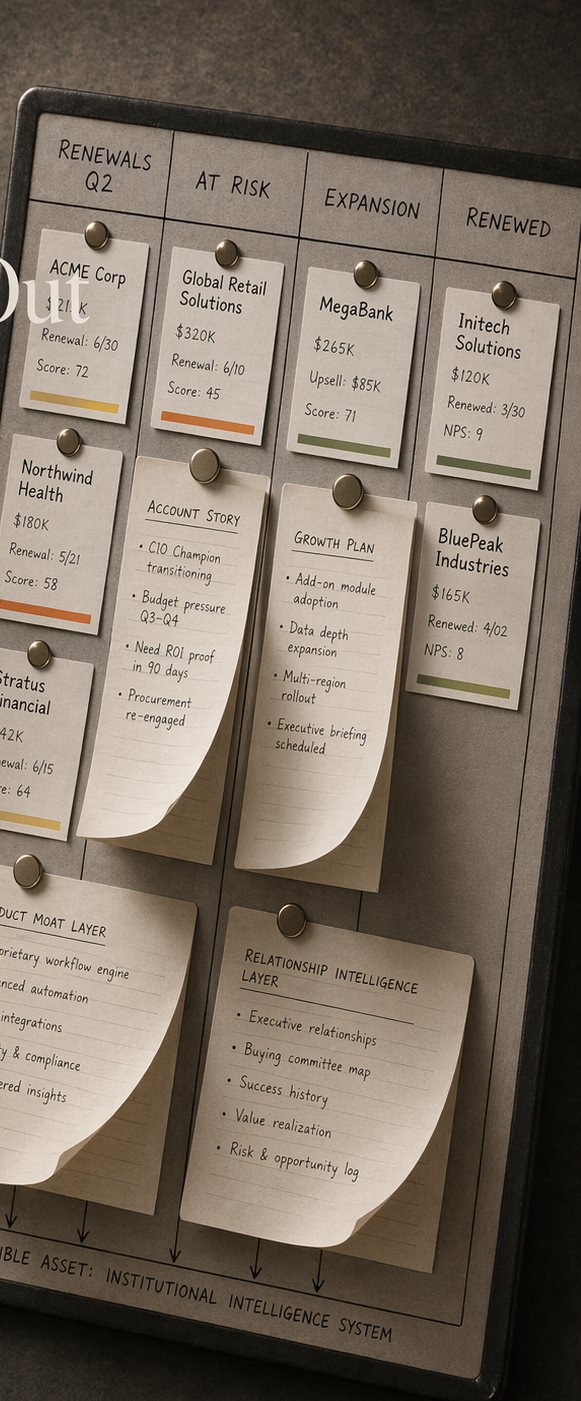
For two decades, the moat under enterprise SaaS was integration depth and switching cost. Your customers were locked in by the configuration they had built around your platform, the integrations they had wired into their stack, and the procurement cycle that made replacement painful. The customer-success knowledge — why this account bought, what they actually use, the political dynamics inside the buying committee — lived in the heads of your senior CSMs. That was the first knowledge fragility. It was always real and always under-managed. A senior CSM resignation degraded account health within ninety days in ways no dashboard surfaced until renewal was at risk. Your category lived with it because the procurement cycle bought you time.
The procurement cycle is no longer buying you time. AI-native entrants reach feature parity in twelve to eighteen months from scratch. The product knowledge — the reasoning behind your data-model decisions, the regulatory navigation history, the multi-region scaling calls — lives in three to five founding engineers' heads, and that is the second knowledge fragility. AI-native startups with fresh capital are making equity offers your refresh grid cannot match. One founding engineer departure can degrade competitive response capability for years. The entrants are not experimenting. They are funded. They are scaling. Your category is repricing on speed of response, and your speed depends on knowledge that is walking out the door.
Your moat used to be one knowledge fragility you under-managed. It is now two. Both are being actively recruited away by competitors who did not exist two years ago.
Procurement has the iron grip too. Microsoft Copilot bundling is compressing your high-ACV seat economics. Expansion ARR is now forty percent of new ARR while net-new acquisition compresses. Your CRO is leaning harder on the senior CSMs who carry the seven-figure accounts. The same senior CSMs whose equity is fully vested. The same senior CSMs that an AI-native customer-platform startup is recruiting this week. Klarna lives in board vocabulary across the category. The public AI bet that printed savings, then printed the trust damage. Every CHRO in your category is reading the same playbook and quietly choosing whether their firm runs that sequence too.
Your people function is feeling it every day
Your talent acquisition. Your principal engineer has an offer from an AI-native startup with $40M earmarked for engineering. The strongest graduates are asking in second-round interviews what your AI tooling looks like, and "we are evaluating" is not an answer that wins them. A-players do not quit on the spot. They start looking quietly. By the time retention moves, they have already decided.
Your L&D. Your engineering enablement runs LinkedIn Learning licences, an annual conference, quarterly AI demos. None of it is continuous in-the-work coaching or agent-paired development on real architectural decisions. Two populations are forming. The top decile uses AI daily as a thinking partner. The rest uses AI as a search engine. Both are becoming who they practice being.
Your compensation architecture. Your equity refresh cycle was designed when the alternative employer was another enterprise SaaS firm. The new alternative is an AI-native Series B that can hand a senior IC half a percent of a $200M-valuation business. Your refresh grid cannot match it on raw upside. Your senior engineers and senior CSMs run that comparison every quarter.
Your employee relations and works council. Your works council in Munich opened framework-agreement consultations on three internal AI tools your CTO shipped without HR in the room. Your French CSE is preparing to do the same. The regulatory load on people functions has stacked. None of it appears on the cost-reduction deck. All of it lands on you.
Your workforce planning and succession. Your VP Engineering, RVP, head-of-CS, and head-of-PS bench has fewer internal candidates than two years ago. The path from staff engineer to engineering manager used to run through routine code production under senior review. Agents have absorbed most of the routine. The external VP Engineering hire in 2030 costs a forty to sixty percent premium.
The senior bench was always the architecture
Your sector is repricing because the dual knowledge fragility is now visible. Your people function is stretched because every internal AI deployment, every equity offer your A-players field, every framework-agreement consultation is a fragment of a workforce strategy that somebody is writing and you are not always in the room when they do. Same force, two altitudes. There is a third thing happening that most enterprise SaaS CHROs have not named yet.
Your firm's workforce strategy is being written every week. The internal Copilot shipped this morning. The equity offer your principal engineer received last week. The framework-agreement consultation your works council opened on Tuesday. The PS line item the CFO is debating. Your senior engineers read the handwriting last month. Your works council is decoding it right now. Your 2030 VP Engineering bench is being shaped by decisions that look like budget items and are actually architecture.
Bell Labs put the junior next to the senior on the hardest problem in the building from week one. Juniors watched every architectural decision in real time. Chemists sat with physicists sat with mathematicians. Graduation was earned on the work, not by time in seat. The senior bench was the architecture. That architecture is available to your engineering organisation for the first time in two centuries, because agents make it affordable to put juniors next to seniors again, instead of next to first drafts.
You can tell which camp a firm is in from a single question. Of the senior IC engineers and senior CSMs you are supposed to grow internally to the bench by 2030, how many came through work that still exists? Most enterprise SaaS firms cannot answer. The ones that can have already rebuilt the pathway.
You have twelve to eighteen months to author the answer deliberately, or the cost-reduction deck on the CFO's desk writes it for you. Same technology. Same workforce. Different outcome depending on whose handwriting the answer is in.
What most firms are doing. What the winners are doing instead.
Every CHRO at a mid-market enterprise SaaS firm has had the AI conversation. Most are making the same four decisions. A smaller group is making different ones.
| The default path | The winners' path |
|---|---|
| Restrict internal AI tools for safety reviewSixty-nine percent of engineers use AI anyway. Senior ICs read restriction as mistrust and start fielding offers. | Publish three rules that defend real trustRouting by task sensitivity, not by tool. Audit trail writes itself. Senior engineers watch how you respond when an experiment fails. |
| Match the equity offer or lose the founding engineerA bidding war you cannot win. Architectural reasoning still walks if the next offer beats yours. | Encode the architectural reasoning, then pair the next ICTwo-week agent-shadow. The senior owns and edits the map. Future engineers learn from the encoded reasoning. |
| Cut the implementation engineer line for marginCustomer onboarding capability degrades. Churn problem inherited in eighteen months. | Redesign the role from implementation to integration architectAgent ensemble paired with the engineer. Time-and-materials repriced to outcomes. Margin moves from fifteen to thirty-five percent. |
| Ship the annual engagement survey as your main HR outputYour cadence is slower than the CFO's quarterly deck. Cost-reduction writes the workforce answer. You inherit the damage. | Publish the for-them memo in first 100 daysTwo pages, co-signed by the CEO, referenced every quarter. Every internal AI deployment gets decoded against it. |
Same workforce. Same twelve months. Opposite outcomes. The difference is whose hand is on the pen.
Talent Gravity. Capability Compounding. Succession Readiness.
Three questions every CHRO is tracking. None of them used to be the same question. They are now.
Are your senior engineers and senior CSMs staying because of you, or despite you?
Your principal engineer has an offer from an AI-native Series B. Your senior CSM in DACH resigned on Friday. Your strongest graduate hires are asking what your AI tooling looks like in second-round interviews. A-players watch which way you lean the first time something goes wrong. The ones who start looking quietly have already decided.
Is the median IC engineer sharper in December than they were in January?
Two populations are forming in your engineering organisation. The top decile is using AI daily as a thinking partner and building judgement that compounds weekly. The rest is using AI as a search engine. Your enablement budget funds licences and a conference. Neither moves the median. The firms pulling ahead are making the senior-junior-agent triad the default workstream unit.
Of your 2030 VP Engineering bench, how many came through work that still exists?
Your bench has fewer internal candidates than it did two years ago. The IC pathway used to run through routine code production under senior review. Agents have absorbed most of the routine. The external VP Engineering hire in 2030 costs a forty to sixty percent premium and brings the previous firm's context. The pathway gets rebuilt now or gets inherited as a gap.
What the firms winning this play are actually doing
Four concrete moves any CHRO can start this quarter. Each addresses one sub-function. Pulled together, they become one answer the firm compounds on.
Talent: publish the for-them memo in your first 100 days
Two pages, co-signed by the CEO. What this firm believes humans are for in a category where the agent layer is real and growing. Which roles are being redesigned around judgement. What happens to someone whose role changes materially. Referenced every quarter. Every internal AI deployment after it gets decoded against this memo. Without the memo, every deployment is decoded against rumour and Glassdoor.
L&D: ship one role redesigned as a triad unit this quarter
Senior IC, junior IC, and agent ensemble as one inseparable workstream unit on a real architectural decision. Or senior CSM, junior CSM, and customer-intelligence agent on a portfolio of seven-figure accounts. The junior operates the agent in front of the senior on live work from week one. Exposure-to-judgement hours go from one hundred and fifty a year to twelve hundred. The IC pathway compresses from twelve years to seven.
Succession: encode-then-pair your founding engineers
Two-week agent-shadow with each founding engineer. The agent drafts the architectural-reasoning map: the multi-tenant decision, the regulatory navigation, the scaling calls. The engineer edits and owns it. Accelerated equity vests on the documented map, not on hours-in-seat. The next IC engineer learns from the encoded reasoning, paired with the senior on live work.
Trust: publish three rules, one escalation, one red line
Three rules about what engineering and customer success can do with internal AI tools without asking permission. One rule about what requires review. One rule about what never goes to an external API. Defended to the works council openly. Defended to the board when an experiment fails. Your A-players watch which way you lean the first time something goes wrong.
The only firm that joins workforce authorship to working infrastructure
The enterprise SaaS CHRO has four places to go. None can do what we do.
The Big Four human-capital practices (Deloitte, Mercer, Korn Ferry, Willis Towers Watson) run survey-benchmark models with audit-relationship conflicts. The benchmark smooths exactly the differences that matter when an AI-native offers half a percent of a $200M-valuation business.
The tech-specialist HR consultancies and search firms (Russell Reynolds tech, Heidrick tech, Spencer Stuart software, Daversa) place senior engineers. They cannot redesign the role at task level or rebuild the IC pathway. They sell people, not architecture.
The HR-tech vendors (Workday HCM, SuccessFactors, Eightfold, Gloat, Lattice) sell platform software. The data encoding which engineer carries which architectural reasoning IS your succession architecture. Building on the vendor stack licenses it back.
The L&D platforms and AI-academy programmes (LinkedIn Learning, Coursera, Pluralsight, Sana Labs, Section AI) sell content libraries. The senior engineering pathway is a pattern-exposure problem. A platform cannot rebuild the architecture agents have collapsed.
The market offers four things you have already said no to. GRAIL is the fifth option.
- Senior advisory that speaks GMT, not HR-deck
- Working infrastructure your team uses the same week
- One role redesigned at task level with incumbent in the room
- A for-them memo the CEO co-signs in your first 100 days
- No vendor lock-in at any phase of the engagement
- Founded by operators who have carried CPO and product seats
- Business first, technology second
- Three weeks from first meeting to working infrastructure
- Your team keeps the infrastructure, you own the IP
- Every next step earned by what just shipped, never assumed
Three sessions with your people leadership. Working infrastructure from week one.
We start with your people leadership team because the change cannot outrun the team's personal understanding of what is possible. Three workshops. Each delivers standalone value. Each earns the right to the next.
How to think
Walk through what is happening in your sector and inside your people function. Draft the first page of your for-them memo in the room, with your CEO and CTO present. Your leadership team leaves with a shared view of what the firm believes humans are for and the first draft of the document the CEO will co-sign.
Your people infrastructure
A half-day build. Your Head of Talent, Head of L&D, Head of Compensation, and Head of Employee Relations each leave with working infrastructure tuned to their function. Task-level role-mapping agent for IC engineers and CSMs. Architectural-reasoning encoding agent for founding engineers. Framework-agreement drafting tooling for the works council. Three-rules trust document. Infrastructure your team is using the same week.
Ready to run
Refined infrastructure based on real use. The first IC role redesigned as a triad unit with the incumbent in the room. The published for-them memo, co-signed by the CEO. The architectural-reasoning encoding pilot underway with one founding engineer. The CFO conversation with numbers the board can check: external-hire premium math, productivity-per-wage-dollar forecast, succession-readiness count.
Three weeks. No IT project. No board approval needed to start. The infrastructure your people function is already running on when we finish.
For your next GMT
The questions where your people leadership cannot agree on an answer are the ones worth an hour on the agenda. Ask these honestly.
If you asked three of your best senior engineers and three of your best senior CSMs privately tomorrow whether the firm's AI strategy is being done for them or to them, what would they say?
Walk me through one role in your firm that has been redesigned at the task level in the last twelve months. What does the incumbent do with their week that they did not do before?
Of the names on your 2030 VP Engineering, RVP, and head-of-CS bench, how many came through IC engineering, junior CSM, or implementation work that agents have already absorbed?
Your workforce strategy is being written this quarter in deployment decisions, equity offers your A-players field, and framework-agreement openings. How many of those fragments are you the author of?
Of your founding engineers who carry the reasoning behind your data-model, regulatory navigation, and scaling decisions, how much of that reasoning has been encoded outside their heads?
If any of these produces a disagreement in your people leadership, that is the conversation worth having before the next board meeting.
Continue reading
Sources and limitations
This briefing draws on GRAIL's engagement experience with leadership teams and on public company disclosures. Figures are illustrative unless a source is named beside them. A sourced edition is in preparation.