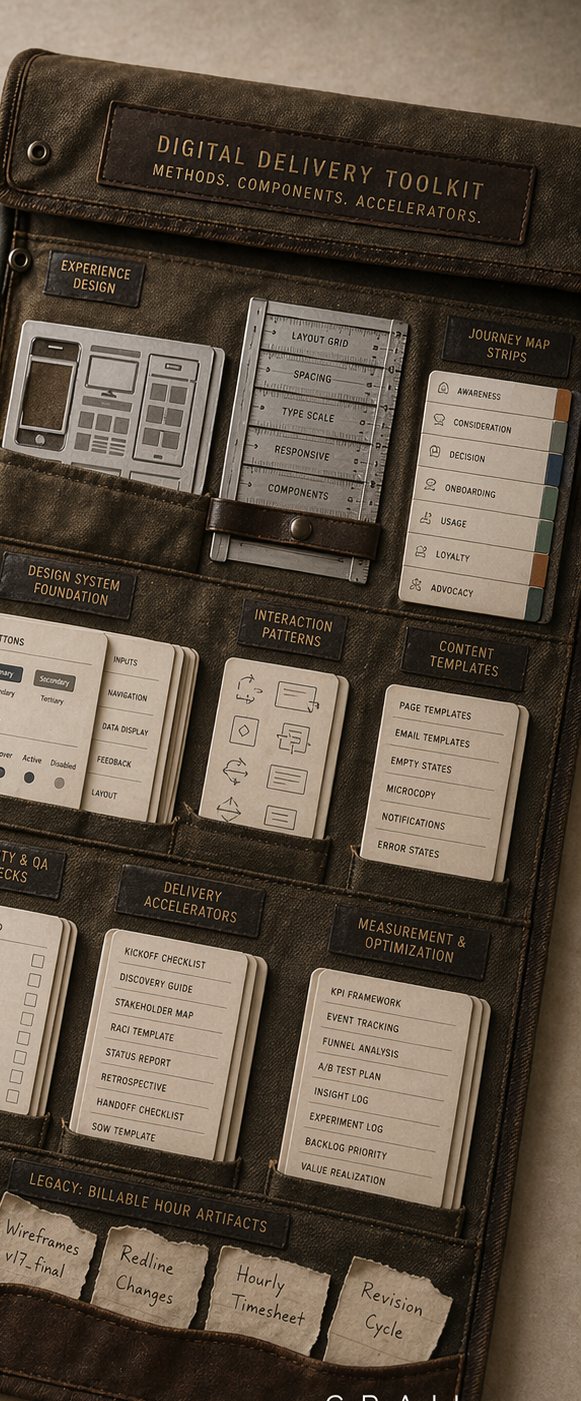
What's Changing in Your Pitch Room
Pitches lost to firms half your size. Senior architects walking to AI-native startups. Clients asking what your own AI delivery looks like. Three problems that look separate, but are actually one. A briefing for commercial directors at technology and digital firms.
You have seen this in your pitch room
Every commercial director at a mid-sized technology firm in Europe has had the same Monday morning. A €3M competitive pitch went to a four-person AI-native firm on Friday. They opened with a working demo of their own internal AI workflow. Your team opened with a case-study deck. A senior cloud architect resigned on the same day for equity at an AI-coding startup. Your CEO asked what the firm's own AI-augmented delivery looks like for the board meeting on Thursday.
You have done this job for twelve years. The pattern used to be simple. Win on reputation, relationships, senior delivery people, a disciplined pipeline, and a credible proposal. The best firms stood out over two or three years. You built the team around them. You took a good share of competitive pitches. The business was understandable.
Something changed. Your close rate on competitive deals is falling against firms with half your headcount. Clients are approving 30-day AI-assisted POCs that replace what used to be six-month engagements. Your senior architects are being recruited weekly. Your day-rate proposals are getting pushed back by procurement teams that already have a view on what AI-augmented delivery should cost. And the CIO clients who used to ask about your methodology are now asking to see your firm's own AI workflow.
This is an industry problem and a function problem, at the same time. Most commercial directors are treating them as two. The ones who see them as one are going to own the next decade of technology services growth. The firms competing with AI-native upstarts on the AI-native game lose. The firms that turn twenty years of delivery judgment into the pitch asset no AI-native firm can copy win.
This briefing covers what is happening in your industry, what it means for your pitch room and your delivery floor, and the three questions your leadership team should answer before the next board cycle.
Technology services just lost the sales cycle that ran it for twenty years
Every technology wave your industry absorbed in the last two decades gave you a reason to run longer, richer engagements. Cloud migration. Mobile. Digital transformation. API economies. Platform modernization. Each wave gave clients a reason to commission six-month engagements with senior architects, a full delivery team, and a discovery phase that paid for itself. Your business ran on time-and-materials at senior day-rates and it never once broke.
AI does not behave the same way. The client still needs the same platform, the same integration, the same user interface. The scope of the work is unchanged. But the routine delivery work that used to absorb most of the hours (boilerplate code, standard integrations, documentation, unit testing, first-pass architecture) can now be done in a fraction of the time. The €3M six-month engagement your firm used to win is now a 30-day AI-assisted POC the client approves for €200K. Your industry calls this billable-hour compression, and for the first time in twenty years, your pricing floor is actually sliding.
Your clients now arrive at pitches with AI-powered procurement already estimating what AI-efficient delivery should cost. Your price floor used to be negotiated in your meeting. Now it is set before your account lead walks in.
The competitors in your segment are not waiting. AI-native firms founded in the last 36 months run on cost structures 40-60% leaner than yours, and they are opening pitches with working demonstrations of their own internal AI workflows. SEB research shows time-based firms growing at 2.1% against value-based firms at 8.7%. Netcompany's 80% fixed-price book is outperforming every peer on profitability. The credibility paradox is the sharpest pressure. Your clients expect you to lead on AI adoption. When the CIO asks to see your firm's own internal AI-augmented delivery workflow and your team has a slide deck, the deal is already lost. Being visibly behind on AI in a technology firm is not an operational problem. It is reputational.
Your pitch room, your proposal team, and your senior bench are feeling it every day
Your pitches. The pitch is now decided by the demo, not the deck. The AI-native firm you lost to last quarter opened the meeting with a working agent running on the client's own published architecture. Your team closed with a reference-story slide. The CIO watched your competitor's demo and decided. Your reps are not losing on relationship or product knowledge. They are losing the credibility moment in the first twenty minutes of the pitch.
Your marketing team. The MQL playbook changed in a single year. Buyers research in ChatGPT, Perplexity, and Gemini before they hit your website. If your firm does not show up in those answers, you are not on the shortlist. Organic search is falling on the pages that used to convert. The leading firms are shifting marketing from lead factory to authority engine. Original research the answer engines cite. Named senior voices in trade press. Customer stories with specific delivery outcomes. Your brand becomes the preferred pick before the RFP is scoped.
Your rev ops. The function that used to run CRM hygiene and utilization dashboards is becoming the architecture of your entire commercial engine. The agents every account lead uses in the pitch room. The pricing logic that holds on fixed-price deals. The data flowing between marketing and sales. The delivery-knowledge capture that makes senior wisdom institutional. All of it runs through rev ops. Most commercial directors still treat rev ops as reporting. The ones pulling ahead are repositioning the rev ops leader as the architect who ties pitch, proposal, delivery, and expansion into one system.
Your senior bench. Your senior architects and delivery leads are the carrier of your pitch credibility and your delivery margin. They are also the most recruited people in the tech services market in 2026. AI-native startups offer them equity, cleaner codebases, and the chance to build instead of maintain. Your ramp time for replacements is twelve months. Two senior resignations in a quarter is a delivery cliff and a pitch cliff at the same time.
Your account managers. New-logo economics are compressing as sales cycles shorten on AI-native POCs. Expansion economics are inflating because client-side AI means the second engagement starts from a known delivery pattern. Your best account managers know this in their instinct. The rest of the team is still hunting new logos with a playbook that stopped working eighteen months ago.
The winners are already running one commercial system
Your industry is compressing because AI takes hours out of delivery. Your function is compressing because AI-native competitors walk into pitches better armed, and your senior architects are being recruited before they resign. Same force, two altitudes. But there is a third thing happening that most commercial directors have not named yet, and it is the one that matters most.
Look at the firms pulling ahead. The pitch demo, the proposal pricing logic, and the senior delivery knowledge are running as one commercial motion, not three separate workstreams. The same agent layer that runs the pitch demo also builds the fixed-price pricing construction. The same delivery-knowledge capture that retains senior wisdom also makes every account manager credible in the expansion conversation. Marketing feeds the authority surfaces that make your firm the preferred pick before the RFP drops. The data flows between pitch, proposal, delivery, and expansion. Everyone works the same system.
Most commercial directors are still running three parallel AI tracks. A Copilot roll-out for the developers. An MQL generator for marketing. A dashboard refresh for rev ops. Twelve months later nothing compounds, because the three tracks never met.
Your competitors who get this will walk into every competitive pitch with a working AI demo of their own delivery, a fixed-price pricing construction the client can audit, and senior-knowledge infrastructure that keeps the firm credible when an architect resigns. Three things compounding into one commercial engine. This is what the next eighteen months look like if you do not move.
You have twelve to eighteen months. The AI adoption debate is over. Your question now is whether you lead the redesign yourself, or the CFO hires someone who will.
What most firms are doing. What the winners are doing instead.
Every commercial director has had the AI conversation. Most are making the same four decisions. A smaller group is making different ones.
| The default path | The winners' path |
|---|---|
| Run pitch, proposal, and delivery as three separate tracksA Copilot roll-out. A marketing refresh. A delivery team update. Three plans that never meet. | Run one commercial motion across pitch, proposal, and deliverySame agent layer powers pitch demo, pricing logic, and expansion playbook. Shared data, tools, metrics. |
| Buy a Copilot licence and tell the board AI is shippingEvery competitor has the same licence in six months. The tool is the commodity. | Build agents tuned to your methodology and proposalsWorking tools your team owns. Tuned to your past wins, your pricing, your delivery pattern. |
| Keep the day-rate model, absorb AI efficiency as marginWorks until the first client notices and demands the efficiency as a discount. | Move 30% of the book to fixed-price with AI-augmented deliveryCapture the efficiency as margin. Fixed-price margins run 25-35% vs 12% on hourly. |
| Hope senior architects stay for the cultureYour best senior resigned last quarter for 15% equity at an AI startup. Two more are in conversations. | Capture senior delivery knowledge now, retain with architect-led AI rolesThe knowledge moves into a system every junior uses. The architect conducts the agents. |
Same technology. Same twelve months. Opposite outcomes. The difference is the operator, not the AI.
Pitch. Upstarts. Talent.
Three questions every technology commercial director is tracking. None of them used to be the same question. They are now.
What do we actually show when a CIO asks to see our own AI workflow?
The pitch is decided in the first twenty minutes. Firms that open with a working demo of their own internal AI-augmented delivery win. Firms that talk about it theoretically lose. Your last three lost competitive pitches went to firms that had the demo ready. Your team had the slide deck. This is the credibility moment, and it is worth 20-40% of your close rate.
Why are we losing to firms with half our headcount?
AI-native firms founded in the last three years run on cost structures 40-60% leaner than yours. Clients are approving 30-day POCs that replace six-month engagements. Your sales cycle was the moat. It is now the liability. The answer is not lower day-rates or more proposals. It is a delivery model that shows AI augmentation in every pitch, and pricing logic that captures it as margin.
What happens when our next senior architect resigns?
Your eight to fifteen senior people carry the critical delivery IP: methodology, client context, failure modes. They are also the most recruited talent in the market, and AI-native startups are offering equity. Your ramp time for replacements is twelve months. The firm that captures senior delivery knowledge before the next resignation defends the margin and the pitch credibility at the same time.
What the firms winning this play are actually doing
Four concrete moves any commercial director can start this quarter. Each touches one function. Pulled together, they fuse your function into one commercial system.
Sales: turn your own delivery into the pitch demo
The pitch is decided by what you open with. Build a working demo of your own internal AI-augmented delivery, running on the client's own published architecture, generated in the pitch room. Your senior architect conducts the agent. The account lead runs the business conversation. Close rate on competitive deals jumps in the range of 15-25% the first quarter the demo ships. Start with one vertical your firm already wins in. Scale from there.
Marketing: authority on the surfaces where buyers research
The MQL pipeline is degrading because buyers research in answer engines before the RFP. Pouring more money into MQL volume makes the problem worse, not better. The move is to build authority where the buyer is already looking. Original research answer engines cite. Senior voices in trade press with specific delivery outcomes. Named case studies with measurable results. Your brand becomes the preferred pick before the shortlist is built. Marketing's job is shortlist shaping now, not funnel feeding.
Rev ops: own the agent layer under every pitch and proposal
Rev ops becomes the architect of the commercial engine. The pitch-demo agent. The pricing-construction agent that generates three pricing paths per RFP with win-probability scoring. The expansion-signal agent that triggers account planning before the account manager would notice. This is the hardest move to hire for and the highest-impact. Without it, the other three moves stay siloed inside their own functions.
Senior talent: capture delivery knowledge before the architect walks
Your senior architects carry fifteen to twenty years of delivery judgment in their heads. Failure modes, client political patterns, integration gotchas, technical positions that win. It has always been biographical. AI now extracts it from project docs, Slack histories, code reviews, and retros into a system every junior uses. The architect becomes the conductor. Ramp compresses. When the resignation lands, the judgment stays. Longest lead time. Start now.
The only firm that joins the pitch-room conversation to the working tools
The commercial director at a mid-market technology firm has four places to go for help. None can do what we do.
The hyperscaler partner programs offer co-funded enablement and reference agent frameworks. They need every partner's delivery model to sit inside their platform. That is their business, not yours.
The big consulting firms will write you a two-million-euro AI transformation strategy. They cannot put a working pitch-demo agent in your team's hands in three weeks because their cost structure requires analyst-hour billing. Deck or tool. Not both.
The AI implementation specialists ship tools. They cannot have the pitch-credibility and business-model conversation that decides whether you move to fixed-price. They build what you specify.
Your internal AI task force is too close to the existing delivery model to counter-position against AI-native entrants. Their political instinct is to protect current engagement patterns, not redesign them.
The market offers four things you have already tried or said no to. GRAIL is the fifth option.
- Senior advisory that speaks pitch-room, not strategy-deck
- Working tools your team uses the same week
- Custom agents built on your methodology and proposals
- The start of a delivery-knowledge system every junior uses
- No platform lock-in, no long-term contract
- Founded by operators who have sold and led technology teams
- Business first, technology second
- Three weeks from first meeting to working tools
- Your team keeps everything, you own the IP
- Every next step earned by what just shipped, never assumed
Three sessions with your commercial leadership team. Working tools from week one.
We start with your commercial leadership team because the change cannot outrun the team's personal understanding of what is possible. Three workshops. Each delivers standalone value. Each earns the right to the next.
How to think
Walk through what is happening in your industry and in your pitch room. Build the first working tool together: a pitch-demo agent running on a real competitive pitch your team is about to do. Your leadership team leaves with a shared view of the move ahead and the first working tool already in their hands.
Your team's tools
A half-day activation. Each member of your commercial leadership team leaves with five to ten working tools tuned to their accounts, their pitches, their proposals. Pitch-demo agents. Pricing-construction agents. Expansion-signal monitoring. Tools your team is using the same week, not slides about tools.
Ready to roll
Refined tools from real use. The roll-out plan to your wider pitch and account teams. The senior-knowledge capture plan. The fixed-price pricing playbook for your next quarter. And the CEO and CFO conversation with numbers they can audit, not a deck they cannot argue with.
Three weeks. No IT project. No board approval to start. The tools your team is already using when we finish.
For your next leadership team meeting
The questions where your leadership team cannot agree on an answer are the ones worth an hour on the agenda. Ask these honestly.
Of the last ten competitive pitches you lost, how many went to firms that opened with a working demo of their own AI delivery workflow? If you do not know, how would you find out?
What share of your book is still time-and-materials today, and how does it compare to two years ago? What would it take to move 30% to fixed-price with outcome-linked pricing by year-end?
If your three most senior architects resigned next quarter, what would happen to the delivery accounts they lead? What have you actually captured from them in the last twelve months?
Where is your average account lead spending their Monday morning today, and where would they need to spend it to win one more competitive pitch per quarter?
Which of your senior people is already conducting AI-augmented delivery in a way the rest of the firm will need to by 2027? What would it take to make that behaviour the default across the team?
If any of these produces a disagreement in your leadership team, that is the conversation worth having before the board asks.
Continue reading
Sources and limitations
This briefing draws on GRAIL's engagement experience with leadership teams and on public company disclosures. Figures are illustrative unless a source is named beside them. A sourced edition is in preparation.