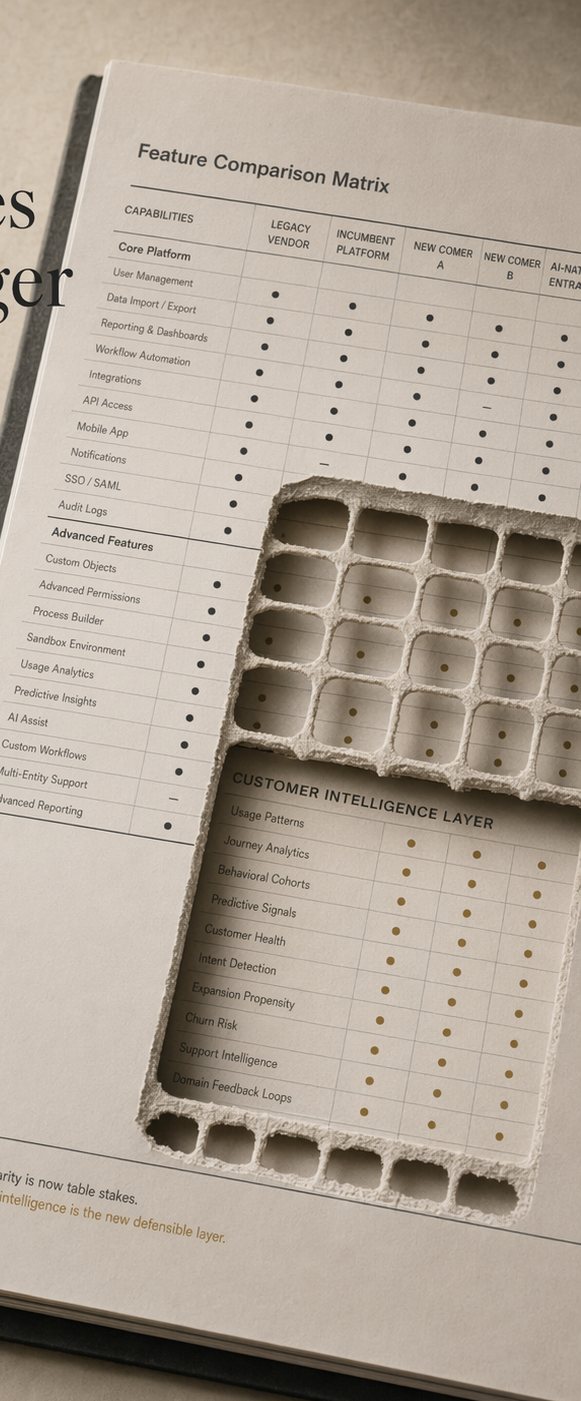
Your Features Are No Longer the Moat
When AI-native entrants can replicate your product in eighteen months, the only defensible asset is the customer intelligence you have been generating for years and have never systematically captured.
What changes for the B2B SaaS company as AI enters its industry
B2B SaaS built its competitive position on three assumptions: features take years and millions to build, integration complexity punishes switching, and accumulated customer data creates network effects that compound over time. AI has invalidated the first assumption. The second is weakening. The third remains, but only for the companies that have captured their customer intelligence institutionally rather than leaving it in individual heads.
AI-native entrants now reach feature parity with established products in twelve to eighteen months. They start with modern architecture, no legacy technical debt, and access to the same foundation models. The feature arms race has no winning end for incumbents. The cost of building competitive software has dropped so far that the product itself is no longer the differentiator.
The defensible asset is something most mid-market SaaS companies already have but have never systematically captured: the accumulated understanding of why customers buy, how they use the product, what their renewal risks look like, and what they need but have never articulated. That customer intelligence, when encoded institutionally, creates a moat that gets harder to cross over time. When it stays in individual heads, it walks out the door with every departure.
The NRR data already shows the split. Mid-market SaaS companies in the squeeze zone are watching net retention compress while enterprise players with deep customer intelligence infrastructure hold at 118%. The difference is not product quality. It is institutional knowledge depth.
This briefing examines how the moat migration from product to intelligence reshapes revenue, profit, and valuation for mid-market B2B SaaS companies, and what the management team can do about it before the competitive window closes.
The moat migrates from product to intelligence
For fifteen years, the B2B SaaS playbook was clear: build deep workflow software, make it hard to switch, and compound data network effects with every new customer. That playbook assumed the cost of building competitive software would stay high. It has not.
Foundation models have compressed the cost of building a competitive B2B product to a fraction of the historic investment. An AI-native entrant with a small team, good API access, and twelve to eighteen months can build what took incumbents five years and twenty million in engineering spend. The feature moat has not just weakened. It has structurally collapsed.
Features used to take years and millions to build. That cost just dropped by an order of magnitude. The companies still competing on feature count are in an arms race with no winning end.
What remains defensible is the accumulated intelligence about customers that the company has been generating for years: why accounts buy, how they actually use the product, what their renewal risks look like six months before any dashboard shows it, and what they need but have never articulated. That understanding cannot be replicated by a well-funded entrant. But in most mid-market SaaS companies, this intelligence is personal, not institutional. It lives in the heads of senior AEs and CSMs. When those people leave, the intelligence disappears. Three major renewals going quiet within ninety days of a key departure is a common pattern. The company loses its one defensible asset through normal employee turnover.
Revenue. Profit. Valuation.
Under the old model these three questions had three different answers. AI ties them together. Move the intelligence infrastructure and you move all three at the same time.
What happens to NRR when procurement teams benchmark against AI-native entrants?
Mid-market NRR has compressed to the squeeze zone. Procurement teams that never benchmarked during growth years are running competitive reviews. The companies with institutional customer knowledge depth win those reviews. Feature lists alone do not hold.
Where is engineering spend actually going: defending features or building intelligence?
Competing on feature velocity against entrants with no legacy architecture compresses gross margin from both sides. The profit question is whether the engineering budget builds something that compounds or something that depreciates the moment a competitor ships the same capability.
Would your ARR multiple survive a founding team transition?
Investors ask about AI-native competitive exposure and knowledge dependency risk in every diligence process. Customer intelligence in individual heads is a valuation discount. The same ARR with institutional intelligence infrastructure commands a premium.
Two columns. The whole industry sorts itself between them.
Every capability in a B2B SaaS company is moving toward one of two columns. The depreciating column contains work that AI can do faster and cheaper. The appreciating column contains work that becomes more valuable precisely because AI handles the rest. The strategic question is how much of your team's time sits in each column today.
- Boilerplate code and standard feature implementation
- Onboarding playbooks and standard QBR preparation
- Prospect research and demo preparation
- Ticket routing, knowledge base, standard troubleshooting
- CRM administration and usage reporting
- Product architecture decisions and deep customer understanding
- Political dynamics in accounts, sensing renewal risk early
- Multi-stakeholder navigation and creative deal structuring
- Complex issue diagnosis and escalation judgment
- Domain knowledge that compounds with every customer interaction
The companies that systematically shift their teams toward the appreciating column build an intelligence advantage that compounds. The companies that keep their best people doing depreciating work are training a capability that AI will do better within eighteen months.
Two paths. Same technology. Opposite outcomes.
Every B2B SaaS company is choosing one of two paths right now. Most are choosing the default path without realizing they are choosing at all.
| The default path | The repositioning path |
|---|---|
| Feature velocityAdd AI badges to existing features. Ship faster. Try to outpace AI-native entrants on their own terms. | Intelligence depthEncode customer knowledge institutionally. Make every interaction compound the moat. Compete on understanding, not features. |
| Cost reductionUse AI to cut engineering and support costs. Protect margins through efficiency. Same product, lower cost base. | Value creationUse AI to deepen vertical specialization. Turn customer data into intelligence infrastructure. Higher value, stronger retention. |
| Headcount defenseKeep customer intelligence in individual heads. Offer retention bonuses. Hope key people stay. | Institutional captureSystematically encode what CSMs and AEs know. Make intelligence survive any departure. Moat becomes structural. |
| NRR pressureProcurement benchmarks reveal feature parity with cheaper alternatives. Renewal defense becomes a pricing conversation. | NRR premiumCustomer intelligence depth creates switching costs that features never could. Renewals hold because no competitor knows the customer better. |
The default path feels productive because features ship and costs drop. The repositioning path feels slower because intelligence infrastructure is invisible until it compounds. By the time the difference shows in NRR, the gap is structural.
The growth levers that compound when used together
Each of these levers creates modest impact in isolation. Together, they rebuild the competitive moat on foundations that AI-native entrants cannot replicate regardless of their funding or architecture advantages.
Encode customer intelligence before it walks out the door
The knowledge about why your top accounts bought, what their real renewal risks are, and what they need next lives in individual heads. Systematically capture it into institutional systems before those people leave. Every month of delay increases the fragility of your most important asset.
Turn every customer interaction into domain training data
Support tickets, QBR notes, feature requests, churn reasons, onboarding friction points. Most SaaS companies generate enormous volumes of customer signal and store almost none of it in a form that compounds. Build the infrastructure that makes every interaction deepen your understanding of the domain.
Use AI to deepen vertical specialization, not broaden feature count
The product roadmap should prioritize intelligence depth over feature breadth. Understanding your customers' operations better than anyone is a position AI-native entrants cannot replicate from scratch. Matching their feature count is a race you will lose. Exceeding their domain understanding is a race they cannot run.
Restructure professional services around AI-augmented delivery
Reduce time to value. Improve implementation margins. Make the switching cost structural rather than contractual. When your services team delivers faster and with deeper domain context than any competitor, the total cost of switching rises even as the software itself becomes easier to replace.
Business first. Technology second.
GRAIL is an AI-native management consultancy. We help European mid-market leadership teams figure out the one or two things that fundamentally change about their business as AI enters their industry, and then build the capability to act on it before competitors do. For B2B SaaS, that means helping the CEO and management team see the moat migration clearly, and building the intelligence infrastructure that makes the new moat real before the competitive window closes.
The market offers two things: vendor lock-in dressed as transformation, and consulting reports dressed as strategy. GRAIL delivers a third option: working AI capability that you own.
- Senior advisory direct to the CEO and GMT
- Working AI capability you own from day one
- Custom agents built around your business logic
- Outcomes in weeks, not quarters
- No lock-in at any phase of the engagement
- Founded by operators, not technologists
- Business-first strategy, technology second
- Context architecture, change management, workflow design
- Results before you commit to scale
- Each next step earned, never assumed
Three sessions with your management team. No IT involvement. Working tools from week one.
GRAIL starts with the management team because organizational transformation cannot outrun the leadership team's personal understanding of what is possible. Three workshops. Each delivers standalone value. Each earns the right to the next.
How to think
The strategic foundation. Where AI creates real value in B2B SaaS and where it is noise. The augmentation framework. The moat migration thesis. Your leadership team leaves with a shared frame for the rest of the work, and with the first working agent built live in the room.
Your AI team
A half-day activation. Each member of the management team receives a personal suite of five to ten custom agents trained on their workflow, their decisions, their competitive landscape. Account intelligence. Renewal risk detection. Competitive positioning. Working tools from week one, not slides about tools.
Competitive edge
Refinement from real usage. Agents upgraded based on how the team actually used them. The intelligence infrastructure roadmap. The customer knowledge capture plan. The recommendation for what comes next, earned by what just shipped.
Three weeks. No IT involvement. No board approval needed to start. The sharpest strategic conversation your leadership team will have this year, backed by working tools they are already using.
What to ask in your next leadership meeting
The questions where the room cannot agree on an answer are the ones worth a longer conversation. Ask these honestly. The point is not the polished response. The point is whether the answer would survive contact with an AI-native competitor closing your largest prospect next quarter.
If our three most senior CSMs left tomorrow, what percentage of our account intelligence would survive in any system we own?
When a well-funded AI-native entrant demos feature parity to our top ten accounts, what is the reason those accounts stay?
What percentage of our engineering budget is building capabilities that compound over time versus features an entrant can replicate in twelve months?
If Microsoft adds our core workflow to Copilot next quarter, what is the answer we give the board about why our ARR holds?
Can we articulate our competitive moat in one sentence that does not mention product features?
If any of these questions land somewhere uncomfortable, that is the conversation worth having.
Continue reading
Sources and limitations
This briefing draws on GRAIL's engagement experience with leadership teams and on public company disclosures. Figures are illustrative unless a source is named beside them. A sourced edition is in preparation.