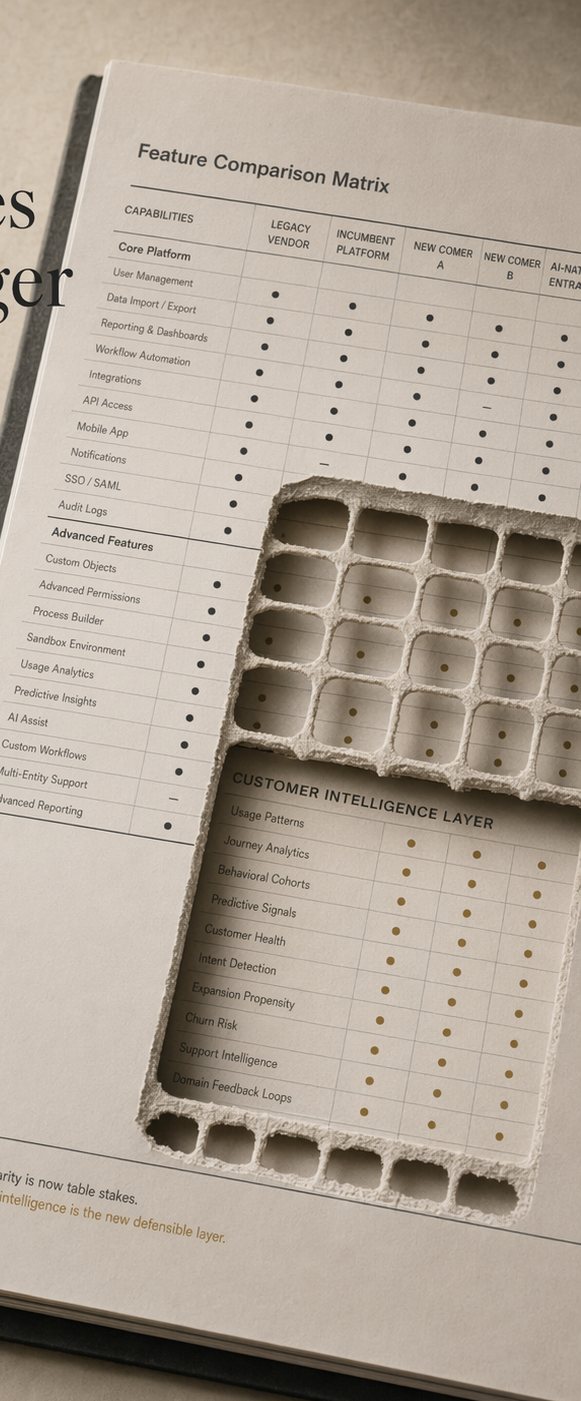
What's Changing Inside Your Post-Sale Engine
Your cost-to-serve is climbing. Your senior CSMs are eighteen months from their next job. Your implementation cycle has not moved in half a decade. Three problems that look separate, but are actually one. A briefing for operations leaders at mid-market B2B SaaS firms.
You have seen this on your post-sale floor
Every Chief Operating Officer or Head of Customer Success at a mid-market B2B SaaS firm in Europe has had the same Monday morning. Three post-sale reviews on this week's calendar. Implementation one: a mid-market CRM rollout, go-live slipped twice because the customer's data has not landed again and your lead implementation consultant has rescheduled the kickoff for the third time. Implementation two: a seven-figure ARR expansion, the customer asked a configuration question in Friday's call that nobody on your side could answer without pulling three people into a Slack huddle. Renewal one: your ten-year senior CSM resigned Friday. She carried six accounts up for renewal in Q3. You know the status of two.
You have run this function for three years. The pattern used to be simple. Hire good CSMs. Build playbooks. Hold gross retention. Keep NRR moving. The business was understandable.
Something changed. Your support queue is at three-hundred tickets against a normal one-eighty because the product team shipped an AI feature two weeks ago and support never got a runbook. Your implementation backlog is eight deals deep and the scoping conversations are getting longer, not shorter. Your NRR came in at one-oh-one percent, four points below plan, and your finance team is asking for an account-level churn cohort by Thursday. And you can name the four senior CSMs whose next resignation email will take a decade of customer context out the door with it.
This is not a you problem. It is an industry problem and a post-sale-engine problem, happening at the same time. Most SaaS COOs are treating them as two. The ones who see them as one are going to own the next decade of European mid-market SaaS.
This briefing covers what is happening in your sector, what it means inside your post-sale engine, and the three questions your operations team should answer before the next board cycle.
Mid-market SaaS just lost the moat that ran it for a decade
Every technology wave your sector absorbed in the last fifteen years added to the product. Workflow specificity deepened. Integration libraries widened. Data schemas grew. Feature parity was the moat because building features took years and serious capital. A well-funded competitor needed three years and fifty engineers to close the gap on a mid-market incumbent. Your rate of feature release kept you ahead. Your customers renewed because switching was painful.
AI does not behave the same way. A well-funded entrant with ten engineers and foundation models now reaches feature parity in twelve to eighteen months on categories that took your firm five years to build. The product floor is collapsing. What your customers have been renewing for, the accumulated understanding of their workflows and their industry that lives inside your CSMs' heads, is still defensible. But your firm has never captured it. Under renewal pressure from an AI-native entrant who is asking your customers three questions you have never asked them, your incumbent advantage depends on infrastructure you have not built.
Your customers' procurement teams are arriving at renewals with comparison quotes that show your ACV against an AI-native alternative at sixty percent of your price. By the time your CSM walks into the executive review, the conversation has already shifted.
The competitors in your segment are not waiting. A handful of Nordic and continental SaaS firms have committed serious budget to customer-intelligence infrastructure in the last eighteen months. The ones moving first are closing implementations in four to six weeks that used to take fourteen, at the same ACV, with hypercare completing inside the same quarter as kickoff. The other half of the story sits on the segment side. Customers below your current implementation-cost floor, the long SMB-upper tail you walked away from because the fixed cost of every implementation was too heavy, are suddenly addressable. The firm that opens that segment first captures ARR competitors have not priced for.
Your post-sale engine is feeling it every day
Your implementation engine. Lead consultants are working harder to close kickoffs at the same quality. Handoffs between sales, scoping, and delivery carry friction built into a 2018 on-prem-era workflow and never redesigned. The firm runs a mid-market CRM implementation the same way it did in 2020. The tooling has changed, the customers have changed, the expected time-to-first-value has changed. The engine has not.
Your customer success function. The health score still shows green. But the health score is backward-looking and the renewal lands when the CSM's judgment hits the quarterly review, not when the dashboard changes colour. Your senior CSMs are the people who can read the warning signal two quarters before the data shows it. That judgment has never been written down. When your ten-year senior resigns, the firm sees the next renewal before the dashboard does, and the retainer she held goes to competitive review the quarter after the announcement.
Your support operation. Tickets are climbing faster than ARR. Tier-one volume doubles every time the product team ships a new AI feature and support does not receive a runbook in time. The cost per ARR dollar on support has drifted upward every quarter for two years. Customer expectations on response time reset every year and your existing support model has no more capacity to give. Most of your tier-one resolution is work that now compresses to seconds with the right substrate. Your support team has not had a conversation yet about what tier-one becomes.
Your senior CSMs. Your four to ten most senior CSMs carry twelve to thirty accounts each. Every one of them is twelve to eighteen months from their next role, at a market where AI-native competitors are actively recruiting. The customer-specific context each carries took four to ten years to build. Most of it is in their heads, a slice is in CRM notes, the rest is in Slack channels and inboxes nobody will read when they leave. The scarcest resource in the firm is carrying your retention risk in her browser tabs.
Your customer continuity. Your top accounts each carry between two and four relationships worth €200K to €2M a year in ARR and services. The senior CSMs who built them spent four to ten years learning the customer's political structure, product usage quirks, executive sponsor rotation, and competitive landscape. When one senior CSM leaves, industry experience is that one of those accounts goes to competitive review within twelve months. The resignation email you are going to get this quarter is already on your calendar.
The firms pulling ahead are building one piece of infrastructure
Your sector is compressing from below because AI takes hours out of implementation and tier-one support. Your post-sale engine is compressing from above because your senior CSMs are spending half their week on the routine coordination work the firm has not built infrastructure to carry. Same force, two altitudes. But there is a third thing happening most SaaS COOs have not named yet, and it is the one that matters most.
Your CSMs and your CEO are trying to build the same asset. Neither of them knows it. The customer intelligence your CEO is trying to build at the firm level is the same intelligence your senior CSM is trying to hold in her head. Your function is the only part of the firm that sits close enough to both to unify them. Every margin drift, every retention risk, every slow implementation is a symptom of that single unsolved thing. Pay a senior CSM to do QBR prep a substrate can do, and cost-to-serve drifts. Let her leave with the customer context still in her head, and the renewal goes to review. Run the implementation engine around a 2018 workflow, and time-to-value does not move.
Look at the firms pulling ahead. Implementation, CS, and support are not three separate programmes. They are one piece of customer-intelligence infrastructure. Every implementation feeds it. Every renewal tests it. Every CSM who leaves adds to it on the way out. The same infrastructure that protects gross retention shortens time-to-value and brings cost-to-serve down.
You can tell which camp a firm is in from one question. Name one thing about your top ten customers that you know better this quarter than last quarter. Most SaaS operators cannot. The ones that can are already winning NRR against AI-native entrants.
You have eighteen to twenty-four months. The AI adoption debate is over. Your question now is whether you build the customer-intelligence infrastructure your firm will run on for the next decade, or wait until the CFO brings in a vendor to build one that belongs to someone else.
What most firms are doing. What the winners are doing instead.
Every SaaS COO has had the AI conversation. Most are making the same four decisions. A smaller group is making different ones. The difference is architecture, not tooling.
| The default path | The winners' path |
|---|---|
| Hold ACV, push CSM account load upSame pricing, harder targets. NRR drifts as AI-native entrants arrive with comparison quotes at sixty percent. | Rebuild around intelligence depth as the moatThe customer knowledge no entrant can replicate becomes institutional. NRR holds because switching is painful in a new way. |
| Treat CSM turnover as an HR problemBackfill fast, hope the notes are in the CRM, watch renewals slip the quarter after each departure. | Extract CSM judgment as a side-effect of daily workCapture from QBR decks, renewal memos, escalation notes. CSMs become the strategic escalation layer. The knowledge stops walking out. |
| Deploy copilots on top of the existing engineEvery CSM gets a chatbot. Productivity rises individually. Time-to-value does not move because the engine is still 2018. | Rebuild the engine around the new unitJunior CSM plus agent plus extracted customer context delivers senior-tier output. Implementation compresses from fourteen weeks to five. |
| Defend mid-tier CSMs by avoiding the conversationPretend roles do not change. Lose the best to firms that moved first. Bench thins at the worst moment. | Redesign the junior CSM pathway around judgmentNew hires pair with agents and the firm's customer-intelligence corpus. Five-year curve compresses to eighteen months. |
Same post-sale engine. Same twelve months. Opposite outcomes. The difference is the architecture, not the agents.
Unit Economics. Customer Outcomes. Time-to-Value.
Three questions every SaaS COO is tracking. None of them used to be the same question. They are now.
Why is our cost-to-serve rising faster than our ARR per customer?
The ACV has not moved. Headcount is within plan. But the cost per ARR dollar on CS, implementation, and support is up quarter over quarter, and AI-native entrants are quoting the same customer at a materially lower implementation cost. Every implementation re-learns what the last already knew. Support cost climbs because customer expectations reset every year. The pricing is fine. The delivery architecture is the question.
What happens to our NRR when our senior CSMs resign?
Four to ten of your most senior CSMs are within eighteen months of their next role. Each one carries customer-specific context that took four to ten years to build and has never been written down. Gross retention holds because they are in the room on renewal calls. When they leave, the next renewal slips before the dashboard changes colour, and the account goes to competitive review the quarter after the announcement. You already know which resignations are coming.
Why has our implementation cycle not moved in five years?
A mid-market implementation takes twelve to sixteen weeks on a standard rollout. Roughly half of that elapsed time is requirements gathering, configuration mapping, data migration, and standard integration work that now compresses to hours not weeks. The firms that rebuild delivery around this close the same implementation in four to six. Same ACV. Same quality. Eight to ten weeks of ARR pulled forward per customer. Not a productivity story. A capacity story.
What the firms winning this play are actually doing
Four moves any SaaS COO can start this quarter. Each touches one part of the post-sale engine. Pulled together, they become one architecture.
Implementation: decompose every template to the task level, then build configuration agents around the tasks that still make money
Most COOs are redesigning implementations. The right unit is the deliverable task. List the task bundles inside each implementation type. Mark each: agent-owned with human audit, hybrid, senior-only, retired. What remains is a different implementation at a different cost base and timeline. The COO who walks into the next pricing review with the task-level map owns the conversation.
Customer success: extract CSM judgment now, as a side-effect of daily work, not as a separate knowledge project
Documentation sprints have failed in every SaaS firm for fifteen years. The judgment is not articulable in prose. Extract from the artefacts the CSM already produces: QBR decks, renewal memos, escalation notes, Slack threads with product. Consent is straightforward because she is not asked to explain herself. Her role moves from daily coordination to strategic escalation.
Bench: redesign the junior CSM pathway around judgment from day one, not ticket triage
The tier-one coordination work that trained juniors into mid-tier CSMs is now running on agents. No routine work, no training ground, no senior bench in 2031. New hires do not start on ticket triage and QBR prep. They start on renewal risk analysis, executive escalation, and paired work with seniors on live accounts. The five-year curve compresses to eighteen months.
Continuity: institutionalise the relationship, so it transfers on architecture, not biography
Every SaaS CEO has lost a seven-figure account once, the quarter after the senior CSM who held it resigned. Treat every major account as a small intelligence asset under active construction. Executive sponsor rotation, product usage quirks, competitive posture, the unwritten rules of the account. When the CSM rotates, the next senior inherits the asset. The relationship holds on the firm's architecture.
The only firm joining post-sale advisory to working infrastructure
The SaaS COO has four places to go for help. None can do what we do.
The big consultancies' SaaS practices sell €500K to €2M diagnostics delivered by partners and analysts billing hours. They produce decks. They cannot put working infrastructure into a CSM's Monday workflow in three months. Their revenue model is the thing being disrupted.
The customer-success and customer-data platforms sell dashboard implementations on top of your existing intelligence problem. They treat health scores as the answer. Judgment extraction is not on their roadmap. Every SaaS firm has watched that purchase fail once already.
The hyperscaler professional services arms sell migrations tuned to their cloud platform. They build agent modules on their stack. Your customer intelligence gets absorbed into the platform. The eighteen-month moat becomes a platform asset.
The AI point-vendors for CS and implementation sell per-seat agent licences that draft QBR narratives and renewal memos. They automate the output without capturing the reasoning. The memo is faster. The judgment still walks out with the CSM.
The market offers four things you have already said no to. GRAIL is the fifth option.
- Senior advisory that speaks post-sale-floor, not diagnostic-deck
- Working infrastructure your CSMs use the same week
- Custom agents built on your accounts, your customers, your domain
- The start of a customer-intelligence asset your best CSMs feed
- No vendor lock-in at any phase of the engagement
- Founded by operators who have run SaaS post-sale delivery
- Business first, technology second
- Three weeks from first meeting to working infrastructure
- Your CSMs keep the infrastructure, you own the IP
- Every next step earned by what just shipped, never assumed
Three sessions with your post-sale leadership. Working infrastructure from week one.
We start with your post-sale leadership because the change cannot outrun the team's personal understanding of what is possible. Three workshops. Each delivers standalone value. Each earns the right to the next.
How to think
Walk through what is happening in your sector and inside your post-sale engine. Build the first piece of infrastructure in the room: a customer-specific agent for one of your real top-ten accounts, extracted from the QBR decks and renewal memos you already have. Your operations team leaves with a shared view of what to do next and the first piece of working infrastructure already in their hands.
Your customer intelligence
A half-day build. Your Head of CS, Head of Implementation, Head of Support, and Head of Renewals each leave with five to ten pieces of working infrastructure tuned to their function. QBR preparation. Renewal memo drafting. Escalation triage. Implementation scoping. Customer-specific knowledge capture. Infrastructure your teams are using the same week, not decks about infrastructure.
Ready to run
Refined infrastructure based on real use. The rollout plan to your wider post-sale organisation. The knowledge-extraction plan for your senior CSMs. The pathway plan for your junior CSMs. And the CEO and CFO conversation with numbers they can check: NRR by cohort, cost-to-serve by tier, retention exposure by senior CSM.
Three weeks. No IT project. No board approval needed to start. The infrastructure your post-sale engine is already running on when we finish.
For your next operations review
The questions where your operations team cannot agree on an answer are the ones worth an hour on the agenda. Ask these honestly.
Of the last ten renewals where NRR came in under plan, how many lost ground because an AI-native entrant arrived with a comparison quote your team had not seen? If you do not know, how would you find out?
What percentage of your senior CSMs' week is spent on QBR prep, renewal memo drafting, and escalation coordination, and what would it take to cut that in half?
If your top three senior CSMs resigned next year, what would happen to the accounts they carry? What have you actually transferred to the rest of the bench in the last twelve months?
Can you name one thing about your top ten customers that you know better this quarter than last quarter? If not, what are the next four quarters going to add up to?
Which of your junior CSMs is already working the way the rest of the bench will need to work by 2027? What would it take for that to be the default across your post-sale organisation?
If any of these produces a disagreement in your operations team, that is the conversation worth having before the board asks.
Continue reading
Sources and limitations
This briefing draws on GRAIL's engagement experience with leadership teams and on public company disclosures. Figures are illustrative unless a source is named beside them. A sourced edition is in preparation.