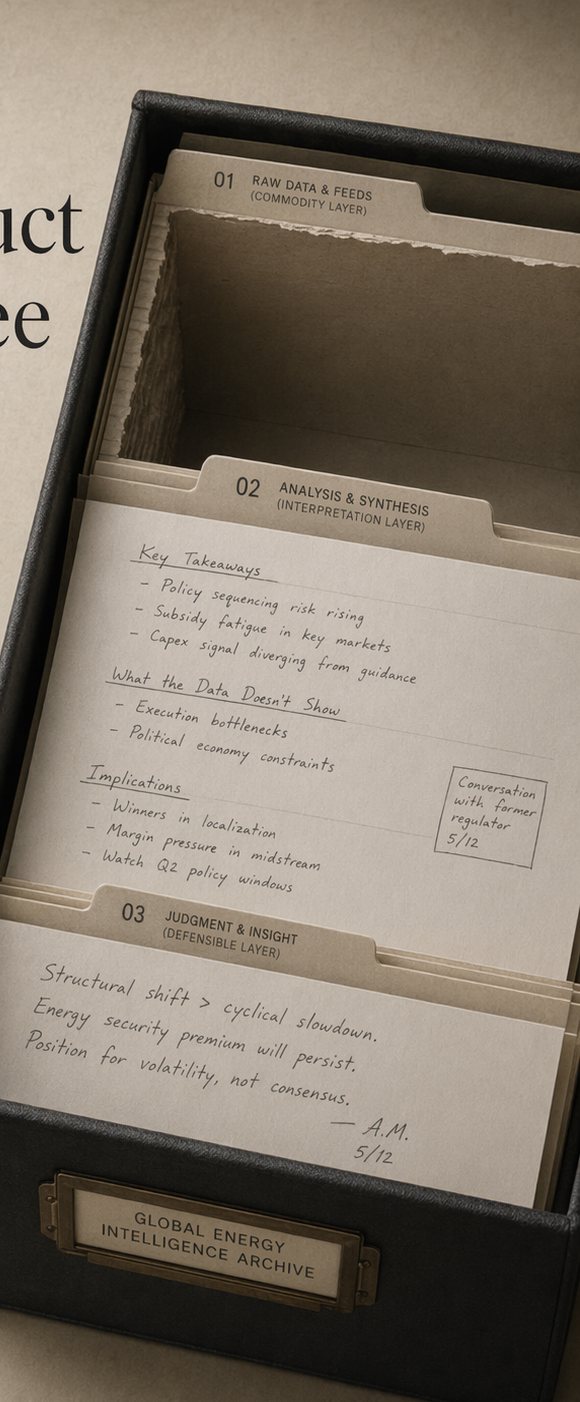
Your Product Is Now Free
Your clients are already running the analysis you used to sell them. The question is what you sell them next.
What changes for the specialist research and intelligence firm as AI enters its industry
Specialist research and intelligence firms built their commercial proposition on a simple premise: gathering and synthesizing information at the required quality and depth is expensive enough to justify outsourcing to specialists. AI has collapsed the cost of information production. Enterprise clients with internal AI access are discovering they can produce roughly 70% of the analysis they used to outsource. The remaining 30% is interpretation, judgment, and sector-specific pattern recognition.
This is not a gradual shift. Subscription intelligence revenue is declining. Project-based research faces pricing pressure in every proposal. AI-native competitors are entering established sectors with dramatically lower cost structures. Clients are citing their own AI capability as a reason to renegotiate or cancel.
The surviving commercial proposition is not cheaper reports produced faster. It is the insight that no model generates: knowing what the data means in a specific sector context, which signals matter and which are noise, and what the client should do about it. That interpretation requires years of accumulated sector knowledge. It is the one asset an AI-native entrant cannot replicate quickly.
Most firms have this asset. They do not recognize it as one. It sits unsystematized in project archives and in the heads of senior analysts. The firms that systematize it, reprice around it, and build a credible quality narrative for AI-augmented research within the next six to twelve months will survive. The ones that defend production-based pricing will not.
This briefing maps the commercial model migration: where production revenue is going, what replaces it, and the four levers that compound when used together.
From information production to insight generation
For decades, research firms sold a bundle: information production (gathering data, synthesizing sources, compiling reports) and expert interpretation (knowing what the data means, what it implies, what to do about it). Clients paid for the bundle because both were expensive. AI has unbundled them by making information production nearly free.
Secondary research, data aggregation, market sizing, competitive scanning, literature review, report compilation. Every one of these tasks is now AI-executable at a fraction of the cost. The client who paid for a competitive landscape report last year can generate one internally this afternoon. Not at the same quality. But at 70% of the quality, at 5% of the cost, delivered in hours instead of weeks.
The client can get the data. They cannot get the interpretation. That is the only business you are actually in now.
The interpretation layer is where the real value lives. Knowing what the data means in a specific sector, which signals matter and which are noise, what a pattern implies for competitive positioning, and what to do about it. This requires sector-specific pattern recognition built over years of client work. It cannot be replicated by an AI-native entrant in twelve months. But it can be lost when senior analysts leave, because in most firms it lives in their heads rather than in institutional systems.
The migration from information delivery to insight generation is not optional. It is the commercial reality. The only question is whether it happens by design or by erosion.
Revenue. Profit. Valuation.
Under the old model these three questions had three different answers. AI ties them together. Move the revenue mix and you move all three at the same time.
What do you charge for when production is free?
Subscription intelligence is declining. Project pricing faces pressure. AI-native entrants compete on speed and cost. The revenue question is not how to defend existing pricing. It is how to reprice around the insight that only your accumulated sector knowledge can deliver.
Can you restructure before economics force it?
Your cost structure was built for information production: teams of junior analysts doing secondary research and report assembly. When production revenue declines, the margin math breaks. Cutting analysts preserves short-term margin but accelerates the loss of institutional knowledge.
Is your intelligence institutional or personal?
An acquirer prices a research firm on revenue defensibility. Production revenue with AI substitution pressure is a discount. Advisory revenue backed by systematized proprietary data is a premium. The same firm, at very different multiples, depending on one strategic choice.
Two columns. The whole industry sorts itself between them.
Every capability in a research firm is migrating toward one of two columns. The left column is where AI directly substitutes human work and the commercial value declines. The right column is where human judgment, interpretation, and accumulated expertise become more valuable precisely because the production layer is commoditized.
- Secondary research and data aggregation
- Market sizing and competitive scanning
- Literature review and report compilation
- Structured analysis and benchmarking
- Standard sector updates and trend projections
- Document review and financial analysis for due diligence
- Knowing what the data means in a specific sector
- Seeing what the data is not showing
- Cross-sector pattern recognition and contrarian insight
- The conversation that changes how a CEO thinks about their market
- Sensing when due diligence data is misleading
- Judgment under pressure when the stakes are high
The firms that price the left column will compete against AI on cost. That race is unwinnable. The firms that price the right column will compete on accumulated expertise. That race is winnable, but only if the expertise is institutional rather than personal.
Two paths. Same technology. Opposite outcomes.
Every research and intelligence firm faces the same strategic fork. The default path feels safer because it preserves existing workflows. The repositioning path requires rethinking the commercial model. Both use AI. Only one builds something defensible.
| The default path | The repositioning path |
|---|---|
| Speed up productionUse AI to produce existing reports faster and cheaper | Migrate to insightReprice around interpretation and advisory, not report volume |
| Defend pricingCompete on turnaround time against AI-native entrants | Reprice the valueCharge for sector judgment that no model can replicate |
| Cut production costReduce analyst headcount to protect margin | Encode the expertiseSystematize accumulated knowledge before analysts leave |
| Add AI quietlyUse AI without addressing client trust and quality | Build the quality storyCreate a credible narrative for AI-augmented research |
The default path competes on cost against entrants who started with a better cost structure. The repositioning path competes on accumulated expertise that takes years to build. One race is unwinnable. The other is yours to lose.
The growth levers that compound when used together
Each lever creates modest value on its own. Together, they rebuild the commercial model on foundations that an AI-native entrant cannot replicate in less than eighteen months.
Systematize accumulated sector intelligence
Years of client work have produced sector-specific pattern libraries, methodology records, and historical databases of industry dynamics. This accumulated intelligence is your most defensible asset. Right now it is sitting unsystematized in project archives and senior analyst heads. Make it queryable, scalable, and the foundation for a new commercial model before the people who carry it leave.
Reprice around interpretation, not information
The client can produce the data. They cannot produce the insight. Price the insight. The conversation where you change how a CEO thinks about their market is worth more than the report that preceded it. Move the commercial model from deliverable-based pricing to advisory-based pricing, where the value is the judgment, not the document.
Turn every engagement into proprietary training data
Every client project generates sector-specific patterns, edge cases, and interpretation precedents. When these flow into a systematized intelligence base, the firm gets smarter with every engagement. The next project starts where the last one ended. This is the compounding advantage that AI-native entrants cannot match because they lack the historical depth.
Build a credible quality narrative for AI-augmented research
The trust challenge in research is acute. High-stakes decisions depend on research quality. The firm that solves quality assurance for AI-augmented research credibly captures the market. The one that uses AI quietly without addressing quality loses credibility when clients discover it. Transparency about methodology, validation processes, and the role of human judgment is the trust differentiator.
Business first. Technology second.
GRAIL is an AI-native management consultancy. We help European mid-market leadership teams figure out the one or two things that fundamentally change about their business as AI enters their industry, and then build the capability to act on it before competitors do. For research and intelligence firms, the shift from information production to insight generation is the defining strategic question. We help leadership teams see the migration path clearly and build the capability to make it.
The market offers two things: vendor lock-in dressed as transformation, and consulting reports dressed as strategy. GRAIL delivers a third option: working AI capability that you own.
- Senior advisory direct to the CEO and GMT
- Working AI capability you own from day one
- Custom agents built around your business logic
- Outcomes in weeks, not quarters
- No lock-in at any phase of the engagement
- Founded by operators, not technologists
- Business-first strategy, technology second
- Context architecture, change management, workflow design
- Results before you commit to scale
- Each next step earned, never assumed
Three sessions with your management team. No IT involvement. Working tools from week one.
GRAIL starts with the management team because organizational transformation cannot outrun the leadership team's personal understanding of what is possible. Three workshops. Each delivers standalone value. Each earns the right to the next.
How to think
The strategic foundation. Where AI creates real value in specialist research and intelligence and where it is noise. The augmentation framework. The commercial model migration thesis. Your leadership team leaves with a shared frame for the rest of the work, and with the first working agent built live in the room.
Your AI team
A half-day activation. Each member of the management team receives a personal suite of five to ten custom agents trained on their workflow, their decisions, their competitive landscape. Insight generation agent. Client advisory briefing builder. Proprietary data synthesis tool. Working tools from week one, not slides about tools.
Competitive edge
Refinement from real usage. Agents upgraded based on how the team actually used them. The commercial model migration roadmap. The proprietary data systematization plan. The recommendation for what comes next, earned by what just shipped.
Three weeks. No IT involvement. No board approval needed to start. The sharpest strategic conversation your leadership team will have this year, backed by working tools they are already using.
What to ask in your next leadership meeting
The questions where the room cannot agree on an answer are the ones worth a longer conversation. Ask these honestly. The point is not the polished response. The point is whether the answer would survive a key client citing their own AI capability as a reason to renegotiate next quarter.
If your three most experienced sector analysts left tomorrow, how much of their pattern recognition would remain accessible to the firm?
What percentage of your current revenue comes from deliverables a client could now produce internally with AI at acceptable quality?
When was the last time a client paid a premium specifically for your interpretation rather than your data, and can you name the engagement?
If an AI-native competitor entered your primary sector next quarter with 80% of your analytical capability at 20% of your price, which clients would stay and why?
What would your commercial model look like if you assumed information production revenue reaches zero within two years?
If any of these questions land somewhere uncomfortable, that is the conversation worth having.
Continue reading
Sources and limitations
This briefing draws on GRAIL's engagement experience with leadership teams and on public company disclosures. Figures are illustrative unless a source is named beside them. A sourced edition is in preparation.