What Your Clients Pay For Next
Your renewals are under pressure. Your clients are running their own first-pass analysis. Twenty years of your work sits in folders nobody has turned into a product. A briefing for commercial directors at specialist research and intelligence firms.
You had this conversation on your Q1 renewals call
Every commercial director at a mid-market research firm in Europe has had the same Monday morning this year. The Q1 renewals call ran long. A three-year client wanted 20% less budget for the same scope. Their reason: the internal team is using AI for the first pass now. Another client paused the subscription entirely. A third renewed, but asked what you would actually deliver in 2027 that their own team could not produce. Your best senior analyst mentioned a call from a competitor on Friday. Your proposal pipeline on advisory work is flat. Your CEO asked on Monday morning what the renewal book looks like at Q3.
You have done this job for fifteen years. The pattern used to be simple. Do good work. Publish credible research. Sit across from a CFO or a Head of Strategy and make the case for twelve more months. Retention stayed above ninety. The advisory book grew off the subscription base. The business was understandable.
Something changed. The work you used to sell is work your clients now produce themselves. Your marketing is still running the report-launch playbook against clients who search in Perplexity and Claude. Your proposal language still describes deliverables. Your best analysts are watching AI-native firms at half your price land on accounts you thought were safe. And under all of it, twenty years of your firm's sector work is sitting in shared drives and senior heads, never organised into anything the market can buy.
This is not a you problem. It is an industry problem and a function problem happening at the same time. Most research commercial directors are treating them as two. The ones who see them as one are going to own the next decade of specialist intelligence work.
This briefing covers what is happening in your industry, what it means for your renewals book and your advisory pipeline, and the three questions your leadership team should answer before the next board cycle.
Specialist research just lost the contract that ran it for forty years
For forty years the deal between specialist research firms and their clients was simple. Gathering and synthesising information at the quality your clients needed was expensive enough to justify outsourcing. Your analysts knew the sector, held the methodology, and maintained the data. Your clients paid an annual subscription or a project fee because doing the work themselves cost more. The product was the information, and the price was a function of how hard it was to produce. Every research firm has priced on that basis since the 1980s.
AI does not sit inside that equation. Secondary research, market sizing, competitive scanning, literature review, data aggregation, the structured analysis that fills the middle of a report — all of it is now AI-executable at near-zero marginal cost. Your clients have discovered this. They are running the first-pass analysis themselves in half a morning with a general-purpose AI tool, and they are getting something that looks a lot like what you used to send them. The part they used to pay for because it was expensive is no longer expensive. That is the quiet end of a forty-year commercial model.
Your clients' internal teams are producing the part of the work you used to charge for. Your subscription price floor is not being negotiated in your renewals call. It is being set before your account director walks in.
The AI-native entrants know this. They are pricing at half your rate because they do not have an analyst base to protect, and they can ship a usable product in six months because their cost base was built AI-first. The reference case your peers read in the trade press is Bisnode being absorbed into Dun & Bradstreet. The next reference case will be a boutique research firm that waited eighteen months and woke up to find its top-twenty accounts renewed at half-scope. The defensive stance (lower your price, cut analyst cost, run the old motion cheaper) is the deflationary spiral your CFO is already modelling. The winning firms are running a different motion: a different product sold under the wrapper of the old relationships, at a margin the old subscription never carried.
Your renewals, your pipeline, and your best analysts are all feeling it
Your renewals book. Your account directors are walking into calls where the client has already priced your subscription against internal AI. They ask for scope cuts you never used to see. They pause on a three-year relationship and tell you they want to see what the team can do alone. The directors who hold the renewal are the ones who walk in with something the client's AI tool did not produce. The ones who defend the old scope at the old price are losing a percentage of the book every quarter, and the percentage is compounding.
Your proposals on advisory work. Your proposal hit rate on advisory expansion used to be your margin engine. It is flat or down. Your proposal language still describes research deliverables in methodology language a client can now get from a generalist tool. What clients actually buy in 2026 is the contrarian reading your senior analysts have on their sector, and the proposals that close are the ones that already show the insight rather than promising it. Most of your proposals do not.
Your marketing team. The report-launch playbook is ten years old and the audience changed under it. Buyers no longer read the quarterly sector report as a ritual. They search in answer engines and they ask the tool what your firm has published. If your firm does not show up in those answers, you are not in the client's mental model. The leading firms are shifting marketing from publication calendar to authority engine. Original research that answer engines cite. Senior analyst voices in industry press. Research the AI-native entrants cannot replicate because they do not have your firm's twenty years of client work underneath it. Marketing's job is becoming the surface layer on the firm's proprietary asset, not a campaign calendar.
Your best analysts. Your senior analysts are the people who make the firm worth paying for. They also know exactly what is happening to the business. The AI-native firms are calling them with founding-team offers and equity. Your competitors' commercial leaders are hiring your directors with double their current comp because the directors come with client relationships. Your senior bench is a retention problem for the first time in ten years. The firms that keep their best senior people are the ones giving them a new instrument to play. The ones still pointing their senior analysts at the old deliverables are losing them to firms offering a product they actually want to build.
Your best people's knowledge. Your top three senior analysts carry twenty years of sector pattern recognition, methodology intuition, client political memory, and contrarian-reading history in their heads. None of it has ever been written down in a form that survives their departure. Two of your top three are over fifty-five. When they leave, the judgment that made the firm worth the premium leaves with them. The industry has never had a way to fix this. In 2026 it does, but only if you move before the retirement conversations land.
The winners are building a new product on twenty years of old work
Your industry is compressing because AI takes the research-production work out of the subscription. Your function is compressing because your account directors walk into renewals with clients already armed. Same force, two altitudes. But there is a third thing happening that most research commercial directors have not named yet, and it is the one that matters most.
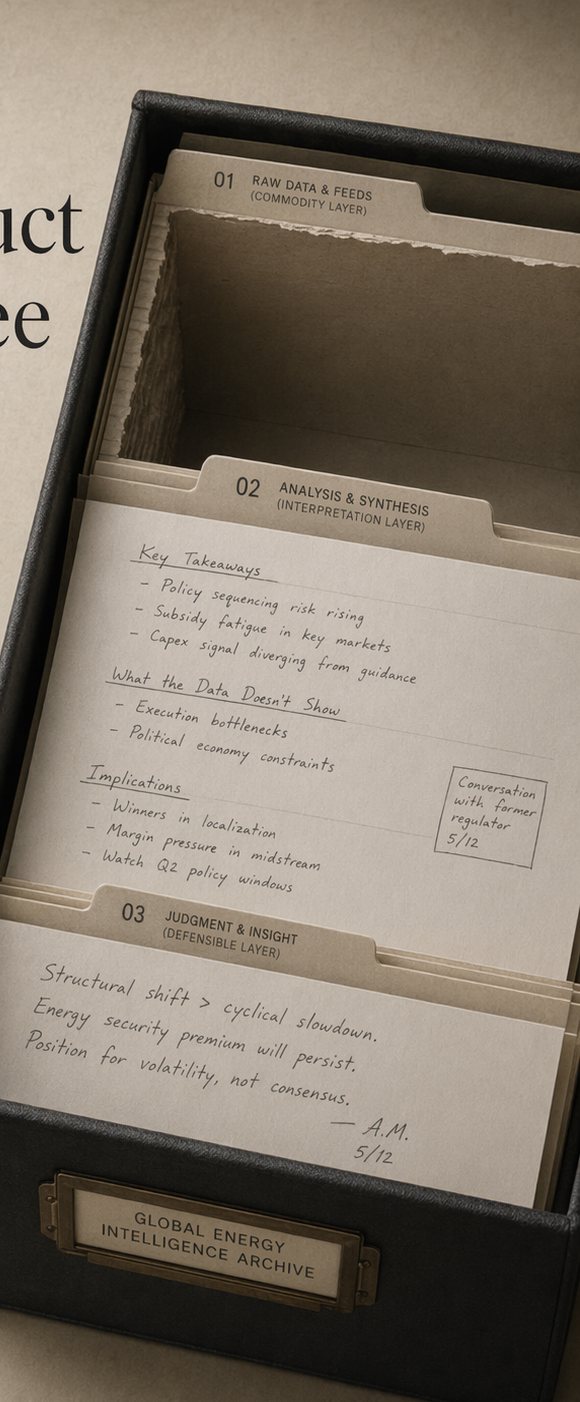
Look at the research firms pulling ahead. They are not defending the old subscription at a lower price. They are organising twenty years of their own client work — every project file, every methodology record, every sector benchmark, every analyst note — into a queryable asset that becomes the basis of a new product. The subscription wrapper stays. Inside the wrapper, the client is buying access to something the AI-native entrant cannot replicate for eighteen months: your firm's actual accumulated sector thinking, available as an instrument their team uses. The senior advisory sits on top at a higher rate. The proposal pitches show a working demo built from the asset against the client's own situation. The whole commercial motion runs on the asset, not on research production.
Most research commercial directors are still running the old motion. A quality push on deliverables. A tool evaluation for analyst productivity. A rebrand of the subscription tier. Twelve months later the book keeps bleeding, because the old motion was built for an economy where production was expensive. Production is no longer expensive. What you have accumulated is.
Your competitors who get this will renew clients at higher average revenue than today while their analyst count shrinks. Their proposals will show the insight before asking for the retainer. Their marketing will be cited by the buyer's AI tool. Three things compounding into one. This is what the next eighteen months look like if you do not move.
You have twelve to eighteen months. The AI adoption debate is over. Your question now is whether you lead the product migration yourself, or the CEO hires someone who will.
What most firms are doing. What the winners are doing instead.
Most research commercial directors have made the same four decisions this year. A smaller group is making different ones. The difference is whether the response is defend-and-cut on the old product, or migrate to a new one the old relationships can still buy.
| The default path | The winners' path |
|---|---|
| Defend the subscription at a lower priceHold the book by discounting and trimming scope. The book shrinks anyway. | Re-price the subscription against a new productAccess to your firm's proprietary asset, not the old report. Higher-value, defensible. |
| Tell analysts to use ChatGPT to produce fasterCheaper production of the deliverable the client already stopped paying for. | Build the tool your analysts sell withAn insight-generation tool tuned to your sector work. The demo is the pitch. |
| Push marketing for more report launchesThe buyer researches in answer engines. Your calendar is invisible. | Build authority the answer engines citeOriginal research only your firm can produce. Your brand becomes the cited source. |
| Wait to see what survives before restructuringThe best analysts leave. The book compounds lower. Recovery is 24 months out. | Encode what your best analysts know while they are still hereThe knowledge moves into the asset every client accesses. Retirement becomes neutral. |
Same eighteen months. Same accumulated work behind you. Opposite outcomes. The difference is the operator, not the AI.
Renewals. What comes next. The asset underneath.
Three questions every research commercial director is tracking. None of them used to be the same question. They are now.
Why are we losing renewals we used to hold?
Your three-year client asked for 20% less budget. Their team uses an internal AI tool now. Your account director did not have a defence because the defence is not on price. The conversation used to be about relationship and scope. It is now about what the client's own team cannot produce. Your directors are not losing talent. They are walking in without the new pitch.
What will our clients actually pay for in 2027?
The deliverable the client can now produce in a morning is not the product. The contrarian reading backed by twenty years of sector pattern recognition is. Your proposals still describe deliverables in methodology language. The advisory pipeline is flat because the pitch sounds like a research output to a client who no longer buys research outputs. Your 2027 product exists. Your proposals are not selling it yet.
What are we doing with twenty years of client work?
Your firm has two decades of sector files, methodology records, benchmark data, and analyst judgment sitting in shared drives. The AI-native entrant does not. This is the asset that survives the commoditisation of production. Nobody on your commercial team is currently paid to turn it into a product. It sits between sales, marketing, and research. It is a commercial director's problem.
What the firms winning this play are actually doing
Four concrete moves any commercial director can start this quarter. Each touches one function. Pulled together, they migrate the firm from a subscription-on-information motion to an access-on-asset motion.
Sales: change the renewals conversation from scope to access
The account director who walks into a renewal with a working demo of the firm's proprietary tool — built on twenty years of sector work and run against the client's own situation — closes at premium. The director who defends the old subscription at the old scope loses. Shift the renewal conversation from "will you renew the reports" to "here is what your team cannot produce, and here is what you keep getting by staying with us." Half a day of prep per top-fifty account. Start with the Q3 renewal book.
Marketing: shift from publication calendar to authority engine
The buyer researches in answer engines before your report launch ever reaches them. Your marketing has to be where the AI tool looks. Original research the answer engines cite. Senior analyst voices in industry press. Benchmarks only your firm can publish because only your firm has the twenty-year dataset. Stop counting report launches. Start counting citations in answer engines and mentions by the client's own AI tool. The firms doing this are the firms being referred in rooms they are not in.
Research: turn twenty years of client work into a queryable asset
Project files, methodology records, sector benchmarks, analyst judgment history — organised into a structured commercial asset your account directors can query in client meetings. This is the 18-month moat. AI-native entrants are building this from scratch now. You have it already, unsystematised. Every week you wait is a week an entrant closes the gap. Owned by the commercial function, not by IT. The asset exists to sell from, not to audit from.
Pricing: migrate from information delivery to insight advisory
The CFO argument has to be larger than the decline on the book. A 1% price increase on the new product mix is worth roughly ten times a 1% volume gain on the old one. The new price reflects a different unit of value: access to the firm's asset plus senior advisory judgment on top, at a margin structure the old subscription never carried. The commercial director who goes to the CFO with the pricing-migration argument gets the budget. The one who goes with productivity gains on the old product gets the cost cut instead.
The only firm that joins the renewals conversation to the working product
The commercial director of a research firm in 2026 has four places to go for help. None of them can do what we do, and each for a specific reason.
The incumbent research-platform vendors will sell you a bigger platform subscription. They cannot build a custom product on your methodology because their platform economics require scale. They are three years from AI-native entrants eating their entry tier, and they know it.
The big consulting firms will write you a two-million-euro strategy deck. They cannot put a working insight tool in your analysts' hands in three weeks because their billing requires analyst hours. You get the deck or the tool. You cannot have both.
The AI-native research startups sell a tool that produces faster output. They have no access to your twenty years of proprietary sector work, and they do not understand the contrarian-insight conversation your senior analysts have with a C-suite. A product, not a capability.
Telling your analysts to use ChatGPT more produces faster deliverables. It produces zero change in the commercial motion. Your clients still cancel because the output is the thing they already chose not to buy.
The market offers four things you have already said no to. GRAIL is the fifth option.
- Senior advisory that speaks research-floor, not strategy-deck
- Working tools your analysts use the same week
- Custom product built on your sector work, your methodology
- The start of a queryable asset your senior analysts feed
- No vendor lock-in at any phase of the engagement
- Founded by operators who have led commercial teams
- Business first, technology second
- Three weeks from first meeting to working tools
- Your analysts keep the tools, you own the IP
- Every next step earned by what just shipped
Three sessions with your commercial leadership team. Working tools from week one.
We start with your commercial leadership team because the change cannot outrun the team's personal understanding of what is possible. Three workshops. Each delivers standalone value. Each earns the right to the next.
How to think
Walk through what is happening in your industry and in your renewals book. Build the first working tool in the room: an insight-generation prototype for one of your real accounts, using your firm's real sector work. Your leadership team leaves with a shared view of what to do next and the first working tool already in their hands.
Your team's tools
A half-day activation. Each member of your commercial leadership team leaves with five to ten working tools tuned to your sectors, your clients, your methodology. Renewals preparation. Proposal-stage insight demos. Contrarian-reading generators for senior analysts. Authority-engine content drafts. Tools your analysts are using the same week.
Ready to roll
Refined tools based on real use. The rollout plan to your account directors and analyst bench. The data-asset construction plan starting from your existing project files. The pricing-migration playbook for the top-fifty book. And the CEO and CFO conversation with numbers they can check, not a deck they cannot argue with.
Three weeks. No IT project. No board approval needed to start. The tools your team is already using when we finish.
For your next leadership team meeting
The questions where your leadership team cannot agree are the ones worth an hour on the agenda. Ask these honestly.
Of the last ten renewals that shrank or paused, how many cited an internal AI tool? If you do not know, how would you find out?
What fraction of your current proposals describe a deliverable, and what fraction describe an insight the client cannot produce themselves? Which of the two closes at a higher rate?
If your top three senior analysts left next year, what would happen to the clients they carry? How much of their sector judgment have you actually encoded into anything the rest of the team can use?
Where does twenty years of your firm's client work live today, and what would it take to make it queryable by any analyst in a client meeting next quarter?
Which of your senior analysts is already doing what the rest of the team will need to do by 2027 to keep winning? What would it take for that pattern to be the default across the bench?
If any of these produces a disagreement in your leadership team, that is the conversation worth having before the board asks.
Continue reading
Sources and limitations
This briefing draws on GRAIL's engagement experience with leadership teams and on public company disclosures. Figures are illustrative unless a source is named beside them. A sourced edition is in preparation.