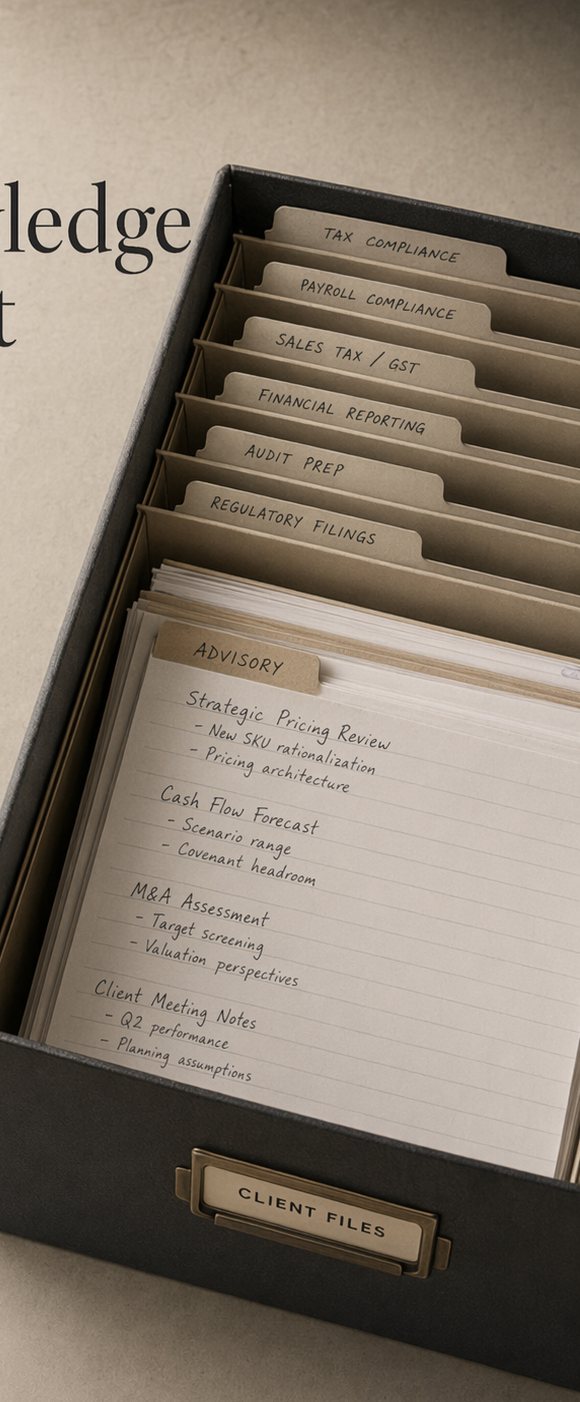
The practice is worth what your partners know
Compliance margins slipping. Advisory proposals losing on specificity. Three of your best partners five years from retirement. Three problems that look separate, but are one. A briefing for managing partners at mid-market accounting and CFO advisory firms.
You have seen this in your partner meeting
Every managing partner at a mid-sized accounting and CFO advisory firm in Europe has had the same Monday morning. Two client conversations last week. The compliance renewal for a 22-year client came back 12% below last year, because the client is quoting a technology-enabled shop. The advisory proposal for the same client's succession went to a fractional CFO boutique, because the junior partner who pitched could not speak to the owner's family dynamics the way your senior partner would have. Same client. Compliance margin down. Advisory revenue lost. And the senior partner whose knowledge would have won both is eighteen months from retirement.
You have done this job for twenty years. The pattern used to be simple. Build a book of clients who trust you. Bring in partners who will do the same. Keep the compliance base steady, grow advisory where the opportunity lands. The compliance base paid the rent. Advisory was the upside. The model worked for forty years.
Something changed in the last twenty-four months. Your compliance margins are sliding on every renewal. Your advisory proposals are losing to boutique competitors who arrive more specific than your junior partners can be. Your senior partners carry 60 years of combined client intelligence in their heads and a retirement list that is about to collect on most of it. The three things feel like three problems. They are one problem.
The compliance base is being automated. The advisory revenue that should replace it requires the client-specific knowledge your senior partners built over twenty years. That knowledge is about to walk out through retirement. Most managing partners are treating these as separate. The ones who see them as one are going to own the next decade of mid-market advisory.
This briefing covers what is happening in your industry, what it means for your partnership and your client book, and three questions your managing board should answer before the next partner meeting.
Mid-market accounting just lost the model that ran it for forty years
Your firm has carried a compliance base and an advisory layer for four decades. The compliance base (tax, statutory audit, routine advisory) paid for the partnership infrastructure. The advisory layer (CFO advisory, succession planning, M&A support) grew slowly and profitably on top. Every wave of change your industry absorbed in that time came from regulation, not from production economics. Your clients still needed the work done. You still charged by the hour or the file. The pricing model never broke.
AI does behave differently. The client still needs the tax return, the statutory accounts, the compliance filing. The scope of the work is unchanged. But the production time on that work compresses by forty to sixty percent once a firm is set up for it. Aspia, Forvis Mazars, and the PE-backed roll-up model are doing it today. Big 4 networks are doing it from the other end of the market. Fee compression on compliance renewals is now running at eight to twelve percent per cycle in most mid-market books, and the direction of travel is one way.
Your clients are already getting quotes from technology-enabled compliance shops for work your partners built the practice on. Your price is not being argued in your partner meeting. It is being set before your renewal letter goes out.
The squeeze is not only from below. Big 4 advisory arms, armed with AI, are now pricing transformation work that used to live safely in the mid-market at fees mid-market firms cannot match. On the side, a new category of client-side AI and fractional CFO firms is absorbing advisory work you used to win by default. Three directions of pressure. All landed in the last twenty-four months. The firms that read this as three problems are planning three responses. The firms that read this as one problem are making one move.
Your partners, your proposals, and your book are feeling it every day
Your senior partners. Three of your top five partners are within five years of retirement. Between them they carry the bulk of the client relationships that produce your advisory revenue. The knowledge they hold is 20 years of family dynamics, undocumented tax positions, owner risk appetite, and the reason a decision six years ago still matters today. You have never written it down. Neither have they. When they leave, the standard handover is a warm introduction to a junior partner and a hope the trust transfers. It almost never does.
Your advisory proposals. The proposals going to boutique fractional CFO shops are not losing on price. They are losing on specificity. The boutique writes two pages about the specific owner, the specific family situation, the specific three risks. Your firm writes six pages of capabilities and generic methodology. The owner picks the shorter one because it reads like the firm already knows them. Your partners have the knowledge to write the specific proposal. Your proposal process does not get it out of their heads in time.
Your compliance production. A senior partner spends 30 to 40 percent of their chargeable time reviewing compliance deliverables that AI could produce to a higher standard. That is your most valuable and scarcest capacity going into your lowest-value work. The firms pulling ahead are redeploying that time into advisory conversations with clients who are about to make succession decisions. The firms defending the old model are paying senior partners to do work AI does better.
Your junior partners and senior managers. The associates who used to serve the partner on production are finding AI has absorbed most of their work. The old bench model ran on associate hours. The new model cannot, because associates are cheaper and slower than AI at the production work. Junior partners need to be pulled into judgment work sooner, and senior managers need to be trained into client conversation rather than into file review. Your current pyramid and your 2030 pyramid are different shapes.
Your client book. Your top ten clients generate disproportionate firm revenue. You could name the partner who holds each relationship without a list. In a firm of 150 partners, that is 10 to 15 relationships carried by five to eight people. That is the concentration your equity value rests on. You have never had a way to make those relationships portable across partners. You do now, and you have to move before the retirements land.
The firms pulling ahead are running one move, not three
Your industry is compressing because AI takes production cost out of compliance. Your firm is compressing because advisory proposals are losing to boutiques and senior partner knowledge is about to retire. Same force, two altitudes. And there is a third thing happening that most managing partners have not named yet, which matters more than the other two.
You are not running a firm in transition. You are running an asset-management problem. Your firm holds two assets that produce revenue. Asset A is the compliance engine, deteriorating every renewal cycle under three directions of pressure. Asset B is the client-intelligence book built over twenty years, carried on three to five senior partners who are five years from the door. Asset A is being competed toward zero. Asset B is the only thing worth anything at partner transition, or at any external transition. And Asset B is currently on people, not held by the firm.
Every partner retirement over the next five years is an asset write-down your P&L does not see for twelve to eighteen months, when the client relationship fails to transfer and revenue migrates with the departed partner. The firms winning the 2030 position are extracting the knowledge that makes Asset B work, into firm-owned infrastructure every partner can query, before the senior partners leave. The firms losing are still hoping personal introduction does the work. The difference is operator judgment, not technology availability. Both firms have the same AI.
Your competitors who get this will carry their client intelligence on the firm by 2028, not on retiring partners. Their junior partners will write proposals more specific than a boutique fractional CFO can match. Their compliance margin will hold because senior partner time was redeployed into advisory, not cut. Three problems compounding into one capability. This is what the next eighteen to twenty-four months look like if you do not move.
You have eighteen to twenty-four months. The AI adoption debate is over. Your question now is whether the managing board acts on it, or waits until the first unplanned retirement proves the cost.
What most firms are doing. What the winners are doing instead.
Every managing partner has had the AI conversation by now. Most are making the same four decisions. A smaller group is making different ones. The difference is whether AI is being treated as a production tool to buy, or as the set of moves that reshape how the firm holds its clients.
| The default path | The winners' path |
|---|---|
| Treat AI as a compliance production toolRoll out compliance automation. Cut associate headcount where possible. Declare the AI programme done. | Redeploy senior partner time into advisoryAI handles production. Senior partner review time shifts to client conversations. Advisory mix grows, compliance margin holds. |
| Lose advisory proposals to boutique fractional CFO firmsWatch your generic advisory proposals lose on specificity. Blame the market. Quote lower on the next one. | Build proposal-specificity tools your partners actually useEvery proposal reads like the firm already knows the client. Win rate rises on specificity, not on fee. |
| Hope succession works through personal introductionIntroduce junior partner to senior partner's clients. Retire the senior partner. Watch accounts migrate twelve months later. | Extract senior partner knowledge while they are still thereCall notes, emails, advisory memos, tax history structured into firm-owned intelligence. Retirement becomes transferable. |
| Wait for the board to approve a transformation programmeDebate the scope. Commission the Big 4 assessment. Spend nine months before anything ships. | Start with three workshops and working tools your partners use the same weekNo IT project. No board approval needed to start. The capability shows up in the next client meeting. |
Same twenty-four months. Same technology. Opposite outcomes. The difference is the operator, not the AI.
Advisory mix. Partner time. Knowledge continuity.
Three questions every managing partner is tracking. None of them used to be the same question. They are now.
What share of our revenue is protected from automation?
Your compliance base is under three directions of pressure. Big 4 with AI from above. PE-backed roll-ups from below. Client AI tools from the side. Every renewal comes back lower. The firms that raised their advisory share to 45% are still holding margin. The ones that held compliance dominance are watching fees slide every quarter. This is the number your managing board should be tracking monthly.
Where are our senior partners actually spending their hours?
Thirty to forty percent of senior partner chargeable time goes to reviewing compliance deliverables AI could produce to a higher standard. That is your most scarce asset on the lowest-value work in the firm. The firms pulling ahead are redeploying that time into advisory conversations with clients approaching succession. The firms losing are paying senior partners to review files.
What happens when our best partners retire?
Three of your top five partners are five years from the door. Between them they carry the client relationships your equity value rests on. The handover model (warm introduction, hope the trust transfers) has almost never worked. 2026 is the first year the underlying knowledge becomes extractable from what partners already produce. Every retirement before you move is an asset write-down.
What the firms winning this play are actually doing
Four concrete moves any managing partner can start this quarter. Each addresses one lever. Together, they fuse the firm's commercial motion into one system.
Knowledge: extract what your best partners know, before they leave
Your senior partners will never write it down. The extraction runs against what they already produce: advisory memos, tax returns filed, client correspondence, call notes, board packs. Twenty years of content gets structured into firm-owned client intelligence any partner can query. Longest lead time, most urgent. A partner retiring in three years without this is an asset write-down. A partner retiring with this is a transferable relationship.
Advisory proposals: stop losing on specificity, not on fee
Your advisory proposals are losing to boutiques that write two specific pages where you write six generic. A proposal agent tuned to the firm's accumulated client intelligence and the firm's winning patterns drafts a first version in thirty minutes that is more specific than the boutique can match. The partner shapes. The junior executes. Win rate rises on specificity. Fee realisation holds.
Partner time: redeploy senior capacity from review to advisory
AI handles first-pass drafting of statutory accounts, tax returns, audit working papers. Senior partners review exceptions rather than line items. Production time per client drops forty to sixty percent. The scarce asset (senior partner judgment) redeploys into client advisory conversations where fees actually grow. This is the defensive and offensive lever at the same time.
Book health: catch client attrition before it shows in the number
Portfolio-level monitoring your firm has never had. Are we hearing from the client as often as we should? Has a regulatory change landed we have not flagged? Is a partner retirement showing up in a client's engagement pattern? This is early-warning on the only asset you cannot replace. Twelve months from now the firms with this see attrition six months before their P&L does.
The only firm that joins the partner room to the working tools
The managing partner in 2026 has four places to go for help. None of them does what we do.
The compliance technology vendors. Tax platforms and audit tools sell to the head of production. They cannot have the partner-level conversation about advisory mix and succession. Their economics require the firm stays on their platform. They build their asset, not yours.
The Big 4 advisory arms. They will write you a two-million-euro transformation deck. They cannot put a working proposal tool in your partners' hands in three weeks because their cost structure requires analyst hours. You can have their deck or their tool. Not both.
The PE-backed roll-ups as acquirers. The alternative on offer is selling the firm to someone with scale economics. That does not transform your practice. It ends it. It gives up on what the partnership was built to carry.
The fractional CFO shops and boutique competitors. These are not advisors you can hire. They are the competitors winning your advisory proposals today. Bringing them in is bringing in the threat.
The market offers four things you have already said no to. GRAIL is the fifth option.
- Senior advisory that speaks partner-room, not strategy-deck
- Working tools your partners use the same week
- Custom agents built on your clients, your advisory work
- The start of firm-owned client intelligence
- No vendor lock-in at any phase of the engagement
- Founded by operators who have built and run practices
- Business first, technology second
- Three weeks from first meeting to working tools
- Your firm keeps the tools. You own the IP
- Every next step earned by what just shipped
Three sessions with your managing board. Working tools from week one.
We start with the managing board because the change cannot outrun the partnership's personal understanding of what is possible. Three workshops. Each delivers standalone value. Each earns the right to the next.
How to think
Walk through what is happening in your industry and your firm. Build the first working tool in the room: a proposal-drafting agent trained on one of your real clients and one of your real advisory engagements. Your managing board leaves with a shared view of what to do and the first tool already in hand.
Your partners' tools
A half-day activation. Each member of your managing board leaves with five to ten working tools tuned to their clients, their advisory specialism, their proposal patterns. Client research. Proposal drafting. Advisory memo acceleration. Meeting prep. Tools your partners are using the same week, not slides about tools.
Ready to roll
Refined tools based on real use. The rollout plan to your wider partnership. The knowledge-extraction plan for your senior partners. The advisory-mix roadmap tied to renewals. And the managing board conversation with numbers your equity partners can check, not a deck they cannot argue with.
Three weeks. No IT project. No managing board approval needed to start. The tools your partners are using when we finish.
For your next managing board meeting
The questions where your managing board cannot agree on an answer are the ones worth an hour on the agenda. Ask these honestly.
Of the last ten advisory proposals you lost, how many went to firms that were more specific about the client, not cheaper? If you do not know, how would you find out?
What share of your revenue is protected from the three-directional squeeze on compliance, and how has that number moved over the last four years?
If your top three partners retired next year, what would happen to the clients they own? What have you actually transferred to the rest of the partnership in the last twelve months?
Where is your average senior partner spending their chargeable hours today, and where would they need to spend them to grow advisory mix by ten points in two years?
Which of your junior partners is already writing proposals the boutique fractional CFO shops cannot match? What would it take for that to be the firm default?
If any of these produces a disagreement in your managing board, that is the conversation worth having before the next retirement announcement.
Continue reading
Sources and limitations
This briefing draws on GRAIL's engagement experience with leadership teams and on public company disclosures. Figures are illustrative unless a source is named beside them. A sourced edition is in preparation.