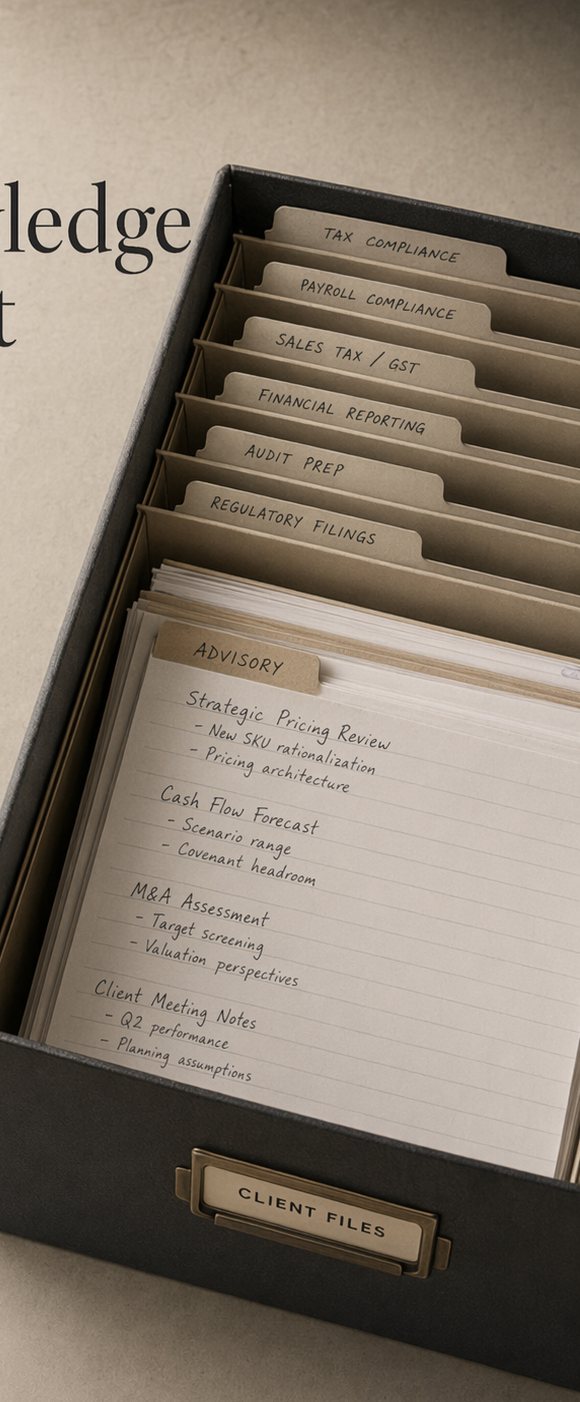
The Knowledge Walks Out
Your practice is worth what your best partners know. How much of that knowledge will still be in the firm in five years?
What changes for accounting and CFO advisory as AI enters its industry
Mid-market accounting firms are caught in a three-directional squeeze. From above, large networks are investing in AI to automate compliance at a scale and cost base that mid-market firms cannot match. From below, PE-backed roll-ups are offering commoditized compliance to your clients at structurally lower prices. From the side, fractional CFO services and client AI tools are reducing advisory demand for standard work.
The compliance revenue base that funded the partnership model for decades is structurally declining. The advisory revenue that should replace it requires client-specific knowledge accumulated over twenty years of personal relationships with owner-managed businesses. That knowledge lives in partner heads. And those partners are approaching retirement.
Most firms have no structured process for capturing what their senior partners know. The succession plan is "introduce the junior partner to our top clients and hope the relationship transfers." It rarely works. A twenty-year relationship built on trust, personal understanding of the owner's tax position, family succession dynamics, and undocumented history of decisions does not transfer through a handshake.
The firms that capture partner knowledge into institutional infrastructure before retirement have a practice worth multiples more at transition. The firms that do not lose both the compliance revenue to automation and the advisory capability to retirement. Both pillars fail at the same time.
This briefing examines what changes structurally for mid-market accounting and CFO advisory firms as AI accelerates the compliance-to-advisory migration, and what the managing partner can do about it before the next partner retirement makes the question academic.
Both pillars are failing at the same time
For thirty years, mid-market accounting firms operated a reliable model. Compliance work generated steady, recurring revenue. Partners built deep relationships with owner-managed businesses. Over time, those relationships expanded from compliance into advisory: tax planning, business valuations, succession support, CFO advisory. The compliance base funded the partnership. The advisory relationships generated the margin.
AI breaks both sides simultaneously. Standard compliance work is now automatable at scale. Tax preparation, statutory accounts, routine audit, regulatory filing, VAT calculations. Large networks and PE-backed roll-ups have the capital to invest in this automation. They are offering compliance at prices that mid-market firms cannot match without destroying their own margin structure.
The compliance revenue base that funded the partnership model is being automated away. The advisory capability that should replace it is about to retire. Both pillars are failing at the same time.
The advisory side faces a different but equally urgent problem. Deep advisory requires the kind of client-specific knowledge that takes decades to build: the owner's real financial position, the family dynamics around succession, the undocumented history of decisions taken and reasons behind them. That knowledge exists in partner heads. Most firms have three to five senior partners within five to seven years of retirement who carry the bulk of the firm's client intelligence. When they leave, the knowledge leaves with them.
Revenue. Profit. Valuation.
Under the old model these three questions had three different answers. AI ties them together. Capture the knowledge and you move all three at the same time.
What replaces compliance before retirement empties the bench?
Compliance revenue is being compressed from three directions. The revenue that funded the partnership model for thirty years is structurally declining. Advisory revenue should replace it, but advisory capacity is constrained by the number of partners with deep client knowledge. Every retirement without knowledge transfer shrinks the advisory bench.
Can margin survive the squeeze?
Compliance margins are compressed by scale competitors. Advisory margins of 30 to 45 percent remain strong but depend on partner knowledge. The profit question is whether the firm can maintain advisory margins while the partners who generate them retire. Knowledge that walks out takes the margin with it.
Does the practice survive a partner transition?
Practice value at succession depends on client retention. A firm where fifteen key relationships survive partner transitions is worth multiples more than one where they do not. Buyers price the risk. Personal knowledge in partner heads is a discount. Institutional knowledge in firm infrastructure is a premium.
Two columns. The whole industry sorts itself between them.
Every capability in accounting and CFO advisory is moving toward one of two columns. The depreciating column contains work that AI can replicate at scale. The appreciating column contains work that requires accumulated trust, judgment, and client-specific knowledge that no model can replicate. The managing partner's job is to move the firm's revenue center of gravity from the left column to the right.
- Tax return preparation and filing
- Statutory accounts production
- Routine audit procedures
- Standard financial analysis and benchmarking
- Regulatory compliance monitoring
- Report generation and formatting
- Complex tax structuring for owner-managed businesses
- Succession advisory across family and business
- The judgment on what the numbers actually mean
- Trust across a twenty-year client relationship
- Reading the owner's readiness for change
- Client-specific knowledge no competitor holds
The firms that thrive will be the ones that have systematically moved their revenue, their talent development, and their client conversations toward the right column. The firms that are still generating the majority of their revenue from the left column in three years will find that revenue has been taken by competitors with better technology and lower cost structures.
Two paths. Same technology. Opposite outcomes.
Every mid-market accounting firm faces the same fork. The default path feels safe because it preserves the current model. The repositioning path feels disruptive because it changes how the firm creates value. But the default path leads to structural decline while the repositioning path builds a practice that compounds.
| The default path | The repositioning path |
|---|---|
| Defend complianceInvest in technology to match network-scale automation. Compete on price against PE-backed platforms. | Release complianceUse AI to handle compliance production. Redeploy partner time toward advisory relationships. |
| Hope succession worksIntroduce junior partners to senior clients. Trust that the relationship transfers through personal chemistry. | Build succession infrastructureCapture partner knowledge through structured extraction. Make succession a capability transfer, not a personal gamble. |
| Advisory as add-onAdvisory stays compliance-adjacent: tax planning, statutory reporting interpretation, basic business planning. | Advisory as the coreMigrate to genuinely strategic advisory: succession planning, business model transformation, AI readiness for owner-managed businesses. |
| Knowledge stays personalClient intelligence lives in partner heads. Leaves when they leave. | Knowledge becomes institutionalClient intelligence captured in firm systems. Survives partner transitions. |
The difference between a practice worth selling and a practice worth closing is whether the client relationships survive the partners who built them.
The growth levers that compound when used together
None of these is transformative alone. Together, they rebuild the practice on foundations that survive partner transitions and create value that competitors cannot replicate by buying better technology.
Capture partner knowledge before retirement
Not through documentation. Partners will never write manuals. Through structured extraction: recorded client reviews, decision histories, relationship maps, pattern recognition sessions. The goal is to move client-specific intelligence from personal memory into institutional infrastructure while the partner is still available to contribute and validate.
Use AI to handle compliance production
Not to cut costs. To redeploy partner time. Every hour a senior partner spends on routine compliance is an hour not spent on advisory relationships. AI handles the production. The partner handles the judgment and the client conversation. The redeployment story, not the cost-cutting story.
Migrate the value proposition to strategic advisory
From compliance-adjacent advisory (tax planning, statutory interpretation) to genuinely strategic work: owner-managed business succession, AI readiness assessment, business model transformation. Work that requires the trust, judgment, and twenty-year client knowledge that no AI tool and no PE-backed platform can replicate.
Build succession as a capability transfer
Stop relying on personal introductions. Build the infrastructure that lets a junior partner walk into a client relationship with the full context: the tax position history, the succession dynamics, the owner's risk appetite, the undocumented decisions. The relationship still needs to be earned. But it starts from knowledge, not from zero.
Business first. Technology second.
GRAIL is an AI-native management consultancy. We help European mid-market leadership teams figure out the one or two things that fundamentally change about their business as AI enters their industry, and then build the capability to act on it before competitors do. For accounting and CFO advisory firms, the fundamental change is not compliance automation. It is the knowledge-capture window closing as senior partners approach retirement.
The market offers two things: vendor lock-in dressed as transformation, and consulting reports dressed as strategy. GRAIL delivers a third option: working AI capability that you own.
- Senior advisory direct to the CEO and GMT
- Working AI capability you own from day one
- Custom agents built around your business logic
- Outcomes in weeks, not quarters
- No lock-in at any phase of the engagement
- Founded by operators, not technologists
- Business-first strategy, technology second
- Context architecture, change management, workflow design
- Results before you commit to scale
- Each next step earned, never assumed
Three sessions with your management team. No IT involvement. Working tools from week one.
GRAIL starts with the management team because organizational transformation cannot outrun the leadership team's personal understanding of what is possible. Three workshops. Each delivers standalone value. Each earns the right to the next.
How to think
The strategic foundation. Where AI creates real value in accounting and CFO advisory and where it is noise. The augmentation framework. The knowledge-capture thesis. Your leadership team leaves with a shared frame for the rest of the work, and with the first working agent built live in the room.
Your AI team
A half-day activation. Each member of the management team receives a personal suite of five to ten custom agents trained on their workflow, their decisions, their competitive landscape. Client intelligence synthesis. Advisory preparation. Regulatory monitoring. Working tools from week one, not slides about tools.
Competitive edge
Refinement from real usage. Agents upgraded based on how the team actually used them. The knowledge-capture roadmap. The advisory repositioning plan. The recommendation for what comes next, earned by what just shipped.
Three weeks. No IT involvement. No board approval needed to start. The sharpest strategic conversation your leadership team will have this year, backed by working tools they are already using.
What to ask in your next leadership meeting
The questions where the room cannot agree on an answer are the ones worth a longer conversation. Ask these honestly. The point is not the polished response. The point is whether the answer would survive the retirement of the partner who carries your largest client relationship.
Of your top twenty client relationships, how many would survive a partner transition today without revenue loss?
What percentage of your revenue comes from compliance work that a PE-backed competitor could offer at half the price within two years?
If your three most senior partners retired this year, how much of the firm's client-specific knowledge would leave with them?
What advisory services does your firm offer today that require twenty years of client knowledge and cannot be replicated by a technology platform?
What is the difference in practice valuation between a firm where key client relationships survive partner transitions and one where they do not?
If any of these questions land somewhere uncomfortable, that is the conversation worth having.
Continue reading
Sources and limitations
This briefing draws on GRAIL's engagement experience with leadership teams and on public company disclosures. Figures are illustrative unless a source is named beside them. A sourced edition is in preparation.