The Efficiency Paradox
Your consultants just got forty percent more productive. Under hourly billing, that is not a growth story. It is a revenue problem. Three questions every IT consulting CEO needs an answer to before the next board meeting.
What changes for the IT consultancy as AI enters its industry
IT consulting built its revenue model on one assumption: that delivering technology projects requires many people billing many hours. AI coding assistants have made individual consultants forty to sixty percent more productive on exactly the work that generates the most billable hours. Under hourly pricing, that productivity gain is self-destructive. The firm gets faster. The invoice gets smaller.
Clients have noticed. They are benchmarking AI-efficient delivery times against proposals still scoped in pre-AI hours. The firms that cannot explain why the same project now costs less are losing deals to firms that have already repriced around outcomes. The ones still billing hourly are watching enterprise buyers demand the efficiency as a discount rather than paying for it as capability.
For the CEO of a mid-market IT consultancy, this is not a technology adoption question. It is a revenue question, a profit question, and a valuation question. Revenue, because the hourly billing engine that generated growth for two decades is now structurally deflating. Profit, because efficiency gains under hourly pricing compress margin rather than expand it. Valuation, because the market is repricing firms based on their pricing model, not their headcount.
The strategic move is not to adopt more AI tools. Every firm is doing that. The move is to reprice the delivery model before clients force the repricing on their terms. The firms that shift to outcome-based pricing capture the efficiency as margin. The firms that keep billing hourly hand it back as discounts. Same technology. Opposite financial outcomes.
This briefing is about what the pricing transformation looks like, and how a management team gets it done before the next major client renegotiation.
Productivity up forty percent. Revenue heading the other direction.
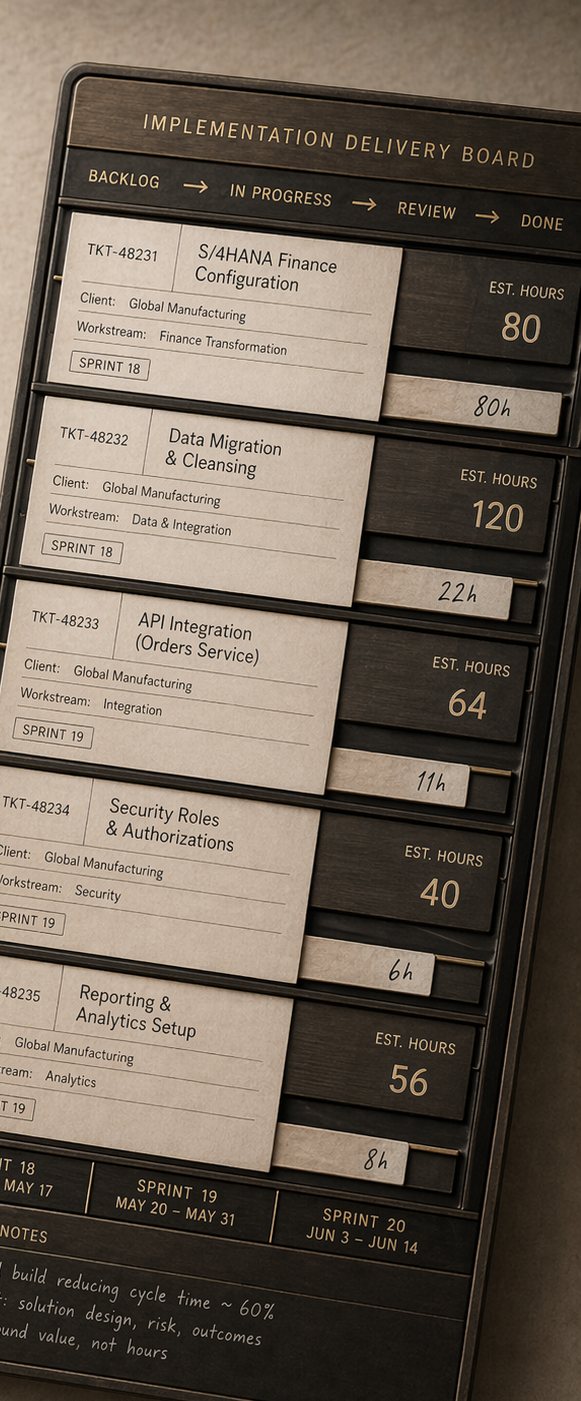
IT consulting priced its work on an implicit contract: clients pay for hours because hours are the best proxy for value delivered. AI has broken that proxy. A senior consultant with AI assistance now completes in three days what used to take a team of four a full week. The output is the same. The hours are not.
The public narrative celebrates this as an AI tailwind. More productive consultants. Happier clients. Better margins. The private reality is that under hourly billing, a forty percent productivity gain means forty percent fewer billable hours on the same scope. The firm that celebrated deploying AI coding assistants across its delivery teams is now watching revenue per project decline while its cost base stays flat.
The firm that reprices around outcomes captures AI efficiency as margin. The firm that keeps billing hourly watches clients demand the efficiency as discounts.
The structural problem compounds. Clients now have their own AI tools. Their internal teams can estimate how long AI-augmented delivery should take. When your proposal says 1,000 hours and their benchmark says 600, the negotiation is over before it starts. The firms that have already moved to fixed-price or outcome-based delivery avoid this conversation entirely. They sell the result, not the hours. The efficiency is theirs to keep.
Revenue. Profit. Valuation.
Under the old model these three questions had three different answers. AI ties them together. Move the pricing model and you move all three at the same time.
What happens to revenue when clients benchmark AI-efficient delivery?
Clients are comparing your proposals against AI-augmented timelines. A firm billing 1,000 hours on a project that AI benchmarks at 600 loses the deal or takes a thirty percent haircut. The revenue decline is not gradual. It arrives the quarter a major client renegotiates.
Does your efficiency gain reach the bottom line or the client's invoice?
Under hourly billing, every productivity improvement goes to the client as fewer hours. Under outcome pricing, efficiency gains stay with the firm as margin. A mid-market IT consultancy at twelve percent EBIT could reach eighteen percent by shifting thirty percent of revenue to fixed-price delivery. Same work. Different pricing. Different P&L.
How does the market price a firm still billing by the hour?
Investors and acquirers are repricing IT consulting firms based on revenue model, not revenue size. Time-based firms are growing at two percent. Value-based firms at nearly nine percent. The valuation gap between the two widens every quarter. The pricing model is the valuation signal.
Two columns. Every function in the firm sorts itself between them.
The pattern is consistent across every function in an IT consultancy. Code writing, testing, documentation, and standard project management are all compressing toward commodity. The work that appreciates is the work that depends on understanding the client's organization, navigating political dynamics, and making judgment calls that no model can replicate. Code is only fifteen to thirty percent of what IT consultants actually do. The rest is where value concentrates.
- Boilerplate code, unit tests, documentation
- Standard integrations and bug fixing
- Progress reporting and resource allocation
- Proposal drafting and pricing benchmarks
- Technology selection matrices and gap assessments
- System architecture for unprecedented requirements
- Understanding why legacy systems work the way they do
- Stakeholder conflict resolution and scope negotiation
- Reading political dynamics in procurement
- The conversation that changes a CTO's mind
Whichever column the management team trains the organization into over the next three years is the firm it becomes. The decision is not whether AI affects delivery. It is which side of the line the leadership deliberately moves the practice toward.
Two paths. Same technology. Opposite outcomes.
The financial logic of the choice in front of the management team is unforgiving in either direction. The same AI tools, deployed into the same firm, produce opposite outcomes depending on how the firm prices its work.
| The default path | The repositioning path |
|---|---|
| Deploy AI, keep billing hourlyConsultants get faster. Proposals shrink. Clients demand fewer hours. Revenue per project declines. | Deploy AI, reprice around outcomesSame efficiency. Sold as fixed-price delivery. Clients pay for results. Margin expands. |
| Compete on rate cardsClients benchmark your rates against offshore and AI-augmented alternatives. Race to the bottom. | Compete on proprietary capabilityBuild reusable IP from every engagement. The next project starts at eighty percent, not zero. |
| Let talent walk to AI-native firmsBest seniors leave for equity. Client relationships leave with them. Knowledge is not in any system. | Encode expertise into the delivery modelRelationship intelligence, domain patterns, delivery playbooks become firm assets, not personal assets. |
| Wait for clients to force the repricingThe renegotiation happens on their terms. Margin collapses overnight. | Lead the repricing before clients demand itSet the terms. Capture the efficiency. Earn the premium for being first. |
Same technology. Opposite outcomes. The difference is the pricing decision, not the AI decision.
The growth levers that compound when used together
Repricing is not a single decision. It is four levers, each available to the firm right now, that compound when pulled together. Used in isolation, any one produces a modest gain. Used together, they rebuild the commercial model on foundations that get stronger with every engagement.
Shift delivery pricing from hours to outcomes
Start with the practices where scope is most predictable. Fixed-price delivery on well-understood project types. Capture the AI efficiency gain as margin rather than passing it to clients as fewer hours. The firms already doing this report operating margins six or more points higher than hourly peers on comparable work.
Build proprietary assets from every engagement
Treat each delivery as an opportunity to create reusable IP. Accelerators, templates, domain-specific tooling, automated testing frameworks. The firm that accumulates proprietary capability through delivery starts every new project at eighty percent, not zero. The body shop starts at zero every time.
Encode relationship intelligence into firm infrastructure
Senior consultants carry client knowledge, political maps, and trust in their heads. When they leave, the client relationship degrades. Encode the reasoning: why this client buys, who the real decision-maker is, what the last three failed initiatives taught about the organization. Make it a firm asset, not a personal one.
Use DORA and NIS2 as the bridge revenue
Regulatory compliance creates real, high-value demand through 2026 and 2027. Use it as near-term revenue that funds the pricing transformation. The compliance work is finite, but the commercial model you build while doing it is permanent. Do not treat compliance as the strategy. Treat it as the funding mechanism for the strategy.
Business first. Technology second.
GRAIL is an AI-native management consultancy. We help European mid-market leadership teams figure out the one or two things that fundamentally change about their business as AI enters their industry, and then build the capability to act on it before competitors do. For IT consulting specifically, we sit in a position no other advisor can occupy. Technology vendors will sell you AI licenses. Strategy firms will write you a transformation deck. Neither can have the pricing model conversation without a conflict of interest. GRAIL can, because we have lived the billable-hour compression from the inside and rebuilt the commercial model around it.
The market offers two things: vendor lock-in dressed as transformation, and consulting reports dressed as strategy. GRAIL delivers a third option: working AI capability that you own.
- Senior advisory direct to the CEO and GMT
- Working AI capability you own from day one
- Custom agents built around your business logic
- Outcomes in weeks, not quarters
- No lock-in at any phase of the engagement
- Founded by operators, not technologists
- Business-first strategy, technology second
- Context architecture, change management, workflow design
- Results before you commit to scale
- Each next step earned, never assumed
Three sessions with your management team. No IT involvement. Working tools from week one.
GRAIL starts with the management team because organizational transformation cannot outrun the leadership team's personal understanding of what is possible. Three workshops. Each delivers standalone value. Each earns the right to the next.
How to think
The strategic foundation. Where AI creates real value in IT consulting and where it is noise. The augmentation framework. The pricing transformation thesis applied to your specific service mix. Your leadership team leaves with a shared frame for the rest of the work, and with the first working agent built live in the room.
Your AI team
A half-day activation. Each member of the management team receives a personal suite of five to ten custom agents trained on their workflow, their decisions, their competitive landscape. Proposal pricing simulator. Resource utilization optimizer. Client intelligence synthesizer. Working tools from week one, not slides about tools.
Competitive edge
Refinement from real usage. Agents upgraded based on how the team actually used them. The pricing transformation roadmap. Practice-level action plans for the shift to outcome-based delivery. The recommendation for what comes next, earned by what just shipped.
Three weeks. No IT involvement. No board approval needed to start. The sharpest strategic conversation your leadership team will have this year, backed by working tools they are already using.
What to ask in your next leadership meeting
The questions where the room cannot agree on an answer are the ones worth a longer conversation. Ask these honestly. The point is not the polished response. The point is whether the answer would survive contact with a major client three months from now.
If your three largest clients each demanded twenty-five percent fewer hours next quarter because they benchmarked AI-efficient delivery, what happens to your P&L?
What percentage of your revenue is priced on outcomes rather than hours, and what is the margin difference between the two?
If your five most senior consultants left tomorrow, how much client relationship intelligence walks out the door with them?
Which of your practices could shift to fixed-price delivery this quarter without increasing delivery risk, and what would the margin impact be?
When your next enterprise client asks why they should pay for 1,000 hours when their own AI tools say the work takes 600, what is your answer?
If any of these questions land somewhere uncomfortable, that is the conversation worth having.
Continue reading
Sources and limitations
This briefing draws on GRAIL's engagement experience with leadership teams and on public company disclosures. Figures are illustrative unless a source is named beside them. A sourced edition is in preparation.