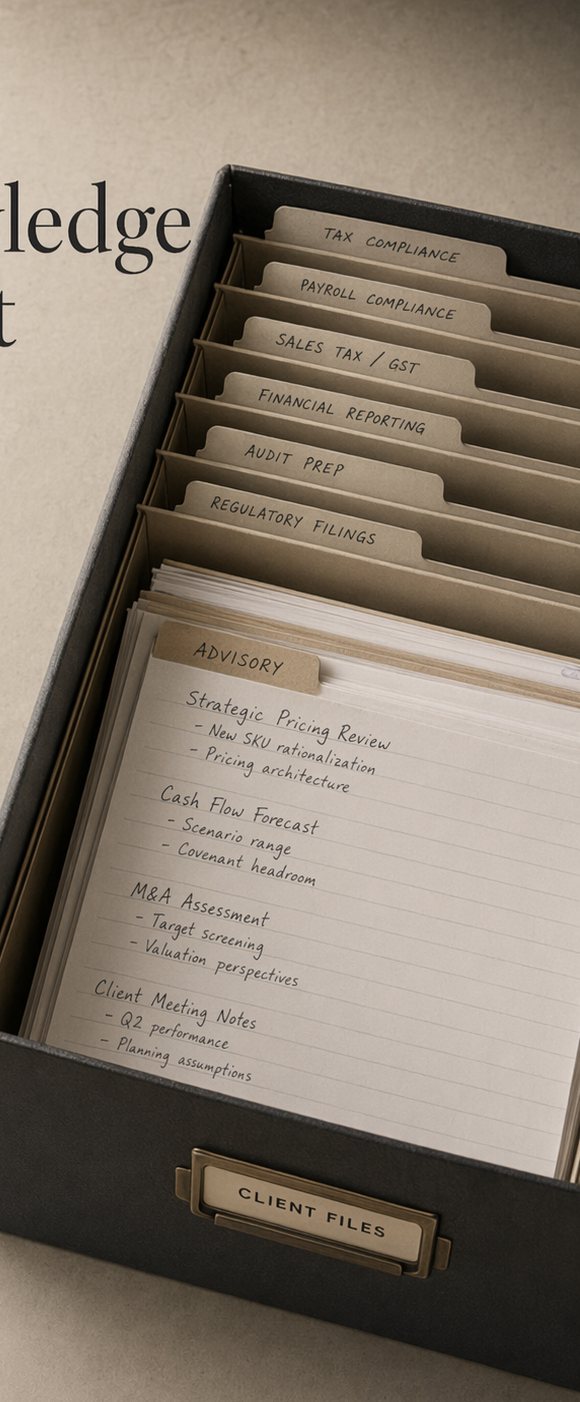
What's Changing in How You Serve
Your compliance margins are drifting. Your senior partners are three years from retirement. Your advisory pipeline depends on relationships no-one has institutionalised. Three problems that are actually one. A briefing for operations leaders at accounting and CFO advisory firms.
You have seen this on your service floor
Every Head of Operations or COO at a mid-market accounting and CFO advisory firm in Europe has had the same Monday morning. Forty-eight statutory accounts packages in the compliance queue, waiting for partner sign-off, three of the four signing partners at client sites. Maria, who has managed the Lindqvist family business account for twenty-two years, flagged Thursday afternoon as a "succession discussion." The two junior partners who were supposed to shadow her on Lindqvist advisory calls have been pulled to onboard a new PE-backed client. The compliance floor is humming. The advisory layer is four senior partners, two of them within three years of retirement, and none of their client-specific judgment is written down anywhere.
You have run this function for fifteen years. The pattern used to be simple. Hire qualified accountants. Let the senior partners build their clients. Hold the quality floor. Hit the compliance deadlines. The business was understandable.
Something changed. AI-enabled competitors are now producing the same compliance output at a fraction of your cost, and the PE-backed roll-ups are pricing accordingly. Your compliance margins are drifting. Your senior partners are approaching retirement on a predictable timeline, and the advisory relationships they carry have never been institutionalised. And your partner capacity is being consumed by preparation work that could run on infrastructure you have not built yet.
Most accounting COOs are treating these as three separate service delivery problems. The firms pulling ahead have seen they are one. The partner intelligence that makes your advisory valuable has never been separated from the people who carry it. Every margin problem, every succession risk, every stuck realisation rate is a symptom of that one unsolved thing.
This briefing covers what is happening in your sector, what it means inside your service operation, and the three questions your operations team should answer before the next management cycle.
The accounting sector just lost the equation that ran it for a generation
Every technology wave your sector absorbed in the last thirty years expanded the scope of what an accounting firm could bill for. Tax software expanded the number of returns a practice could handle. Digital document management expanded the scope of what compliance partners could serve. Regulatory complexity added layers of advisory that justified more partner hours. The billable-hour model worked because complexity kept growing and only qualified professionals could handle it.
AI does not behave the same way. The client still needs the statutory accounts, the VAT return, the compliance audit, the regulatory filing. The scope of the work is unchanged. But the routine production layer that used to absorb most of the compliance-floor hours can now be drafted in a fraction of the time by tools the client is already asking you about. Under hourly billing, faster production at the same rate means less revenue for the same mandate. The compliance rate card is sliding structurally for the first time in a generation.
PE-backed roll-ups are already producing compliant statutory accounts at a cost base your current production floor cannot match. By the time your compliance team finishes the VAT return, a competitor has already sent it.
The mid-market firm that has been "pivoting to advisory" for a decade now has a burning platform, not a strategy option. The three-directional squeeze is no longer theoretical. Large networks with AI investment capacity are compressing margins from above. PE-backed roll-ups are undercutting compliance fees from below. Client AI tools are reducing demand for standard advisory work from the side. The mid-market firm that has not migrated revenue toward deep, trust-based advisory is being squeezed from all three directions simultaneously. And the advisory revenue that should replace compliance requires the client-specific knowledge that senior partners accumulated over twenty-year relationships. That knowledge is about to walk out through retirement.
Your compliance floor, your advisory layer, and your partner bench are all feeling it
Your compliance production floor. The compliance queue holds. Quality standards are met. Deadlines are hit. But the margin on each statutory accounts package, VAT return, and routine audit mandate is drifting three to five points a year against what it was in 2021. The production workflow was designed for a team producing at human speed, and the billing model was built around that cost structure. AI-enabled competitors have redesigned their production floor. Yours has not moved in a decade.
Your advisory delivery. Advisory engagements still produce healthy margins. But the pipeline depends entirely on senior partners who originate, structure, and deliver the work. Your advisory service relies on a handful of people who cannot be easily replaced. The engagement quality, the client relationship, and the firm's advisory reputation all sit in the same four or five individuals. When one of them is unavailable, the advisory floor stalls. When one retires, a client relationship goes to tender.
Your partner bench. Your senior partners bill at premium rates. On a standard billable week, thirty to forty percent of their time goes into preparation for client meetings, regulatory research, internal coordination, and review of work produced by the compliance floor. That preparation runs at senior-partner economics and produces no direct advisory value. Your most expensive resource is spending a third of its week on work that could run on infrastructure the firm has not built.
Your senior partners. Your three to six most senior partners each carry two to four long-running client relationships. Those relationships were built on fifteen to twenty-five years of client-specific judgment: the owner-manager's real financial position, the family succession dynamics, the regulatory history, the decisions taken in difficult years. That judgment has never been written down. When one of them retires, industry experience is that one of those client relationships goes to tender within eighteen months. You already know which retirement conversations are on the calendar.
Your client continuity. The advisory revenue attached to your top ten senior partner relationships is your firm's equity value. The difference between a clean succession on those relationships and a contested one is the difference between selling a practice and closing one. Your current succession plan is "introduce the junior partner to our top clients and hope the relationship transfers." That plan has a 40% failure rate in professional services. You know it and so does your Managing Partner.
The firms pulling ahead are building one piece of infrastructure
Your compliance floor is being squeezed because AI reduces the cost of producing what you bill hours for. Your advisory layer depends on people who are approaching retirement on a predictable timeline. Your partner capacity is being consumed by preparation work that could run on infrastructure you have not built. Most accounting COOs are treating these as three separate problems. They are one.
The partner intelligence that makes your advisory valuable has never been separated from the people who carry it. Every compliance margin problem, every succession risk, every stuck realisation rate is a symptom of that single unsolved thing. When a senior partner spends four hours preparing for a complex owner-manager advisory meeting, the firm is paying senior-partner rates for work that could run on infrastructure. When that partner retires without transferring their client reasoning into the firm, the advisory equity walks out with them. When the compliance floor runs on a cost structure designed for human production speeds, the margin erodes against competitors who redesigned first.
Look at the firms pulling ahead. Compliance production, advisory quality, and partner continuity are not three programmes. They are one piece of infrastructure. Every engagement makes it smarter. The senior partner who retires adds to it on the way out. The junior partner learns by working inside it. The client relationship holds because it lives in it. The same infrastructure that protects compliance margin protects advisory continuity and frees partner capacity.
You can tell which camp a firm is in from a single question. Can you point to one thing in your firm that is measurably better at serving clients this quarter than last quarter? Most mid-market accounting firms cannot. The ones that can have already made the shift, and they are already winning mandates you thought were yours.
You have eighteen to twenty-four months. The automation of compliance production is not a debate; it is already your competitors' cost structure. Your question now is whether you build the infrastructure your firm's advisory practice runs on for the next decade, or wait until the retirements land and the Managing Partner brings in a vendor who builds one that belongs to someone else.
What most firms are doing. What the winners are doing instead.
Every accounting COO has had the AI conversation. Most are making the same four decisions. A smaller group is making different ones. The difference is architecture, not tooling.
| The default path | The winners' path |
|---|---|
| Defend compliance margins by pushing utilisationSame production workflow, harder targets. Margins drift as AI-enabled competitors price below your cost floor. | Redesign production around what AI now doesCompliance staff handle exception review and client communication. Production cost drops. Margin recovers on mandates that stay. |
| Treat partner retirement as a people problemIntroduce the junior partner, run a mentoring programme, hope the relationship transfers. Lose one in three major retainers at each retirement. | Extract partner intelligence from daily work artefactsCapture from reports, meeting notes, and correspondence. Not documentation sprints. The next partner inherits the relationship, not just the name. |
| Deploy AI tools on top of the existing service modelEvery partner gets a copilot. Individual productivity rises. Advisory pipeline does not grow because partner capacity is still consumed by preparation. | Free partner capacity by rebuilding preparation infrastructureAdvisory preparation runs on agents the firm controls. Partners arrive better prepared in 20% of the time. Same fee income, more advisory relationships. |
| Avoid the junior pathway conversationNew accountants start on compliance production work. AI takes that work. No training ground. Senior bench thins at the worst moment. | Rebuild junior entry around advisory judgment from year oneNew accountants pair with agents and the firm's client intelligence from day one. Five-year curve to advisory competence compresses to two. |
Same firm. Same twelve months. Opposite outcomes. The difference is the architecture, not the tools.
Engagement Margin. Advisory Continuity. Partner Capacity.
Three questions every accounting COO is tracking. None of them used to be the same question. They are now.
Why is our margin drifting on compliance work the rate card says should hold?
The rate card has not moved. Compliance volumes are stable. But realisation on statutory accounts, VAT preparation, and routine audit is down three to five points against two years ago, and the client who pushed back most recently cited a competitor running the same work for significantly less. The production floor has not been redesigned since 2019. The competitors who have redesigned it are already at a cost base yours cannot match.
What happens to our advisory revenue when our senior partners retire?
Three to six of your most senior partners are within five years of retirement. Each one carries client-specific judgment that took twenty years to build and has never been captured anywhere. The advisory quality holds because they are in the meeting. When they leave, the client relationship the firm thought it owned goes to tender within eighteen months. You already know which conversations are on the calendar. The question is whether you act before or after the first one.
How much of each partner's week is going into work that should not need them?
A typical senior partner spends 30-40% of their billable week on preparation work, compliance review, internal coordination, and administrative load that carries no direct client advisory value. That preparation runs at senior-partner economics. The firm that frees that time does not need to hire more senior partners. The equivalent of two additional partners appears in the capacity already employed, once the preparation infrastructure is built.
What the firms winning this play are actually doing
Four concrete moves any accounting COO can start this quarter. Each touches one part of the service operation. Pulled together, they become one architecture the firm runs on.
Compliance floor: redesign production around what AI now does, so your accountants focus on judgment work
AI handles the drafting tier: statutory accounts preparation, VAT calculation, tax return first pass, regulatory filing review. Your qualified accountants move to exception review, client communication, and quality sign-off. The cost base changes. The margin recovers. The COO who maps the task split owns the next version of the compliance floor.
Advisory delivery: extract senior partner judgment from artefacts they already produce, not documentation projects
Documentation sprints fail in accounting firms. Partners will not write manuals. Extract from what already exists: advisory reports, tax structuring notes, client correspondence, meeting summaries. The firm captures reasoning patterns as a side-effect of paid work. The senior partner is not asked to explain themselves. When they retire, the next partner inherits the intelligence, not just the phone number.
Partner bench: free partner preparation time with advisory research infrastructure the firm controls
For every client meeting a senior partner walks into, preparation work can now run on custom agents: regulatory landscape, comparable transactions, owner-manager scenario modeling. The partner arrives better prepared in 20% of the time. That freed time translates directly to more advisory capacity. The equivalent of hiring a fifth senior partner appears in the capacity already employed.
Client continuity: build each major client relationship as a firm asset, not a personal one
Every major client retainer should accumulate intelligence: engagement history, regulatory positions, succession dynamics, the unwritten rules of the relationship. When the partner who built it retires, the next partner inherits the asset. Clean succession on a major retainer requires eighteen months of deliberate transfer. The COO who starts that transfer three years before retirement is the one whose firm does not lose the retainer.
The only firm that joins service-floor advisory to working infrastructure
The accounting COO has four places to go for help. None of them can do what we do.
The big consulting firms' operations practices will sell a €400K to €1.5M diagnostic billing analyst hours. They produce transition roadmaps. They cannot put working partner-intelligence infrastructure into a senior partner's workflow in eight weeks. Their revenue model is built on the billable-hour structure your problem is about.
Knowledge-management and document platforms will sell an eighteen-month document repository with metadata tagging. They treat your partner's judgment as a document to file. Every accounting firm has watched that purchase fail. The knowledge is not in the documents; it is in how the partner reads them.
Accounting-technology vendors will sell an AI module on their compliance platform. They are the layer commoditising your production floor. Buying more accelerates the margin pressure. They have no answer for advisory continuity.
Your internal IT function will automate billing workflows or build a compliance dashboard. IT does not sit close enough to how senior partners reason through complex owner-manager situations to extract that judgment.
The market offers four things you have already said no to. GRAIL is the fifth option.
- Senior advisory that speaks service-floor, not operating-model deck
- Working infrastructure your partners use the same week
- Custom agents built on your client files, your mandates, your domain
- The start of a client intelligence base your senior partners feed into
- No vendor lock-in at any phase of the engagement
- Built by practitioners who have run professional-services operations
- Business first, technology second
- Three weeks from first meeting to working infrastructure
- Your firm keeps the infrastructure, you own the IP
- Every next step earned by what just shipped, never assumed
Three sessions with your service leadership. Working infrastructure from week one.
We start with your service leadership team because the change cannot outrun the team's personal understanding of what is possible. Three workshops. Each delivers standalone value. Each earns the right to the next.
How to think
Walk through what is happening in your sector and inside your service operation. Build the first piece of infrastructure in the room: a client-specific agent for one of your real advisory retainers, extracted from the engagement archive you already have. Your operations team leaves with a shared view of what to do next and the first piece of working infrastructure already in their hands.
Your service infrastructure
A half-day build. Your Head of Tax, Head of Audit, Head of Advisory, and Head of Operations each leave with five to ten pieces of working infrastructure tuned to their function. Compliance production workflows. Partner preparation agents. Client intelligence capture. Advisory research agents. Succession transfer tools. Infrastructure your teams are using the same week, not decks about infrastructure.
Ready to run
Refined infrastructure based on real use. The rollout plan to your wider service organisation. The partner intelligence extraction plan for your senior partners. The junior pathway plan for your newly qualified accountants. And the Managing Partner conversation with numbers they can check: advisory revenue per senior partner, compliance margin by mandate type, retention exposure by client relationship.
Three weeks. No IT project. No board approval needed to start. The infrastructure your service operation is already running on when we finish.
For your next service review
The questions where your operations team cannot agree on an answer are the ones worth an hour on the agenda. Ask these honestly.
Of the last five compliance mandates where realisation came in below plan, how many lost ground because a client questioned the fee against AI-based alternatives? If you do not know, how would you find out?
What is the actual preparation burden on your senior partners? What percentage of their week is going into compliance review, internal coordination, and administrative work that carries no direct advisory value? What would it take to cut that in half without losing quality?
If your three most senior partners retired next year, what would happen to the clients they carry? What have you actually transferred to the rest of the advisory bench in the last twelve months?
Can you point to one thing in your firm that is measurably better at serving clients this quarter than last quarter? If not, what are the next four quarters going to add up to?
Which of your junior accountants is already working the way your advisory bench will need to work by 2028? What would it take for that to be the default across your service organisation?
If any of these produces a disagreement in your operations team, that is the conversation worth having before the Managing Partner asks.
Continue reading
Sources and limitations
This briefing draws on GRAIL's engagement experience with leadership teams and on public company disclosures. Figures are illustrative unless a source is named beside them. A sourced edition is in preparation.