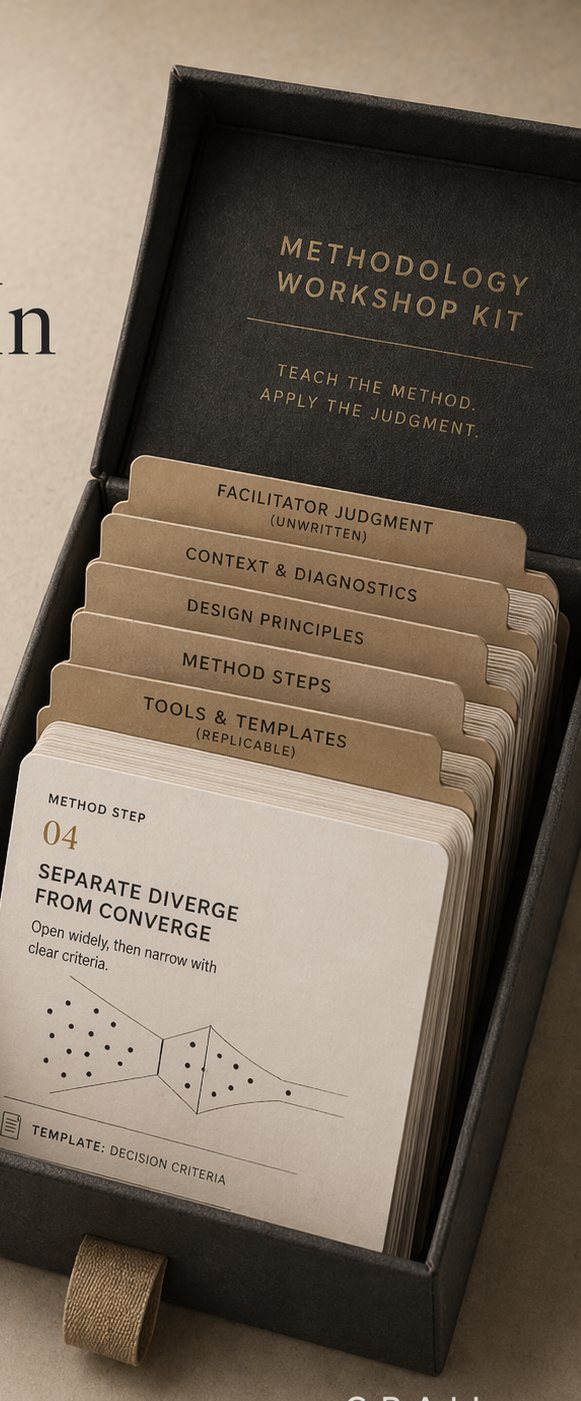
The Moat Is Filling In
Your methodology took 20 years to build. AI produces a comparable version in 20 weeks. The question is whether you protect the framework or move to the judgment layer above it.
What changes for the specialist methodology firm as AI enters its industry
Specialist methodology firms compete on proprietary frameworks developed over 10 to 25 years. Revenue comes from deploying the methodology, training practitioners, and licensing the framework. The commercial moat rests on two pillars: the methodology is genuinely better than alternatives, and accessing it requires engaging the firm.
AI is attacking both pillars simultaneously. It compresses the time required to develop comparable frameworks from decades to weeks. And it makes tacit methodology knowledge explicit and accessible without the firm present. The dependency relationship that justified premium fees is weakening at the same rate the methodology itself becomes replicable.
The certification and training revenue that scales these firms is the most AI-vulnerable layer of the business. The content is structured, codified, and designed for transfer. Every characteristic that made it scalable now makes it commoditizable.
The value is not disappearing. It is migrating from methodology delivery to the judgment layer above it: knowing when the standard approach is wrong, diagnosing which problem the client actually has, synthesizing across frameworks, adapting methodology in real-time to complex contexts. The firms that move to this layer and price it explicitly capture the advisory premium. The ones defending the methodology layer are running a race where the finish line is commoditization.
This briefing maps where the value is moving, what the financial consequences look like for firms that move early versus late, and what it takes to rebuild the moat on higher ground.
From methodology delivery to judgment delivery
For 20 years the methodology firm's competitive position rested on a simple logic: the framework was hard to build, hard to learn, and hard to deploy without trained practitioners. Clients paid for access to all three.
AI collapses the first two. Foundation models have ingested enough structured knowledge that a well-prompted system can produce an 80% comparable version of most proprietary frameworks. Not a perfect copy. But good enough that clients start questioning whether the remaining 20% justifies the engagement fee.
The third pillar, deployment expertise, is splitting in two. Standard deployment (following the playbook, running the assessment, facilitating the workshop from script) is increasingly AI-replicable. Complex deployment (diagnosing the real problem, knowing when to deviate from the standard approach, adapting in real-time) is not.
The methodology was designed to be teachable. That is precisely what makes it AI-learnable. The judgment that sits above it was never written down. That is what makes it defensible.
The financial proof is already visible. Listed methodology firms are showing margin compression despite growing markets. The market is paying less for packaged methodology and more for senior strategic judgment. This is not a temporary pricing adjustment. It is a structural migration in where clients see value. The firms that recognize this and reprice around judgment capture the advisory premium. The firms that defend methodology-rate pricing watch margins narrow until the business model breaks.
Revenue. Profit. Valuation.
Under the old model these three questions had three different answers. AI ties them together. Move the revenue mix and you move all three at the same time.
Where does the next 30% of revenue come from?
Standard methodology deployment faces pricing pressure as clients access comparable frameworks independently. Advisory revenue, complex diagnosis, and cross-framework synthesis grow. The revenue question is whether the firm reprices around judgment before deployment revenue erodes.
Why are margins compressing in a growing market?
Adding certification layers and methodology content increases cost without increasing the price the market will pay. The defensive investment deepens as the moat fills in. Repricing around judgment reverses the margin trend because judgment commands a premium the market still values.
What is the firm worth if the moat is replicable?
A moat built on codified expertise AI can replicate is a discount. A moat built on institutional judgment, captured tacit knowledge, and practitioner networks is a premium. The same firm, same revenue, different valuation depending on where the defensibility sits.
Two columns. The whole industry sorts itself between them.
Every function inside a methodology firm contains work that AI handles well and work that AI cannot touch. The line is not between roles. It is between the production layer (structured, repeatable, codified) and the judgment layer (contextual, adaptive, experiential). The firms that sort deliberately capture the premium. The ones that sort by accident lose their best people to firms that did.
- Standard framework application from script
- Certification content delivery
- Assessment tool administration
- Best-practice benchmarking
- Workshop facilitation from playbook
- Case study compilation and documentation
- Diagnosing which problem the client actually has
- Knowing when the standard approach is wrong
- Cross-methodology synthesis for complex contexts
- Building genuine practitioner judgment
- Original insight and methodology innovation
- The uncomfortable diagnosis nobody else will give
The pattern is consistent across every methodology firm we analyze. The production layer depreciates. The judgment layer appreciates. The gap between them widens every quarter. The question is which side of the gap the firm's revenue model sits on.
Two paths. Same technology. Opposite outcomes.
Every methodology firm faces the same fork. One path protects the methodology. The other path moves above it. Both use AI. They produce opposite results over 18 months.
| The default path | The repositioning path |
|---|---|
| Defend the frameworkAdd more content, more certification layers, more "next-generation" methodology | Move to judgmentPrice the diagnostic, the synthesis, the adaptive expertise explicitly |
| AI-enhance the methodologyBadge the existing framework as "AI-powered" without changing the value proposition | AI-handle standard deliveryFree senior practitioners for complex work that commands the advisory premium |
| Protect certification revenueAdd layers to preserve the training model as structured content becomes AI-accessible | Capture tacit knowledgeSystematically encode the decision rules that experienced practitioners use but never document |
| Compete on methodology depthDeeper framework, more tools, more proprietary content | Compete on judgment qualityThe firm that gives the uncomfortable diagnosis and gets it right becomes irreplaceable |
The default path feels like investment. It is deepening commitment to a moat that is filling in. The repositioning path feels like letting go. It is moving to higher ground before the water rises.
The growth levers that compound when used together
Each lever is modest in isolation. Together, they rebuild the moat on foundations AI cannot replicate. The compounding effect is the point: the firm that pulls all four creates separation that takes competitors 18 or more months to close.
Move from methodology delivery to judgment delivery
Stop selling the framework and start selling the thinking that sits above it. Strategic diagnosis, cross-methodology synthesis, adaptive application in complex contexts. Price the judgment explicitly. The market already values it more than deployment. The pricing model needs to follow.
Use AI to handle standard methodology deployment
Standard framework application, assessment delivery, workshop facilitation from script. Let AI handle the production layer so senior practitioners spend their time on genuinely complex work. The same pattern every professional services firm is navigating: AI handles production, humans handle judgment.
Systematically capture the tacit knowledge above the written methodology
The decision rules that experienced practitioners use but never document. When to deviate from the standard approach. What signals to read in a client situation. Which framework variant fits which context. This is the institutional knowledge that makes the firm's judgment defensible even when the methodology itself is replicable.
Reprice the firm around the advisory layer AI cannot reach
Methodology-rate pricing compresses as the methodology becomes commoditized. Judgment-rate pricing appreciates as the judgment becomes scarcer and more valuable. The pricing transformation from methodology-rate to judgment-rate reverses the margin compression that listed firms are already showing in their financials.
Business first. Technology second.
GRAIL is an AI-native management consultancy. We help European mid-market leadership teams figure out the one or two things that fundamentally change about their business as AI enters their industry, and then build the capability to act on it before competitors do. For specialist methodology firms, the shift is unusually personal. The methodology is the founder's life work. GRAIL understands IP-leverage professional services business models and what it takes to move from methodology delivery to judgment delivery without losing the identity that built the firm.
The market offers two things: vendor lock-in dressed as transformation, and consulting reports dressed as strategy. GRAIL delivers a third option: working AI capability that you own.
- Senior advisory direct to the CEO and GMT
- Working AI capability you own from day one
- Custom agents built around your business logic
- Outcomes in weeks, not quarters
- No lock-in at any phase of the engagement
- Founded by operators, not technologists
- Business-first strategy, technology second
- Context architecture, change management, workflow design
- Results before you commit to scale
- Each next step earned, never assumed
Three sessions with your management team. No IT involvement. Working tools from week one.
GRAIL starts with the management team because organizational transformation cannot outrun the leadership team's personal understanding of what is possible. Three workshops. Each delivers standalone value. Each earns the right to the next.
How to think
The strategic foundation. Where AI creates real value in specialist methodology firms and where it is noise. The augmentation framework. The pricing transformation thesis. Your leadership team leaves with a shared frame for the rest of the work, and with the first working agent built live in the room.
Your AI team
A half-day activation. Each member of the management team receives a personal suite of five to ten custom agents trained on their workflow, their decisions, their competitive landscape. Client diagnostics. Cross-framework synthesis. Proposal generation that emphasizes judgment, not methodology. Working tools from week one, not slides about tools.
Competitive edge
Refinement from real usage. Agents upgraded based on how the team actually used them. The pricing transformation roadmap. The tacit knowledge capture plan. The recommendation for what comes next, earned by what just shipped.
Three weeks. No IT involvement. No board approval needed to start. The sharpest strategic conversation your leadership team will have this year, backed by working tools they are already using.
What to ask in your next partner meeting
The questions where the room cannot agree on an answer are the ones worth a longer conversation. Ask these honestly. The point is not the polished response. The point is whether the answer would survive a client asking why they need your firm when AI can deliver the framework.
What percentage of our revenue comes from methodology deployment that a well-prompted AI could replicate at 80% quality today?
If our three most experienced practitioners left tomorrow, how much of what makes our firm genuinely better than the written methodology would walk out with them?
When was the last time we gave a client the uncomfortable diagnosis that contradicted our own methodology's standard recommendation?
Are we pricing for the methodology or for the judgment? And does the client understand which one they are buying?
If a competitor launched an AI-powered version of a comparable framework next quarter, which of our clients would stay and why?
If any of these questions land somewhere uncomfortable, that is the conversation worth having.
Continue reading
Sources and limitations
This briefing draws on GRAIL's engagement experience with leadership teams and on public company disclosures. Figures are illustrative unless a source is named beside them. A sourced edition is in preparation.