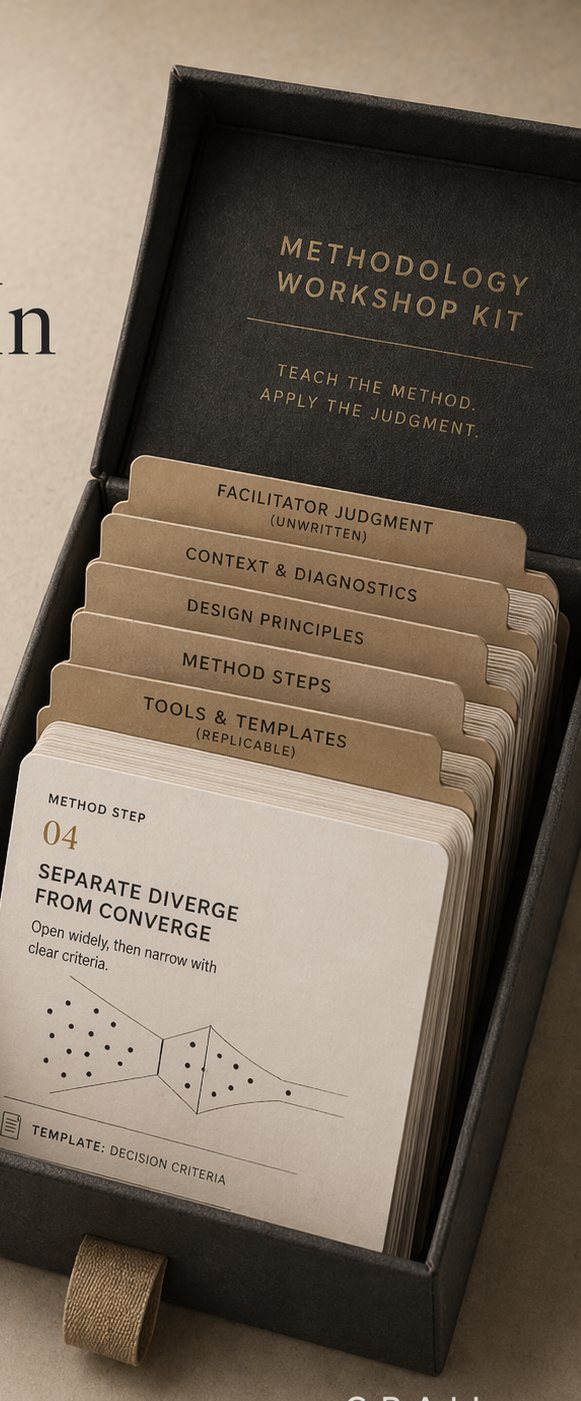
Your methodology is your platform, not your product
Your advisory premium. Your practitioner leverage. Your renewal and expansion. Three numbers every methodology-firm commercial director tracks. In 2026 they stop being separate. A briefing for commercial leaders at mid-market specialist methodology firms.
You have already felt this on Monday morning
Every commercial director at a mid-market European methodology firm has had the same week. Your head of certification reported Q1 seat counts down 8% year-over-year. A long-time client, the one who put three cohorts through your master-trainer programme and used to renew the methodology refresh every two years, emailed Friday asking for a 60-day engagement at €85K. She mentioned her L&D team built an internal facilitator group on your framework. A competing firm announced an AI-enhanced version of a comparable methodology last Tuesday. Your founder-CEO forwarded you a Forbes piece about a boutique whose revenue per practitioner doubled after it repositioned to senior diagnostic advisory. The email subject line was "Are we missing something?"
You have done this job for fifteen years. The pattern used to be simple. Build a great methodology. Train practitioners to deploy it. Certify client teams so they come back for the next wave. Margin ran 25 to 35 percent where methodology leverage was high. The moat was that the methodology was genuinely better than alternatives, and accessing it required engaging your firm. Both pillars held for decades.
Something changed. Your deployment margin is softening. Your certification seats are plateauing. Your best senior practitioners are booked months out on the judgment work, where margins are twice what deployment carries. A listed methodology firm you know saw EBITA margin slide from 13 percent to 10.2 percent in one year on a growing market. That number is already printing in your own financials, quarter by quarter.
Every methodology-firm commercial director is living one industry shift and one firm shift at the same time. Most are treating them as two. The ones who see them as one will own the next decade.
This briefing covers what is happening in your industry, what it means for your deployment team and your senior practitioners, and the three questions your leadership team should answer before the next board meeting.
Methodology firms just lost the economics that ran them for thirty years
Every specialist methodology firm you know runs on the same arithmetic. The founder built the framework over ten to twenty-five years. Practitioners learned the methodology and deployed it with clients. Clients paid for deployment engagements, sent their people through certification, and came back for the next wave. The moat had two pillars. The methodology was better than alternatives, and accessing it required engaging your firm. Lean, Kaizen, change management, operational excellence, pricing advisory, leadership development, quality management. Different frameworks, one economic model. For thirty years the model worked because codified methodology was scarce and practitioner-delivered deployment was the way clients got to it.
AI changed both pillars at once. Methodology is codified expertise. It is already partly explicit by design. AI learns, structures, and recombines codified frameworks faster than any other form of competitive advantage. What took twenty years to refine, AI can produce a comparable version of in weeks. At the same time, clients accessing these frameworks through the AI tools they already have can do the first pass of deployment without your firm present. The dependency relationship that justified premium fees is loosening. A listed methodology firm you know reported EBITA margin compression from 13 percent to 10.2 percent in one year on a growing market. Revenue down four percent nominally. Organic growth negative one percent. That is the value migration showing up in audited numbers.
The methodology that took twenty years to build is being repositioned underneath a judgment service. The firms that move to the judgment layer above the methodology capture the advisory premium. The ones defending the deployment rate watch margins compress.
The market is paying less for packaged methodology deployment and more for the judgment that sits above it. The firms pulling ahead are not the ones adding more certification content or more "AI-enhanced" framework versions. They are the ones who repositioned their methodology as the platform underneath a senior judgment service. The deployment work still runs, but at a different price and with different tooling. The judgment engagements carry double the margin. The firms that made this move in 2024 and 2025 are already quoting the new shape to their boards. The ones defending the old shape are the ones whose margin lines are compressing.
Your pitches, your certifications, your renewals, and your senior practitioners
Your deployment pitches. Your proposal team walks into pitch conversations where the client has already briefed an AI on the framework, read three vendor responses, and drafted their own implementation outline. The client is no longer asking what the methodology is. They are asking why they should pay your deployment rate when they could run a first pass internally. The firms who send a senior practitioner to run the diagnostic upstream close at the judgment rate. The firms who send a standard pitch for deployment fee negotiate the deployment rate down.
Your certification programme. Seat counts are the canary. Every methodology firm built a scaling engine on certification revenue and train-the-trainer programmes. It is the most codified layer of your IP, which is exactly what AI replicates most easily. Clients who used to send ten practitioners through certification are now sending three and running the rest through internal programmes built on your framework. The firms redesigning certification around client-deployed agent tooling, where participants learn to run the methodology with their own AI ensemble, are seeing renewal rates climb. The firms holding the standard curriculum are watching seats slip.
Your renewal and expansion conversations. 60 to 70 percent of your profitable revenue comes from existing clients renewing and expanding. The dependency relationship that drove renewal for thirty years is weakening. Clients who went through two deployments now have practitioners who can run the framework. The question at renewal shifts from "which wave do we run next" to "what do we buy that we cannot build ourselves." Most renewals are answered by adding more methodology content. The answer the client actually wants is senior judgment on a problem the framework has not encountered before.
Your senior practitioners. The ones clients ask for by name. The ones booked six months out on diagnostic and advisory engagements where margins are twice what deployment carries. They are the firm's most valuable asset and the one your commercial engine has not yet repriced around. The judgment rate is 5 to 10 times the deployment rate. Your senior practitioners are already doing the work. Your commercial motion is still selling it at the methodology-deployment price.
The winners are already running the methodology as the platform underneath a judgment service
Your industry is compressing because AI takes hours out of deployment work and makes codified methodology accessible to clients directly. Your function is compressing because proposals come back benchmarked against AI-produced alternatives, certifications are flattening, and senior practitioners are booked on the judgment work while deployment revenue softens. Same force, two altitudes. But there is a third thing happening that most methodology-firm commercial directors have not named yet, and it is the one that matters most.
Look at the firms pulling ahead. They have stopped selling methodology deployment as the product. The methodology is the platform underneath. The product is senior judgment amplified by the platform. Every senior practitioner operates with a custom 5-to-10 agent ensemble tuned to their domain expertise, case library, and client history. Every deployment engagement ships with a client-deployed agent set the client keeps. Every renewal comes back for the next-generation agent tuning and the senior diagnostic that interprets what the agents surface. The framework did not commoditise. It scaled.
Most firms are still running separate AI pilots inside the methodology team and inside the commercial team. A copilot for consultants. A content-generation tool for training. A CRM extension for sales. Twelve months later nothing compounds because the pilots never met the senior practitioners. The certification renewal rate still slips. The deployment margin still compresses. The judgment work is still being sold at the deployment rate.
Your competitors who reposition their methodology as the platform underneath a senior judgment service will quote year-three engagements at three times the deployment rate. Their senior practitioners will carry portfolios four times the size yours carry today. Their certification programmes will renew because clients come back for the next agent tuning. This is what the next eighteen months look like if you do not move.
You have eighteen to twenty-four months. The AI adoption debate is over. Your question now is whether you lead this inside your firm, or your board brings in someone who will.
What most firms are doing. What the winners are doing instead.
Every methodology-firm leadership team has had the AI conversation. Most have made the same four decisions. A smaller group has made different ones.
| The default path | The winners' path |
|---|---|
| Add "AI-enhanced" to the methodology and call it newEvery competitor does the same thing. Deployment rate does not move. | Reprice 30 percent of senior work to the judgment rateThe judgment rate is 5 to 10x deployment. Margins recover within two renewal cycles. |
| Buy a content-generation tool for the training teamEvery methodology firm has the same tool in six months. The tool is the commodity. | Equip every senior practitioner with a custom agent ensembleTuned to their cases, their clients, their framework variants. Portfolio expands 3 to 4x. |
| Defend certification seats by adding more programme layersMore content, more certifications, more tools. The moat keeps filling in. | Ship client-deployed agent tooling with every engagementClients come back for the next tuning. Renewal deepens, not weakens. |
| Let the pattern graph stay in senior practitioners' headsRetirement conversations remove twenty years of pattern recognition. | Capture twenty years of engagement history as firm infrastructureThe graph becomes the 18-month moat no competitor can copy. |
Same framework. Same twelve months. Opposite outcomes. The difference is the operator, not the AI.
Advisory Premium. Practitioner Leverage. Renewal and Expansion.
Three questions every methodology-firm commercial director is tracking. None of them used to be the same question. They are now.
Are we still pricing on deployment when the market pays for judgment?
Your senior practitioners are booked six months out on diagnostic and advisory work. The margin on that work is double what deployment carries. A listed firm you know saw EBITA margin slide from 13 to 10.2 percent in one year because the mix stayed on deployment pricing. Moving senior work to the judgment rate is the defensive argument. It also funds everything else.
Can our senior-to-junior ratio redesign around agent infrastructure?
Your senior practitioners carry the judgment work. Your juniors carry standard deployment. AI takes hours out of the junior layer. The old leverage ratio does not hold. The firms pulling ahead are redesigning the ratio: fewer junior practitioner days per senior, agent ensembles carrying the compressible deployment, senior capacity redirected to judgment. Apprenticeship compresses. Margins expand.
What do clients buy from us in year two when they can run the framework themselves?
60 to 70 percent of profitable revenue comes from existing clients. The dependency that drove renewal is weakening. Clients who went through two deployments can now run the framework internally. The question at renewal is no longer "which wave next" but "what do we buy that we cannot build ourselves." The answer is senior judgment on problems the framework has not seen before, delivered with agent tooling the client keeps.
What the firms winning this play are actually doing
Four moves any methodology-firm commercial director can start this quarter. Each touches one part of the firm. Together they redesign how the firm commercialises.
Reprice: move senior-practitioner work to the judgment rate
Your senior practitioners are already doing diagnostic and advisory work. They are booked on it six months out. Your commercial motion is still selling it at the deployment rate. Move 30 percent of senior work into named judgment engagements priced separately from deployment. The judgment rate is 5 to 10x deployment. Margins on that work run twice what deployment carries. This is the defensive argument against the EBITA-compression trend and the first move that funds everything else.
Senior amplification: custom agent ensembles for every senior practitioner
Five to ten agents per senior, tuned to their domain expertise, case library across the firm's history, client decision patterns, framework variants, proposal drafting, advisory memo synthesis. Prep time for a pitch or diagnostic compresses seventy percent. Each senior carries three to four times the client portfolio they carried before. The senior stays senior. Their reach expands. This is the productivity lever, and it lives in your senior practitioners, not in your tools.
Deployment as platform: ship client-deployed agent tooling with every engagement
Every methodology engagement ships with a bespoke agent set trained on the client's context, role library, and data. The client takes away the agents as part of the deal. The engagement becomes methodology plus your deployed AI toolkit. This reverses the renewal risk. Clients who used to "build internal capability and not need us" now come back for the next-generation tuning, the new framework variant loaded into the agents, and the senior diagnostic. Dependency deepens.
Pattern graph: twenty years of engagement history as firm infrastructure
Every engagement, diagnostic, follow-through, renewal, and expansion across your firm's history becomes structured data in one pattern graph. When a senior practitioner faces a novel client situation, the graph surfaces the analogous engagements: what worked, what did not, which framework variant applied. Pattern recognition that used to require decade-long tenure becomes queryable firm infrastructure. This is the 18-month moat. Longest lead time. Start now.
The only firm that speaks methodology and builds the tools
The methodology-firm commercial director in 2026 has four places to go. None can do what we do.
Competing methodology firms adding AI-enhanced content are running the same race you are. Their certification economics depend on practitioner-delivered training, so they cannot put working agent tooling in your senior practitioners' hands. Their investment deepens as yours does. The moat fills in for all of you together.
The big consulting firms will write you a two-million-euro strategy deck. They cannot put working tools in your senior practitioners' hands in three weeks because their cost structure requires billing analyst hours. You can have the deck or the tool, never both in the same engagement.
Enterprise training platforms offering AI layers want an 18-month implementation that installs AI inside their platform. Your framework IP sits inside their cloud. Their business needs your firm dependent on the platform as system of record. Your most valuable asset becomes theirs.
Your internal AI champions programme has a designated practitioner, a small budget, and no firm-wide mandate. Every methodology firm tried this in 2024. No single practitioner can reprice the firm's commercial motion without CEO authority and external methodology to anchor it.
The market offers four things you have already said no to. GRAIL is the fifth option.
- Senior advisory that speaks methodology, not strategy-deck
- Working tools your senior practitioners use the same week
- Custom agents tuned to your framework and case history
- The pattern graph as your proprietary firm asset
- No vendor lock-in at any phase of the engagement
- Founded by operators who have built IP-based firms themselves
- Business first, technology second
- Three weeks from first meeting to working tools
- Your practitioners keep the tools, you own the IP
- Every next step earned by what just shipped, never assumed
Three sessions with your commercial leadership. Working tools from week one.
We start with your founder and commercial leadership because the change cannot outrun the leadership team's personal understanding of what is possible. Three workshops. Each delivers standalone value. Each earns the right to the next.
How to think
Walk through what is happening in your industry and in your commercial motion. Build the first working tool in the room: a diagnostic agent for one of your senior practitioners, on one of their real clients, for one of their real engagements. The leadership team leaves with a shared view of what to do next and the first working tool already in their hands.
Your team's tools
A half-day activation. Each member of your commercial leadership leaves with 5 to 10 working tools tuned to their clients, their framework variants, their engagement history. Diagnostic agents. Advisory memo drafting. Proposal positioning. Pattern-graph queries. Tools your senior practitioners are using the same week, not slides about tools.
Ready to roll
Refined tools based on real use. The rollout plan to your wider practitioner group. The judgment-rate pricing plan for senior work. The pattern-graph design. The board conversation with numbers they can check, not a deck they cannot argue with.
Three weeks. No IT project. No board approval needed to start. The tools your senior practitioners are already using when we finish.
For your next leadership meeting
The questions where your leadership cannot agree are the ones worth an hour on the agenda. Ask these honestly.
Of the last ten deployment mandates that came back smaller than budgeted, how many were clients who built internal capability on your framework? What did they buy instead, and at what rate?
What percentage of your senior-practitioner time is currently billed at the judgment rate versus the deployment rate? What would your margin look like if that ratio shifted twenty points?
If your top three senior practitioners retired next year, what would happen to the pattern recognition they carry in their heads? What have you captured in the last twelve months that would survive that day?
Which of your deployment engagements last year would have closed at a higher rate if you had sent a senior diagnostic first and the deployment followed? What stopped you from running that shape?
Which of your senior practitioners is already doing what the rest of your senior group will need to do by 2027 to keep margins where the board expects them? What would it take for that to be the default?
If any of these produces a disagreement in your leadership, that is the conversation worth having before your board asks.
Continue reading
Sources and limitations
This briefing draws on GRAIL's engagement experience with leadership teams and on public company disclosures. Figures are illustrative unless a source is named beside them. A sourced edition is in preparation.