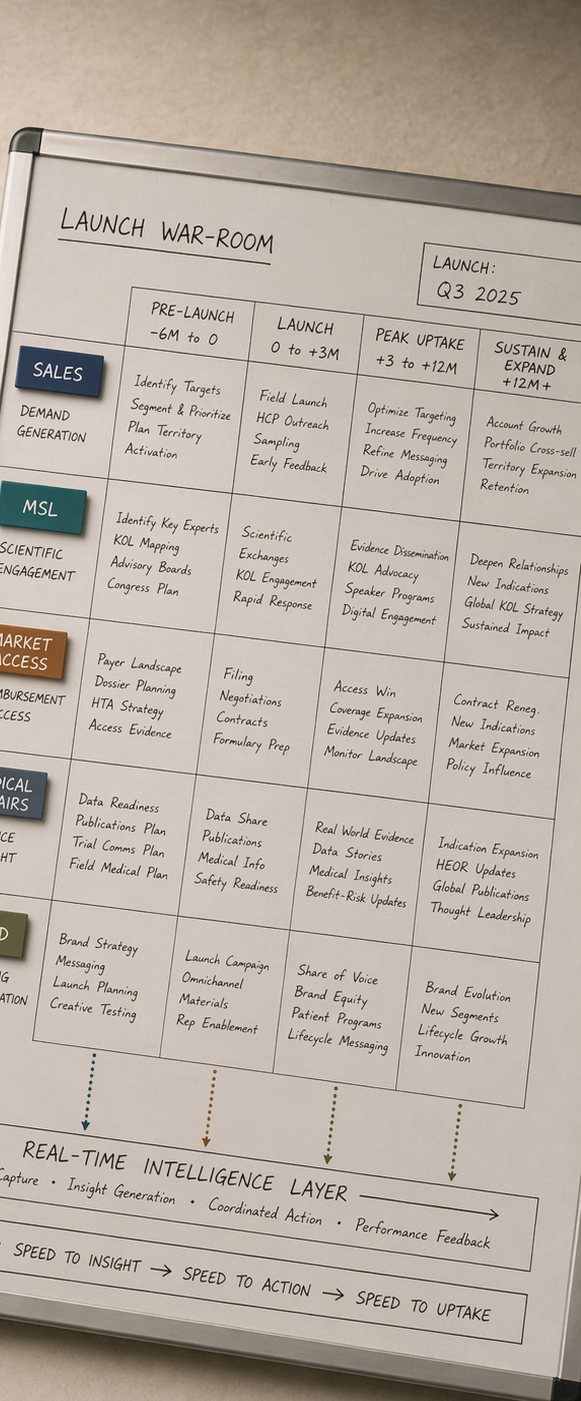
The Patent Clock Is Running
Your five commercial functions each hit their KPIs. Your uptake curve tells a different story. The gap between functional performance and commercial velocity is where millions in gross profit disappear under the patent clock.
What changes for pharma commercial operations as AI enters the industry
A typical Nordic specialty launch generates 50M SEK in peak annual revenue across an 8-to-10-year commercial life. Every month the uptake curve takes to reach peak is revenue that never comes back. For an affiliate running three to five active launches, compressing peak uptake by four months recovers an estimated 40 to 80M SEK in cumulative gross profit at 70 to 80 percent margins.
The bottleneck is not any single function. Market access wins the reimbursement decision. Medical affairs builds scientific credibility with KOLs. The field force executes physician meetings. Public affairs manages the political landscape. Each function performs. The bottleneck is the speed at which intelligence moves between them.
Today, an MSL hears in a hospital corridor that a regional formulary committee is reconsidering inclusion criteria. That signal takes days to reach market access, weeks to change field force priorities. By then, the window may have closed. This is not a coordination problem fixable with better meetings. It is an information metabolism problem. The organization digests signals too slowly relative to the speed at which the competitive and regulatory landscape moves.
CRM vendors will give your reps better pre-call summaries. They will not touch cross-functional coordination. If the GM lets vendor solutions define what "AI in pharma" means, the strategic opportunity is lost to point-solution thinking.
This briefing is about the structural shift underneath the tools: when intelligence becomes cheap and abundant, the pharmaceutical affiliate that routes signals fastest between its five commercial functions captures disproportionate value under the patent clock.
From functional excellence to coordination velocity
Pharmaceutical affiliates have spent decades optimizing each commercial function independently. Market access teams track formulary decisions. Medical affairs teams manage KOL relationships. Field forces execute call plans. Public affairs monitors regulatory sentiment. Each function has its own KPIs, its own tools, its own reporting cadence.
The problem is visible in one metric: the uptake curve. An affiliate with five strong functions that cannot coordinate across them in real time will consistently lose months of peak uptake to competitors whose intelligence flows faster. The quarterly cross-functional meeting is still the fastest coordination mechanism most affiliates have. It is also structurally too slow for a competitive environment where a formulary change in one region should reshape field messaging within days, not quarters.
The affiliate that coordinates fastest wins the patent clock. Not the one with the best reps, the best MSLs, or the best market access team. The one where intelligence moves between all five functions in real time.
AI makes this possible for the first time. Not because AI replaces any function, but because AI can monitor, synthesize, and route signals across functions at a speed that was previously impossible. A formulary change detected by market access can instantly reshape MSL priorities and field messaging. A competitive launch signal can trigger coordinated responses across all five functions within hours. The quarterly coordination cycle becomes structurally obsolete.
Revenue. Profit. Valuation.
Under the old model these three questions had three different answers. AI ties them together. Accelerate the uptake curve and you move all three at the same time.
What if peak uptake arrived four months sooner on every launch?
Every month of delayed peak uptake on a 50M SEK product is millions in gross profit that never returns. With three to five active launches, compressing the uptake curve by four months recovers an estimated 40 to 80M SEK across the pipeline. The revenue question is not whether AI helps. It is how many months of peak uptake the current coordination speed is costing you.
Can you grow commercial impact without growing headcount?
An MSL who spends three hours preparing for a KOL meeting could spend thirty minutes with AI-augmented preparation and invest the remaining time in a second meeting. The same capacity, doubled in effective output. When preparation, monitoring, synthesis, and documentation run on AI, the cost structure of commercial operations shifts. The same team covers more ground at higher quality without adding heads.
Does your commercial engine survive a GM transition?
When the cross-functional intelligence lives in the GM's head and the relationships of three senior directors, the organization is fragile. Institutional coordination infrastructure that routes signals regardless of who sits in the chair is worth more than personal networks. Investors and boards increasingly ask whether the commercial capability is personal or structural. The answer determines how the affiliate is valued in a portfolio review.
Two columns. The whole industry sorts itself between them.
Every pharma commercial function has activities that AI handles well and activities where human judgment is irreplaceable. The organizations that sort this clearly will free their most expensive talent for the work that actually moves the uptake curve. The ones that do not will keep paying senior people to compile slides and monitor inboxes.
- HTA dossier data compilation and price benchmarking
- Standard pharmacoeconomic modelling
- Literature monitoring and publication scanning
- Pre-call research and CRM administration
- Policy monitoring and standard position papers
- Compliance documentation and training materials
- Formulary tracking and competitive pipeline monitoring
- TLV negotiation and creative managed-entry structuring
- Nuanced clinical interpretation for specific KOLs
- Reading a physician's unspoken concerns in conversation
- Building genuine political relationships
- Cross-functional prioritization under the patent clock
- Real-time signal routing between commercial functions
- Trust-building and hospital politics navigation
The pattern is consistent: anything that involves compiling, monitoring, or standardizing is moving inside the AI frontier. Anything that requires reading a room, building trust, navigating ambiguity, or making judgment calls under uncertainty is appreciating. The highest-value work in pharma commercial operations has always been relational and political. AI makes it possible to spend dramatically more time there.
Two paths. Same technology. Opposite outcomes.
Every pharma affiliate will adopt AI tools. The CRM vendors are shipping them now. The question is whether AI enters as a collection of function-level efficiency tools or as the coordination layer that connects the entire commercial engine.
| The default path | The repositioning path |
|---|---|
| Adopt vendor AI per functionEach function gets its own AI tools. Reps get pre-call agents. MSLs get literature monitors. Market access gets formulary trackers. Five silos, each faster. | Build cross-functional intelligenceAI connects the five functions into a single intelligence system. Signals flow in real time. Coordination speed becomes the competitive advantage. |
| Optimize existing KPIsEach function improves on its own metrics. Call volume increases. Literature reviews accelerate. The uptake curve does not change because the coordination gap remains. | Measure coordination velocityNew metrics track signal-to-action speed across functions. A formulary change reaches field messaging in days, not quarters. The uptake curve compresses. |
| Wait for global playbookLet HQ standardize the AI approach across affiliates. Safe. Slow. The local GM loses autonomy to shape how AI enters the organization. | Lead locally, scale globallyBuild the coordination model at affiliate level. Prove the uptake acceleration. Become the reference case for the rest of the organization. |
| Plateau at function-level gainsEach function gets 15 to 20 percent more efficient. The organization gets cheaper but not faster. Competitors who coordinate better still win the uptake race. | Compound through coordinationEvery signal routed faster improves the next response. The coordination advantage compounds with each launch, each market, each molecule. |
The default path makes each function faster. The repositioning path makes the whole commercial engine faster. Under a patent clock, the difference between the two is tens of millions in recoverable gross profit.
The growth levers that compound when used together
None of these is transformative in isolation. Together, they rebuild the commercial operating model around coordination speed instead of functional headcount.
Build cross-functional signal routing
Create the intelligence layer that connects market access, medical affairs, field sales, public affairs, and HQ admin in real time. When a formulary committee signals a policy shift, the field force messaging changes within days. When a KOL raises a clinical concern, market access adjusts the evidence package before the next payer meeting. The quarterly coordination cycle is replaced by continuous signal flow.
Augment the intelligence layer across all five functions
Free capacity in every function simultaneously by moving preparation, monitoring, synthesis, and documentation to AI. MSLs spend less time compiling and more time in scientific conversation. Market access teams spend less time benchmarking and more time structuring creative managed-entry agreements. The goal is not fewer people. It is more time on the work that moves the uptake curve.
Treat uptake acceleration as the strategic objective
Stop measuring commercial success by function-level KPIs alone. Measure the speed from EMA approval to peak uptake as the north-star metric. Every decision, every resource allocation, every AI investment should be evaluated against one question: does this compress the time to peak? The functions exist to serve the uptake curve. Not the other way around.
Build unified stakeholder intelligence
Each function holds partial intelligence about the same stakeholders. The same KOL is a prescriber to field sales, a scientific peer to medical affairs, a committee member to market access. AI makes it trivial to build a unified view that today is manual, incomplete, and politically contested. A complete stakeholder picture compounds the value of every interaction across every function.
Business first. Technology second.
GRAIL is an AI-native management consultancy. We help European mid-market leadership teams figure out the one or two things that fundamentally change about their business as AI enters their industry, and then build the capability to act on it before competitors do. For pharma commercial operations, the shift is not about better CRM tools for individual reps. It is about coordination velocity across the five functions that determine how fast the uptake curve moves. No CRM vendor, consulting firm, or global IT function is having this conversation at affiliate level.
The market offers two things: vendor lock-in dressed as transformation, and consulting reports dressed as strategy. GRAIL delivers a third option: working AI capability that you own.
- Senior advisory direct to the CEO and GMT
- Working AI capability you own from day one
- Custom agents built around your business logic
- Outcomes in weeks, not quarters
- No lock-in at any phase of the engagement
- Founded by operators, not technologists
- Business-first strategy, technology second
- Context architecture, change management, workflow design
- Results before you commit to scale
- Each next step earned, never assumed
Three sessions with your management team. No IT involvement. Working tools from week one.
GRAIL starts with the management team because organizational transformation cannot outrun the leadership team's personal understanding of what is possible. Three workshops. Each delivers standalone value. Each earns the right to the next.
How to think
The strategic foundation. Where AI creates real value in pharma commercial operations and where it is noise. The coordination metabolism thesis. Each functional head sees their own jagged frontier. Your leadership team leaves with a shared frame for the rest of the work, and with the first working agent built live in the room.
Your AI team
A half-day activation. Each member of the management team receives a personal suite of five to ten custom agents trained on their workflow and competitive landscape. Launch intelligence monitor. KOL preparation agent. Competitive pipeline tracker. Market access synthesizer. Working tools from week one, not slides about tools.
Competitive edge
Refinement from real usage. Agents upgraded based on how the team actually used them. The cross-functional intelligence layer demonstrated live. The uptake acceleration roadmap. The recommendation for what comes next, earned by what just shipped.
Three weeks. No IT involvement. No global approval needed to start. The sharpest strategic conversation your leadership team will have this year, backed by working tools they are already using.
What to ask in your next leadership meeting
The questions where the room cannot agree on an answer are the ones worth a longer conversation. Ask these honestly. The point is not the polished response. The point is whether the answer would survive contact with a competitor who launches faster next quarter.
When our market access team wins a new formulary decision, what is the actual mechanism that changes what our field force says in physician meetings the following week?
How many months of peak uptake are we losing across our active launches because intelligence moves between functions at the speed of the quarterly review?
If our three most experienced directors left tomorrow, would the cross-functional coordination capability survive their departure?
Are we letting CRM vendor roadmaps define what AI in pharma means for this organization, or do we have our own thesis about where AI creates strategic value?
When global HQ arrives with a standardized AI playbook in twelve months, will we be the affiliate that shaped the approach, or the one that received it?
If any of these questions land somewhere uncomfortable, that is the conversation worth having.
Continue reading
Sources and limitations
This briefing draws on GRAIL's engagement experience with leadership teams and on public company disclosures. Figures are illustrative unless a source is named beside them. A sourced edition is in preparation.