What's Changing in Your Launch Economics
Your commercial envelope. Your uptake curve. The portfolio story against your LoE cliff. Three questions that look separate, but are actually one. A briefing for Commercial CFOs at European pharma affiliates.
Tuesday morning, Regional VP call in 72 hours
Every commercial CFO at a European pharma affiliate has had the same Tuesday morning. Three things on the screen before 09:00. Uptake on your flagship launch is tracking four months behind plan against a 50M SEK peak annual revenue, and under the patent clock that gap is gross profit that does not come back. The CRM AI bundle from your platform vendor landed in SG&A last quarter without a rep-force or medical-affairs re-plan. LoE on the brand that carries a third of your contribution margin hits in eighteen months, and only one in-licensing candidate is slotted into the pipeline bridge.
You have signed ten launch forecasts for this Regional. The pattern used to be simple. Size the rep force to the call plan. Resource medical affairs to the KOL map. Fund market access to the formulary timeline. Close ex-factory clean. Keep gross-to-net reconciled. The affiliate was understandable.
Something changed. Joint Clinical Assessments have been live since January 2025 and are rewriting launch timing across markets. Your vendor-supplied CRM AI is optimising individual reps without touching the coordination between market access, medical affairs, and the field force. Global HQ is drafting commercial-AI playbooks that will arrive in your affiliate in twelve to eighteen months. Your prescribers are themselves reading AI-summarised trial data before your MSL briefing. The close is clean. The launch story underneath it is not.
The job has not changed in fifty years. The bar has risen on every measure of doing it, simultaneously, and the equation that matters most is the one it has always been: time-to-peak under the patent clock. The commercial CFOs who treat this as one capital decision run the offensive play. The ones who sign five separate requisitions lose envelope authorship to the functions inside eighteen months.
This briefing covers what is happening in your sector, what it means for the commercial finance function you run, and the three questions your team should answer before the next Regional review.
European pharma commercialisation just lost the equation that paced it
The patent clock has always been the only clock that matters in pharma commercial economics. Every month of delayed peak uptake on a 50M SEK brand is on the order of 15-20M SEK in gross profit that never returns. What changed in 2025 is that three forces landed on that clock at the same time. Joint Clinical Assessments went live in January with thirty-five oncology assessments, fifteen ATMPs, and five high-risk devices scheduled through 2026. The market-access timeline is being rewritten on compressed cycles, and the uptake forecasts built against older assumptions are exposed. Sister affiliates that moved first on the new cadence are already landing formulary wins four to six weeks ahead of peers.
At the same time, the CRM vendors arrived with production AI. Veeva shipped its first wave of commercial agents in December 2025 with further waves through 2026. Salesforce Life Sciences Cloud went generally available in October 2025 with seventy-plus pharma customers migrating. IQVIA OCE+ is embedding Next Best Action at the rep level. Each one is real. Each one is a subscription line now sitting on your SG&A page rather than a pilot. And each one is optimising the individual rep inside the CRM workflow, while leaving the coordination between market access, medical affairs, and the field force exactly where it was: quarterly meetings and PowerPoint decks.
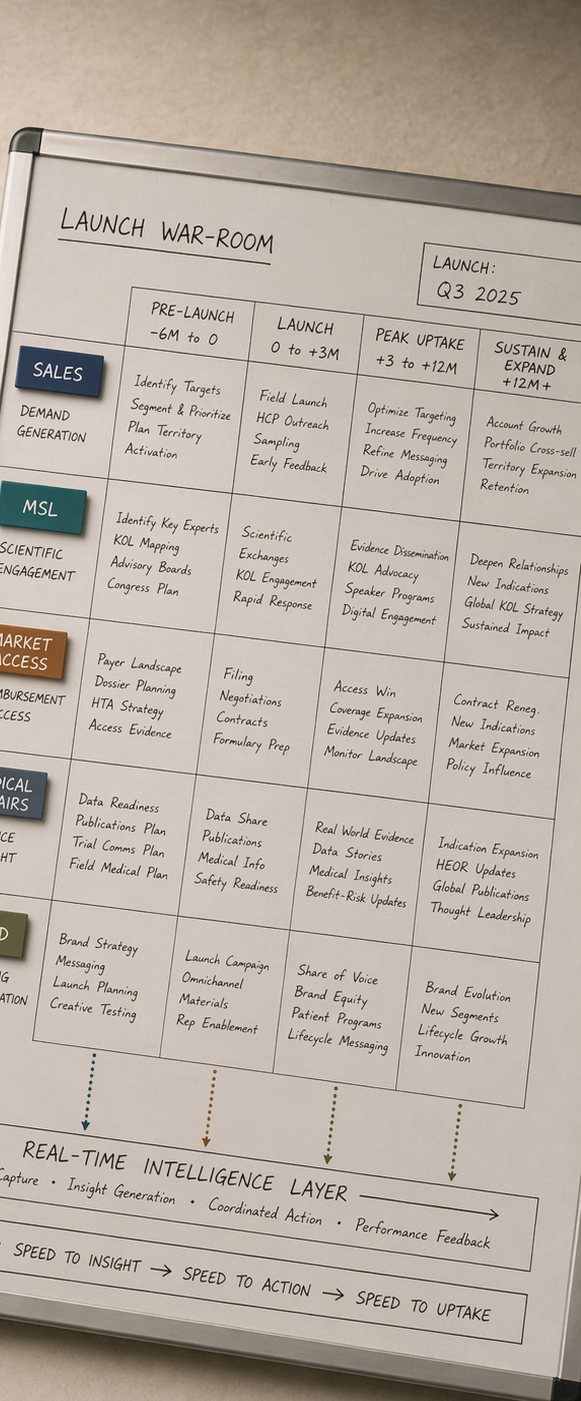
Your vendor CRM optimises the rep. It does not compress the signal-to-action cycle across your five commercial functions. That gap is where uptake is leaking GP under the clock.
Global HQ is drafting standardised commercial-AI playbooks. When they arrive at your affiliate in twelve to eighteen months, the local window to shape how AI lands in your commercial operation closes. The affiliates repricing underneath the sector right now are the ones that built the integrated commercial-intelligence layer before the global playbook hit. The ones still running five functional KPI tracks with a quarterly cross-functional meeting are walking into a Regional review they cannot win.
Your envelope, your uptake, and your portfolio are feeling it every week
Your launch envelope. The spend across rep-force sizing, medical affairs depth, market-access investment per launch, and the new CRM AI licences is being set function by function. Five requisitions land on your desk, one per head. You sign them. That is not capital allocation. It is envelope administration. The commercial CFOs that present the envelope as one capital line with five options and one choice keep launch-economics authorship for the rest of the portfolio. The ones who sign each requisition hand authorship to the functions and, eventually, to the vendor roadmap sitting underneath them.
Your uptake forecast. The plan was built on a launch curve that assumed JCA timing, competitive entries, and formulary cadence you booked last year. Three of those four moved this quarter, and your Head of FP&A cannot reconstruct the asset-level story because the formulary-change signal sits with Market Access, the prescribing-behaviour signal sits with Medical Affairs, and the competitive-launch signal sits in Public Affairs. The plan is not wrong because the forecast was aggressive. It is exposed because the commercial-intelligence layer underneath it was built for quarterly meetings, not for continuous reconstruction of the uptake story.
Your SG&A per rep. The Veeva and Salesforce AI licences landed on your SG&A page in Q3. No corresponding re-plan of rep-force size, medical-affairs capacity, or KAM coverage ratios. The AI was supposed to augment. It is currently adding cost. The commercial CFOs rebuilding the productivity envelope are assuming 1.5x to 2x prescriber coverage per rep on AI-augmented workflows and re-planning headcount against that. The ones who are not are paying for the licences twice, once in SG&A and once in the missed productivity gain.
Your controller and FP&A bench. The ex-factory reconciliation, gross-to-net accruals, standard territory variance commentary, and first-draft launch packs that used to train a commercial controller into a senior candidate are running on agents. The Q1 headcount saving is real. The 2031 succession bench is not being built. The affiliate that cuts the junior layer without redesigning the entry pathway has a cheaper commercial-finance function this year and no internal Commercial CFO candidate in five.
Your portfolio narrative. Your Regional VP has asked for the portfolio review. Your Global CFO has asked for the LoE-exposure note. Your compliance officer has asked for the AI-governance position. Three audiences, three documents, each drafted by a different team, each drawing from different numbers. The CFOs pulling ahead write the thesis once and refresh it continuously off the same commercial-intelligence data. The ones behind are reconciling three decks the night before.
You do not have three scorecard problems. You have one.
Your sector is repricing underneath you because JCA timing, competitor launch cadence, and vendor-supplied rep AI all landed on the same patent clock in the same eighteen months. Your commercial finance function is stretched because the envelope authorship, the uptake forecast, and the portfolio narrative are each managed as a separate programme, drawing on different data, drafted by different teams. Same force, two altitudes. And there is a third thing happening that most commercial CFOs have not named, and it is the one that matters most.
Envelope allocation without uptake credibility is guessing. Uptake credibility without a portfolio narrative is scorekeeping. A portfolio narrative without a commercial-intelligence layer underneath it is marketing. The seat that holds all three holds one integrated asset, not three separate programmes. Every envelope fragment, every uptake miss, every portfolio-story weakness is a symptom of the same missing layer: the commercial-intelligence infrastructure that compresses signal-to-action across market access, medical affairs, field sales, public affairs, and HQ admin from the same data, on the same cadence, under the same discipline.
This is the launch-intelligence-infrastructure decision of this decade. Every commercial CFO in your Region is making it right now, whether they see it or not. The ones who personally owned the 1993-1998 launch-CRM decision kept commercial authority for the next twenty years. The ones who signed the IT requisition because it was framed as a technology decision watched the commercial ops and IT functions consolidate the authorship, and the next affiliate CFO hire came from outside. The shape is the same. The asset under decision is different. Under the patent clock, the cost of getting it wrong is compressed into this launch cycle, not five years from now.
You can tell which camp an affiliate is in from a single question. When the formulary committee changes its inclusion criteria on a Wednesday afternoon, how long before the field force is having the right conversation in the next physician meeting? Most affiliates answer in weeks. The ones that answer in days have already built the layer. They are the ones winning uptake.
You have twelve to eighteen months before Global HQ's commercial-AI playbook arrives in your affiliate. The CFOs who own this decision personally run the offensive play. The ones who do not inherit the version someone else wrote.
What most affiliates are doing. What the winners are doing instead.
Every commercial CFO has had the AI conversation. Most are making the same four decisions. Default looks cleaner for two quarters. Winners compound from month fifteen under the clock.
| The default path | The winners' path |
|---|---|
| Sign five envelope requisitionsOne per function. Each set against last year's plan. Envelope authorship drifts to the heads. | Present one capital page, one choiceRep force, medical affairs, CRM AI, intelligence, in-licensing, working capital. ROIC-scored against one hurdle. |
| Buy vendor CRM AI and assume productivityLicences land in SG&A. No re-plan of rep-force or medical-affairs capacity. SG&A rises. Productivity flat. | Re-plan capacity against AI-augmented coverageAssume 1.5-2x prescriber coverage per rep. Medical Affairs extended to next KOL tier. SG&A holds, coverage grows. |
| Run uptake forecasts quarterlyThree scenarios take a week. Below-plan quarters produce no asset story until the post-mortem. JCA shifts reach FP&A late. | Rebuild the forecast as a live driver graphThree scenarios in an afternoon. Asset-level story in the same meeting. JCA, formulary, competitive signals feed continuously. |
| Cut the controller layer for the Q1 winCommercial-finance headcount down. Empty succession bench in 2031. External hire takes three years. | Redesign the junior pathway around judgmentNew hires pair with agents on launch modelling, envelope exposure, Regional reviews. Bench rebuilds. |
The default path looks cleaner for two quarters. The winners' path carries visible SG&A friction while the capacity re-plan lands, and compounds under the patent clock from month fifteen onward. The difference is whether the CFO is authoring the envelope or administering it.
Capital Allocation. Forecast Credibility. Value-Creation Narrative.
Three questions every commercial CFO is tracking. The first is the crux. The other two are how you earn the right to answer it.
How does the next €5-10M of envelope actually compound?
Rep-force sizing, medical-affairs depth, market-access resource, CRM AI licences, commercial-intelligence infrastructure, in-licensing candidate, share of working capital. Today's default: five requisitions from five function heads. The vendor sells licences straight into Commercial Ops. The capital-allocation authority slides away from the seat. The question is not which function to fund. The question is whose decision this is.
Why is uptake printing below plan, and what is the asset-level story?
Your Regional voted on a launch curve built before the last JCA cycle. Your print is tracking four months behind peak. Your Head of FP&A cannot walk the next Regional call through the asset-level story because the formulary signal sits with Market Access, the prescribing signal sits with Medical Affairs, and the competitor-launch signal sits in Public Affairs. Three scenarios used to take a week. They now run in an afternoon. The bar has risen on what credible means.
What does this affiliate do that holds GP against the LoE cliff?
Your Regional VP wants the portfolio review. Your Global CFO wants the LoE-exposure note. Your compliance officer wants the AI-governance position. Three audiences, three documents, three teams. The commercial CFOs pulling ahead write the portfolio thesis once and refresh it continuously from the same commercial-intelligence layer that runs the forecast. The three audiences read excerpts of the same document.
What the affiliates winning this play are actually doing
Four concrete moves any commercial CFO can start this quarter. Each addresses one lever. Pulled together, they become one commercial-intelligence asset the affiliate runs on.
Envelope: route the commercial-intelligence decision through the in-licensing hurdle
Your infrastructure ask sits on the same capital page as a €5M in-licensing candidate, not on the CRM-licence page. Present the alternatives: rep-force expansion, medical-affairs depth, CRM AI bundle, in-licensing, intelligence infrastructure, working capital. ROIC-scored against the same five-year horizon. Name what you are choosing not to fund to protect what you are funding. That is the sentence that keeps envelope authorship at the seat.
Uptake: rebuild the forecast as a live driver graph, not a rolling spreadsheet
Your launch model should draw from live formulary-committee signals, live competitor launch trackers, live KOL-interaction data, and live JCA-timing feeds, as one graph rather than four spreadsheets stitched together. Three scenarios compress from a week to an afternoon. Below-plan quarters produce the asset-level story in the same Regional call, not at the post-mortem. The forecast stops being a quarterly deliverable and becomes a live artefact the CFO invests in continuously.
SG&A: re-plan rep-force and medical-affairs capacity against AI-augmented coverage
Vendor CRM AI landed in SG&A this year. It delivers productivity only if the coverage model gets rebuilt around it. Assume 1.5-2x prescriber coverage per rep on AI-augmented workflows. Medical Affairs extends to the next KOL tier. KAM ratios re-size to the new capacity. Finance authors the re-plan. Commercial Ops builds against it. Otherwise the licence is a cost addition.
Portfolio: write the LoE-and-pipeline thesis once, refresh continuously
Three sentences on one page. What does this affiliate do that compounds GP faster than the patent clock erodes it? What assets are being defended and which are being allowed to roll off? What is the in-licensing slot against the 2027 LoE? Refresh continuously off the same commercial-intelligence graph that runs the forecast. Regional VP, Global CFO, compliance, in-licensing team all draw from the same document in different registers.
The only firm that joins envelope authorship to working infrastructure
The commercial CFO has four places to go. None can do what we do.
The big pharma commercial-transformation practices will sell a twelve-to-twenty-four-month programme staffed by a partner and analysts billing hours. Their output is dashboards and a target operating model. They ship a tighter commercial-ops layer, not authorship of launch economics.
The CRM-vendor AI bundles will sell licences and implementation. They optimise the individual rep inside the CRM. They do not touch the coordination between market access, medical affairs, and the field force. The intelligence layer sits on vendor infrastructure, not yours.
The Global HQ commercial-ops templates will arrive in twelve to eighteen months with a playbook someone else wrote. By then the affiliate-specific window is closed. The local CFO inherits the frame rather than shapes it.
The strategy firms as platform implementation partners will advise your global HQ on the Salesforce or Veeva migration. Your affiliate CFO is not their client. Their advice will be generic by the time it reaches your launch portfolio.
The market offers four things you have already said no to. GRAIL is the fifth option.
- Senior advisory that speaks commercial-floor, not deck-room
- Working infrastructure your team uses the same week
- Custom agents built on your portfolio, your payers, your KOLs
- The start of a commercial-intelligence layer your FP&A owns
- No vendor lock-in at any phase of the engagement
- Founders with pharma commercial training across three majors
- Business first, technology second
- Three weeks from first meeting to working infrastructure
- Your affiliate keeps the infrastructure, you own the IP
- Every next step earned by what just shipped, never assumed
Three sessions with your commercial leadership. Working infrastructure from week one.
We start with your commercial leadership team because the change cannot outrun the team's personal understanding of what is possible. Three workshops. Each delivers standalone value. Each earns the right to the next.
How to think
Walk through what is happening in your sector and inside your commercial finance function. Build the first piece of infrastructure in the room: a live uptake-driver agent on your real launch curve, running against real formulary signals, competitor trackers, and KOL-interaction data. Your leadership team leaves with a shared view of what to do next and working infrastructure already in their hands.
Your commercial infrastructure
A half-day build. Your Head of FP&A, Head of Market Access, Medical Director, and Head of Commercial Ops each leave with five to ten pieces of working infrastructure tuned to their function. Launch-uptake agents, formulary-signal trackers, KOL-preparation helpers, continuous scenario generation. Infrastructure your team is using the same week, not decks about infrastructure.
Ready to run
Refined infrastructure based on real use. The rollout plan to the wider commercial organisation. The envelope-thesis document for the next Regional review. The capacity re-plan for the commercial-ops team. And the Regional VP and Global CFO conversation with numbers they can check: ROIC alternatives, uptake scenario ranges, LoE-cliff measurements.
Three weeks. No IT project. No global approval needed to start. The infrastructure your affiliate is already running on when we finish.
For your next launch review
The questions where your commercial leadership cannot agree on an answer are the ones worth an hour on the agenda. Ask these honestly.
Your commercial-intelligence infrastructure ask: is it on the IT-and-CRM-licence requisition page, or on the capital page next to an in-licensing candidate? If the former, what would it take to move it before the next Regional review?
Your Regional voted on a launch curve built before the last JCA cycle. Your print is tracking four months behind peak. Can your team walk the next Regional call through the asset-level story in the same meeting, or does it take a post-mortem?
Your vendor CRM AI licences landed in SG&A last quarter. Has the rep-force and medical-affairs capacity model been re-planned against 1.5-2x AI-augmented coverage, or is the licence currently a cost addition?
Your Regional VP, Global CFO, and compliance officer have each asked for a different AI-and-portfolio document in the last ninety days. Are they excerpting the same thesis, or are your teams drafting three documents that do not reconcile?
Of the junior controllers and commercial-FP&A analysts you are cutting to agents this year, how many are the people who would have made your 2031 Commercial CFO bench? What are you doing instead to build it?
If any of these produces a disagreement in your commercial leadership, that is the conversation worth having before the Regional asks.
Continue reading
Sources and limitations
This briefing draws on GRAIL's engagement experience with leadership teams and on public company disclosures. Figures are illustrative unless a source is named beside them. A sourced edition is in preparation.