What's Changing in How You Launch
Your uptake curves are sliding. Your senior MSLs are burning out. Your signal-to-action cycle is stuck at quarterly. Three problems that look separate, but are actually one. A briefing for commercial-operations leaders at European pharma affiliates.
You have seen this in your launch reviews
Every Head of Commercial Operations or Country Ops Director at a mid-sized pharma affiliate in Europe has had the same Monday morning. Three launch reviews on this week's calendar. Launch one: an oncology specialty asset, peak projected for Q3, the uptake curve is fourteen percent below the benchmark launches in the therapeutic area and nobody can agree why. Launch two: your senior oncology MSL spent twenty-two hours last week on pre-call preparation, literature monitoring across three competitor assets, and the cross-functional brief the market-access team needed by Friday. Launch three: your twenty-year market-access lead scheduled thirty minutes with you for Thursday. The calendar subject line says career.
You have run commercial operations in this affiliate for fifteen years. The pattern used to be simple. Hire the best field force and medical team the country can field. Run launches on the brand plan. Hold compliance. Protect share of voice. The business was understandable.
Something changed. Your CRM vendor is shipping AI agents in quarterly waves and your reps are using them whether or not training has caught up. Global HQ is putting an AI playbook together and will push it down inside eighteen months. Swedish prescribers and payers are using AI tools themselves, so your field force is no longer the best-prepared person in the room. And you can name the six senior MSLs and market-access leads whose departure inside five years will cost you more than any launch-excellence programme has ever gained you.
This is not a you problem. It is an industry problem and a commercial-operations problem, happening at the same time. Most pharma COOs are treating them as two. The ones who see them as one are going to own the next decade of European pharma commercialisation.
This briefing covers what is happening in your sector, what it means inside your commercial engine, and the three questions your leadership team should answer before the next launch review.
Pharma commercialisation just lost the tempo it ran on for a generation
Every regulatory and technology wave your sector absorbed in the last twenty years added new work to the commercial engine. New indications expanded the MSL brief. Digital channels added a marketing layer. Compliance tightened the promotional review. Managed-entry agreements added complexity to market access. Each new layer was absorbed by hiring, training, and more quarterly coordination meetings. The tempo ran on fifteen-year patterns. It worked.
AI is resetting the tempo from three directions at once, and not on a timeline the affiliate controls. Your CRM vendor is shipping pre-call, voice, and next-best-action agents in quarterly waves, and your reps are using them whether or not the training has caught up. Global HQ is standing up an AI playbook and will push it to every affiliate inside twelve to eighteen months. Prescribers and payers are using AI tools to prepare for your MSL visits, which means the preparation asymmetry your field force used to count on is gone. The scope of your commercial work has not shrunk. The cadence the outside world expects has moved.
Your prescribers are already prepped by AI before your MSL walks in. Your payer counterparts are running AI dossier reviews before your market-access team arrives. The affiliate that is still running quarterly coordination meetings is showing up slower than the people it is there to engage.
The competitors in your region are not waiting. A handful of Nordic and continental affiliates have committed serious budget to cross-functional intelligence infrastructure in the last eighteen months. The ones moving first are turning a formulary signal from Wednesday into Monday field execution, instead of carrying it through the next quarterly meeting cycle. They are compressing time-to-peak-uptake by months on assets where the patent clock will not let you claim that revenue back on the back half of the curve. The affiliate that opens that gap first does not need to win on science or price. It wins on how fast the commercial engine moves.
Your sales, medical, and market-access engine is feeling it every day
Your sales operations. Your field force is running a call plan built on pre-call prep that now runs on the CRM vendor's AI agents, not on the rep's own weekend reading. Territory design has not been revisited against what an AI-augmented rep can cover. Incentive compensation is still keyed to share-of-voice metrics that no longer separate the top rep from the average. The ops team is working harder to report on a call plan that increasingly reflects last year's commercial reality, not next quarter's.
Your medical operations. The MSL model is capacity-limited by what one person can read, prepare, and remember. Your senior oncology MSL, your senior cardiology MSL, and your senior haematology MSL are each holding a KOL roster they built over fifteen to twenty years. The literature monitoring, congress coverage, and advisory-board preparation work that used to fill their week is now handled by agent infrastructure the vendors are shipping. But the agent briefs do not exist yet inside the affiliate. Your best MSLs are doing work the substrate could do, while the KOL conversations they uniquely can hold get the leftover hours.
Your market-access operations. Joint Clinical Assessments live since January 2025 demand cross-market evidence coordination the affiliate was never structured for. Your market-access lead produces a JCA submission in one market while coordinating with two or three other country affiliates on the same asset. Forty to fifty percent of the senior hours on each submission go into cross-check, formatting, and coordination that could run on infrastructure. The judgment calls, the payer reads, the negotiating instinct, are what those hours should be spent on.
Your compliance operations. Promotional review, medical review, and adverse-event handling are running at a volume the 2019 process was not built for. AI tools can draft adverse-event narratives, cross-check promotional claims against the label, and route documentation for human review. None of that removes compliance judgment from humans. It removes the queue backlog that currently stretches review cycles from days to weeks and slows every launch behind the queue.
Your senior specialists. Your six to fourteen most senior MSLs, market-access leads, and public-affairs veterans are the firm's scarcest resource. They spend twenty to twenty-four hours a week on substrate work: pre-call prep, literature monitoring, dossier formatting, coordination meetings. Twelve to eighteen hours remain for the KOL engagement, payer negotiation, and political reading only they can do. And the retirement or approach-by-competitor conversations are already on your calendar. You know which ones.
The affiliates pulling ahead are building one piece of infrastructure
Your sector is compressing from below because CRM vendors are shipping AI agents that eat substrate work. Your commercial engine is compressing from above because your senior MSLs and market-access leads spend half their billable week on that same substrate. Same force, two altitudes. But there is a third thing happening that most pharma COOs have not named yet, and it is the one that matters most.
You do not have three problems. You have one. The senior judgment that drives your launches has never been separated from the specialist who carries it. Every uptake drift, every compliance lag, every stuck coordination cycle is a symptom of that single unsolved thing. Let a senior MSL burn out on substrate work, and the KOL roster slows. Let a market-access lead retire with the payer-negotiation instinct still in their head, and the next dossier lands softer. Keep the five commercial functions coordinating through quarterly meetings, and the signal-to-action cycle cannot shorten.
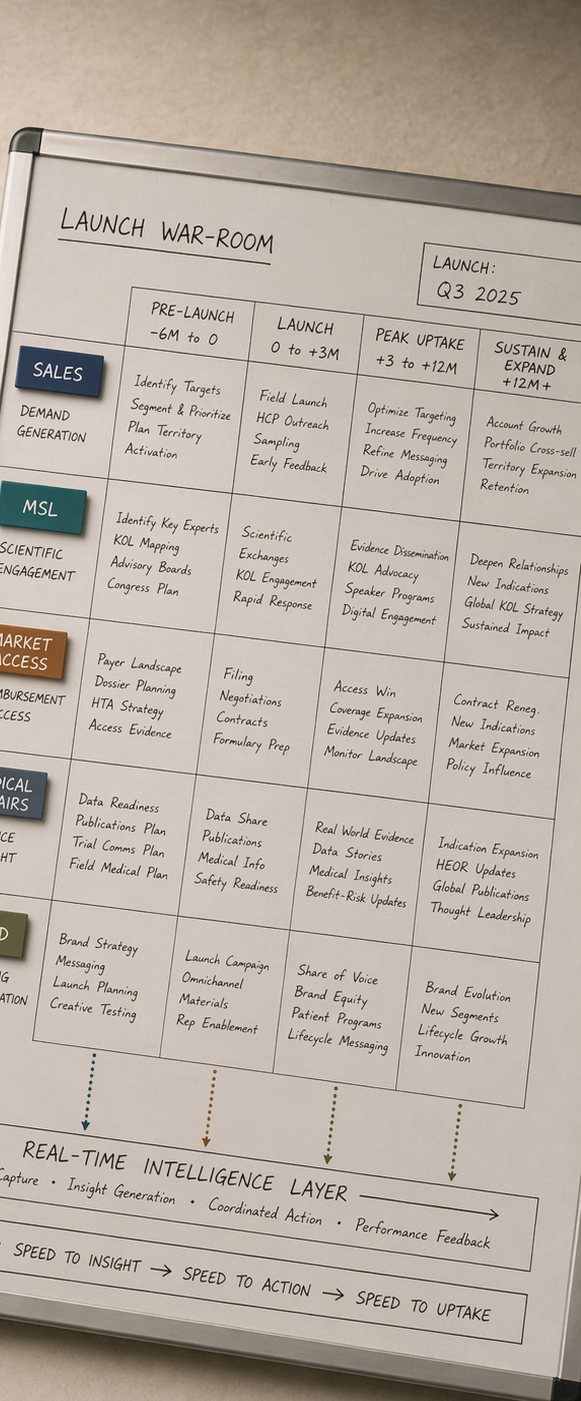
Look at the affiliates pulling ahead. Sales, medical, market access, compliance, and senior-specialist continuity are not five separate programmes. They are one intelligence layer. Every launch makes the layer smarter. The senior MSL who retires contributes to it on the way out. The mid-tier medical analyst learns by using it. The KOL relationship holds because the engagement history lives in it. The same infrastructure that compresses time-to-peak-uptake protects compliance and frees senior judgment.
You can tell which camp an affiliate is in from a single question. Can you point to one thing in your affiliate that is measurably smarter this quarter than last? Most cannot. The ones that can have already made the shift, and they are already compressing the uptake curves you thought were the ceiling.
You have twelve to eighteen months before global HQ's AI playbook arrives and the local window closes. Your question now is whether you build the intelligence layer your affiliate will run on for the next decade, or wait until a playbook designed by someone who has never sat in a Nordic tender gets pushed down from Basel or New Brunswick.
What most affiliates are doing. What the winners are doing instead.
Every pharma COO has had the AI conversation. Most are making the same four decisions. A smaller group is making different ones. The difference is architecture, not tooling.
| The default path | The winners' path |
|---|---|
| Let the CRM vendor's AI agents ship rep-by-repPre-call prep improves per rep. The coordination gap between reps, MSLs, and market access holds exactly where it was. | Build one intelligence layer that routes signals across five functionsA Wednesday formulary signal reaches field messaging and payer dossier by Monday. Uptake curves move. |
| Treat senior MSL retirements as an HR problemMentor, hire replacements, watch the KOL roster soften eighteen months after each departure. | Extract senior MSL judgment as a side-effect of daily workCapture from engagement notes, advisory-board outputs, publication reviews. Seniors stay the escalation layer. The roster holds. |
| Run five function-specific AI pilots in parallelEach pilot shows activity. Cross-functional cycle time does not move. The uptake curve still slides. | Build the cross-functional intelligence layer firstPilot the layer across one launch. Signal-to-action compresses from six weeks to one. Every next launch runs on it. |
| Wait for global HQ's AI playbookLose twelve to eighteen months of local window. Run the next five years on an operating model designed elsewhere. | Build the local layer now, align with global when it arrivesKeep the twelve-month first-mover window. Frame the local build as the reference for global when the playbook drafts. |
Same affiliate. Same twelve months. Opposite outcomes. The difference is the architecture, not the agents.
Unit Economics. Delivery Reliability. Cycle Time.
Three questions every pharma commercial-ops COO is tracking. None of them used to be the same question. They are now.
Why is our cost-per-peak-uptake-month rising even when headcount is flat?
Your affiliate OpEx holds. Your launch count grows. Every month of delayed peak on a specialty asset costs millions in gross profit that the patent clock will not let you claim back. The substrate work your senior MSLs and market-access leads absorb is eating the very hours that would compress the uptake curve. The headcount plan is fine. The work-allocation model is the question.
What happens to our launch quality when our senior specialists retire?
Six to fourteen of your most senior MSLs, market-access leads, and public-affairs veterans are within five years of retirement or open to approach by a larger affiliate. Each carries KOL or payer judgment that took twenty-plus years to build and has never been written down. The quality floor holds because they are in the room. When they leave, the floor drops before the outcome shows, and the next launch lands softer. You already know which conversations are on your calendar.
Why is our signal-to-action cycle still running at quarterly cadence?
A formulary signal picked up by an MSL on Wednesday today takes six weeks to reach field messaging and the payer dossier. The affiliates rebuilding commercial ops around cross-functional intelligence compress that to one week. Same field force. Same medical team. Forty percent more coordinated launch weeks per year. Not a productivity story. A capacity story.
What the affiliates winning this play are actually doing
Four concrete moves any pharma commercial-ops COO can start this quarter. Each touches one part of the commercial engine. Pulled together, they become one layer the affiliate runs on.
Sales and medical: compress signal-to-action across five functions by building one intelligence layer
Most affiliates are running five function-specific AI pilots. The right move is the cross-functional layer. Pick one launch. Wire one layer that routes signals from the MSL's advisory-board insight to market access and field messaging in days, not quarters. The COO who walks into the next launch review with signal-to-action metrics owns the conversation. The ones reporting five function-specific pilot updates are still running the 2023 playbook.
Medical affairs: extract senior MSL judgment now, as a side-effect of daily work
Documentation sprints and knowledge-management projects have failed in pharma for thirty years. The judgment is not articulable in prose. Extract from the artefacts the senior MSL already produces: advisory-board notes, publication reviews, KOL engagement records, congress debriefs. The affiliate captures the reasoning patterns as a side-effect of paid work. Senior consent is straightforward because the MSL is not asked to explain themselves. Their role elevates from prep to escalation. The KOL roster stops being biographical.
Market access: redesign JCA and dossier workflow around real-time cross-market coordination
Joint Clinical Assessments live since January 2025 demand cross-market evidence in lockstep. Forty to fifty percent of senior market-access hours on each submission go into cross-check, formatting, and coordination. That is the work the infrastructure should carry. Redesign the submission workflow so cross-market coordination runs on shared infrastructure, not on PowerPoint and email. The senior hours that were eaten by format go back to payer judgment.
MSL and market-access bench: rebuild the mid-tier pathway around judgment work from day one
The literature monitoring and pre-call prep that trained juniors into seniors is running on agents. No routine work, no training ground, no senior bench in 2031. New hires do not start on literature reviews. They start on escalation, advisory-board preparation as pair work with seniors, and payer-engagement shadowing. The five-year curve compresses to eighteen months. The junior who in 2022 built competence through three years of pre-call prep now builds it through three years of judgment at volume.
The only firm that joins commercial-ops advisory to working tools
The pharma commercial-ops COO has four places to go for help. None of them can do what we do, and each for a specific reason.
The big consulting firms' operations practices will sell an eighteen-month programme delivered by a partner and analysts. They are now Salesforce and Veeva implementation partners. Their incentive is platform deployment, not the coordination redesign your affiliate needs.
The CRM vendor professional-services arms will optimise the individual rep inside their CRM. Their AI agents are capable. They do not touch the handoff between sales, medical, market access, and compliance. The tool runs. The coordination gap holds.
The pharma-specialist boutiques and ex-Big-Pharma-ops advisories will sell a playbook and a deck. Your affiliate has watched that purchase fail once already. The decks go in the drawer. The operating model does not change.
The global HQ AI playbook will arrive in twelve to eighteen months. When it does, the operating model your affiliate runs on for five years is designed by someone who has never sat in a Nordic tender.
The market offers four things you have already said no to. GRAIL is the fifth option.
- Senior advisory that speaks commercial-ops, not implementation-deck
- Working infrastructure your MSLs and reps use the same week
- Custom agents built on your launches, your KOLs, your therapeutic areas
- The start of an intelligence layer your senior MSLs feed
- No vendor lock-in at any phase of the engagement
- Founded by operators who have run commercial transformation
- Business first, technology second
- Three weeks from first meeting to working infrastructure
- Your affiliate keeps the infrastructure, you own the IP
- Every next step earned by what just shipped, never assumed
Three sessions with your commercial leadership. Working infrastructure from week one.
We start with your commercial leadership team because the change cannot outrun the team's personal understanding of what is possible. Three workshops. Each delivers standalone value. Each earns the right to the next.
How to think
Walk through what is happening in your sector and inside your commercial engine. Build the first piece of infrastructure in the room: a KOL-specific agent for one of your real launches, extracted from the advisory-board and publication record you already have. Your leadership team leaves with a shared view of what to do next and the first piece of working infrastructure in their hands.
Your commercial infrastructure
A half-day build. Your Head of Sales, Head of Medical, Head of Market Access, and Compliance Lead each leave with five to ten pieces of working infrastructure tuned to their function. Pre-call prep. KOL briefing. Formulary monitoring. Congress intelligence. JCA cross-check. Adverse-event drafting. Infrastructure your teams use the same week, not decks about infrastructure.
Ready to run
Refined infrastructure based on real use. The rollout plan to your wider commercial organisation. The knowledge-extraction plan for your senior MSLs and market-access leads. The pathway plan for your mid-tier analysts. And the GM and CFO conversation with numbers they can check: peak-uptake compression, senior-hour reallocation, retention exposure by senior.
Three weeks. No IT project. No global approval needed to start. The infrastructure your commercial engine is already running on when we finish.
For your next launch review
The questions where your commercial leadership team cannot agree on an answer are the ones worth an hour on the agenda. Ask these honestly.
Of the last three launches where uptake came in under benchmark, how many slipped because a signal from one function reached the other functions too slowly? If you do not know, how would you find out?
What percentage of your senior MSLs' and market-access leads' billable week is spent on pre-call prep, literature monitoring, dossier cross-check, and coordination, and what would it take to cut that in half?
If your top three senior MSLs retired or moved next year, what would happen to the KOL roster they carry? What have you actually transferred to the rest of the team in the last twelve months?
Can you point to one thing in your affiliate that is measurably smarter this quarter than last? If not, what are the next four quarters going to add up to?
Which of your mid-tier MSLs is already working the way the rest of the medical team will need to work by 2027? What would it take for that to be the default across your commercial organisation?
If any of these produces a disagreement in your commercial leadership team, that is the conversation worth having before the GM asks.
Continue reading
Sources and limitations
This briefing draws on GRAIL's engagement experience with leadership teams and on public company disclosures. Figures are illustrative unless a source is named beside them. A sourced edition is in preparation.