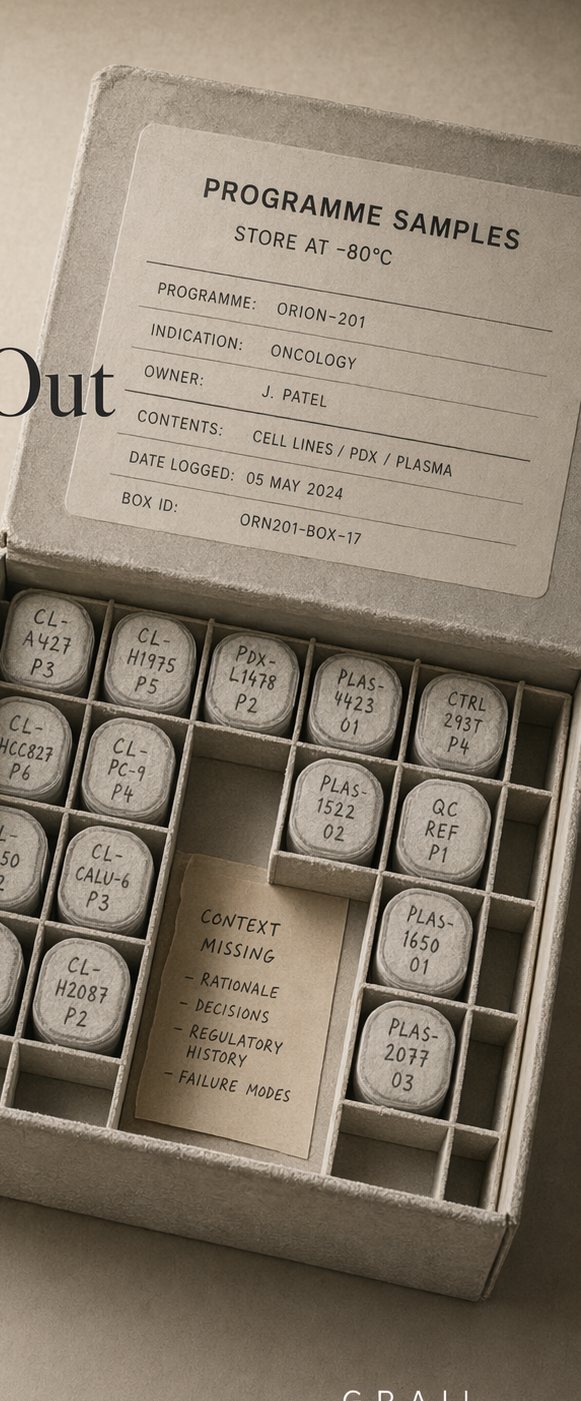
The Knowledge Is Walking Out
Your pipeline velocity depends on three to five specialists whose knowledge lives in their heads, not in any system. What happens when the next one leaves?
What changes for life sciences as AI enters the industry
AI is compressing early discovery timelines by 30 to 40 percent. Target identification and molecular simulation move faster than ever. But clinical trials remain biology-bound. The result: more programs reach translational and regulatory phases simultaneously, creating capacity pressure on the specialists who manage those phases.
Those specialists carry knowledge accumulated over years. Regulatory interpretation history, clinical program context, cross-functional commercial intelligence, and market access strategy all live in individual heads. When they leave, programs slow. Submissions lose precision. Launch timelines drift by quarters.
Most life sciences AI investment goes to discovery and product. The commercial and regulatory layers where personnel knowledge fragility is highest receive almost nothing. The investment is going to the wrong layer.
AI now makes it feasible to build institutional knowledge infrastructure that survives personnel transitions. The cost of building it while the expert is available is trivial compared to reconstructing it after they leave. The companies that build this infrastructure first will compound a structural advantage that takes years to replicate.
This briefing is about the structural vulnerability underneath every pipeline review: the knowledge that makes your programs move is personal, scarce, and at risk of walking out.
From personal expertise to institutional knowledge
Life sciences has always been a specialist-dependent industry. Regulatory affairs directors who know what the agency actually enforces versus what it publishes. Principal scientists who carry the context of why a program pivoted three years ago. MSLs whose relationships with key opinion leaders open doors that cold introductions cannot.
This specialist dependency was always a risk. But two forces have made it acute. First, AI is pushing more programs into later phases simultaneously, compressing the capacity of the very specialists who are hardest to replace. Second, the talent market has become structurally tighter in the exact roles where knowledge fragility is highest. Biotech layoffs affected 42,700 people in 2025, yet regulatory affairs and clinical development roles remain persistently short-staffed.
The succession plan for most life sciences organizations is "hope the replacement can figure it out from the files." The files do not contain what matters.
What AI changes is the feasibility of encoding this knowledge. Regulatory interpretation history, program decision context, cross-functional coordination patterns, and market access intelligence can now be captured, structured, and made searchable in ways that were not practical five years ago. The question is whether organizations build this infrastructure while the experts are still available, or attempt to reconstruct it after they leave.
Revenue. Profit. Valuation.
Under the old model these three questions had three different answers. Knowledge fragility ties them together. Solve the knowledge problem and you move all three at the same time.
What happens to pipeline velocity when the next specialist leaves?
Programs do not stop when a key specialist departs. They slow. Regulatory responses lose the precision that comes from institutional memory. Cross-functional coordination loses the informal knowledge that made it efficient. Launch timelines drift. The revenue impact appears in pipeline reviews as delays, not as departures.
What does knowledge reconstruction actually cost?
External consultants to fill the gap. Rework on regulatory narratives. Delayed submissions. Lost context on why specific decisions were made. The replacement hire is the visible cost. The 12 to 18 months of degraded decision quality is the real cost. Most organizations never measure it because they attribute the degradation to other causes.
How do investors price knowledge that lives in three heads?
Due diligence that reveals pipeline-critical knowledge concentrated in a handful of specialists creates a risk premium. Institutional knowledge infrastructure that demonstrates the organization can execute through personnel transitions is a valuation premium. Same pipeline, same revenue, different multiples.
Two columns. The whole industry sorts itself between them.
Every life sciences organization sits somewhere between these two columns. The left column describes capabilities that AI compresses or that personnel transitions destroy. The right column describes capabilities that compound when institutional knowledge infrastructure is in place.
- Personal specialist knowledge undocumented
- Manual regulatory submission preparation
- Informal cross-functional coordination
- Literature review and data synthesis by hand
- Institutional memory carried by tenure
- Encoded regulatory interpretation history
- AI-augmented submission workflows
- Structured knowledge systems for program context
- Specialist judgment freed from preparation work
- Institutional knowledge that survives transitions
The organizations in the right column do not just retain knowledge better. They make every specialist more productive, every transition less costly, and every program less dependent on any single individual. The gap compounds quarterly.
Two paths. Same technology. Opposite outcomes.
Every life sciences CEO faces this choice, whether they frame it explicitly or not. The default path feels safer because it changes nothing. The repositioning path requires building something new. But the default path leaves the organization structurally exposed to the next departure.
| The default path | The repositioning path |
|---|---|
| Invest in discovery AITarget identification, molecular simulation, clinical trial optimization | Invest in knowledge infrastructureRegulatory, commercial, and program knowledge encoded institutionally |
| Manage talent through hiringReplace departed specialists with external recruitment | Manage knowledge through architectureEncode expertise before departures force reconstruction |
| Succession as documentationHandover documents and process manuals | Succession as infrastructureAI-augmented systems that carry institutional context |
| Accept pipeline riskEvery specialist departure is a pipeline event | Build pipeline resiliencePrograms move through personnel transitions without velocity loss |
The default path is not wrong. It is incomplete. Discovery AI accelerates the front of the pipeline. Knowledge infrastructure protects the back. The organizations that build both will move faster and break less.
The growth levers that compound when used together
Each lever creates value independently. Together, they transform a personnel-dependent organization into one where knowledge compounds institutionally and specialist capacity multiplies.
Encode specialist knowledge while the experts are still available
Regulatory interpretation history, program decision context, market access strategy, and cross-functional coordination patterns. Capture it in structured, searchable, AI-augmented infrastructure. The cost of building this today is a fraction of reconstructing it after a departure. Every month of delay is a month closer to the departure that forces reconstruction at ten times the cost.
Free 40 to 50 percent of specialist time from preparation work
Regulatory specialists spend half their time on literature review, data synthesis, submission formatting, and monitoring. AI handles the preparation layer. The specialist focuses on the judgment layer: interpreting results, handling agency interactions, making the calls that require accumulated expertise. Same headcount, dramatically higher output on the work that actually matters.
Build cross-functional knowledge systems that survive personnel transitions
The informal coordination that makes programs move fast is the first thing that breaks when key people leave. Structured knowledge systems for program context, regulatory history, and commercial intelligence mean new team members reach productive capacity in months, not years. The organization stops losing 12 to 18 months of institutional learning with every departure.
Reframe the talent strategy around knowledge architecture
Stop competing purely on compensation for scarce specialists. Build the infrastructure that makes every specialist more productive, every onboarding faster, and every departure less destructive. The organizations that build this become more attractive to top talent, not less. Specialists want to work where their expertise is amplified, not where they carry the entire institutional memory alone.
Business first. Technology second.
GRAIL is an AI-native management consultancy. We help European mid-market leadership teams figure out the one or two things that fundamentally change about their business as AI enters their industry, and then build the capability to act on it before competitors do. For life sciences, the shift is clear: the knowledge that drives pipeline velocity is personal and fragile. The intervention is institutional knowledge infrastructure built while the experts are still available.
The market offers two things: vendor lock-in dressed as transformation, and consulting reports dressed as strategy. GRAIL delivers a third option: working AI capability that you own.
- Senior advisory direct to the CEO and GMT
- Working AI capability you own from day one
- Custom agents built around your business logic
- Outcomes in weeks, not quarters
- No lock-in at any phase of the engagement
- Founded by operators, not technologists
- Business-first strategy, technology second
- Context architecture, change management, workflow design
- Results before you commit to scale
- Each next step earned, never assumed
Three sessions with your management team. No IT involvement. Working tools from week one.
GRAIL starts with the management team because organizational transformation cannot outrun the leadership team's personal understanding of what is possible. Three workshops. Each delivers standalone value. Each earns the right to the next.
How to think
The strategic foundation. Where AI creates real value in life sciences and where it is noise. The augmentation framework. The knowledge infrastructure thesis. Your leadership team leaves with a shared frame for the rest of the work, and with the first working agent built live in the room.
Your AI team
A half-day activation. Each member of the management team receives a personal suite of five to ten custom agents trained on their workflow, their decisions, their competitive landscape. Regulatory monitoring. Literature synthesis. Pipeline analysis. Working tools from week one, not slides about tools.
Competitive edge
Refinement from real usage. Agents upgraded based on how the team actually used them. The knowledge infrastructure roadmap. The specialist capacity plan. The recommendation for what comes next, earned by what just shipped.
Three weeks. No IT involvement. No board approval needed to start. The sharpest strategic conversation your leadership team will have this year, backed by working tools they are already using.
What to ask in your next leadership meeting
The questions where the room cannot agree on an answer are the ones worth a longer conversation. Ask these honestly. The point is not the polished response. The point is whether the answer would survive a key specialist giving notice next quarter.
If your most experienced regulatory affairs director left tomorrow, how many months would it take to recover the institutional knowledge they carry?
What percentage of your AI investment goes to discovery versus the commercial and regulatory layers where personnel knowledge fragility is highest?
Could a new hire reconstruct why your last three major regulatory decisions were made from what is currently documented?
If an acquirer's due diligence team asked how many people carry pipeline-critical knowledge that is not in any system, what would the honest answer be?
Are you building knowledge infrastructure while the experts are available, or will you be forced to reconstruct it after the next departure?
If any of these questions land somewhere uncomfortable, that is the conversation worth having.
Continue reading
Sources and limitations
This briefing draws on GRAIL's engagement experience with leadership teams and on public company disclosures. Figures are illustrative unless a source is named beside them. A sourced edition is in preparation.