What's Changing on Your Commercial Floor
Your uptake curve is flattening. Your MSLs are falling behind KOLs who arrive briefed by their own AI. Two of your best specialists are on competitors' lists. A briefing for commercial leaders at European life sciences affiliates.
You have seen this on your commercial floor
It is Monday at a European pharma affiliate. Three things happened over the weekend. Your lead MSL sent a long voicemail about a KOL who raised a safety concern that depends on a sub-group your field force has never been briefed on. Your Head of Market Access emailed at eleven Friday night: TLV signalled the reimbursement decision may come two months earlier, which means the launch plan you built for Q3 has to compress to Q2. Your competitor announced EMA approval in the same indication, six weeks ahead of your expected decision. Every one of these signals matters. Every one will cost uptake if the function that needs it does not have it by Wednesday.
You have run four launches in this affiliate. The pattern used to be clear. Hire the right specialists. Build a tight launch team. Run disciplined quarterly coordination. The best affiliates hit peak uptake in 18 to 24 months. You took your share. You lost some. The patent clock was a constraint, not a crisis.
Something changed. Your MSLs are working harder and their KOLs are arriving better briefed than before. Your market access team is compiling JCA dossiers by hand while the submission windows compress. Your field force is calling physicians with last quarter's narrative. Your uptake curve on the last two launches plateaued earlier than you modelled. And your GM is asking why the commercial operation is not turning faster on the patent clock you both can see.
This is not a you problem. It is an industry problem and a function problem, happening at the same time. Most commercial leaders are treating them as two. The ones who see them as one are going to own the next decade of launches.
This briefing covers what is happening in life sciences commercialisation, what it means for your field force and your market access team, and the three questions your leadership team should answer before the next launch readiness review.
Life sciences commercialisation is being rewritten around you
Every CRM vendor your affiliate depends on launched agent products in the last twelve months. Veeva put Pre-call, Voice, and Free Text agents into production in December 2025. Salesforce Life Sciences Cloud went live in October 2025 with 70-plus customers including the global names you watch. IQVIA OCE+ is shipping Next Best Action AI in the same quarter. Their business is platform subscription. They are building agents that optimise individual reps inside their own CRM. None of them touches the cross-functional layer where your uptake curve actually gets decided.
The regulatory ground is moving at the same time. EU HTA Joint Clinical Assessments went live in January 2025 for oncology and ATMPs. 2026 adds high-risk devices. 2028 brings orphan medicines into scope. By 2030 it is every new medicine. Your market access team now has to coordinate evidence across markets to a regulatory clock that did not exist three years ago, while your medical affairs team has to support that evidence with clinical depth, while your field force prepares for earlier-than-expected formulary decisions in some markets and later-than-expected in others.
Your KOLs and payers are using the same AI tools your MSLs are evaluating. Half of your field meetings already have a better-prepared physician on the other side of the table than your own team.
Global HQ is the other side of the same shift. The standardised AI playbook they are writing in New York or Basel will arrive at your affiliate in 12 to 18 months. It will solve HQ's problems first, not yours. It will lock your commercial operation into the platform they picked. The affiliate that moves first shapes what that playbook looks like. The affiliate that waits inherits it. Inside that window, the market for affiliate-level AI advisors who actually understand your launch curve is thin, and the Big 4 who used to fill that role are now implementation partners for Salesforce. The strategic advisor seat at your table is open.
Your MSLs, your market access team, and your field force are feeling it every day
Your MSLs. Every MSL on your team spends four to six hours preparing for a single KOL interaction. Literature review, interaction history, competitive positioning, sub-indication data. That prep window used to be enough. It is not now. The KOLs your MSLs call on are themselves using AI tools to arrive briefed on your trial data, the comparator's data, and the last six months of publications your MSL may not have read yet. Your senior MSLs still hold the advantage because they carry fifteen years of relationship capital. Your newer MSLs are losing ground every quarter.
Your market access team. JCA submissions landed on the team in 2025 and the workload has not stopped growing. Your specialists are compiling evidence dossiers in spreadsheets while the submission calendar compresses. Formulary monitoring runs on manual alerts. Pricing benchmarks get pulled together for each negotiation from scratch. The people who do this work are scarce and being approached by larger affiliates. Two of your top three are on someone else's call list this month. The knowledge they carry about your portfolio and your payer relationships is not in any system.
Your field force. Your reps walk into physician calls with preparation built for a buyer who does not exist anymore. The physician already read the AI-summarised trial comparison before your rep sat down. The call plan runs a month behind the formulary decision your market access team just landed, because nothing connects the two. Your top reps still close. Your middle reps are working the same accounts they worked last quarter with worse results, and they cannot explain why.
Your public affairs and commercial operations. The function that used to track policy signals manually is missing things that matter. The launch readiness reviews that used to be strategic sessions have become three-hour status aggregators because the signals from every function are still being manually compiled at 10pm the night before. The commercial operations lead who should be the architect of the whole commercial engine is running reports instead.
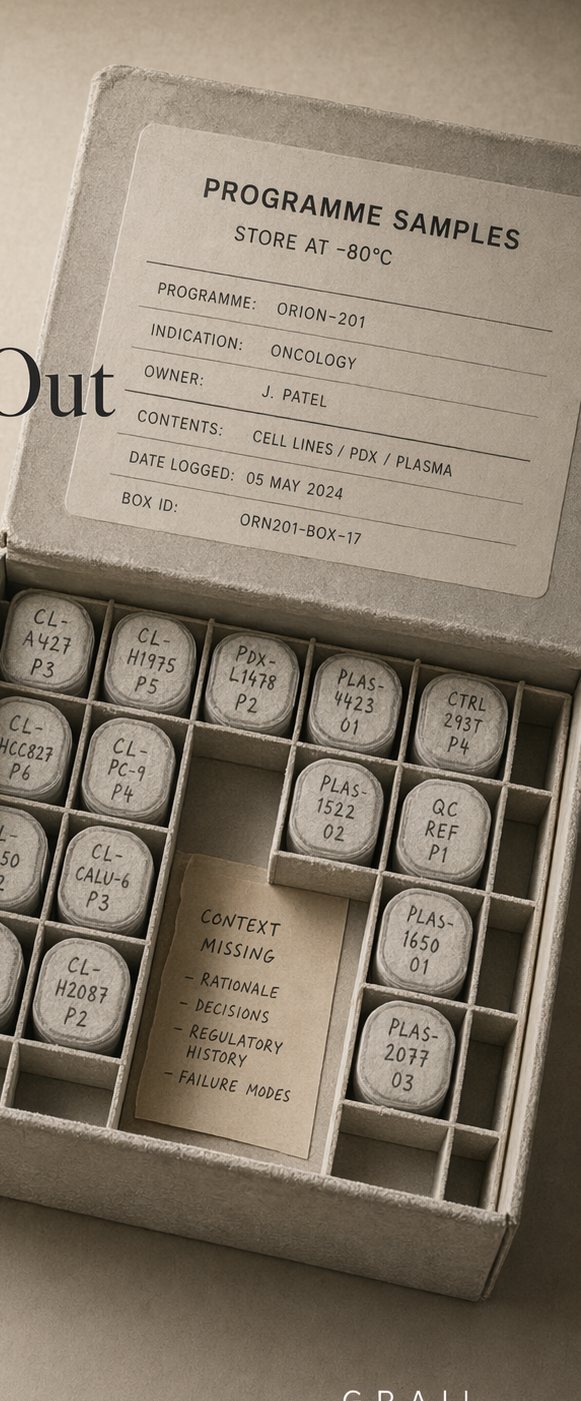
Your specialists who hold it together. Three to five people on your floor carry the knowledge that makes your commercial operation actually run. Principal MSLs with the KOL trust. Market access specialists who know every county council's procurement rhythm. A medical director who can read between the lines of a regulator's email. None of it is documented. The retention conversations are already on your calendar. You know which ones.
The affiliates pulling ahead are running one commercial operation
Your industry is compressing because AI changes how every function prepares, monitors, and synthesises. Your function is compressing because your specialists are overloaded, your KOLs are better briefed than your MSLs, and your launch calendar is moving faster than your coordination cycle. Same force, two altitudes. There is a third thing happening that most commercial leaders have not named yet, and it is the one that matters most.
Look at the affiliates pulling ahead. Market access, medical affairs, field sales, public affairs, and commercial operations are running as one motion, not five separate functions. The moment market access lands a formulary win, the field force knows it that Friday and the MSLs know it by Tuesday's KOL call. The MSL captures a safety signal at a congress; market access sees it in the JCA dossier that afternoon. A competitor announces approval; every function that needs to adjust the launch plan is briefed within hours. The signal layer is what changed.
Most commercial leaders are still running five functions with five plans. A Veeva agent pilot for the field force. A dossier template refresh for market access. A Salesforce migration project for commercial operations. A KOL dashboard for medical affairs. Twelve months later nothing compounds, because the five plans never met.
Think of your affiliate as an airport in 1965, just before radar changed coordination forever. Every pilot (function) has their own flight plan. The tower (your staff meeting) coordinates them manually. It works most of the time. Most of the time is not good enough at scale. The affiliates with radar see the whole airspace before any pilot does.
You have twelve to eighteen months. The AI adoption debate at your affiliate is effectively over. Your question now is whether you lead the cross-functional build yourself, or the Veeva roadmap and the HQ playbook arrive and lead you.
What most affiliates are doing. What the winners are doing instead.
Every commercial leader has had the AI conversation by now. Most are making the same four decisions. A smaller group is making different ones.
| The default path | The winners' path |
|---|---|
| Run five functions with five AI plansFive separate pilots that never meet. A copilot for reps, a dashboard for market access, a template refresh for medical. | Run one commercial operation across all fiveMarket access signals reach the field force on Friday. MSL signals reach market access the same afternoon. |
| Buy a CRM vendor's agent and call it an AI strategyEvery competitor has the same Veeva or Salesforce agent within six months. The vendor tool is not the advantage. | Build custom tools your team actually usesTuned to your assets, your KOLs, your payers, your launch calendar. Yours to keep, compounding with every launch you run. |
| Measure AI return on cost reductionSavings look good in Q1. The CFO gets a small number approved. Uptake does not move. | Measure return on uptake accelerationFour months of uptake compression on a €50M asset is €15-20M of gross profit that never comes back. The CFO has not counted it yet. |
| Wait for your senior specialists to leave, hope the handover worksThe launches they carried lose momentum twelve to eighteen months later. | Capture what they know now, while they are still thereTheir knowledge moves into a system every specialist uses. Commercial operations owns it. Departure becomes a lower-impact event. |
Same technology. Same twelve months. Opposite outcomes. The difference is the operator, not the AI.
Uptake. Coordination. Continuity.
Three questions every commercial leader is tracking. None of them used to be the same question. They are now.
Why is our uptake curve flattening earlier than we modelled?
The launch you ran two years ago hit plateau faster than the launch before it. The one currently in market looks like it will plateau sooner still. Your patent clock has not changed. What changed is that competitors landed formulary positions faster, KOLs arrived at advisory boards already briefed, and your commercial operation turned slower than the window allowed. Every month of delay against peak uptake is gross profit that never comes back.
How fast do signals move between our functions?
Your market access team lands a formulary win on Tuesday. Your field force does not hear about it until the next planning meeting. An MSL captures a KOL's concern at a congress; the JCA dossier team finds out three weeks later. This is invisible in any function's KPIs. It is the single biggest driver of your launch curve shape, and the first thing AI makes measurable.
What happens when your senior specialists leave?
Three to five people on your floor carry the KOL relationships, the HTA knowledge, and the payer read that your commercial operation runs on. Two are being approached by larger affiliates this quarter. When they leave, the launch momentum stalls twelve to eighteen months later. There has never been a way to capture what they know. There is now.
What the affiliates winning this play are actually doing
Four concrete moves any commercial leader can start this quarter. Each touches one function. Pulled together, they fuse your commercial operation into one system.
MSLs: build the research cell around each specialist
Every MSL gets a five-to-eight agent ensemble. Literature monitor for their therapeutic area. KOL interaction synthesiser. Competitive positioning tracker. Congress intelligence. Meeting-pack builder. Four-to-six hours of prep compresses to fifteen minutes, compliant and within scope. Your MSLs walk into KOL calls with the depth of a specialist who had three associates. Capacity doubles. Status goes up, not down.
Market access: build the HTA and formulary intelligence layer
Cross-market HTA tracker. Formulary watcher across every county council and regional payer. Comparator pricing benchmark. JCA preparation agent. A pricing and access dashboard for the GM. Three-to-five agents per specialist. JCA prep compresses from six weeks to two. Formulary wins propagate to the field in days. Your team enters negotiations with the comparator analysis pre-built.
Field force: translate KOL-level intelligence into physician calls fast
The signal layer every commercial leader needs but nobody has built. When an MSL captures a KOL concern, the field force briefing updates that afternoon. When market access lands a formulary win, the call plan reflects it by Friday. When a competitor announces, the territory response is briefed within hours. Not a dashboard. A routing layer that every function's tools plug into.
Continuity: capture what your senior specialists know, before they leave
Every senior MSL, market access specialist, and medical director carries fifteen years of KOL relationships, payer reads, and clinical judgment in their head. It has always been personal. AI now extracts it from call logs, advisory board notes, email threads, and interaction history, into a system every specialist uses. Ramp compresses. When the next departure lands, the operation keeps moving. Longest lead time. Start now.
The only firm that joins the commercial conversation to the working tools
The commercial leader in life sciences in 2026 has four places to go. None of them can do what we do.
Your CRM vendors. Veeva, Salesforce Life Sciences Cloud, and IQVIA ship agents that optimise your reps inside their platform. They do not cross your five functions and they cannot, because their unit economics depend on you being locked into one platform.
The Big 4. McKinsey, BCG, and Bain are now Salesforce implementation partners for your global HQ. They bill analyst hours. They cannot put a working MSL preparation agent on your lead specialist's desk in three weeks because their cost structure does not support it.
The life sciences consultancies. ZS, Trinity, IQVIA Consulting deliver deep vertical analytics and launch readiness work. Their model is the same analyst-hour billing. They are not building custom agents per specialist, and they do not own the strategic conversation at affiliate level.
Your global HQ's own AI playbook. It arrives in 12 to 18 months. It will solve HQ's problems first. It will pick the platform. You will inherit the decision.
The market offers four things you have already said no to. GRAIL is the fifth option.
- Senior advisory that speaks commercial-floor, not strategy-deck
- Working tools your specialists use the same week
- Custom agents built on your assets, your KOLs, your payers
- The start of a knowledge system your best specialists feed
- No vendor lock-in at any phase of the engagement
- Founded by operators with pharma commercial backgrounds
- Business first, technology second
- Three weeks from first meeting to working tools
- Your team keeps the tools, you own the IP
- Every next step earned by what just shipped, never assumed
Three sessions with your commercial leadership team. Working tools from week one.
We start with your commercial leadership team because the change cannot outrun the team's personal understanding of what is possible. Three workshops. Each delivers standalone value. Each earns the right to the next.
How to think
Walk through what is happening in life sciences commercialisation and on your affiliate's floor. Build the first working tool in the room: a KOL preparation agent for one of your MSLs, on one of your real assets, for one of your real advisory boards. Your leadership team leaves with a shared view of what to do next and the first working tool already in their hands.
Your team's tools
A half-day activation. Each member of your commercial leadership team leaves with five to ten working tools tuned to their function. MSL preparation. Market access intelligence. Field force briefing updates. Congress monitoring. Competitive launch tracking. Tools your specialists are using the same week, not slides about tools.
Ready to roll
Refined tools based on real use. The rollout plan to your wider MSL, market access, and field teams. The knowledge-capture plan for your senior specialists. The signal layer plan that connects your five functions. And the CEO and CFO conversation with uptake numbers they can check, not a deck they cannot argue with.
Three weeks. No IT project. No global HQ approval needed to start. The tools your team is already using when we finish.
For your next launch readiness review
The questions where your leadership team cannot agree on an answer are the ones worth an hour on the agenda. Ask these honestly.
On your last two launches, how many months did it take from approval to peak uptake? What was the gap versus your forecast, and what moved the number?
When your market access team lands a formulary win, what is the actual mechanism that changes your field force's next week of calls? If the answer is "the next planning meeting," how much uptake is that costing you?
If your top three MSLs and market access specialists left next year, what would happen to your next launch? What have you actually transferred to the rest of the team in the last twelve months?
Where is your average MSL spending their Monday morning today, and where would they need to spend it to cover twice as many KOLs at the same depth?
Which of your specialists is already doing what the rest of the team will need to do by 2027 to keep winning launches? What would it take for that behaviour to be the default?
If any of these produces a disagreement in your leadership team, that is the conversation worth having before the next board cycle.
Continue reading
Sources and limitations
This briefing draws on GRAIL's engagement experience with leadership teams and on public company disclosures. Figures are illustrative unless a source is named beside them. A sourced edition is in preparation.