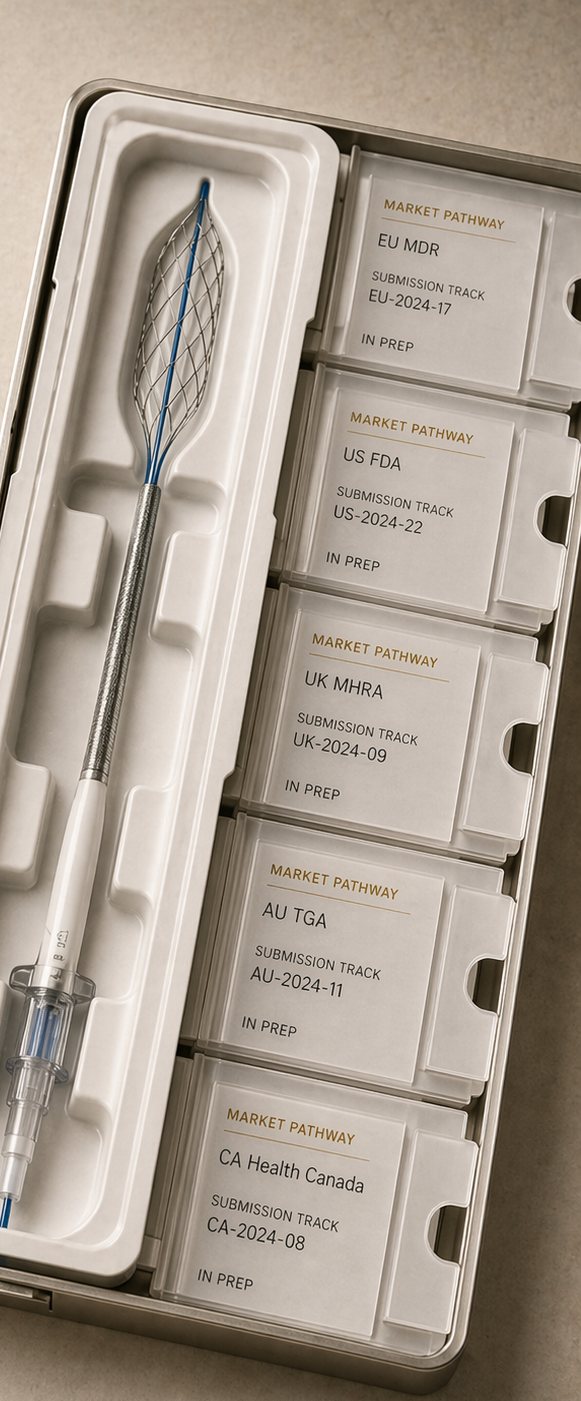
What's Changing on Your Tender Floor
The procurement committee runs structured evaluation. Your top KAM is sixty-one. Your head of market access is at a conference. A briefing for Commercial Directors at mid-market European medtech firms.
You have seen this on your tender floor
Every Commercial Director at a mid-market European medtech firm has had the same Monday morning. A regional university-hospital procurement committee sent the evaluation framework Friday afternoon. Forty questions on comparative clinical effectiveness, budget-impact model, real-world evidence, and cost-per-outcome. Your tender manager has three weeks. Your head of market access is at a conference. Your top KAM knows the surgeon at the hospital but has never built a budget-impact model. Your number-two clinical specialist is sixty-one. And the CEO wants to talk about the board question: why you are losing framework agreements to firms whose devices are not clinically better.
You have done this job for fifteen years. The pattern used to be simple. Build reference sites with teaching hospitals. Cultivate senior surgeons as clinical champions. Train your KAMs on the device and on the customer. Run framework tenders on clinical data and pricing. The business was understandable. A strong KOL network and a credible trial dataset won most of the agreements you cared about, and the procurement team tended to follow the clinicians.
Something changed. The procurement committee is running its own evaluation now. The questions landed Friday because the committee has already scored three competitors and wants your evidence package in the same shape. The head of surgery you know is on the committee but does not chair it. The chair is a health-economics lead you have met twice. Your tender response will be scored against a structured framework your team has never had to produce in writing before. The KAM who owns the hospital is brilliant with the surgeon and has nothing to offer the committee chair.
This is an industry shift and a function shift, happening at the same time. Most commercial directors are treating them as two. The ones who see them as one are going to own the next decade of medtech procurement in Europe.
This briefing covers what is happening in your industry, what it means on your tender floor and across your KAM, marketing, and market access teams, and the three questions your leadership should answer before the next board meeting.
Hospital procurement is being audited for the first time in forty years
Every technology wave your industry absorbed since the 1980s left the commercial model untouched. Imaging got better and hospitals bought more of it. Minimally invasive techniques expanded case volumes and increased device consumption per procedure. Digital health and connectivity added service revenue on top of the device base. Every wave added commercial capacity. None of them touched the claim that sat at the centre of medtech procurement: the surgeon champion plus the registration trial plus the KAM relationship carried the sale, and the procurement committee accepted the clinical case on trust.
The two forces hitting your industry in 2026 are different. EU HTA extends to high-risk devices under the Joint Clinical Assessment window in 2026, bringing a formal evidence demand the mid-market has never faced before. Regional health authorities and hospital procurement groups are running structured evaluation frameworks with AI-assisted scoring: comparative clinical effectiveness, budget-impact modelling, real-world evidence, and cost-per-outcome, scored against three or four named competitors in the same week. For forty years medtech told the story. For the first time, the committee can audit it against a dataset, and every mid-market firm is being evaluated the same Tuesday.
The procurement committee has already scored your three competitors by the time your tender manager opens the framework. Your KAM's surgeon relationship is in the room. It is no longer the whole room.
The succession side of the shift is the other half. The senior KAM and clinical-specialist generation that built the European installed base through the 1990s and 2000s is reaching retirement at the same moment. Two of your top three carry the relationships, the reference-site history, the complication-management narratives, and the committee-political read that your product has been defended with for twenty years. The knowledge has never been written down because until now, the committee took the endorsement on trust. It no longer does. The firm that moves first captures the record before the retirement conversation. The firm that waits loses the knowledge and the relationships in the same quarter.
Your tender team, your KAMs, and your market access team are feeling it every day
Your tender team. A framework tender lands. Forty questions on comparative clinical effectiveness, budget-impact model, real-world outcomes. Three weeks. Your head of market access is at ISPOR or a regional conference. The tender manager pulls last year's submission and edits. The answer reads as marketing narrative because that is what it was. The committee's evaluation flags the gap between this year's budget-impact claim and the one you made in 2023, and the framework agreement moves to a competitor whose response reads as a structured evidence file.
Your KAMs and clinical specialists. Your best KAM walks into the committee meeting with fifteen years of surgeon history, a reference-site case, and three installation outcome stories. The committee has read three years of your published material, run your device against two competitors on a structured framework, and already scored the clinical evidence. The surgeon champion still matters. The committee chair is a health-economics lead your team met twice. The conversation is starting behind the committee, not in front of it. Your best KAM is strongest with the people your team used to sell to, weakest with the people the decision is moving to.
Your market access and health-economics team. Three people, or five at a mid-market firm, producing the budget-impact models, literature reviews, and HTA submissions. Tender volume is running ahead of their capacity every quarter. They triage the biggest agreements and the rest of the pipeline gets assembled from prior material the committee has already seen. The team you hired to build evidence has become the team assembling what marketing wrote. You know which submissions this year have the thinnest case. So does the competitor whose head of market access is sitting two rows away at every conference.
Your best three KAMs. Between them they hold thirty percent of your revenue. Two are over fifty-five. One is already talking about winding down. They carry the surgeon political maps, reference-site histories, complication-management narratives, and procurement-committee-chair relationships that your firm has been defended with for twenty years. When they leave, the accounts' order frequency drops in the twelve to eighteen months that follow, and the competitor takes the next framework renewal before the handover KAM has seen a full tender cycle.
The winners are already running one commercial system
Your industry is compressing because procurement committees have AI-assisted structured evaluation for the first time and the KAM generation that built the European installed base is retiring. Your function is compressing because the tender team is still assembling submissions from marketing narrative, the KAM is walking in behind the committee's research, and the health-economics team is triaging against capacity. Same force, two altitudes.
Look at the firms pulling ahead. The tender team, the KAM force, the clinical specialists, the market access team, and marketing are running as one commercial system, not five. The tender team answers framework evaluations from real evidence documentation the market access team has built into an institutional file. KAMs walk into the committee meeting with the committee's decision history, political map, and prior concerns already loaded. Marketing is showing up in the procurement group's reference research before the framework is scoped. Clinical specialists feed every installation outcome into a record the tender response can cite. Five functions, one system, one set of numbers.
Most commercial directors are still running five teams with five plans. A content upgrade for marketing. A submission template refresh for the tender team. A CRM push for the KAM force. A promise to start documenting installation outcomes next year. A request to hire two more market access analysts. Twelve months later the framework agreement walks to a firm that built the five together, and the board question on why clinically comparable devices are losing tenders is still unanswered.
On a firm submitting forty framework tenders a year at two to eight million per agreement over three years, the gap between eighteen percent win rate and twenty-eight percent is eighty to two hundred million in additional pipeline per year. On your next senior KAM exit, the gap between forty percent and eighty-five percent installed-base defence is thirty to fifty-five million of revenue preserved. This is the next twenty-four months if you do not move.
You have eighteen to twenty-four months. The firms that move first build the evidence record and the KAM continuity infrastructure. The firms that wait watch both walk out with their seniors.
What most firms are doing. What the winners are doing instead.
Every commercial director has made the AI call by now. Most picked four similar moves.
| The default path | The winners' path |
|---|---|
| Five teams, five plansContent for marketing. Templates for tender. CRM for KAMs. Outcomes promised for next year. | Run one commercial system across all fiveTender answering from real evidence. KAMs loaded with committee history. Marketing in the procurement research flow. |
| Buy HCP-data software, call it the AI strategyEvery competitor has the same platform in a year. Account planning, not committee evidence. | Build evidence tools tied to your real product fileTuned to your devices, your KAMs, your committee history. Yours to keep, compounding every tender. |
| Push marketing for more clinical content volumeMore webinars, more surgeon videos, more congress collateral. Procurement groups research elsewhere. | Build authority in the procurement group's researchHealth-economics research the committee cites. Named outcomes. Preferred name before the framework is scoped. |
| Wait for the senior KAM to retire, hope the next carries the accountsSector revenue defence on senior KAM exit runs forty percent. | Capture what she knows now, while she is still thereThe record moves into a system every KAM builds into. Revenue defence on handover runs eighty-five to ninety. |
Same technology. Same twelve months. Opposite outcomes. The difference is the operator, not the AI.
Tenders. Discount. Retirement.
Three questions every medtech commercial director is tracking. None of them used to be the same question. They are now.
Why are we losing frameworks we should be winning?
Sector-average mid-market framework win rate on structured evaluation runs fifteen to twenty-two percent. Firms delivering submissions tied to real evidence documentation run twenty-eight to thirty-five. On forty framework tenders a year, the gap between eighteen and twenty-eight percent is eighty to two hundred million in additional pipeline. The committee reads both responses the same Tuesday.
Why are our wins increasingly on price?
Half your wins this quarter closed after a procurement-committee price concession your KAM could not refuse. The committee said the budget-impact case was thin. Your KAM had the clinical argument and nothing on cost-per-outcome. Two to five hundred basis points of operating profit per framework walks out every quarter. It is not a tougher buyer. Your team is outgunned at the committee table.
What walks when our best KAMs retire?
Your top three KAMs carry a third of your revenue and every senior surgeon relationship that matters. Two are over fifty-five. Once they leave, the accounts' order frequency drops twelve to eighteen months later and the committee you knew never meets your replacement the same way. There has never been a way to capture what they know. There is now. The retirement conversations are on your calendar.
What the firms winning this play are actually doing
Four concrete moves any medtech commercial director can start this quarter. Each touches one function. Pulled together, they fuse the firm into one commercial system.
Tender team: answer framework evaluations from real evidence documentation
A response agent trained on your firm's past submissions, clinical trial data, CE-mark documentation, post-market surveillance reports, and real-world outcome data drafts first-pass answers to each question, flagged where market access input is needed. The tender team reviews. The market access lead spends four hours on the five questions that need judgment rather than three weeks on assembly. Cycle compresses from three weeks to four days.
Marketing: become the preferred name in the procurement group's research
Hospital procurement groups and regional health authorities research medtech firms through answer engines and peer-benchmark tools your marketing team is not measuring. More surgeon webinars will not fix that. Move the spend into authority placement where the committee is actually looking. Original health-economics research the committee cites. Named installation outcomes, specific cost-per-outcome data. Senior KAM voices on the record. Win-rate recovery starts here, not in the congress calendar.
KAMs and market access: arm the KAM with committee history at the meeting
A committee-intelligence agent captures every hospital visit note, committee meeting, surgeon conversation, training session, installation outcome, published paper, and reference-site case. The KAM opens the record before a committee visit and sees five years of that committee's procurement patterns, political map, prior concerns, and competitive decisions. Four hours of prep compresses to twenty minutes of directed review. The committee experiences a KAM who remembers every conversation.
Firm: capture what your senior KAMs know, before they retire
Every hospital relationship documented. Every installation tagged with outcome, committee decision, reference-site potential. Every competitive near-miss captured with why. Every HTA submission indexed with determination. Becomes the firm's institutional record of the commercial-clinical relationship layer. When the senior KAM retires, the next KAM opens the record and sees twenty years of surgeon engagement, installation pattern, and committee dynamics. Revenue defence on transition runs twice the sector norm.
The only firm that joins the commercial conversation to working tools
The medtech commercial director in 2026 has four places to go. None of them do what we do.
HCP-data and commercial-intelligence platforms sell you a reporting and account-planning system. Their business needs the platform as system of record. They commoditise the database. They do not capture what your senior KAM knows about a committee-chair negotiation in 2019.
The big consulting firms will write you a five-hundred-thousand-euro market-access strategy deck. They cannot put a working tender-response tool in your bid team's hands in three weeks because their cost structure requires billing analyst hours.
Health-economics specialist consultancies deliver the budget-impact model and the cost-effectiveness analysis per submission. Fee runs a hundred and fifty to four hundred thousand per piece, across a tender pipeline that needs forty of them a year. The team is back to square one on the next tender.
Tender-response software sells template matching against a content library. Point tools born in the pre-AI procurement motion. Your team tries them, the committee's evaluation flags the familiar copy, you go back to the old pattern.
The market offers four things you have already said no to. GRAIL is the fifth option.
- Senior commercial thinking, not strategy-deck consulting
- Working tools your tender team uses the same week
- Custom agents built on your devices, your KAMs, your committees
- The start of an evidence record your firm builds into
- No platform lock-in at any phase of the engagement
- Founded by operators who have built and led commercial teams
- Business first, technology second
- Three weeks from first meeting to working tools
- Your firm keeps the tools, you own the IP
- Every next step earned by what just shipped
Three sessions with your commercial leadership. Working tools from week one.
We start with your commercial leadership because the change cannot outrun the team's personal understanding of what is possible. Three workshops. Each delivers standalone value. Each earns the right to the next.
How to think
Walk through what is happening in your industry and on your tender floor. Build the first working tool in the room: a tender-response agent for one of your open framework evaluations, trained on your real product file, for a procurement committee you are actually submitting to. Your leadership team leaves with a shared view of what to do next and a tool already in their hands.
Your team's tools
A half-day activation. Each leadership-team member leaves with five to ten working tools tuned to their function. Tender-response agent for the bid team. Committee-intelligence agent for KAMs. Budget-impact drafting agent for market access. Research-synthesis agent for clinical specialists. Tools the committee never sees, that the team uses every week.
Ready to roll
Refined tools based on real use. The rollout plan to the broader KAM and tender team. The clinical-commercial record capture plan for your retiring senior KAMs. The authority-placement plan for marketing in the procurement group's research flow. And the CEO and board conversation with numbers they can check, not a deck they cannot argue with.
Three weeks. No platform implementation. No board approval to start. The tools your tender team is already using when we finish.
For your next board meeting
The questions where your CEO, COO, and board cannot agree on an answer are the ones worth an hour on the agenda. Ask these honestly.
If your top senior KAM retired in the next two years, what percentage of her installed-base revenue would stay at the firm? If you do not know the number, how would you find it out?
When your next framework tender runs through a procurement committee's structured evaluation, does your response read as real evidence documentation or as marketing narrative? Which three answers would you reread first?
When a hospital procurement group researches active medtech firms in your indication today through an answer engine, does your firm appear? If not, what is your marketing actually producing?
Where is your head of market access spending her Mondays today, and where would she need to be by 2027 to cover the tender volume your growth plan requires?
What is the firm worth at the next capital event if the commercial record exists, against the firm-value if your senior KAMs still carry it in their heads? Which side of that is the current trajectory?
If any of these produces disagreement at your board, that is the conversation worth having before the next framework evaluation lands.
Continue reading
Sources and limitations
This briefing draws on GRAIL's engagement experience with leadership teams and on public company disclosures. Figures are illustrative unless a source is named beside them. A sourced edition is in preparation.