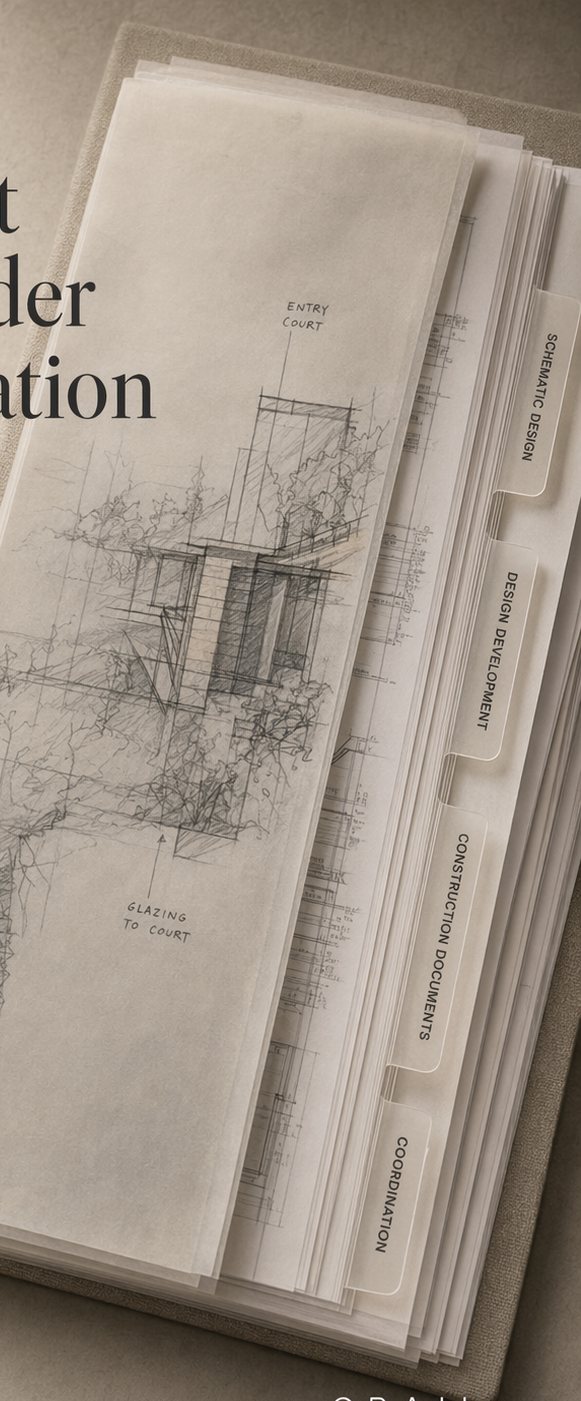
Design Got Buried Under Documentation
Your senior designers spend 40% of their time on production coordination. AI compresses that layer. The question is whether you use it to cut costs or to design more.
What changes for architecture and design as AI enters the industry
Architecture practices generate revenue through phase-based project delivery: concept, developed design, technical documentation, and contract administration. Margins sit between 12% and 20%. The business model bundles high-judgment early phases with high-intelligence later phases at blended rates that obscure radically different AI exposure profiles.
The production layer is AI-compressible today. Specification writing, BIM coordination, sustainability calculations, regulatory compliance checking, standard detail generation. These tasks consume 40% or more of senior designer time. That time is not spent on concept development, client relationships, or design quality. The production layer is not just a cost center. It is an opportunity cost against the work that actually wins commissions and builds reputation.
The sustainability dimension is the force multiplier. Whole-life carbon analysis, climate resilience assessment, and ESG certification demand analytical depth that exceeds human capacity at current billing rates. Firms with serious environmental commitments cannot deliver on those commitments manually at scale. AI makes the analytical infrastructure credible.
The junior talent pipeline compounds the pressure. The production grind drives talented graduates to technology careers. They entered architecture to design buildings, not to coordinate specifications. AI that removes production drudgery changes what the junior architect role actually is.
This briefing examines how the compression of architecture's production layer reshapes commission revenue, project margins, and firm valuation. And why the practices that treat this as a creative capacity question, not an efficiency question, will pull away from those that do not.
The production layer stopped being a cost of practice. It became the ceiling on creative capacity.
Architecture has always carried a tension between the work that matters and the work that has to happen. Design is why the firm exists. Documentation is how the design becomes a building. Both are essential. But the ratio has drifted. Senior designers and partners now spend more time on production coordination than on the concept-phase work that won them their reputation.
This is not a new complaint. What is new is that the constraint is now removable. AI can draft specifications, generate standard details, coordinate BIM models, check regulatory compliance, and calculate whole-life carbon at a fraction of the time and cost. The production layer that consumed 40% of senior time can be compressed to 15%.
The practice that uses AI to put its best designers back on design is not cutting costs. It is removing the ceiling on what it can create.
The critical insight is cultural. Architecture is a vocation. Framing AI as efficiency triggers identity resistance because efficiency language reduces practice to a throughput optimization problem. The frame that works is creative redeployment: AI handles the production layer so that the humans who chose this profession for design reasons can spend their time on design. Same outcome. Different conversation. Different adoption rate inside the practice.
Revenue. Margin. Valuation.
Under the old model these three questions had three different answers. AI ties them together. Move the production ratio and you move all three at the same time.
What if every competition entry carried twice the design depth?
High-end commissions are won on the quality of the concept and the depth of the client relationship. Every hour a senior designer spends on documentation is an hour not spent on the work that wins the next project. The practice that redirects 25% of senior capacity from production to concept work can enter more competitions at higher quality. Commission revenue follows design depth.
Can you serve work that was previously uneconomical?
Whole-life carbon analysis, climate resilience assessment, and ESG certification preparation require analytical depth that practices cannot deliver manually at current rates. AI-augmented sustainability analysis opens a category of work that competitors cannot profitably serve. The margin gain comes from new capability, not from cutting the cost of existing work.
Can the firm deliver quality without the founders in every room?
Architecture firms are valued on reputation, pipeline, and scalability. A practice where senior design capacity is consumed by production is a practice that cannot grow without diluting quality. When AI handles production, senior designers focus on design and client relationships. The practice scales without the founding partners becoming the bottleneck on every project.
Two columns. The whole industry sorts itself between them.
Every capability in an architecture practice is moving toward one of two columns. The first contains work that AI can do faster, cheaper, and at consistent quality. The second contains work that becomes more valuable precisely because the production layer is compressed. The practices that understand which column their people should be in will pull away from those that do not.
- Specification writing and standard detail generation
- BIM coordination and clash detection
- Regulatory compliance checking
- Sustainability data compilation and benchmarking
- Progress reporting and cost tracking
- Standard visualization rendering
- Creative synthesis and spatial judgment
- Client aesthetic interpretation and relationship depth
- Sustainability design integration and creative problem-solving
- Cultural reading and site-specific adaptation
- Scope negotiation and creative conflict resolution
- Mentoring junior designers in design judgment
The depreciating column is not worthless. It is essential. But its value as a human activity is declining rapidly. The appreciating column is where the practice's competitive advantage lives. Every hour of senior capacity redirected from left to right is an investment in the work that wins commissions, retains talent, and builds reputation.
Two paths. Same technology. Opposite outcomes.
Every architecture practice will adopt AI tools for documentation and production. The technology is not the differentiator. The strategic choice is what you do with the capacity it creates. Two practices using the same tools will arrive at very different places three years from now depending on which path they choose.
| The default path | The repositioning path |
|---|---|
| Production efficiencyTreat AI as the next BIM transition. Same work, fewer people. Reduce documentation headcount. | Creative redeploymentRedirect senior capacity from production to concept-phase work. More design depth per project. Higher win rate on commissions. |
| Cost reductionLower the cost of production phases. Margins improve temporarily. Competitors follow within 12 months. | Capability expansionBuild AI-augmented sustainability analysis. Serve whole-life carbon and ESG work that competitors cannot deliver at current rates. |
| Junior role unchangedJunior architects still do production work. AI makes it faster but the role stays the same. Talent attrition continues. | Junior role redesignedJunior architects learn design judgment from day one. Production drudgery removed. The role becomes what attracted them to architecture. |
| Partner dependency persistsSenior designers still stretched across production and design. The firm cannot scale without diluting quality. | Scalable design qualityAI handles production. Seniors focus on design and client relationships. The practice grows without the founders in every room. |
The default path makes the practice cheaper. The repositioning path makes it more creative. Only one of those compounds over three years.
The growth levers that compound when used together
Each of these levers creates value independently. Together, they create a practice that is simultaneously more creative, more sustainable, and more attractive to talent. The compounding effect comes from the interaction: freed senior capacity enables deeper sustainability work, which wins new commissions, which creates training opportunities for redesigned junior roles.
Redirect senior design time from production to concept
AI-augmented specification drafting, BIM coordination, and compliance checking compress the production layer. The goal is not to produce documentation faster. It is to give senior designers 25% more time for concept development, competition entries, and client relationship depth. Design quality per project goes up. Commission win rate follows.
Build sustainability analysis as a competitive differentiator
Whole-life carbon calculation, climate resilience assessment, and ESG certification preparation require analytical depth that exceeds human capacity at current billing rates. AI-augmented sustainability analysis opens a category of work that competitors cannot profitably serve. For practices with environmental commitments, this is the capability that makes the commitment credible at scale.
Redesign the junior architect role around design judgment
The production grind drives talented graduates to technology careers within three to five years. When AI handles specification coordination and standard detail generation, the junior role shifts from production labor to design apprenticeship. The talent retention benefit is structural. Three years of compounding junior development creates a design depth advantage that practices still running production-heavy junior roles cannot match.
Turn every project into training data for the next one
Every completed project generates specification patterns, regulatory solutions, sustainability benchmarks, and design approaches. When this knowledge is encoded into the practice's AI systems rather than locked in individual experience, the quality of production output improves with every project. The practice gets faster and more consistent without adding headcount. The tenth project of a type is dramatically better than the first.
Business first. Technology second.
GRAIL is an AI-native management consultancy. We help European mid-market leadership teams figure out the one or two things that fundamentally change about their business as AI enters their industry, and then build the capability to act on it before competitors do. For architecture and design firms, the shift is not about production efficiency. It is about what happens when senior creative capacity is no longer consumed by the production layer. That is a practice transformation question, not a technology question.
The market offers two things: vendor lock-in dressed as transformation, and consulting reports dressed as strategy. GRAIL delivers a third option: working AI capability that you own.
- Senior advisory direct to the CEO and GMT
- Working AI capability you own from day one
- Custom agents built around your business logic
- Outcomes in weeks, not quarters
- No lock-in at any phase of the engagement
- Founded by operators, not technologists
- Business-first strategy, technology second
- Context architecture, change management, workflow design
- Results before you commit to scale
- Each next step earned, never assumed
Three sessions with your management team. No IT involvement. Working tools from week one.
GRAIL starts with the management team because organizational transformation cannot outrun the leadership team's personal understanding of what is possible. Three workshops. Each delivers standalone value. Each earns the right to the next.
How to think
The strategic foundation. Where AI creates real value in architecture and design and where it is noise. The creative capacity reframe. The sustainability capability thesis. Your leadership team leaves with a shared frame for the rest of the work, and with the first working agent built live in the room.
Your AI team
A half-day activation. Each member of the management team receives a personal suite of five to ten custom agents trained on their workflow, their decisions, their competitive landscape. Sustainability calculation engine. Specification drafting. Regulatory compliance checker. Working tools from week one, not slides about tools.
Competitive edge
Refinement from real usage. Agents upgraded based on how the team actually used them. The creative capacity roadmap. The sustainability capability plan. The recommendation for what comes next, earned by what just shipped.
Three weeks. No IT involvement. No board approval needed to start. The sharpest strategic conversation your leadership team will have this year, backed by working tools they are already using.
What to ask in your next partnership meeting
The questions where the room cannot agree on an answer are the ones worth a longer conversation. Ask these honestly. The point is not the polished response. The point is whether the answer would survive contact with a major client three months from now.
What percentage of our senior designers' time is spent on the work that made them want to be architects, and what percentage is documentation and production coordination?
If we could give every senior designer 25% more time for concept-phase work, what would change about our competition win rate and project quality?
Can we deliver on our sustainability commitments at the analytical depth our clients will require in two years, using the capacity we have today?
When was the last time a talented junior architect left because the role was more production coordination than design? What did that departure cost us?
If a competing practice redirects its senior capacity from production to design and starts winning commissions we used to win, how long before we can respond?
If any of these questions land somewhere uncomfortable, that is the conversation worth having.
Continue reading
Sources and limitations
This briefing draws on GRAIL's engagement experience with leadership teams and on public company disclosures. Figures are illustrative unless a source is named beside them. A sourced edition is in preparation.