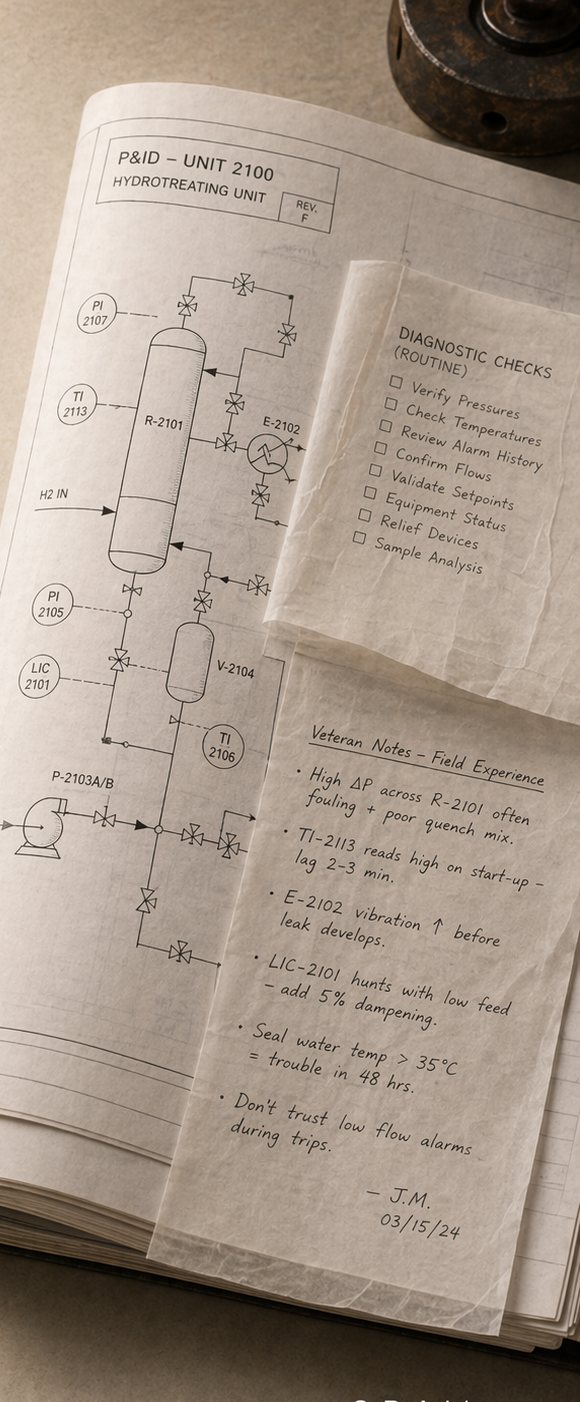
The Quiet Crisis in Process Engineering
Your three most valuable process engineers are within five years of retirement. The knowledge that makes your firm valuable exists only in their heads. When they leave, client relationships that have run for a decade go to tender for the first time.
What changes for the industrial and process engineering firm as AI enters its industry
Process engineering firms sell expertise that took decades to develop. The knowledge required to advise on complex process design, hazardous materials handling, or specialty chemistry application is expensive and slow to build. Client relationships are long-term, trust-based, and almost entirely personal. Clients buy the expert, not the firm brand. This model has worked for a generation. It is now being compressed from two directions at the same time.
From below: AI-powered process simulation and diagnostic tools are commoditizing the analysis work that justified mid-level billing rates. The revenue base for mid-tier engineers is eroding. From above: the senior specialists whose scarcity IS the product are aging out. Over 25% of the manufacturing workforce in major European economies is over 55. By 2030, Europe needs approximately 10.2 million replacement workers due to retirements. The knowledge these specialists carry is entirely tacit. It cannot be captured by asking them to fill in a template.
For the CEO of a process engineering firm, this is not a technology question. It is a revenue question, a profit question, and a valuation question. Revenue, because when a senior specialist retires, the client relationship they held personally goes to tender for the first time in a decade. Profit, because defending mid-level billing rates for diagnostic work that AI tools now perform at a fraction of the cost is a losing position. Valuation, because a firm whose competitive advantage walks out with every retirement is priced accordingly.
The strategic move is to capture senior knowledge while the specialists are still available, extend mid-level engineers' capability with AI so they can hold advisory-grade client conversations earlier, and build formal transition infrastructure so client relationships survive succession. The firms that move first do not just protect what they have. They convert personal expertise into institutional capability before the window closes.
This briefing is about what that move looks like, and how a management team gets it done before the next retirement announcement.
A knowledge crisis in slow motion. Revenue looks fine until it is not.
Process engineering built its business model on an assumption about knowledge scarcity. The expertise required to advise on complex industrial processes takes 25 to 35 years of field experience to develop. That scarcity created premium billing rates, long-running client retainers, and a competitive position that felt permanent. The model worked because the knowledge was hard to acquire, harder to transfer, and impossible to replicate quickly.
Two forces are now compressing that model simultaneously. AI simulation and diagnostic tools are performing the analytical work that justified mid-level billing rates. A process diagnostic that once required a team of three for a week can increasingly be completed in hours. The mid-tier revenue base is shrinking. At the same time, the senior specialists whose judgment commands the premium rates are approaching retirement age. 85% of European companies report insufficient technical talent, and 79% expect it to worsen. The pipeline of replacements is thin because the training period is measured in decades, not years.
When a 30-year veteran process engineer retires, the replacement challenge is not filling a vacancy. It is replacing institutional knowledge that took three decades of field experience to build.
The crisis is uniquely quiet. Revenue figures look stable because long-running client relationships continue on momentum. Delivery quality appears consistent because the remaining seniors absorb the load. The trigger event comes with little warning and significant consequence: a senior specialist announces retirement, a 15-year client goes to tender for the first time, and the firm discovers that the knowledge underpinning the relationship existed in one person's head. The firms that recognize this pattern before the trigger event have time to act. The firms that wait for the trigger are already behind.
Revenue. Profit. Valuation.
Under the old model these three questions had three different answers. The retirement wave ties them together. Solve the knowledge transfer problem and you move all three at the same time.
How many client relationships are one retirement away from going to tender?
In process engineering, clients buy the person. When that person retires, the relationship does not transfer automatically. A 15-year retainer that funded overhead, built trust, and generated referrals becomes an open competitive bid. The revenue impact is not the project fee. It is the decade of accumulated trust and the annual retainer that disappears with it.
What is your margin on diagnostic work that AI tools now perform?
Process simulation and analysis tools are compressing the diagnostic layer. The work that justified billing mid-level process engineers at premium rates is increasingly available at a fraction of the cost. Defending those rates against clients who have seen the alternatives is a losing position. The margin question is whether the firm can move upmarket fast enough to replace what the mid-tier is losing.
What fraction of your firm's value survives the next five retirements?
A process engineering firm whose competitive advantage is three specialists with 30 years of experience each is priced as a collection of personal practices. A firm whose knowledge is institutional, transferable, and encoded into its operating infrastructure is priced as an enterprise. Same revenue, very different multiples. Same firm, two different valuations depending on one architectural choice.
Two columns. The whole industry sorts itself between them.
The pattern is consistent across every function in a process engineering firm. Standard diagnostic work, regulatory compliance checking, and routine analysis are all compressing toward commodity. The work that appreciates is the work that depends on decades of accumulated field judgment, client-specific knowledge, and the intuition about what is about to go wrong. The further a function sits from that deep expertise, the more pressure it is under.
- Standard process simulation and diagnostic analysis
- Regulatory compliance checking and documentation
- Progress reporting and project administration
- Proposal boilerplate and qualification responses
- Training materials and onboarding procedures
- Complex process design for unusual conditions
- Hazardous materials judgment built over decades
- Client-specific knowledge no competitor holds
- The intuition about what is about to go wrong
- Relationship trust that survives personnel changes
Whichever column the management team trains the organization into over the next three years is the firm it becomes. The decision is not whether AI affects process engineering. It is which side of the line the leadership deliberately moves the organization toward.
Two paths. Same technology. Opposite outcomes.
Every process engineering firm faces the same retirement wave and the same AI compression. The technology is identical. The outcomes depend entirely on which problem the management team chooses to solve.
| The default path | The repositioning path |
|---|---|
| Hope knowledge transfers naturallyTrust mentoring and on-the-job training. Wait for the retirement announcement before acting. | Capture knowledge systematicallyExtract from project reports, client interactions, and specialist input while the experts are still available. |
| Defend mid-level billing ratesMaintain current pricing on diagnostic work. Absorb margin compression quietly. | Move the mid-tier upmarketUse AI to handle diagnostics. Free senior time for complex advisory. Extend mid-level engineers' capability earlier. |
| Let client transitions happen informallyThe retiring specialist introduces the replacement. Hope the client stays. | Build formal transition infrastructureInstitutional client knowledge, structured handover protocols, relationship continuity that does not depend on personal chemistry. |
| Accept the valuation discountThe firm is priced as personal practices. Every retirement is a write-down. | Earn the enterprise multipleInstitutional knowledge, transferable capability, client relationships that survive succession. The same revenue at a structurally different valuation. |
Same retirement wave. Same AI tools. Opposite firm valuations in five years. The difference is the knowledge architecture decision, not the technology decision.
The growth levers that compound when used together
The repositioning is not a single decision. It is four levers, each available to the firm right now, that compound when pulled together. Used in isolation, any one produces a modest gain. Used together, they convert personal expertise into institutional capability before the retirement wave makes it too late.
Capture senior knowledge while the specialists are still available
Not documentation projects. Not manuals. Structured knowledge extraction from existing project reports, client interaction histories, and active specialist input. Build queryable institutional knowledge from the work artifacts that already exist. The 30-year veteran's judgment about why a process works this way and not another way, captured and made accessible before the retirement announcement.
Extend mid-level engineers with AI-powered analytical capability
AI handles the diagnostic and simulation layer. Mid-level engineers spend less time on analysis that tools now perform and more time on the advisory conversations that build client trust. The gap between a 5-year engineer and a 25-year engineer narrows on the analytical side. The senior's time shifts to the complex judgment that commands premium rates.
Build formal client relationship transition protocols
Treat partner successions as programs, not events. Institutional client knowledge: what makes this client's process unique, what history matters, what concerns are never spoken but always present. Structured transition timelines that start two years before retirement, not two months. The client relationship survives because the knowledge infrastructure exists, not because someone hoped it would work out.
Reprice the firm around institutional capability, not individual expertise
A firm whose value proposition is "we have three people who know everything" is priced as a collection of personal practices. A firm whose value proposition is "we have institutional process knowledge that no competitor can replicate" earns a structurally different valuation. The reprice follows from the first three levers. The valuation changes when the knowledge architecture changes.
Business first. Technology second.
GRAIL is an AI-native management consultancy. We help European mid-market leadership teams figure out the one or two things that fundamentally change about their business as AI enters their industry, and then build the capability to act on it before competitors do. For industrial and process engineering firms specifically, the conversation is not about process simulation tools or automation platforms. It is about the knowledge architecture that determines whether your firm's competitive advantage survives the next wave of retirements.
The market offers two things: vendor lock-in dressed as transformation, and consulting reports dressed as strategy. GRAIL delivers a third option: working AI capability that you own.
- Senior advisory direct to the CEO and GMT
- Working AI capability you own from day one
- Custom agents built around your business logic
- Outcomes in weeks, not quarters
- No lock-in at any phase of the engagement
- Founded by operators, not technologists
- Business-first strategy, technology second
- Context architecture, change management, workflow design
- Results before you commit to scale
- Each next step earned, never assumed
Three sessions with your management team. No IT involvement. Working tools from week one.
GRAIL starts with the management team because organizational transformation cannot outrun the leadership team's personal understanding of what is possible. Three workshops. Each delivers standalone value. Each earns the right to the next.
How to think
The strategic foundation. Where AI creates real value in process engineering and where it is noise. The knowledge capture thesis. The client continuity framework. Your leadership team leaves with a shared frame for the rest of the work, and with the first working agent built live in the room.
Your AI team
A half-day activation. Each member of the management team receives a personal suite of five to ten custom agents trained on their workflow, their decisions, their competitive landscape. Client intelligence. Process knowledge extraction. Tender preparation. Working tools from week one, not slides about tools.
Competitive edge
Refinement from real usage. Agents upgraded based on how the team actually used them. The knowledge capture roadmap. The client transition infrastructure plan. The recommendation for what comes next, earned by what just shipped.
Three weeks. No IT involvement. No board approval needed to start. The sharpest strategic conversation your leadership team will have this year, backed by working tools they are already using.
What to ask in your next leadership meeting
The questions where the room cannot agree on an answer are the ones worth a longer conversation. Ask these honestly. The point is not the polished response. The point is whether the answer would survive contact with a major client retirement three months from now.
How many of your top ten client relationships are held personally by a specialist within five years of retirement, and what is the plan for each?
If you asked your team to document everything your most senior specialist knows about your longest-running client, how much of it could they actually write down without that person in the room?
What is your current margin on diagnostic and analysis work, and how does it compare to what AI-powered simulation tools deliver at a fraction of the cost?
When the last senior specialist retired, what happened to the client relationship they held? Would the same outcome be acceptable if it happened three times in the next two years?
If a potential acquirer asked what fraction of your firm's competitive advantage is institutional versus personal, what would the honest answer be?
If any of these questions land somewhere uncomfortable, that is the conversation worth having.
Continue reading
Sources and limitations
This briefing draws on GRAIL's engagement experience with leadership teams and on public company disclosures. Figures are illustrative unless a source is named beside them. A sourced edition is in preparation.