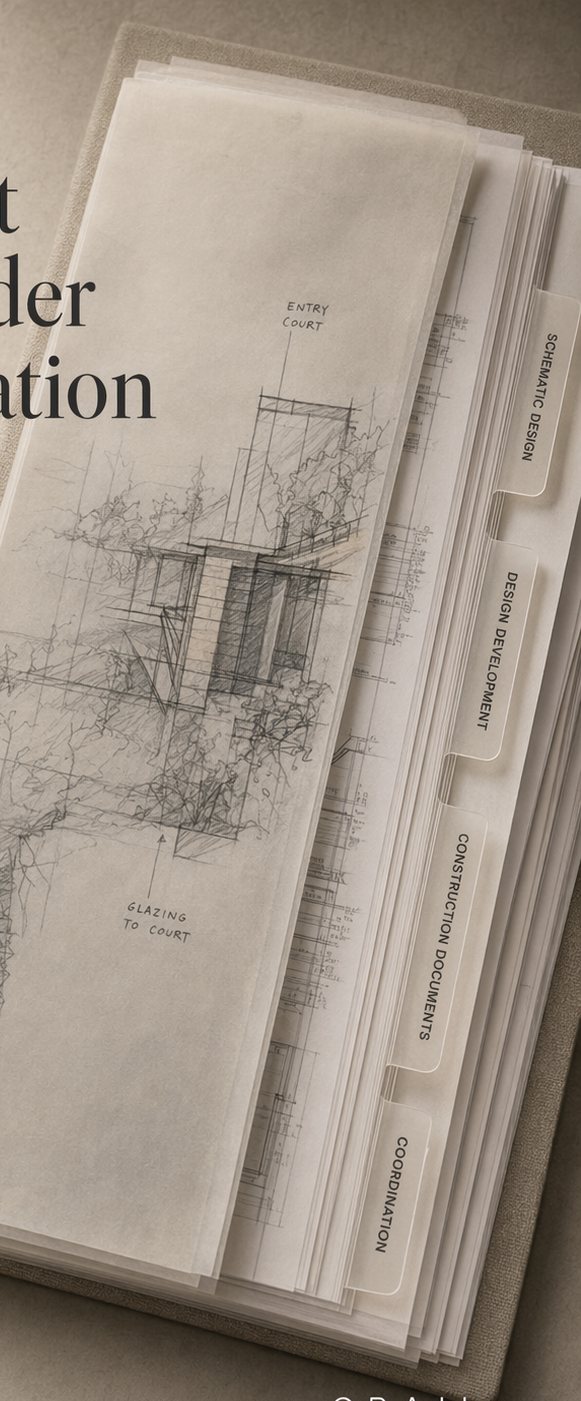
What's Changing in the Studio You're Building
Your senior designers spend forty percent of their time on the work they did not become architects to do. Your graduates leave the profession in their first three years. Your 2030 partner-track list is being shaped by decisions you were not invited to. A briefing for People Directors at mid-market European architecture practices.
Monday, 9:14 a.m.
Every People Director at a mid-sized European architecture practice has had the same Monday. Three things in the inbox. Friday: your senior designer of seven years resigned. The largest project he leads has the client asking for him by name. He took a position at an AI-native architecture firm in Stockholm. Your Managing Partner attached a note about the four graduate offer-accept declines this season. All four cited variants of "I want to design, not document." Two of them had the strongest portfolios in the intake round. Your sustainability specialist forwarded a client RFP demanding whole-life carbon analysis at a depth your team cannot deliver at current rates. The deadline is six weeks.
You have held this seat for four years. The pattern used to be simple. Hire designers who care about the work. Train them well. Protect studio culture. Keep the practice's reputation through the work it ships. The business was understandable.
Something changed. Your senior designers spend forty percent of their time on documentation, BIM coordination, specification writing, and sustainability calculations. That is not why they became architects. The graduates leaving cite the same fact. Your sustainability commitments demand analytical depth your team cannot deliver manually at current billing rates. AI-native architecture firms are starting to appear in the Nordics, and they are recruiting from your practice with a frame your senior designers find very compelling.
You do not have a retention problem. You have a vocation problem. Your apprenticeship architecture is being written every commission, in decisions you were not invited to: the BIM tool the design partner approved, the graduate role description that has not changed since 2019, the four declined offers nobody reconstructed this season. Your senior designers read the handwriting last month. Your graduates read it this morning.
This briefing covers what is happening in your sector, what it means for the people function you run, and the three questions your leadership team should answer before the next practice review.
Architecture practice just lost the equation that ran the apprenticeship
For nearly two centuries, the economic architecture of a practice ran on a simple exchange. Junior architects produced documentation under supervision. Senior designers exposed them by osmosis to design judgment over fifteen to twenty-five years. The best juniors became senior designers, then partners, and the practice's reputation compounded. Production work was the layer that paid for the apprenticeship. It was also the layer most exposed to AI. BIM coordination, specification drafting, regulatory compliance, sustainability calculation, standard detail generation. Substantially AI-augmentable today. Senior designers spend forty percent of their time on this work. Junior architects spend eighty percent.
The graduate retention problem in architecture is rooted in this same fact. Talented graduates leave the profession in their first three years citing variants of the same sentence. They came to design and they are documenting. Architecture has watched its strongest portfolios drift to tech careers and product design for a decade. AI removes the production grind that drove them out. The practice that uses this to redesign the graduate role around design exposure changes what the junior architect job actually is.
Your apprenticeship ran for two centuries on production work that is no longer yours to give. The question is whether the pathway gets rebuilt before the 2030 partner opening has no internal candidate.
The sustainability dimension is the second pressure on the same equation. Whole-life carbon analysis, climate resilience assessment, ESG certification, circular-economy material sourcing. Analytical demand that exceeds what any practice can deliver manually at current billing rates. AI is the infrastructure that makes serious environmental commitment credible at scale. The practices building that capacity now are winning commissions that competitors cannot serve. The ones still treating sustainability as a specialist function are watching those commissions go elsewhere. Same technology. Different competitive position depending on which lens you pick up first.
Your studio is feeling it every day
Your talent acquisition. Your senior designer of seven years resigned on Friday to an AI-native firm. Your best lateral recruits in the last two quarters came from competitors who read your hesitation as opportunity. Your graduate offer-accept rate is dropping; the strongest portfolios are asking what your practice's AI strategy is in second-round interviews, and "we are thinking about it" loses them. A-players do not quit on the spot. They start looking quietly. By the time retention moves in the dashboard, they have already decided.
Your L&D. Your CPD budget is allocated to RIBA-compliant modules, software training, and an annual conference. None of it is designed for continuous in-the-studio coaching, agent-paired practice, or the apprenticeship redesign your sector now requires. Two populations are forming inside your studio whether you designed it or not. The top decile is using AI daily and building design judgment that compounds weekly. The rest is producing the work the previous generation of juniors produced. Both groups are becoming who they practice being.
Your compensation architecture. Your rate card and partner-track compensation reward billable hours and project delivery. Agents are compressing the production hours, and the senior designers who matter most read every quarter for a signal about whether the practice is being redesigned around the design work or around a thinner studio with cheaper labour. Your sustainability specialist commands a market premium your current pay band does not match. The compensation review last month did not see the gap.
Your employee relations and works council. Your design partners have introduced three AI tools into the studio without HR in the room. The works council, where you have one, is asking questions. The regulatory load on people functions has stacked: AI literacy documentation, high-risk recruiting and performance-management systems, framework agreements, data-minimisation in new agentic tools. None of it shows up on the project dashboard. All of it lands on you.
Your workforce planning and succession. Your 2030 partner-track list has names on it. At least three came through the production work that agents have already absorbed. You have not replaced the pathway. The external senior designer hire in 2030 will cost a thirty to forty percent premium, take eighteen months to integrate, and bring the previous practice's design DNA. On a long enough horizon, the People Director who watched the production layer compress without rebuilding the apprenticeship is the People Director the partnership blames for the 2031 partner opening with no internal candidate.
The atelier was always the architecture
Your sector is repricing the apprenticeship from below because the production layer is compressing. Your people function is stretched because every tool decision, every project staffing call, every framework-agreement opening is a fragment of an apprenticeship strategy that somebody is writing and you are not always in the room when they do. Same force, two altitudes. There is a third thing happening that most mid-market practice People Directors have not named yet.
Your apprenticeship architecture is being written every commission. The BIM tool the design partner approved last quarter. The graduate role description that has not been updated since 2019. The four declined offers this season nobody reconstructed. Your senior designers read the handwriting last month. Your graduates read it this morning. Your 2030 partner-track list is being shaped by decisions that look like project staffing and are actually architecture.
The atelier system produced the world's great architects for six centuries because the apprentice sat next to the master on real commissions. Production work was what collapsed the atelier in the twentieth century, when the master could not afford to have apprentices in the room while production happened at scale. The school-then-firm model replaced it. Junior architects spent two to four years on documentation to build technical competence before exposure to design judgment. AI inverts the math. Production costs near-zero in agent time. The atelier is suddenly affordable again, in agent-paired form, for the first time since 1816.
You can tell which camp a practice is in from a single question. Of the successors on your 2030 list, which ones came through work that still exists? Most mid-market practices cannot answer. The ones that can have already rebuilt the pathway.
You have twelve to eighteen months to author the apprenticeship deliberately, or the project pipeline writes it for you in staffing decisions you make under deadline pressure. Same technology. Same studio. Different practice depending on whose handwriting the answer is in.
What most practices are doing. What the winners are doing instead.
Every practice has had the AI conversation. Most are making the same four decisions. A smaller group is making different ones.
| The default path | The winners' path |
|---|---|
| Restrict AI tools for quality and IP controlSenior designers use AI anyway. They read restriction as mistrust. The best ones start looking quietly. | Publish three rules that defend real trustRouting by design sensitivity, not by tool. Senior designers watch the leadership the first time something fails. |
| Cut graduate intake to fund production-tool licencesCheaper studio in Q1. Empty senior bench by 2031. External hires bring the previous practice's design DNA. | Ship one commission as a senior-junior-agent triadJunior sits next to senior on every design judgment from week one. The atelier mechanism, agent-paired form. |
| Announce a studio-wide redesign at the partner meetingSenior designers whose work changes vote against. The redesign stalls. Lift-out risk rises. | Four senior designers author their own redesigns firstEight-week atelier-style council. They bring it as their own work. The loudest critics become the loudest defenders. |
| Treat sustainability as a specialist function with one hireCapacity ceiling defined by one person's hours. Commissions exceeding that ceiling go to competitors who built the capability across the studio. | Ship sustainability as default capability across the studioEvery senior designer paired with whole-life-carbon analysis. The practice wins commissions that exceed competitors' capacity at current rates. |
Same studio. Same twelve months. Opposite outcomes. The difference is whose hand is on the pen.
Talent Gravity. Capability Compounding. Succession Readiness.
Three questions every People Director is tracking. None of them used to be the same question. They are now.
Are your senior designers staying because of you, or despite you?
Your best senior designer resigned on Friday to an AI-native firm. Your best lateral recruits last quarter came from the same place. Your graduate offer-accept rate is slipping. The strongest portfolios are asking what your AI strategy is and "we are thinking about it" is not winning them. A-players watch which way you lean the first time something goes wrong.
Is your studio's design capability deeper this December than last?
Two populations are forming in every practice. The top decile is using AI daily and building design judgment that compounds weekly. The rest is producing the work the previous generation produced. Your CPD budget funds modules and an annual conference. Neither moves the median. The practices pulling ahead make the 90th-percentile workflow the studio default.
Of your 2030 partner-track list, how many came through work that still exists?
Your successor list has names. At least three came through production work that agents have already absorbed. You have not replaced the pathway. The external senior hire in 2030 costs a thirty to forty percent premium and brings the previous practice's design DNA. The apprenticeship gets rebuilt now or gets inherited as a gap.
What the practices winning this play are actually doing
Four concrete moves any People Director can start this quarter. Each addresses one sub-function. Pulled together, they become one answer the practice compounds on.
Talent: publish the practice's vocation memo in your first 100 days
Two pages, co-signed by the Managing Partner. What this practice believes architects are for. Which roles are being redesigned around design exposure and agent partnership. What happens to a designer whose role changes materially. Referenced every quarter. Every AI tool decision after it gets decoded against this memo. Without it, every decision is decoded against rumour and your senior designers fill in the gap with the worst reading.
L&D: ship one commission as a senior-junior-agent triad this quarter
Senior designer, junior architect, and agent ensemble as one inseparable unit. The junior does not coordinate BIM models in the back room. The junior operates the agent ensemble in front of the senior on live design work from week one. The senior watches the design judgment in real time. Design-exposure hours go from one hundred and fifty a year on the old apprenticeship to eighteen hundred on this one. The atelier clock compresses from twelve years to five. Start with one commission. Template the next three from the learning.
Succession: senior designers author their own practice redesigns first
Do not announce a studio-wide redesign at the partner meeting. That meeting fails because the senior designers being asked to approve it are the ones whose work changes most. Invert. Assemble four senior designers — the ones whose departure would be most damaging — as the authoring council. Their first assignment: redesign their own practice area at the task level in eight weeks. They bring it to the partnership as their own work. The four loudest possible critics become the four loudest defenders.
Trust: publish three rules, one for client-visible work, one red line
Three rules about what the studio can do with AI without asking permission. One rule about what gets senior review before it reaches the client. One rule about what never goes to an agent. Published. Defended to the partnership when an experiment fails. Your senior designers watch which way you lean the first time something goes wrong. Published rules build real capability. A thousand small, sensible no's build the illusion of control and the reality of drift toward AI-native competitors.
The only firm that joins studio authorship to working agent infrastructure
The architecture-practice People Director has four places to go. None can do what we do.
The architecture-industry HR consultancies and professional bodies (RIBA Practice Resource, AIA practice management, regional networks, salary surveys) describe how practices have always worked. When the apprenticeship pattern inverts, their benchmarks become a liability.
The Big Four human-capital practices (Deloitte Human Capital, Mercer, Korn Ferry, Willis Towers Watson) run survey-benchmark models. They have never sat in a design crit. The differences that actually matter in architecture get smoothed in their benchmarks.
The HR-tech vendors (Workday, BambooHR, Personio, Hibob) sell platform software. Your practice's design DNA encoded in senior-junior relationships and project archives is your moat. Building this on a vendor stack licenses the moat back to the vendor.
The CPD platforms (LinkedIn Learning, Coursera, RIBA CPD) sell content libraries. The architectural pathway is pattern-exposure work, not module work. A platform cannot rebuild the apprenticeship that agents have just made affordable to redesign.
The market offers four things you have already said no to. GRAIL is the fifth option.
- Senior advisory that speaks studio, not HR-deck
- Working agent infrastructure your team uses week one
- One commission redesigned as senior-junior-agent triad
- A vocation memo the Managing Partner co-signs
- No vendor lock-in at any phase of the engagement
- Founded by operators who have carried people-adjacent seats
- Business first, technology second
- Three weeks from first meeting to working infrastructure
- Your team keeps the infrastructure, you own the IP
- Every next step earned by what just shipped, never assumed
Three sessions with your studio leadership. Working infrastructure from week one.
We start with your studio leadership team because the change cannot outrun the team's personal understanding of what is possible. Three workshops. Each delivers standalone value. Each earns the right to the next.
How to think
Walk through what is happening in your sector and inside your studio. Draft the first page of your vocation memo in the room, with your Managing Partner present. Your leadership team leaves with a shared view of what the practice believes architects are for and the first draft of the document the Managing Partner will co-sign.
Your studio infrastructure
A half-day build. Your design partners, studio heads, sustainability specialist, and graduate-programme lead each leave with working infrastructure tuned to their domain. Senior-junior-agent triad architecture. Whole-life carbon analysis agent. Senior-designer-authored redesign template. Three-rules studio trust document. Infrastructure your team uses the same week.
Ready to run
Refined infrastructure based on real use. The first commission delivered as senior-junior-agent triad. The published vocation memo, co-signed. The senior-designer-authored redesign roadmap. The Managing Partner conversation with numbers the partnership can check: external-hire premium math, graduate retention forecast, sustainability commission pipeline.
Three weeks. No IT project. No partner vote needed to start. The infrastructure your studio is already using when we finish.
For your next practice review
The questions where your studio leadership cannot agree on an answer are the ones worth an hour on the agenda. Ask these honestly.
If you asked three of your best senior designers privately tomorrow whether the practice's AI strategy is being done for them or to them, what would they say? Do you know the names, and can you describe the evidence?
Walk me through one role in your studio that has been redesigned at the task level in the last twelve months. Who did the redesign, what did it change, and what does the incumbent do with their week that they did not do before?
Of the names on your 2030 partner-track list, how many came through the production work that agents have already absorbed? What is replacing the pathway for the ones whose pathway is gone?
Your apprenticeship architecture is being written this quarter in tool decisions, project staffing, and graduate role descriptions. How many of those fragments are you the author of, and how many are you decoding after they ship?
Of your senior designers — the four whose departure would be most damaging — have any of them been asked to author the redesign yet, or are they waiting to be presented with a vote on yours?
If any of these produces a disagreement in your studio leadership, that is the conversation worth having before the next partner meeting.
Continue reading
Sources and limitations
This briefing draws on GRAIL's engagement experience with leadership teams and on public company disclosures. Figures are illustrative unless a source is named beside them. A sourced edition is in preparation.