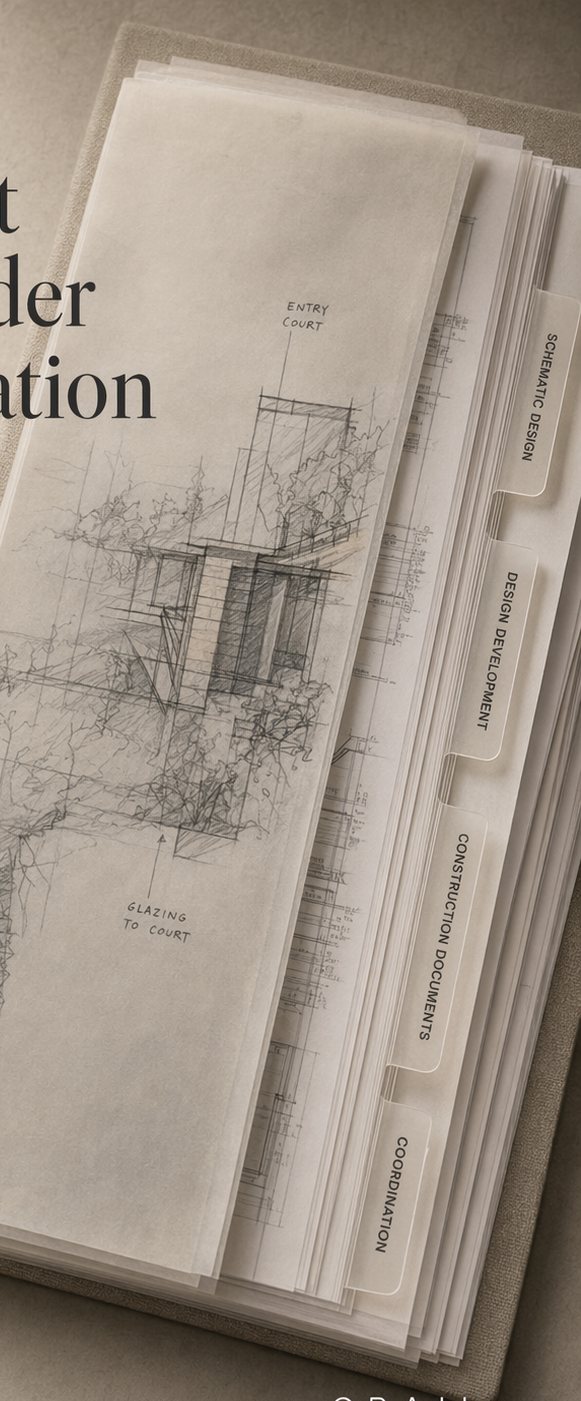
What's Changing on Your Studio Floor
Competitions lost to practices whose work you do not admire. Fees under quiet pressure. Your best designers buried in documentation. Three problems that look separate, but are actually one. A briefing for commercial directors at European architecture and design practices.
You have seen this in your studio
Every commercial director at a mid-sized European architecture practice has had the same Thursday. Three items on the partnership agenda. The competition submission for the municipal culture quarter went to a practice whose work you do not admire. They had whole-life carbon analysis across four material strategies. Your team had one. Anna, your best technical architect in the sustainability group, resigned on Monday citing "I want to do design, not spec chase." Your senior partner asked you to explain what the practice is doing about AI before the board meeting next month. You have a folder of vendor demos and no coherent answer.
You have been leading new business at this practice for more than a decade. The pattern used to be simple. Win the right commissions. Build long client relationships. Hire designers who could carry the craft. Keep the fees at a level that funded the design depth. The practice grew on reputation and on designers who were known by name.
Something changed. Your senior designers spend forty percent of their week on technical documentation, BIM coordination, and specifications. The sustainability analysis the commission requires now exceeds what your team can deliver at the fee the client will pay. Your junior pipeline is thinning because graduates did not come to your studio to coordinate BIM. Competition submissions are getting beaten by practices whose bid teams clearly have more analytical depth at the same stage. Fees are under quiet pressure from bidders who have worked out how to deliver more design per euro.
This is not a you problem. It is an industry shift and a practice shift, happening at the same time. Most commercial directors are treating them as two. The ones who see them as one are going to own the next decade of signature commissions in European architecture.
This briefing covers what is happening in architecture as a sector, what it means for your studio floor and your bid team, and the three questions your partnership should answer before the next board cycle.
Architecture just got the first technology wave in forty years that funds design
Every technology wave your profession absorbed in the last four decades expanded the technical layer you had to deliver. CAD made drawings richer, so clients expected more iterations. BIM made models coordinated, so projects produced more documentation. Digital twins extended the deliverable set across the full asset lifecycle. Each wave gave the practice a bigger production layer and a proportionally smaller design layer. That is why your senior designers now spend forty percent of their week on documentation. Forty years of accumulated technical capability has to ship on every project, and somebody has to ship it.
AI does not behave the same way. The client still needs the same building, the same compliance submission, the same technical documentation set. The scope of work is unchanged. What changes is that the production layer can now be done by AI under senior review. For the first time in forty years, a technology wave compresses the production side of the practice instead of expanding it. The senior designer hours that have been slowly bleeding out of the studio since CAD can return to the work only senior designers can do.
The practice that sees this first recovers design time from the administrative layer that has grown around it since BIM. The practice that treats it as efficiency misses the whole point.
The sustainability dimension is the second force, and for many practices it is the stronger one. Whole-life carbon analysis, circular economy material sourcing, climate resilience assessment, and ESG certification preparation. The analytical demand on a credible sustainability commitment now exceeds what any practice can deliver manually at current fees. Practices with serious environmental ambition need AI to make the commitment operationally real. White Arkitekter's 2030 climate-neutral design target, Henning Larsen's sustainability-led positioning, C.F. Møller's circular economy work all run into the same analytical capacity wall. Practices that build this capability win the commission tier where sustainability credentials are the buying criterion. Practices that do not cannot credibly bid that tier at all.
Your studio, your bid team, and your junior pipeline are all saying the same thing
Your competition submissions. Your bid team walks into the shortlist review with the sustainability narrative they could prepare inside the bid window. Your competitor walks in with whole-life carbon analysis across four material strategies, climate resilience modelling, and material-sourcing comparisons. Win rate on competitions where the client is buying sustainability credentials is dropping. The bid window has not changed. What changed is the analytical depth competitors can now deliver in the same window, because they have built the infrastructure to produce it.
Your practice brand. Clients who commission signature buildings research practices differently than they did three years ago. Answer engines surface the practices whose work is documented with specific sustainability outcomes, whose senior designers are cited in trade press, whose methodology is visible in published research. Practices that treat brand as "we post project photos" are losing consideration before the shortlist forms. The leading practices are shifting brand work from documentation to authority: original research on whole-life carbon methodology, senior designer voices in architectural trade press, published studies of completed work. Your practice becomes the preferred candidate before the competition brief drops.
Your bid team and operations. The function that assembles competition submissions, including bid coordinators, technical support, sustainability specialists, and visualisation team, is becoming the architecture of your entire commercial engine. The tools every senior designer uses. The precedent library. The sustainability methodology. The agents that capture what your senior designers know. The analysis your competitor already has. All of it runs through the bid and operations layer. Most practices still treat bid as a reactive function. The ones pulling ahead are repositioning it as the place where the practice's commercial capability is built.
Your senior designers' week. Technical documentation, BIM coordination, specification writing, regulatory compliance. Sixteen to twenty hours a week of work that used to be the cost of being a senior designer at a practice with serious technical standards. That work can now be done by AI under senior review in under an hour once your studio is set up for it. Your senior designers spend the recovered time on concept development, design critique of junior work, and client dialogue. The design depth per project rises. The practice's reputation follows.
Your junior architects. Your graduates did not come to your studio to coordinate BIM. They came to design. The production grind consumes sixty percent of their week today, and the best of them are leaving for design-tech startups where they at least feel like they are building something. Redesign the junior role around design apprenticeship, with AI doing the production work under junior supervision, and retention compounds. The junior learns design by designing under senior critique, which is what the studio promised them on hire day.
The winners are already running one practice motion
Your industry is compressing the production layer because AI takes hours out of documentation. Your practice is compressing because your senior designers now have hours back they did not have before, and competitors are showing up with analytical depth your bid team cannot match in the same window. Same force, two altitudes. But there is a third thing happening that most commercial directors have not named yet, and it is the one that matters most.
Look at the practices pulling ahead. The studio, the practice brand, and the bid operations are running as one commercial motion, not three separate teams. Senior designers feed the precedent library after each project. The bid team draws on that library with sustainability and material specificity nobody else can match. The brand team publishes the methodology the bid team used, which feeds the next competition shortlist. The data compounds. The tools compound. The reputation compounds.
Most practices are still running three separate plans. A design-tool update for the studio. A website refresh for brand. A new competition template for bid. Twelve months later nothing compounds, because the three plans never met.
Your competitors who get this will win signature commissions that require design depth yours cannot show in the bid window. Their senior designers will design more, their juniors will stay longer, their sustainability work will be operationally credible, and their fees will hold. Three things compounding into one. This is what the next eighteen months look like if your practice does not move.
You have eighteen to twenty-four months. The AI conversation across architecture has moved from "should we" to "how do we." Your question now is whether the partnership leads the direction of this investment, or the operations team decides it for you.
What most practices are doing. What the winners are doing instead.
Every commercial director has had the AI conversation by now. Most practices are making the same four decisions. A smaller group is making different ones. The difference is whether AI is treated as a tool to roll out, or as the set of levers that reshape how the practice operates.
| The default path | The winners' path |
|---|---|
| Run studio, brand, and bid as three separate plansThree plans that never meet. A design tool for studio, a website refresh for brand, a competition template for bid. | Run one practice motion across all threeSenior designers feeding the precedent library. Bid team drawing on it with specificity. Brand publishing the methodology it produces. |
| Buy a design-visualisation tool and call it the AI strategyEvery practice has the same tool within a year. The tool is the commodity. | Build the tools your senior designers actually useTuned to your practice's typology, precedent, and sustainability methodology. Yours to keep, compounding with every project. |
| Treat sustainability as a marketing narrativeAmbition stays aspirational because the analytical capacity to back it up does not exist at current fees. | Build sustainability as analytical capabilityWhole-life carbon, material sourcing, climate resilience delivered at depth. Commission tier opens that competitors cannot bid credibly. |
| Wait for the production grind to drive juniors outRetention drops. Senior pipeline thins. Recruitment gets harder every year. | Redesign the junior role around design apprenticeshipAI does production under junior review. Juniors learn design by designing. Retention compounds. |
Same technology. Same twelve months. Opposite outcomes. The difference is the partnership, not the AI.
Commissions. Fees. Design time.
Three questions every commercial director at an architecture practice is tracking. None of them used to be the same question. They are now.
Why are we losing commissions we should be winning?
The competition went to a practice whose work you do not admire. They did not undercut you on fee. Their submission showed more design depth and more sustainability specificity than yours in the same bid window. Their bid team had analytical capacity your bid team could not match. This is happening more often than two years ago, and the trend moves in one direction. Your bid team is not losing talent. They are losing the preparation race.
Why are our fees under quiet pressure?
The fee bid went in at the level the practice needs to do the work at its standard of design depth. The client came back with a reference to a competitor's fee that was fifteen percent lower. You either walk or redesign the scope at a fee that does not fund the design depth your partnership committed to. Fees are not collapsing in one quarter. They are drifting quietly, and the practices that figure out AI first will hold the fee tier you are losing.
Where did our senior designers' design time go?
Your senior designers spend forty percent of their week on technical documentation, BIM coordination, and specifications. The work that wins commissions, which is concept development, client dialogue, and critique of junior work, gets squeezed into evenings. Your junior pipeline is thinning because the production grind is what juniors actually do at your studio. For thirty years this problem has had no answer. In 2026 it has one, but only if you move before the operations team decides for you.
What the practices winning this play are actually doing
Four concrete moves any commercial director at an architecture practice can start this quarter. Each one touches a different part of the practice. Pulled together, they fuse the whole practice into one commercial motion.
Competitions: get your bid team to design depth your competitors cannot match in the window
The bid team that walks into a competition with whole-life carbon analysis across four material strategies, climate resilience modelling, and precedent specificity wins at roughly twice the rate of the team that walks in with one material strategy and a sustainability narrative. Twenty hours of bid analysis compresses to two hours of senior designer review. Your senior designers spend the recovered time on concept direction and client dialogue. Your win rate follows.
Brand: shift from project photography to published methodology
Clients commissioning signature buildings research practices through answer engines, architectural trade press, and published methodology now. Project photography is not enough. The leading practices publish whole-life carbon methodology, circular economy approach, and senior designer voice on the craft questions the client is wrestling with. Your practice becomes the preferred candidate before the competition brief is drafted.
Bid and operations: move from reactive to architected
The bid function that used to assemble submissions when the brief drops is the new centre of gravity for the practice's commercial capability. In the leading practices, bid owns the precedent library, the sustainability methodology, the analytical tools every senior designer uses, and the agents that capture senior knowledge. Hardest role to hire for. Highest impact once in place. Without it, the other three moves stay siloed.
Senior knowledge and junior role: capture one, redesign the other
Your senior designers carry twenty years of typology knowledge, material intuition, and client judgment in their heads. It has always been biographical, which is why replacing one takes a decade. AI now extracts it from project records, design critiques, and precedent studies into a system every designer at the practice uses. Junior role redesigns around design apprenticeship with AI doing production under junior review. Seniors stay productive in design. Juniors stay in the profession. Start now.
The only firm that joins the studio to the working tools
The commercial director at an architecture practice in 2026 has four places to go. None can do what we do, each for a specific reason.
Architecture-specific AI tools, like Veras, Midjourney, parametric assistants, and Autodesk AI in Revit, ship real capability. They will not sit in the partnership meeting and help decide which tools, for which designers, on which projects.
Multidisciplinary consultants with architecture arms, like Ramboll, AFRY, Sweco, and Arup, have engineering scale to build AI capability. They cannot carry the design sensibility a practice is hired for. The client hiring White Arkitekter is not going to accept a Ramboll response in a White logo.
The large consulting firms will produce a strategy deck about the future of architecture practice. They cannot put a working whole-life carbon tool in a senior designer's hand in three weeks. Their cost structure requires partner-led teams billing analyst hours.
Hire a Head of AI, or partner with an AI-native studio. Works at the scale of SOM, Foster + Partners, or Zaha Hadid. At mid-market scale, the hire is either senior enough to not build the tools or junior enough to not have the practice context.
The market offers four things your partnership has already said no to. GRAIL is the fifth option.
- Senior advisory that speaks studio, not strategy-deck
- Working tools your senior designers use the same week
- Custom tools built on your precedent, your sustainability methodology
- The start of a knowledge system your seniors feed
- No vendor lock-in at any phase of the engagement
- Founded by operators who have sat in creative practice rooms
- Business first, technology second
- Three weeks from first meeting to working tools
- Your practice keeps the tools, you own the IP
- Every next step earned by what just shipped, never assumed
Three sessions with your partnership. Working tools from week one.
We start with your partnership because the change cannot outrun the senior team's personal understanding of what is possible. Three workshops. Each delivers standalone value. Each earns the right to the next.
How to think
Walk through what is happening in architecture and inside your practice. Build the first working tool in the room: a whole-life carbon analysis agent on a real project your senior designers are running, or a competition-submission engine drawing on your practice's real precedent library. Your partnership leaves with a shared view and the first working tool already in senior hands.
Your practice's tools
A half-day activation. Each member of your partnership leaves with five to ten working tools tuned to their projects, their clients, their typology. Competition submission. Sustainability analysis. Precedent curation. Design critique support. Junior coordination replacement. Tools your senior designers use the same week, not slides about tools.
Ready to roll
Refined tools based on real use. The rollout plan to your wider studio. The senior-knowledge capture plan. The junior role redesign. The sustainability capability you can now credibly bid. And the Managing Partner and board conversation with numbers they can check, not a deck they cannot argue with.
Three weeks. No IT project. No board approval needed to start. The tools your practice is already using when we finish.
For your next partnership meeting
The questions where your partnership cannot agree on an answer are the ones worth an hour on the agenda. Ask these honestly.
Of the last ten competitions you lost, how many went to practices whose submissions showed design or sustainability depth yours could not match in the same window?
What percentage of your senior designers' week is design and design critique, and what percentage is technical documentation and coordination? What was the ratio five years ago?
If your practice committed to a 2030 climate-neutral design standard tomorrow, what analytical capacity would you need, and how much of it exists in your studio today?
How many of the juniors you hired three years ago are still at the practice, and what do the ones who left say in their exit conversations about why?
Which senior designer at your practice is already using AI tools on their projects today, and what would it take for that to be the way the practice designs by 2027?
If any of these produces a disagreement in your partnership, that is the conversation worth having before the board asks.
Continue reading
Sources and limitations
This briefing draws on GRAIL's engagement experience with leadership teams and on public company disclosures. Figures are illustrative unless a source is named beside them. A sourced edition is in preparation.