What's Changing in How You Think Together
Your partners are spending their best hours supervising work AI now does. Your analyst pipeline is losing the training ground that produced your seniors. And the knowledge your best partner carries has never been written down. Three problems that are one. A briefing for operations leaders at strategy and management consulting firms.
You have seen this on your delivery floor
Every Chief Operating Officer or Head of Delivery at a mid-sized European strategy or management consulting firm has had the same Tuesday morning. Three engagements on review. The first: a €280K organisational study, two weeks late because the senior partner cannot clear eight hours for the synthesis session. The second: a private equity due diligence, the junior team's model took four days and the client's own tool parsed the same data in an afternoon. The managing partner mentioned it in the debrief. The third: your most experienced strategy partner, twenty-two years in the firm, had coffee yesterday with someone from a competitor. Nobody on your bench has led a CEO-facing engagement alone.
You have run this function for fifteen years. The model used to work. Senior partners hold clients. Managers run engagements. Analysts produce. Something changed.
Your senior partners are spending twelve to fifteen hours of their billable week supervising analysis AI tools already do faster. Your analysts are producing work clients benchmark against those same tools. And the retainers your best partner carries are a single departure away from competitive tender. Most operations leaders are treating these as three separate problems. The ones who see them as one are redesigning for the next decade.
This is an industry problem and a delivery-engine problem, arriving together. The firms that see the connection first are closing more work with the same partner headcount at margins the old model could not reach.
This briefing covers what is happening in your sector, what it means inside your delivery engine, and the three questions your operations leadership should answer before the next partner meeting.
Strategy consulting just lost the cost structure that ran it for a generation
Every technology wave the consulting sector absorbed in the last thirty years gave clients a reason to pay for more advisory hours. Complexity expanded. Clients needed more specialists. The junior cohort absorbed the growth. The margin held because clients could not do the work themselves.
AI does not behave the same way. The client still needs the strategy engagement, the due diligence, the competitive assessment. But sixty to seventy percent of what junior analysts spend their week producing — benchmarking, modeling, market sizing, slide construction — can now be done in a fraction of the time by tools the client already uses. Under hourly billing, faster delivery means less revenue per engagement. And for the first time, clients are arriving at the proposal with their own estimate of what efficient delivery should cost.
Your clients' procurement teams are arriving at RFPs with AI-cost benchmarks. By the time your proposal lands, the rate has been anchored.
A handful of Nordic and European boutiques have moved first. They have separated the pricing of the senior judgment layer from the junior production work that used to carry it. The same engagement closes faster, at a cleaner margin, with senior partners on the advisory the client cannot produce themselves. A boutique with twelve senior partners that frees fifteen hours per partner per week from supervision does not get the same firm at lower cost. It gets a different firm, one that takes significantly more work with the same team.
Your delivery engine, your bench, and your client continuity are feeling it this week
Your delivery engine. Engagement timelines are slipping on work that has not changed in scope. Project reviews surface the same friction points every quarter: senior partners unavailable for synthesis, junior work cycling through three rounds of review, handoffs built in 2010 and never revisited. The delivery engine runs the same way it ran in 2015. The tools changed. The process did not.
Your delivery quality. The quality floor holds. The ceiling has not risen in ten years. The senior partners who catch the strategic framing error a manager would miss, who read the client's political landscape before it appears in the briefing. They carry that judgment as biography. It has never been written down anywhere the firm owns. When one leaves, the next engagement reveals the gap quietly. Three engagements later, the client mentions it.
Your partner bench. Your senior partners bill at premium rates on work that increasingly contains a production layer the firm has not redesigned around. Realisation on mid-tier engagements is drifting two to four points a year. Most of your partner bench has not had a direct conversation yet about what supervision looks like when the production layer below it changes.
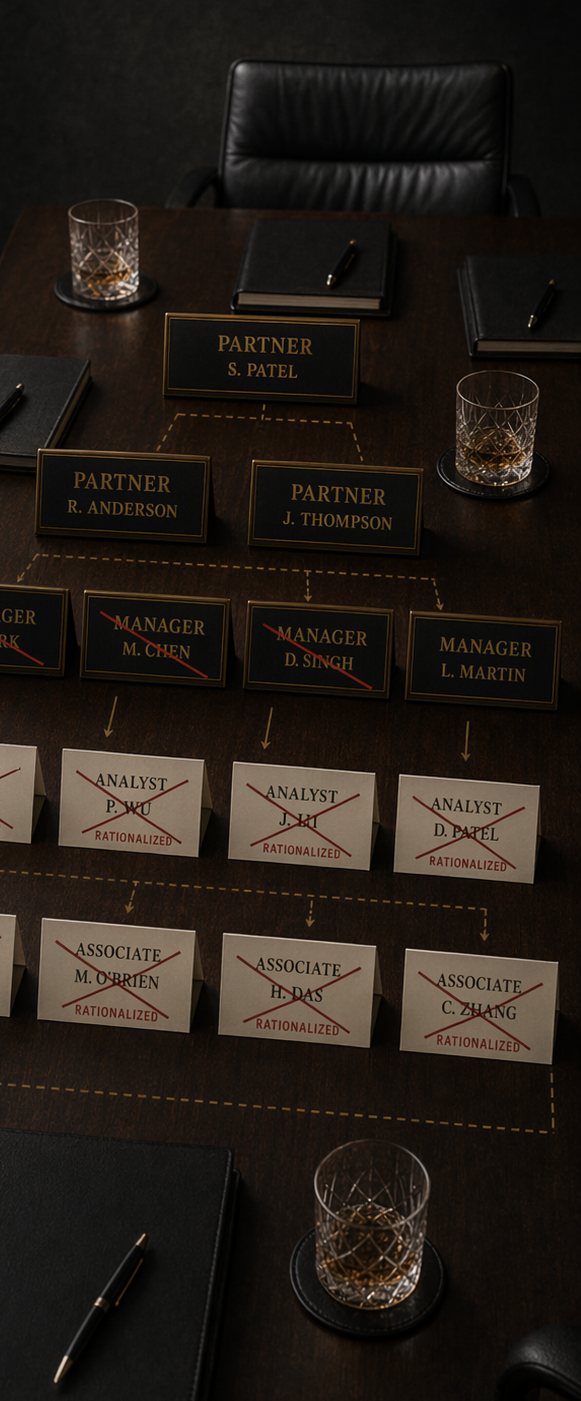
Your analyst pipeline. The routine analysis that trained analysts into managers is running on agents at the firms that have moved. New graduates are spending months on work that will not exist in the same form in two years. The training ground is disappearing. The firm that does not rebuild the analyst pathway around judgment and synthesis from day one will have a thin senior bench by 2030.
Your client continuity. Your three most experienced partners carry two to four major retainers each, built on fifteen to twenty years of client-specific knowledge never captured anywhere the firm owns. One departure can put €400K to €1.2M in annual retainer revenue at competitive tender within eighteen months. The retirement conversations are on your calendar.
The firms pulling ahead have seen that this is one problem
Your sector is compressing from below because AI shrinks the analysis work junior consultants bill for. Your delivery engine is stretched from above because your senior partners spend a third of their billable week supervising the production underneath their advisory work. Same force, two altitudes. But there is a third thing most consulting operations leaders have not named, and it is the load-bearing one.
You do not have three problems. You have one. The knowledge that makes your firm valuable has never been separated from the people who carry it. Every margin problem, every quality inconsistency, every client continuity risk is a symptom of that single unsolved thing. The firms pulling ahead are not running three separate programmes. They are building one piece of infrastructure: engagement memory as a firm asset, not as individual biography. The senior who leaves contributes to it on the way out. The new analyst learns from it on the way in.
You can tell which camp a firm is in from one question. Can you name one senior partner whose advisory hours with clients went up this quarter while their supervision hours went down? The firms that answer yes have already started. The ones that cannot are running a delivery engine designed for a cost structure that no longer exists.
You have eighteen to twenty-four months before clients routinely arrive at the proposal with their own benchmark for what efficient delivery should cost. The firms that reprice on their own terms before that moment own the conversation.
What most firms are doing. What the winners are doing instead.
Every consulting operations leader has had the AI conversation. The difference between most firms and the winners is architecture, not tooling.
| The default path | The winners' path |
|---|---|
| Add AI to juniors, bill the same wayEngagements close sooner. Revenue per engagement falls when clients ask why the rate did not move with the efficiency. | Price the judgment layer explicitlySeparate what the senior partner does from what production infrastructure does. Advisory rates hold. Production layer is internal cost. |
| Leave partner knowledge as personal biographyNobody captures what the senior knows. Replacement learns the hard way. Client notices within two engagements. | Build engagement memory as a firm assetCapture from artefacts partners already produce. Prior syntheses, client briefs, working notes. The knowledge stays when the partner goes. |
| Deploy tools on the existing delivery modelIndividual work speeds up. Timelines stay stuck because bottlenecks are in handoffs and senior review cycles, not in production speed. | Rebuild delivery around freed senior hoursFifteen fewer hours per week on supervision per senior. Those hours go to client advisory. Firm takes more work at better margin with the same headcount. |
| Protect analysts by keeping production workPathway feels intact. But the skills being built are the ones that will not exist in the same form in three years. | Redesign around judgment from day oneNew analysts on composite advisory work paired with agents. Skills that compound into senior capacity, not skills that agents replace. |
Same talent. Same clients. Same twelve months. The architecture is the difference.
Engagement Margin. Delivery Quality. Partner Throughput.
Three questions every consulting operations leader tracks. None of them used to be the same question. They are now.
Why is our realisation rate drifting on work our rate card says should hold?
The rate card has not changed. Utilisation is within plan. But the margin on engagements where the production layer is most visible is eroding two to four points a year, and clients have started arriving at proposals with AI-derived cost estimates the firm has never seen before. The rate card is fine. The model it sits inside is the question.
What happens to intellectual quality when our best partner leaves the firm?
Your three most experienced partners carry client-specific knowledge that took twenty years to build and has never been written down. The quality they deliver is the firm's quality promise to the client. When they leave, the next senior steps into a relationship built on context they do not have. The floor drops before anyone says it aloud, and the retainer goes to tender shortly after.
How much more advisory work could our senior partners take on if they were not supervising production?
A senior partner spending thirty-five percent of their billable week reviewing junior production is spending that time on work that does not need them. The firms that have redesigned around this find their senior partners delivering forty to fifty percent more client-facing advisory in the same quarter. Not a productivity story. A capacity story. The firm's revenue ceiling rises without adding a single headcount.
What the firms winning this play are actually doing
Four concrete moves any consulting operations leader can start this quarter. Each touches one part of the delivery engine. Together they become one architecture.
Delivery: map every engagement at the task level, price around the tasks that still require a senior
Most operations leaders look at engagement types. The right unit is the task inside. Map twenty to thirty core tasks per service line. Mark each: production infrastructure, composite advisory, senior judgment, or retired. What remains is a different engagement at a different cost structure. The operations leader with that task map owns the pricing committee conversation. The ones with blended-rate P&Ls are still running the 2017 model.
Quality: build engagement memory as a firm asset from artefacts partners already produce
Knowledge programmes have failed in every consulting firm for twenty years. Partners do not write documentation. Extract from what they already produce: prior syntheses, client briefing notes, workshop outputs, annotated recommendations. Seniors are not asked to explain themselves. Their role shifts to escalation point for judgment calls the knowledge base flags. The knowledge stops walking out with the person.
Bench: redesign the analyst pathway around composite advisory from day one
The analysis work that trained analysts into senior consultants is running on agents at the firms that have moved. New analysts starting on production that will not exist in three years are building the wrong skills. The redesign: analysts start on synthesis, client preparation, and judgment-layer work paired with agents from their first engagement. The learning curve compresses because the work is the work that compounds.
Continuity: treat every major retainer as an active knowledge asset the firm owns
Every consulting operations leader has seen a long-running retainer go to tender the quarter after the partner who held it left. The move: treat each major client relationship as an intelligence asset under active construction: ten years of engagement history, accumulated context from every senior who has served the account, the firm's read on how decisions get made inside that leadership team. When a partner moves on, the next senior inherits the asset.
The fifth option for consulting delivery leaders
The consulting operations leader has four places to go. None can do what we do, each for a structural reason.
The Big 4 transformation practices sell a diagnostic into your delivery model, delivered by a partner and a team billing analyst hours. Their own revenue model depends on the junior billing cohort. The thing your problem is about is the thing they cannot touch.
The AI-native entrants build fast and price low, without the institutional knowledge, client relationships, or senior bench your firm has built over decades. They cannot show your managing partner what the economics look like from the other side. They have never run the model you are leaving.
The AI tool vendors sell faster production. Faster production at the same rate card is not a business-model redesign. The rate card survives until the client asks why it did not move with the efficiency.
Your internal task force has already produced the recommendation. Partnership governance gave every senior partner with a client book an implicit voice. The recommendation is in a deck somewhere. The delivery model has not changed.
The market offers four things you have already said no to. GRAIL is the fifth option.
- Senior advisory that speaks delivery-floor, not transformation-deck
- Working infrastructure your partners and analysts use the same week
- Engagement memory built from the artefacts your firm already produces
- The start of a knowledge asset your senior partners feed, not maintain
- No vendor lock-in at any stage of the engagement
- We are a consulting firm that has already crossed the transformation
- Business model redesign first, tooling second
- Three weeks from first meeting to working infrastructure
- Your team keeps the infrastructure, you own the IP
- Every next step earned by what just shipped, never assumed
Three sessions with your delivery leadership. Working infrastructure from week one.
Three workshops with your delivery leadership. Each delivers standalone value. Each earns the right to the next.
How to think
Walk through what is happening in your sector and inside your delivery engine. Build the first piece of infrastructure in the room: a client-specific knowledge asset for one of your real retainers, drawn from the engagement archive you already have. Your operations team leaves with a shared view of what to do next and the first piece of working infrastructure already in their hands.
Your delivery infrastructure
A half-day build. Your Head of Delivery, Head of Practice, Head of Talent, and senior partner leads each leave with working infrastructure for their function: client preparation, prior-engagement synthesis, benchmarking, project-review agents, knowledge capture from artefacts. Infrastructure your team is using the same week, not a deck about infrastructure.
Ready to run
Refined infrastructure from real use. The rollout plan for your wider delivery organisation. The knowledge-extraction plan for your senior partners. The analyst pathway redesign. And the managing partner and CFO conversation with numbers they can check: advisory hours per senior, realisation by engagement type, client continuity exposure by partner.
Three weeks. No IT project. No board approval needed to start. The infrastructure your delivery engine is already running on when we finish.
For your next partner meeting
The ones your team cannot align on quickly are worth an hour on the agenda.
Of the last ten engagements where realisation came in below plan, how many slipped because the senior partner could not clear time for the synthesis session? And how many because the production work took longer than the client now benchmarks it at?
What percentage of each senior partner's billable week is currently spent reviewing and supervising production work? If you halved that number, where would those hours go?
If your two most experienced partners left the firm next year, what would happen to the retainers they carry? What has actually been transferred to anyone else in the last twelve months?
Can you point to one engagement where your firm delivered faster, at higher quality, and at better margin this quarter than the same type of engagement a year ago? If not, what are the next four quarters going to add up to?
Which of your current analysts is already working the way the rest of the bench will need to work by 2028? What would it take for that to be the default across your delivery organisation, starting from the next intake?
The hours your most experienced partners spend supervising work that does not need them are the most expensive hours in the firm. They are also the only ones that disappear entirely when you rebuild the delivery engine around it.
Continue reading
Sources and limitations
This briefing draws on GRAIL's engagement experience with leadership teams and on public company disclosures. Figures are illustrative unless a source is named beside them. A sourced edition is in preparation.