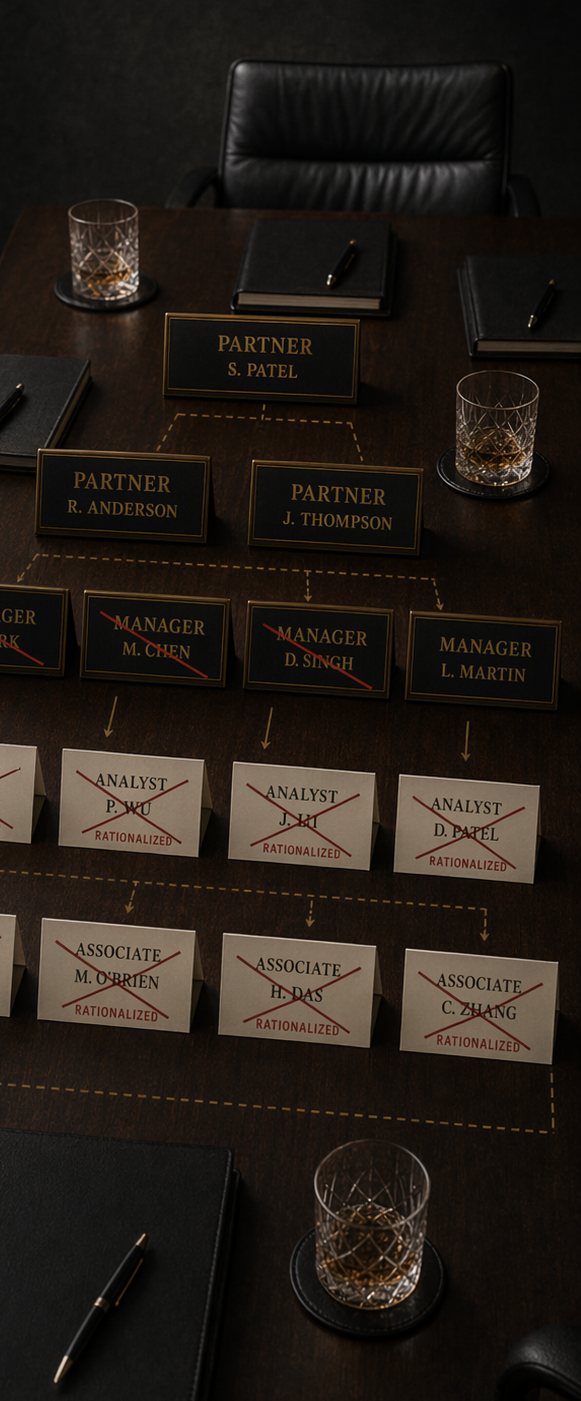
You have written the deck you are now the subject of
Originated revenue per partner. The rate you can still defend. What the rainmaker carries out of the room. Three numbers every BD committee tracks. In 2026 they stop being separate. A briefing for managing directors and BD leaders at strategy and management-consulting boutiques.
You have seen this at the partner meeting
Every managing director at a mid-market European strategy or management-consulting boutique has had the same Monday. Partner review last Friday. Three partners originated nothing last quarter. The MD named two of them at the committee. One is six months from the equity vote. Over the weekend you read the BD committee minutes. The rainmaker partner mentioned that her biggest client asked her last Tuesday what percentage of the last deliverable was produced by AI. She gave a vague answer. The client followed up on Thursday asking for a rate-card conversation.
You have done this job for twenty years. You have written the slide deck your clients now need about their industry. The pattern used to be simple. Hire bright juniors. Put them on the engagement. Partners carry the relationship, set the frame, and sell the next piece of work. The economics compounded. Firms on time-based billing grew steadily. The partnership model was the quiet competitive position your firm did not have to defend.
Something changed. Your juniors are doing less work your clients want to pay for. Your pitches arrive against procurement teams that ran your proposal through their own AI first. Your discounts are bigger than they were three years ago. Your cross-practice expansion signals get lost between service-line heads. Your best rainmaker is five years from retirement and nothing has been captured. And the PE-backed AI-native entrant has just pitched one of your clients at 40% below your rate. You have read the articles. You wrote one of them.
The firm that advises clients on transformation has not transformed itself. Every partner at the meeting knows this. Nobody has said it. The ones who say it first, and act on it before the arbitrage window closes, own the next decade of European mid-market advisory.
This briefing covers what has happened to your industry's economics, what it means for your BD committee and your pitch floor, and the three questions to answer before the next partner offsite.
The economics that ran strategy consulting for forty years just broke
Every strategy and management-consulting boutique runs on the same arithmetic. The partner brings the mandate. The analysts and associates do the production hours — market sizing, benchmarking, financial models, slide decks, literature reviews, synthesis documents. The client pays a blended rate that buries the junior margin. The partner's compensation comes out of the spread. For forty years the model worked because junior production hours were the expensive part of every engagement and clients paid for them.
AI changed the expensive part. Between 60 and 70 percent of junior analyst work — the benchmarking, the modelling, the slide production, the secondary research, the first-pass synthesis — is now AI-executable in a fraction of the time, at a fraction of the cost. The biggest firms are already running it inside. One flagship internal AI at the top of the market sits at 72% staff adoption and 30% time reduction on research and synthesis. Top consultancies have frozen graduate salaries three years running. Graduate hiring targets were missed and withdrawn. Industry EBITDA sits at a five-year low of 9.8%. Billable utilisation sits at 68.9%, below the 75% threshold that is supposed to be the minimum for a healthy firm.
You are not being outpriced by firms that hired more juniors. You are being outpriced by firms that do not have juniors at all.
The competitors you have watched for a decade are no longer the ones you are up against. A $300M PE-backed AI-native entrant has launched explicitly pyramid-free, founded by a former Big Four chair and a former Big Four COO. A YC-backed due-diligence firm is pricing the work you quote at €800K-1.2M at 90% below your rate. 73% of your clients now prefer outcome-based pricing. Firms on time-based pricing grew 2.1% last year. Firms on value-based pricing grew 8.7%. The arbitrage window, the one where you can quietly adopt AI inside and keep the client rate unchanged, is twelve to eighteen months. After that your clients start asking the AI-content question and the conversation is not about rates any more. It is about trust.
Your BD committee, your pitch floor, your practice heads feel this weekly
Your pitches. Your BD partner walks into a specification meeting where the client has already briefed an AI tool on your proposal and compared three peer-firm responses. The partner who arrives with the client's three-year procurement history, the cross-practice angle drafted, and the senior-judgement premium priced explicitly sits at around 65% win rate. The partner walking in with last year's credentials deck and a blended rate card sits at 25%. The discount conversation is lost in the pitch, not in the negotiation at close.
Your rate card. Procurement teams at mid-market clients now run your proposals through AI before your partner walks in. They arrive with their own estimate of what AI-efficient delivery should cost. They ask what percentage of the last engagement deliverable was produced by AI. The firm with a good answer holds fee. The firm that has not had this conversation internally gives ground at 15-25% per engagement. The arbitrage window where you can quietly run AI inside and keep the old rate card intact is closing. Your rate conversation is being set before your partner walks in.
Your cross-practice expansion. Most of your profitable revenue growth comes from existing clients buying the second and third mandate. Your strategy partner sees the operational issue that signals transformation work. Your transformation partner sees the capital question that signals corporate finance. Today those signals move at the speed of partner coffee. Your cross-sell rate sits at 35-40% when the best firms have moved to 60-70%. The intelligence is in your firm. The graph that connects it is not.
Your rainmakers. Your top three partners originate 30-40% of firm revenue. They built their books on twenty years of client political maps, competitive near-misses, and the judgement that tells them which pitch to take. Two are over 55. When they retire, the book decays 12-18 months later by which time you cannot catch it. Nothing has been captured. Nothing has been transferred. The retirement conversations are already on your calendar. You know the partners we mean.
The winners are already pricing senior judgement separately
Your industry is compressing because AI takes junior hours out of every engagement. Your function is compressing because your partners walk into pitches outgunned, your rate card has a growing credibility gap with procurement, and your expansion signals get lost between practice heads. Same force, two altitudes. But there is a third thing happening that most MDs have not named yet, and it is the one that matters most.
Look at the firms pulling ahead. The production layer and the judgement layer have been separated and priced distinctly. AI-executable research and analysis sits at one rate, and the partner's diagnostic, framing, and client-political judgement sits at another. Proposals state the AI content of deliverables explicitly. Procurement's AI-benchmark conversation becomes a rate-defence conversation, not a rate-attack conversation. The partner's senior judgement is the thing the client is still paying full freight for, and both sides of the table can see it clearly.
Most boutiques are still running a single blended rate card that disguises production hours clients know are AI-executable. A copilot for the juniors. A research tool for the analysts. A pitch-prep agent for a handful of partners. Twelve months later the rate-card credibility is gone and nobody knows exactly when it went.
Your competitors who reprice around separated senior judgement first will hold rate while you defend yours. They will arrive at every pitch with a credible answer to the AI-content question. Your rate-card conversation becomes a Q3 crisis and their rate-card conversation becomes a growth story. Same technology. Twelve months. Opposite outcomes.
You have twelve to eighteen months. The billing arbitrage window is real, and it closes. Your question now is whether you lead the rate redesign inside the partnership, or your biggest client forces it on you in a renewal conversation.
What most firms are doing. What the winners are doing instead.
Every BD committee has had the AI conversation. Most partnerships have landed on the same four decisions. A smaller group has made different ones.
| The default path | The winners' path |
|---|---|
| Quietly run AI inside and keep the blended rate cardMargin expands for a year. Procurement asks the AI-content question. Credibility resets permanently. | Separate production from judgement and price both explicitlyAI-content disclosed in every proposal. Rate-defence conversation, not rate-attack conversation. |
| Run an AI task force with a small budget and no mandateQuarterly updates to the MC. Recommendations partnership governance will not implement. | Make AI architecture an MD and BD-committee agenda itemPartner comp and rate-card redesign on the table. External peer carries the methodology. |
| Buy a pitch-prep copilot and call it the AI strategyEvery peer firm has the same tool within six months. The copilot is the commodity. | Build tools your partners actually use on your clientsTuned to your practices, your pitch history, your rainmaker book. Yours to keep. |
| Wait for your rainmakers to retire, hope the handover worksThe book decays 12-18 months later by which time you cannot catch it. | Capture what they know now, while they are still hereQueryable firm infrastructure. Retirement becomes a non-event. |
Same technology. Same twelve months. Opposite outcomes. The difference is whether the partnership acts on what the partnership already knows.
Origination. Rate. Succession.
Three questions every BD committee is tracking. None of them used to be the same question. They are now.
Why are we losing pitches we should be winning?
Originated revenue per partner is sliding. Three partners at zero last quarter. The pitch went to a firm you do not respect. They did not price you out. They showed up better prepared and with a credible answer to the AI-content question. Your partners are not losing the capacity to originate. They are losing the preparation race before they walk in.
Can our rate card survive the AI-content question?
Procurement is running your proposals through their own AI. They arrive with their own estimate. They ask the question. The firm with a credible answer holds fee. The firm without one gives 15-25% per engagement. The arbitrage window where you run AI inside and keep the old rate card closes in the next four to six quarters. You know which conversation is coming.
What walks out when our rainmaker retires?
Your top three partners originate between 30 and 40 percent of firm revenue. You have never found a way to pass what they know to the rest of the partnership. Two are over 55. Once they leave, the book decays inside eighteen months. There has never been a way to capture their judgement. There is now. The retirement conversations are already on your calendar.
What the firms winning this play are actually doing
Four moves any BD leader can start this quarter. Each touches one part of the firm. Together they redesign how the partnership commercialises.
Origination: get your BD partners into the pitch earlier and designed-in
The partner who arrives with the client's three-year procurement history, peer-firm benchmarks, a specific diagnostic drafted on the client's own public strategy, and comparable mandates on hand closes at 65%. The partner walking in cold closes at 25%. Four hours of partner prep compresses to twenty minutes once the tools are in place. Your best originators do this mentally today. The rest needs the tool in their hand.
Rate: separate production from judgement and price both explicitly
Every proposal states the AI-executable content, the senior-judgement content, and the rate for each. Procurement's AI-content question becomes a rate-defence conversation you arrived prepared for. On a €500K mandate, 200-300 basis points of rate defence is €10-15K per deal. Across 30 pitches a year per BD partner, that is €300K each. On a 40-partner firm, €12M in annual margin defence.
Expansion: build the cross-practice client graph
Every pitch, engagement memo, industry finding, relationship note, and client conversation from every practice becomes structured data in one firm view. The strategy partner's finding reaches the transformation BD partner within 48 hours with supporting context. Cross-practice cross-sell moves from 35% toward 65%. This is the 18-month moat every peer firm is discarding today.
Succession: capture what your rainmakers know before they retire
Every rainmaker carries twenty years of client judgement in their head. Which pitches to take. Which relationships to escalate. Which pricing move to make when. AI now extracts that judgement from call notes, engagement memos, pitch archives, and correspondence into a form every partner queries. When the retirement lands, the book stays. The longest lead time of the four. Start now.
The only advisor who has done the transformation
The MD in 2026 has four places to go. None can do what we do.
The internal AI task force. Every boutique has run one since 2023. Designated partner, small budget, quarterly update to the MC. The recommendations partnership governance will not implement. No single partner can rewrite firm-level economic architecture without MD-level authority and external methodology.
The big strategy firms and the Big Four advisory arms. They will write you a beautiful strategy deck. They cannot put a working pitch-prep agent in your partners' hands in three weeks because their revenue model still requires the analyst hours. And asking a competitor to diagnose your firm is a non-starter for every reason it sounds like.
The generative-AI platform vendors. Eighteen-month implementation projects that install AI inside their platform. Their business needs your firm dependent on the platform as system of record. They cannot have the partnership-economics conversation. They ship features, not commercial architecture.
The consulting-vertical AI startups. You have been demoed five of these this year. Every one is a copilot every peer firm will have in six months. Point tools, not commercial architecture. Your partners will not trust them, your juniors will not adopt them, and the IP sits in someone else's cloud.
You have four options you have already said no to. GRAIL is the fifth.
- Senior-to-senior conversation, not vendor-to-buyer
- Working tools your partners use the same week
- Custom agents built on your practices, your pitch history
- The separated-judgement pricing architecture
- No lock-in. All IP transfers to your firm
- Founded by operators who have done this transformation themselves
- Business first, technology second
- Three weeks from first meeting to working tools
- Fixed fee. No billable hours. No pyramid
- Every next step earned by what just shipped
Three sessions with the MD and the BD committee. Working tools from week one.
We start with the MD and four to six senior partners because the change cannot outrun the partnership's personal understanding of what is possible. Three workshops. Each delivers standalone value. Each earns the right to the next.
The mirror
Walk through your own firm's economics with the partnership in the room. Originated revenue per partner. Rate-card exposure. The arbitrage clock. Build the first working tool live: a pitch-prep agent for one of your partners, on one of your real clients, for one of your real pitches. The partnership leaves with a shared view and the first tool in hand.
Your partners' tools
A half-day activation. Each member of the BD committee leaves with five to ten working tools tuned to their practice, their clients, their pitch history. Pitch preparation. Rate-transparency calculator. Cross-practice expansion triage. RFP response drafting. Tools your partners are using the same week, not slides about tools.
The rate redesign roadmap
Refined tools from real use. Separated-judgement pricing model drafted for one practice area. Rainmaker knowledge-capture plan. The MD-level conversation with numbers the CFO can check, not a deck the partnership can argue with. The roadmap for the May offsite.
Three weeks. No IT project. No partnership-wide vote needed to start. The tools your partners are already using when we finish.
For your next partner meeting
The questions where your partnership cannot agree are the ones worth an hour on the agenda. Ask these honestly.
Of the last ten pitches you lost, how many went to firms that showed up better prepared or with a credible AI-content answer, not lower on price? If you do not know, how would you find out?
When a client's procurement team asks what percentage of the last deliverable was produced by AI, does the firm have a good answer ready? Which partner would you put in that conversation today?
If your top three rainmakers retired next year, what would happen to the books they own? What have you actually transferred to the rest of the partnership in the last twelve months?
Where is your average associate spending their Monday morning today, and where would they need to spend it for your partner-to-associate economics to work in 2027?
Which partner in the firm is already doing what the rest of the BD committee will need to do by 2027 to keep originating? What would it take for that behaviour to be the partnership default?
If any of these produces a disagreement in your partnership, that is the conversation worth having before the next offsite.
Continue reading
Sources and limitations
This briefing draws on GRAIL's engagement experience with leadership teams and on public company disclosures. Figures are illustrative unless a source is named beside them. A sourced edition is in preparation.