The Nerd Principle
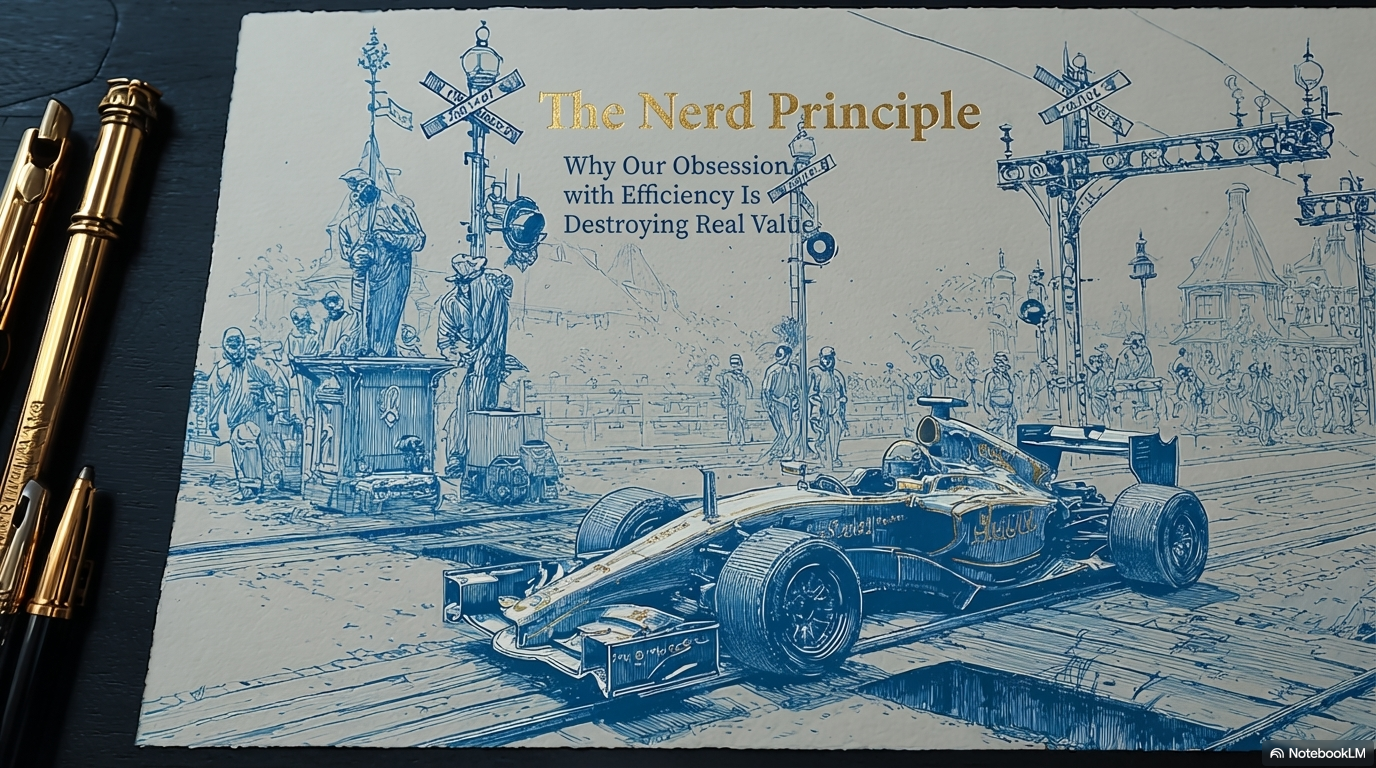
There's a difference between eliminating waste and destroying the conditions for mastery.
Most organizations have made efficiency their religion.
Speed. Metrics. Optimization. Do more with less. Move fast.
And they're destroying the only thing that actually compounds.
I recently talked to Jerry Månsson, a former professional footballer who now trains salespeople across Europe. He made an observation I can't shake: the best salespeople have exactly one thing in common with elite athletes.
Not charisma. Not talent.
Nördighet. The Swedish word for obsessive attention to details everyone else dismisses as trivial. How they prepare before meetings. How they research prospects. How they manage their mental state. The same fundamentals, practiced the same way, every time.
Most salespeople skip all of it. Most organizations let them.
"I can ask any company: do you have a sales process?" Jerry told me.
"They say yes, of course.
Then I ask: is it documented?
Do all your managers teach it the same way?
And they start squirming."
They don't have a process.
They have people.
And they've confused the two.
Here's what elite performance actually looks like.
Kobe Bryant showed up at 3:15am. Every day. A trainer watched him spend 45 minutes on footwork pivots. Basic drills. The kind you'd teach a twelve-year-old.

"Why do you think I'm the best player in the world? Because I never get bored with the basics."
When Dave Brailsford took over British Cycling in 2003, the program was a joke. One Olympic gold since 1908. His strategy wasn't revolutionary training. He hired a surgeon to teach riders hand-washing technique. He tested pillows and transported each rider's preferred bedding to every hotel. He painted team trucks white inside to spot dust that might degrade the bikes.
The math: 1% improvement across everything compounds to 37x over a year. Not 3.65x. 37x.
Five years later: eight Olympic golds. Then five Tour de France victories in six years. After 110 years without a single British winner.
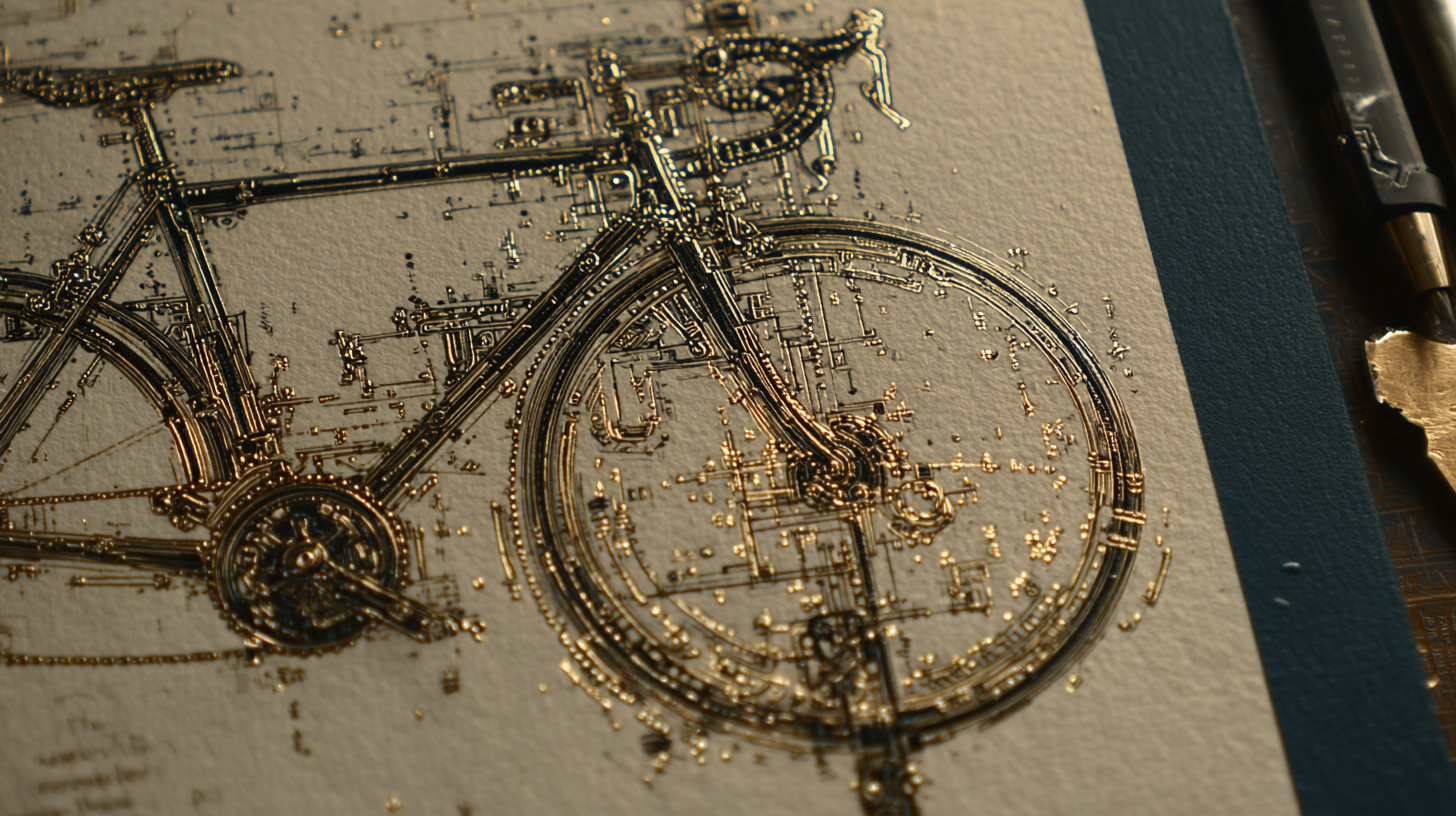
Same pattern. Obsessive attention to details that look trivial to outsiders. Sustained over time horizons that seem irrational. Producing outcomes that can't be replicated by people who skip the boring parts.
The mechanism is simple
Practice literally rewires your brain. Each session adds myelin to neural pathways, increasing signal speed up to 100x. The effect compounds. What starts as conscious effort becomes automatic capability.
You can't skip to the intuition part. The obsessive early attention builds the pattern library that enables later speed.
Now look at what modern business culture does to this.
Gloria Mark's research: the average time on any task before switching is 3 minutes. Time to regain deep focus after interruption: 23 minutes. People check email 74 times a day.
You can't build compound capability in 3-minute increments.

But it's worse than distraction. We've built an ideology around speed that actively destroys mastery.
Boeing moved headquarters from Seattle to Chicago. Created distance between leadership and engineering. Former McDonnell Douglas executive Harry Stonecipher was explicit: "When people say I changed the culture of Boeing, that was the intent, so that it is run like a business rather than a great engineering firm."
Efficiency metrics replaced engineering judgment. 346 people died. Cost to shareholders: $87 billion.
This is what happens when you optimize for what's measurable and let fundamentals atrophy.
Jerry sees the same pattern everywhere. "Most organizations operate at too low a level. Not strategically wrong. Tactically sloppy." They've stopped caring about the details that compound.
I'm not arguing against efficiency. Waste is waste.
But there's a difference between eliminating waste and destroying the conditions for mastery.
The question for any leader: what fundamentals are you obsessing over?
Not delegating. Not measuring. Personally obsessing over.
Spending time on what everyone around you thinks is excessive.

Jerry structures his life around what he calls the balance board.
Health first.
Then family.
Work comes last.
Sounds backwards. But the ordering enables everything else.
"I wouldn't function in my role if I didn't take care of those other things first."
Your attention architecture shows up in your company.
If you treat deep work as a luxury, your organization treats it as irrelevant.
Toyota's production system took 27 years to mature. Companies that try to copy it fail at rates between 70% and 95%.
They copy tools without culture. They want the outcomes without the obsessive attention that created them.
The Japanese call this shokunin. Craftsman spirit. Master swordsmith Yoshihara Yoshindo's apprentices work without pay for years, hoping to learn techniques that can't be articulated. Most leave. The patience required is too much.

That's the test.
Selective obsession with fundamentals that appear trivial.
Time horizons that seem irrational.
Outcomes that can't be replicated by those who skip the boring parts.
What are you practicing at 4am?