Tantric Lessons for CEOs in the Age of AI
What ancient wisdom about polarity reveals about why your organization feels dead
I never expected to find answers to modern leadership problems in tantric philosophy.
But here I am. A strategy guy. An AI guy. Diving deep into masculine and feminine energies, eros, life force. Wondering if I've finally lost it.
Then I look at the organizations around me. Technically sophisticated. Strategically sound. And completely dead inside. People going through motions. Meetings that drain everyone present. Process multiplying like cancer. Billions spent on engagement initiatives that produce nothing but survey fatigue.
Something is systematically wrong. And the business playbook has no diagnosis.
So I went looking in unusual places. And what I found in polarity work and embodiment traditions might be the most strategically relevant insight I've encountered in years.
Here's the provocation: AI is accelerating a race to the bottom that most CEOs don't even see. We're optimizing the life out of our organizations. And the winners in the next decade will be the leaders who understand that presence and aliveness are becoming the ultimate competitive advantage.
The Imbalance Nobody Talks About
Polarity traditions describe two fundamental energies. Call them masculine and feminine. *
Forget gender. This is about capacities.
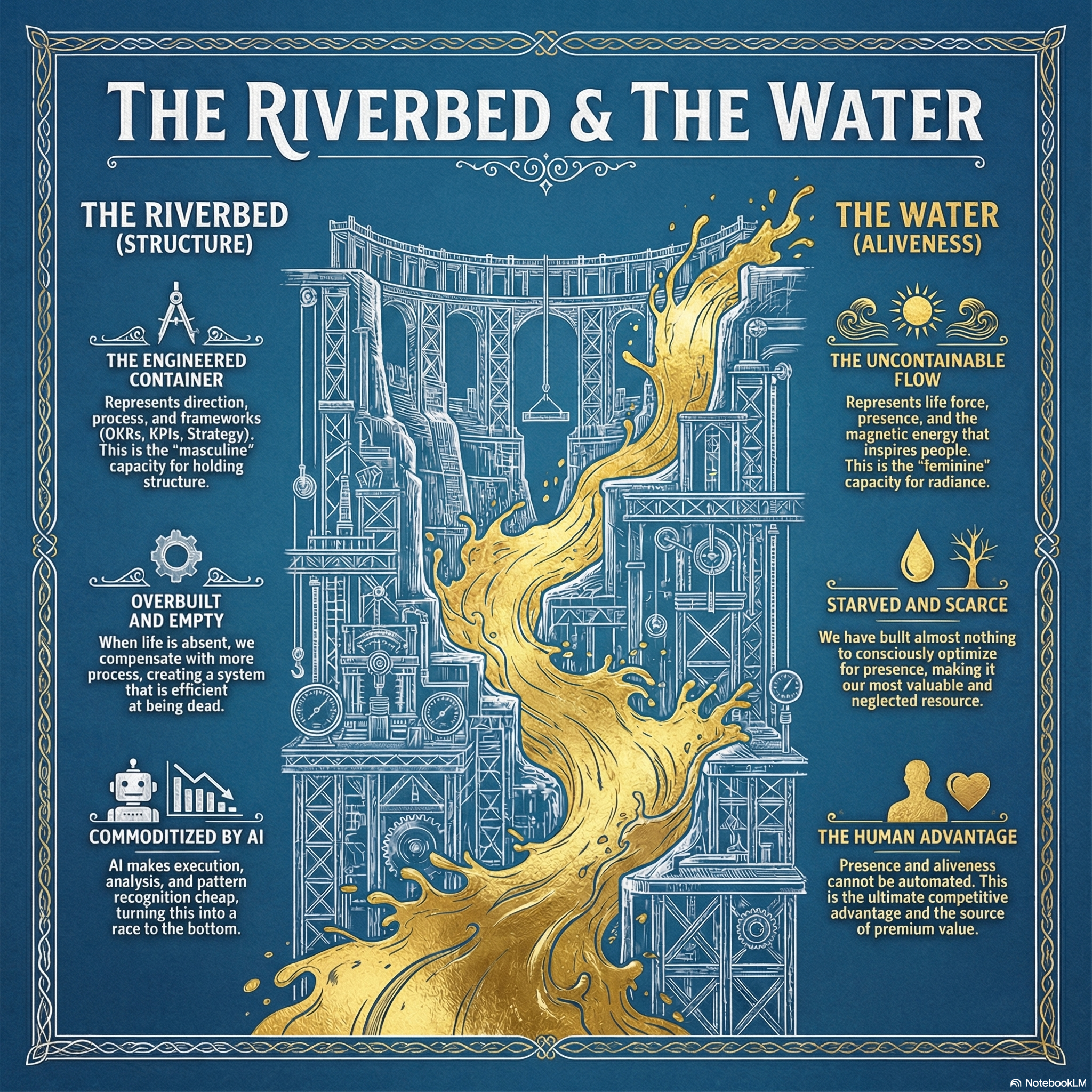
The masculine is direction, structure, holding.
The ability to set a container, maintain focus, execute against a goal.
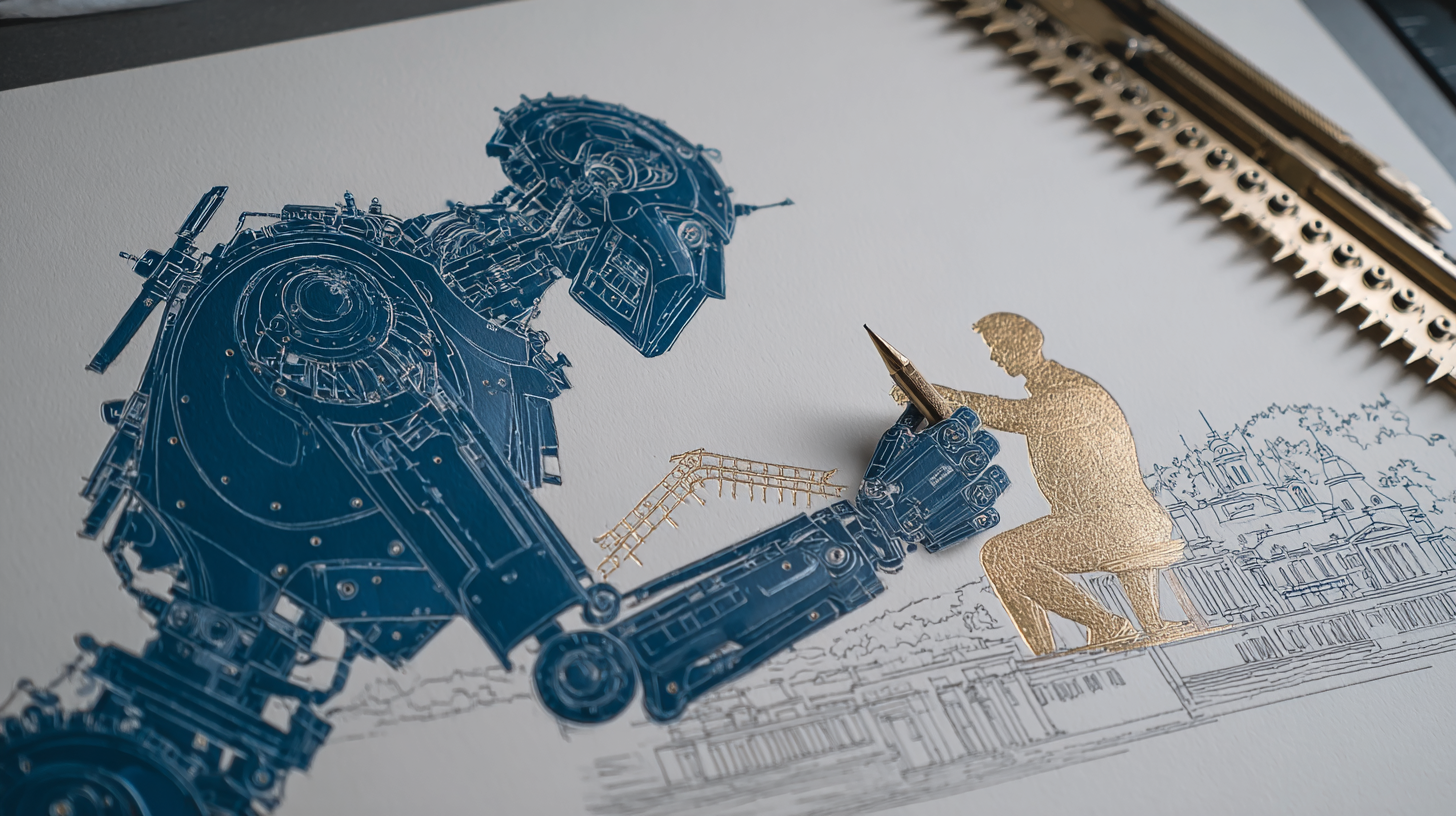
The riverbed.
The feminine is life force itself. Presence. Radiance.
The energy that makes people lean in. The capacity to sense what's actually alive in a room.
The water.
Both are essential. David Deida puts it simply: the masculine provides depth and direction, the feminine provides energy and inspiration. One without the other is either rigid or chaotic.
Now look at what we've built in business.
We have extraordinary infrastructure for the masculine. Strategy frameworks. OKRs. Governance. Decision matrices. Approval workflows. The machinery of direction and containment is sophisticated beyond anything previous generations imagined.
What have we consciously built to optimize for the feminine? Almost nothing. We've systematically starved our organizations of presence, aliveness, sensing. Then wondered why engagement scores keep dropping despite all our initiatives.
Zenger/Folkman studied over 100,000 leaders. Found that 76% are more proficient at pushing than pulling. The rare leaders who master both? They reach the 85th percentile for innovation. Most organizations are three-quarters riverbed, one-quarter water. And they're dying of thirst.

The Compensation Spiral
When aliveness is absent, organizations don't accept the absence. They compensate. With more structure.
More check-ins. More alignment meetings. More documented procedures. More process to manage the process.
I talked with Fanny Norlin on ThinkRoom. She watches this pattern destroy tech teams. Agile started as a rebellion against bureaucracy. Small teams. Trust. Rapid iteration. Now look at SAFe: hundreds of pages of documentation. Scrum ceremonies eating half the workweek. The original impulse buried under administrative weight.
Her diagnosis: when there's no one who can sense "what does this moment need?", you replace sensing with structure. Rules substitute for attunement. Process substitutes for presence.
But you cannot systematize aliveness. More riverbed doesn't create more water.

So process multiplies. People get more exhausted. Leaders add more structure to manage the exhaustion. The spiral tightens. The organization gets more efficient at being dead.
Push Organizations Extract. Pull Organizations Generate.
This is where the energetics translate to economics.
Most organizations run on push. Goals cascade. Pressure applies. People perform because they have to or because they're afraid. The fuel is cortisol and adrenalin.
Push works. It produces output. But it's extractive. Every push depletes the system. You're mining your people. Eventually the seam runs out.
Pull is different. It's what happens when a leader or organization becomes so present, so clear in purpose, so alive that people move toward it. Not because they must. Because they can't help it.
Apply this to organizations. Pull creates energy. People leave meetings fueled rather than drained. Work generates more than it consumes. The system becomes regenerative rather than extractive.
You've felt the difference. Some rooms drain you. Some light you up. Same agenda, radically different outcomes. The variable is presence. Whether someone is generating pull.

Why This Becomes Strategic Now
Here's where it matters for your next board meeting.
AI is commoditizing the directive masculine. Analysis. Pattern recognition. Execution. Any organization can access these capabilities now. They're getting cheaper by the month.
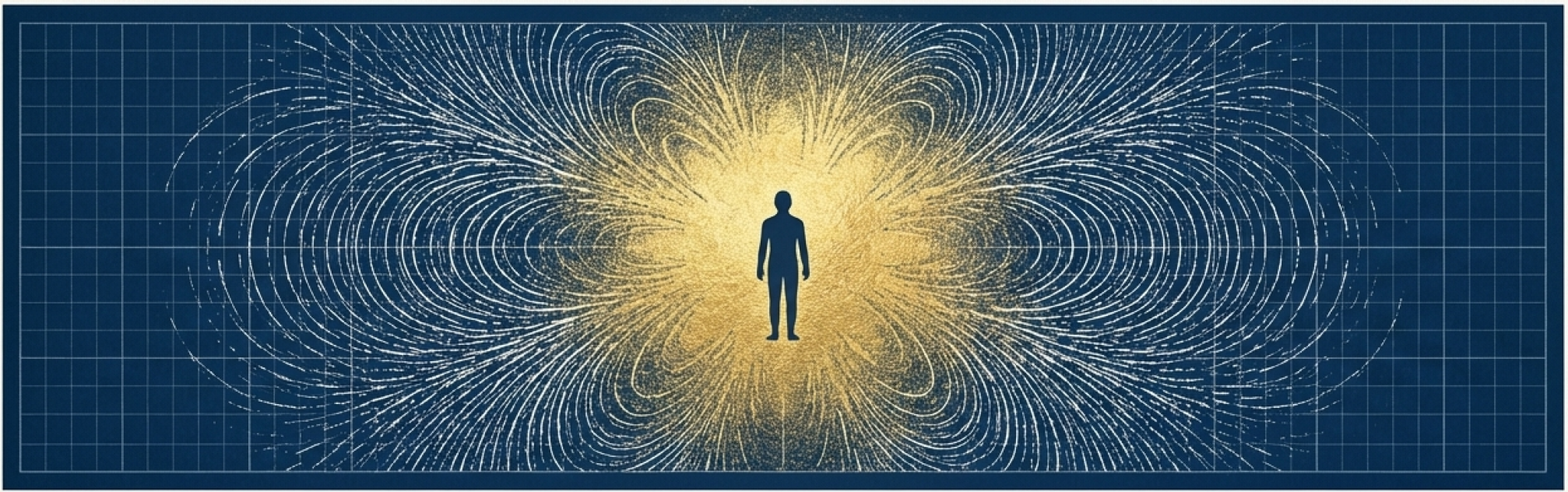
What AI cannot generate is presence. The felt sense of someone actually being with you. The aliveness that creates psychological safety. The magnetism that makes people want to follow.
Your competitive landscape is splitting. Organizations competing on execution race to the bottom. AI makes execution cheap. Organizations competing on presence command premium. Because presence is scarce. Because you can't automate aliveness.
The talent implications are brutal. Your best people feel the difference between an organization that's alive and one that's just functioning. They'll go where the life is. The dead organizations will be left with people who don't have options.
This is personal too. What kind of leader are you becoming?
One people follow because they have to? You're being automated. The forcing function you provide, AI provides cheaper.
One people follow because they want to? Because your presence creates something they can't get elsewhere? That's the premium position. That's irreplaceable.
The Question
Look at where process is multiplying in your organization.
Don't ask how to fix the process. Ask what presence is missing that you're trying to replace.
Is it leaders who can't sense what's actually alive in their teams? That's a development problem, not a process problem.
Is it a culture that's all push, no pull? No restructuring fixes that. Someone has to generate the pull.
Is it you? Have you optimized yourself into a directing machine and starved your own aliveness? Your organization mirrors what you embody.
Some studies point to that toxic leadership costs the U.S. economy $23 billion annually. That's not bad strategy. It's dead presence. Leaders who push because they've forgotten how to pull. Organizations that function but don't live.
The tantric traditions have known for millennia what business is just beginning to discover: life flows toward what is alive. People follow what has presence. Energy moves toward magnetism, not toward process.
Your organization's exhaustion isn't a productivity problem. It's a vitality problem.
The water is missing. More riverbed won't help.