
The Margin That Blinds You

The Real Reason Your AI Transformation Is Stalling
Your most profitable business unit is the one killing your AI transformation.
Not your skeptics. Not your laggards. Not the people who "don't get it." The division generating 40% margins is actively, rationally suppressing every initiative that threatens those margins. And because they control budget allocation, they're winning.
This isn't resistance to change. It's something harder to fix: your organization working exactly as designed.
I've started calling it margin addiction. And it killed Kodak, killed Blockbuster, and is quietly strangling AI initiatives in companies that know better.
The Lie We Tell About Disruption
Everyone tells the Kodak story wrong.
Standard version: Kodak invented the digital camera in 1975, failed to see its potential, got disrupted by nimbler competitors. Classic innovator's dilemma. Technology blindness. Case closed.
Comforting. And almost entirely false.
Kodak didn't miss digital photography. They invented it. Steve Sasson, a Kodak engineer, built the first digital camera in December 1975. Eight pounds. 0.01 megapixels. Images stored on a cassette tape. Kodak executives saw this prototype, understood exactly what it meant, and made a deliberate choice.
They chose to protect their margins.
Film profit margins ran close to 70-80%. Leo J. Thomas, Kodak's senior vice president, told the Wall Street Journal in 1985: "It is very hard to find anything with profit margins like color photography that is legal."

Digital cameras? Single-digit margins. By 2001, Kodak was losing $60 on every digital camera it sold.
Kodak executives weren't blind. They could see perfectly. They just couldn't act against their own success.
The Pattern Nobody Wants to Name
Here's what I keep seeing in AI transformations:
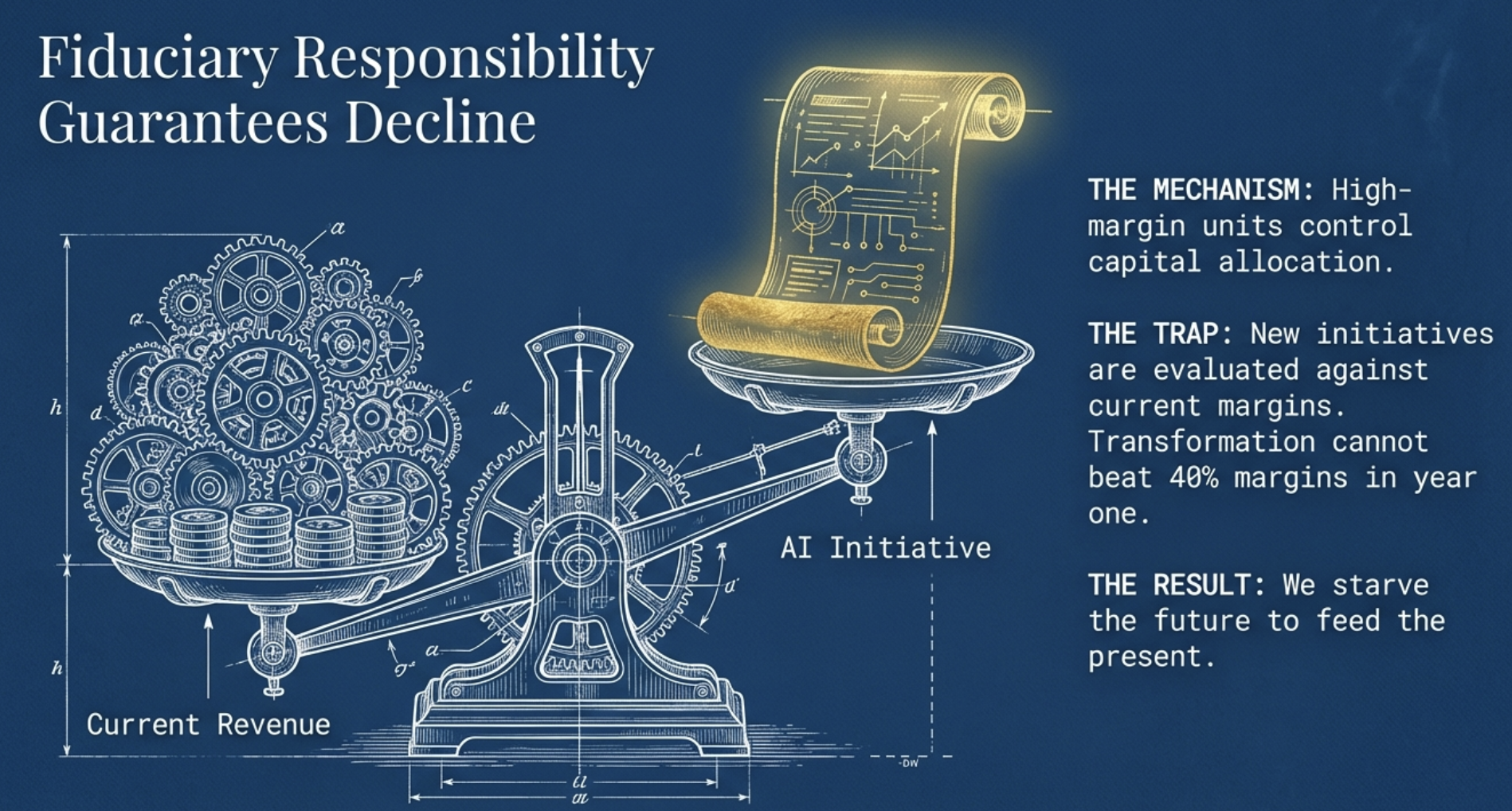
The highest-margin business units control capital allocation. They don't just resist threats. They suppress them. Every AI initiative gets evaluated against current margins. Every business case has to prove ROI against a benchmark that transformation, by definition, cannot beat in year one.
This isn't sabotage. It's fiduciary responsibility, applied in a way that guarantees decline.
I was exploring this pattern recently on ThinkRoom with Samuel West. He runs the Museum of failure (love that!). The conversation kept circling back to the same point: companies with the most to protect are the least able to transform. Not because they can't see what's coming. Because acting on it would require cannibalizing what's currently working.
Kodak had over a thousand digital imaging patents. They had the technology. They had the talent. They had two decades of runway. What they built, quarter by quarter, was an organization incapable of cannibalizing itself.
By the time the market forced the change, they didn't have an organization that could execute. They had an organization that had spent 20 years being rewarded for preventing exactly that.
The Blockbuster Variation
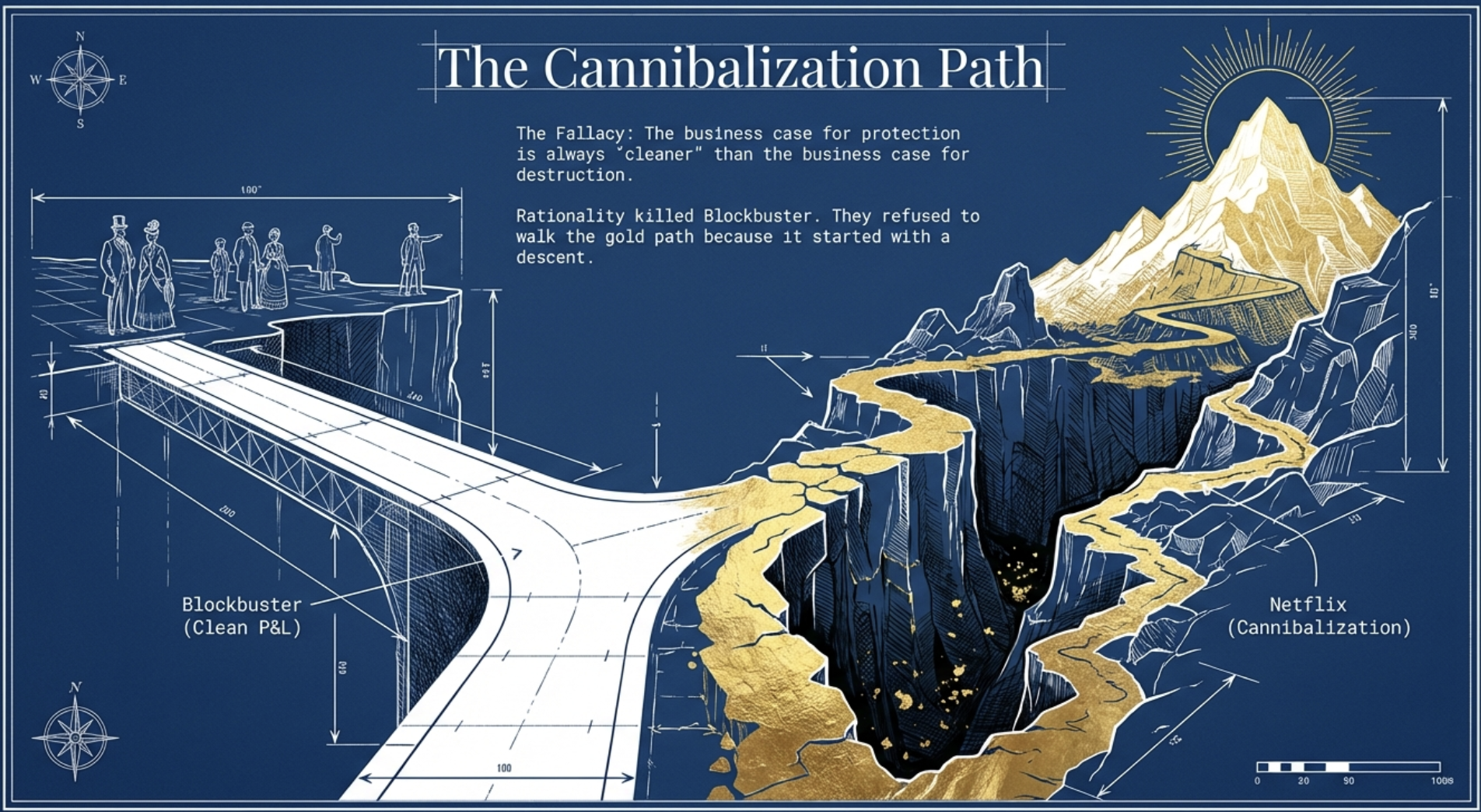
Same pattern. Different industry. Same ending.
Blockbuster's late fees generated $800 million in 2000. Pure profit that dropped straight to the bottom line.
When Netflix offered to sell for $50 million in 2000, Blockbuster's executives laughed them out. Not stupid. Rational. Netflix's model would eliminate the revenue stream that made Blockbuster's economics work.
John Antioco, Blockbuster's CEO, actually understood. He launched Blockbuster Online. By late 2006, their subscriber growth exceeded Netflix's.
Then the board changed. New CEO. New strategy: protect the stores, protect the margins.
Bankruptcy in 2010. Netflix now worth over $300 billion.
The Meeting Happening Right Now
Somewhere in your organization this week, someone is proposing an AI initiative that would cannibalize a profitable business line. Somewhere else, someone with P&L responsibility for that line is explaining why the timing isn't right, the technology isn't proven, the ROI doesn't work.
The P&L owner isn't wrong about the ROI. Transformation has a J-curve. It looks worse before it looks better. The business case for protecting current margins is always cleaner than the business case for destroying them.
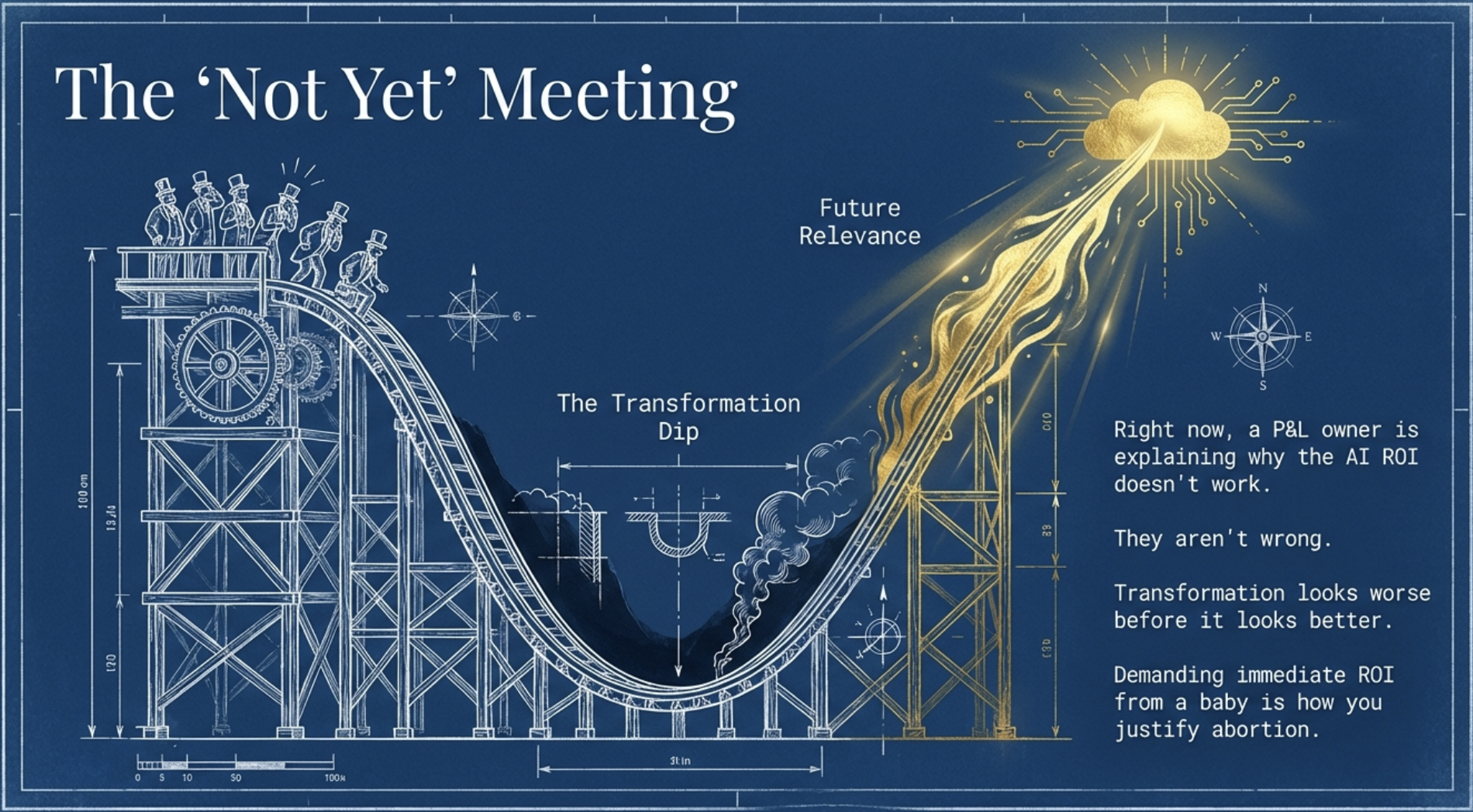
Clean isn't the same as correct.
The question nobody asks in these meetings: "What happens to our competitive position in 36 months if we keep optimizing what we have instead of building what we need?"
Nobody asks because the answer is uncomfortable. And because the people who'd have to answer it are the same people whose bonuses depend on this quarter's margins.
What Gets Trained Gets Built
Every quarter you optimize for current margins, you're training your organization to resist transformation. You're promoting leaders who protect the cash cow. You're building muscles for defense while offense atrophies.
The question isn't whether you can see what's coming. The question is whether you can act when acting requires hurting what's currently making you successful.
Every AI decision your company makes this year is training something. Every budget allocation. Every promotion. Every "not yet" and "let's wait for more data."
Three years from now, you'll have either an organization that can transform, or an organization that spent three years being rewarded for preventing it.
Kodak had 70% margins and two decades of warning.
What's your margin? And how much is it blinding you?

