
The Dumbest Strategy in the Room

I spent two hours last week talking to a man who manages billions of kronor in assets, has built companies from napkin sketches to European market leaders, and has navigated one of the most complex family successions I've come across.
When I asked about his strategy, he said three words.
"Beat last year."
I waited for the rest. There was no rest.
Not a ten-year vision. Not a disruption thesis.
Not a portfolio theory with Greek letters in it.
Just: did we do better than twelve months ago?
Yes or no?
My immediate reaction (and I'm a bit embarrassed about this) was to reach for a more interesting interpretation.
Surely there's a system underneath? I sell strategic frameworks for a living.
Three words felt like showing up to a knife fight with a spoon.
But the longer Johan Andersson talked, the more I realized those three words weren't the absence of strategy. They were what strategy looks like after you've compressed it far enough to actually use it.
The dirty secret of strategic planning
Here's a question I don't think gets asked enough: what's the point of a strategy nobody can remember it?
I'm serious. Think about the last strategic offsite you attended. Two days. A nice hotel. Post-its. Breakout sessions. Maybe a consultant with a framework that had a lot of boxes and arrows. You left feeling aligned and energised. And then what?

Andersson (who chairs or sits on enough boards to have lived through this ritual dozens of times) put it bluntly: "Everyone has forgotten the strategy the moment they leave the room."
He's not being cynical. He's being observational. And he's right, because this is the dirty secret of strategic planning: the output is almost never designed to survive contact with reality. It's designed to survive the meeting. Those are very different things.
A strategy is only worth what it provokes on a random Tuesday when everything's on fire and nobody's thinking about the deck in the shared drive. That's when it either earns its keep or reveals itself as theatre. And "beat last year" - embarrassingly, maddeningly, almost insultingly simple - passes that test every single time. Because you can't forget it. It's too short to forget.
Some of Mellby Gård's portfolio companies have abolished budgets entirely. Bonus structures are tied purely to beating the prior year's result, not hitting some fictional target negotiated in October and obsolete by February. My first instinct was to call it reckless. Then I thought about how many organizations I've watched pour months into budgeting processes that produce numbers nobody believes and nobody remembers. And I wasn't sure who was being reckless anymore.
300 shops nobody wanted
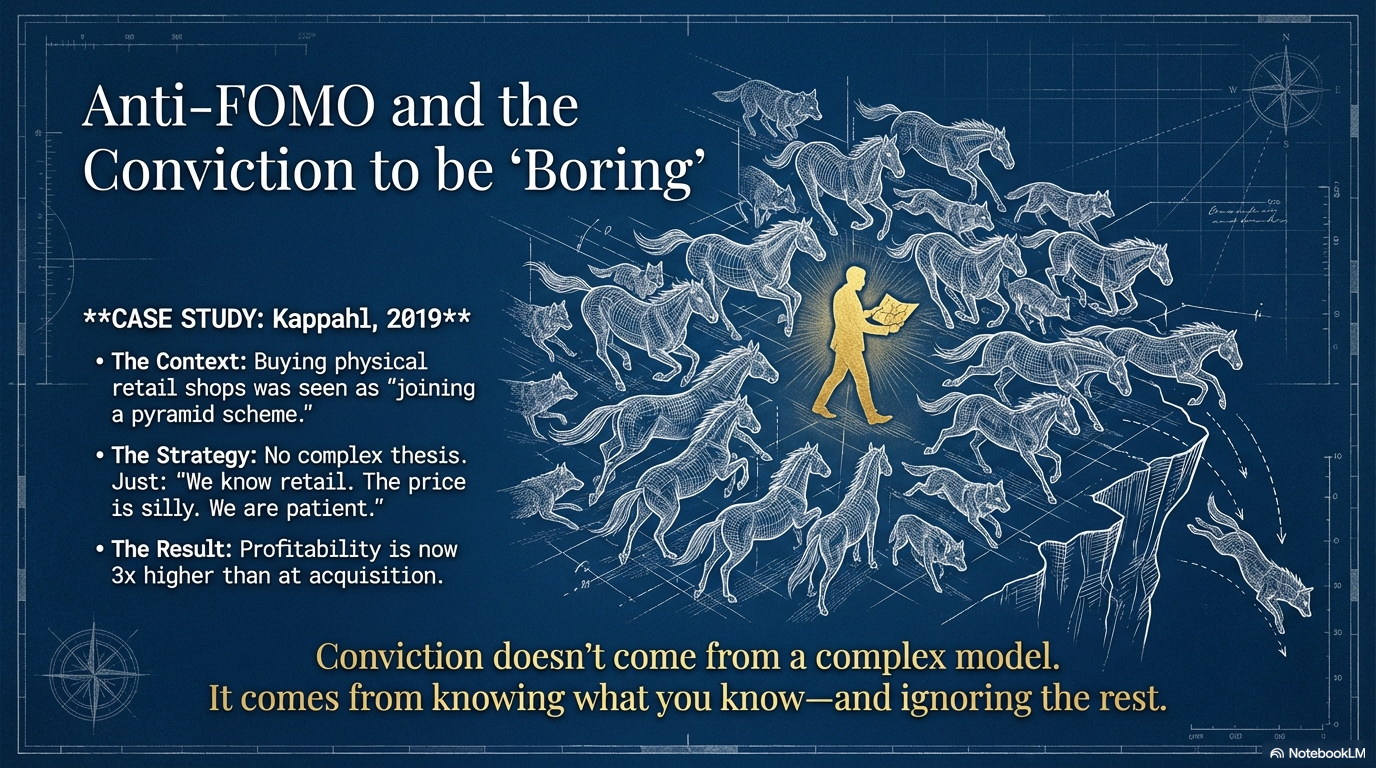
In 2019, Mellby Gård bought Kappahl.
If you're not Swedish, Kappahl is a mid-market fashion retailer with about 300 physical stores. If you are Swedish, you just winced - because in 2019, saying "I bought a chain of shops" was about as popular at dinner parties as "I've joined a pyramid scheme."
The narrative was total. Online was eating everything. Shops were heritage infrastructure - phone boxes, fax machines - still standing but functionally dead. Even with a 40% acquisition premium, Mellby Gård paid under six times (Kappahl dismal) EBITDA. That's how little the market believed in the future of someone walking into a shop and buying a jumper.
Then covid hit. Which, on paper, should have been the extinction event.
Fast forward to today. Not a single one of those 300 stores loses money. Profitability is three times higher than at acquisition. E-commerce settled at roughly 20% of revenue - meaningful, but nowhere near the everything-killer it was supposed to be. The shops didn't die. They just needed an owner who wasn't panicking.
Now here's what fascinated me. When I asked what gave him the conviction, he didn't produce a counter-thesis. No slide deck about omnichannel resilience. He said: "We'd built Smart Eyes. We'd operated hundreds of stores. We knew retail."
That's it. He knew what he knew. And (just as importantly) he knew what he didn't know, which is why he isn't chasing AI valuations at 50x revenue right now. He called his approach "anti-FOMO." I love that. Might steal it.
But notice what's underneath the Kappahl decision: it's the same compression. Not a complex contrarian thesis. Not a bet against the market based on superior analysis. Just: we understand this business, the price was silly and we're patient. Three moving parts. You could hold it in your head while running a dozen other things. Which, of course, is exactly what a family investment group with a broad portfolio needs.
What this did to me
Now. This is the part where I have to be honest about what this conversation did to me.
I build frameworks.
That's my whole thing. GRAIL exists because I believe rigorous, structured thinking about AI transformation is genuinely valuable (…and the results suggest I'm not deluded). But I also know - and I don't always love knowing this - that I'm attracted to complexity the way some people are attracted to drama. It feels important. It feels earned. It feels like proof that I've worked hard enough to deserve being in the room.
And then I sit across from a man who is clearly outperforming most of the sophisticated operators I know, and his entire philosophy fits on a Post-it note. And I have to ask myself a question I don't especially enjoy: am I building complexity because it's true..? or because it makes me feel clever?
I don't think the answer is either/or. (It rarely is.) The frameworks matter. But they only matter if they eventually compress into something simple enough to survive contact with reality. If the complexity never arrives at clarity, it's not sophistication.
It's decoration.
The compression pattern
And that, I think, is what Andersson has actually earned. Not simplicity as a starting point; anyone can be simple when they don't know enough of the complexities of the world. But as simplicity as a destination. The kind you only reach after a decade of navigating family succession, sibling dynamics, portfolio strategy, and the careful work of figuring out where your father's instincts end and yours begin. Everything compresses. Every framework, every governance model, every family business textbook - into words you can actually use.

That's the pattern. That's what Andersson keeps doing, whether he's talking about investment, management, or family. He takes the whole sprawling mess of a problem and squeezes it until what's left is too small to be impressive and too true to argue with.
"Beat last year."
It sounds like the absence of strategy. I'm starting to think it's the only strategy that doesn't lie to you.
So here's my question: does your strategy survive Tuesday afternoon?
Or does it only work in the meeting where you wrote it?
