
A Jobs-Survival Guide for the Already Doomed
In which AI comes for your job and finds it defended by confusion, inertia, and a mortgage.

There is a kind of article going around at the moment. You've read it. It was written by someone in technology who woke up, watched an AI do his entire job in four hours, and wrote about it with the energy of a man who has just seen his own ghost.
These articles always end the same way. Adapt or die. Learn AI. Start today.
I read three of them on a Tuesday. By lunch I was convinced my career had every terminal condition known to modern economics. By afternoon I had briefly considered retraining as a shepherd, before remembering that humanoid robots are rounding that corner too. Even the goats aren't safe.
By Wednesday I had seventeen meetings, a strategy deck that required judgment no machine could provide, and a strong suspicion that the distance between "AI can theoretically do this" and "AI is actually doing this in your organization where it takes four months to get a software license approved" is roughly the width of the Atlantic.
I have since calmed down. What follows is what I found when I did.
Your job does not exist
I should say this gently, but there's no gentle version. Your job, as a single coherent thing, does not exist.
What exists is a collection of thirty to fifty different cognitive tasks that someone bundled together under one title. Partly because deep context matters across those tasks. Partly because institutional knowledge compounds. Mostly because the entire architecture of professional life, from mortgages to self-worth to how you answer "what do you do?" at a dinner party, is built on the assumption that a job title describes a real thing.
It describes a bundle. "Marketing director" is actually thirty-seven different cognitive activities wearing a trenchcoat and pretending to be one job.
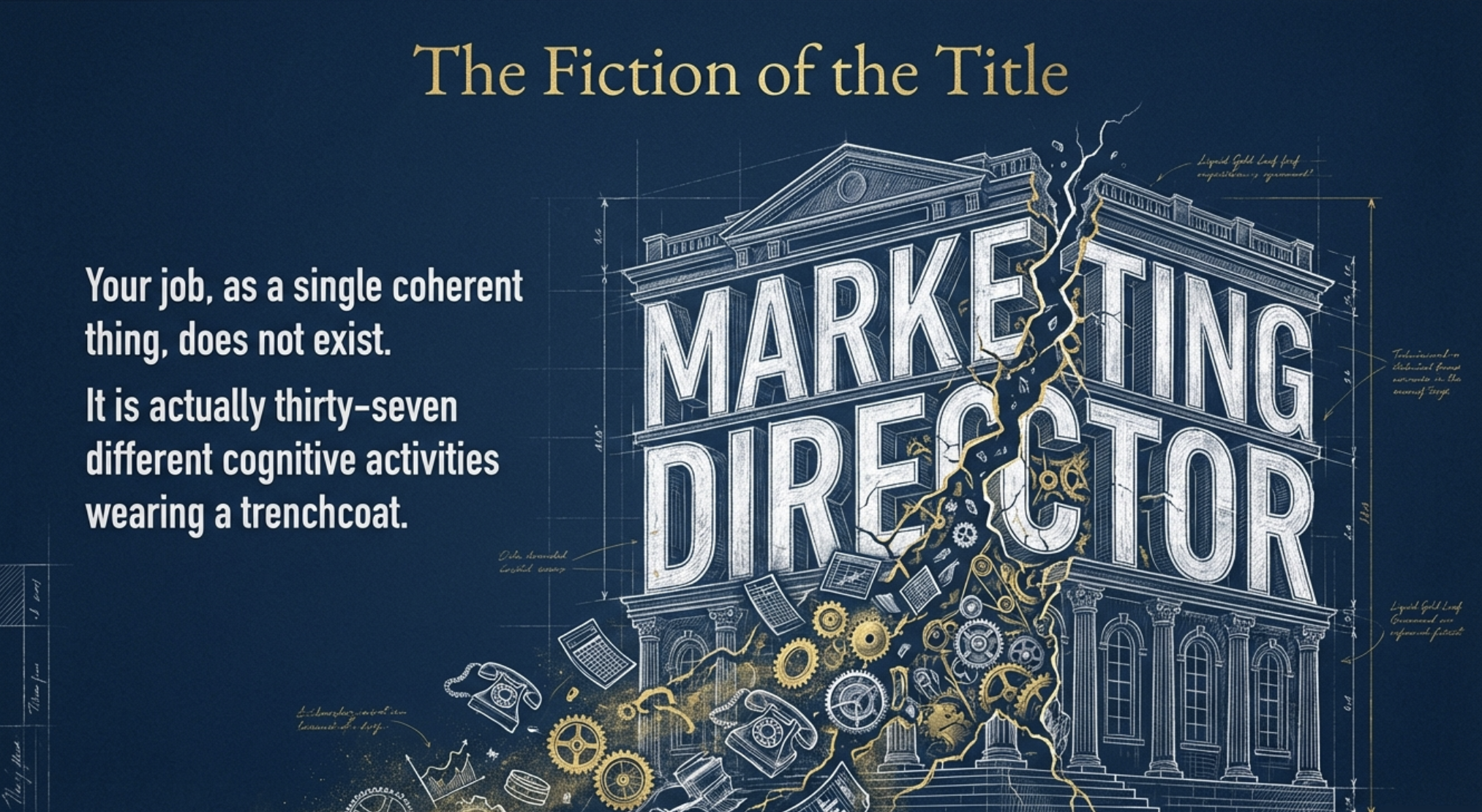
We package them this way because organisations have never figured out how to hire a third of a person. The gig economy proved you technically can. For senior roles, nobody does. Too much context. Too much risk. Too many mortgages depending on the fiction holding together.
AI doesn't care about any of that. AI works at the task level. It doesn't see your title. It sees the individual tasks inside it. Some it can do. Most it can't.
Which brings us to the useful bit.
The quadrants
Erik Brynjolfsson built a matrix I keep coming back to. Take your thirty-seven tasks. For each one, ask: how complex is it? And how much depends on your specific judgment, your relationships, your ability to read a room?
This gives you four boxes.
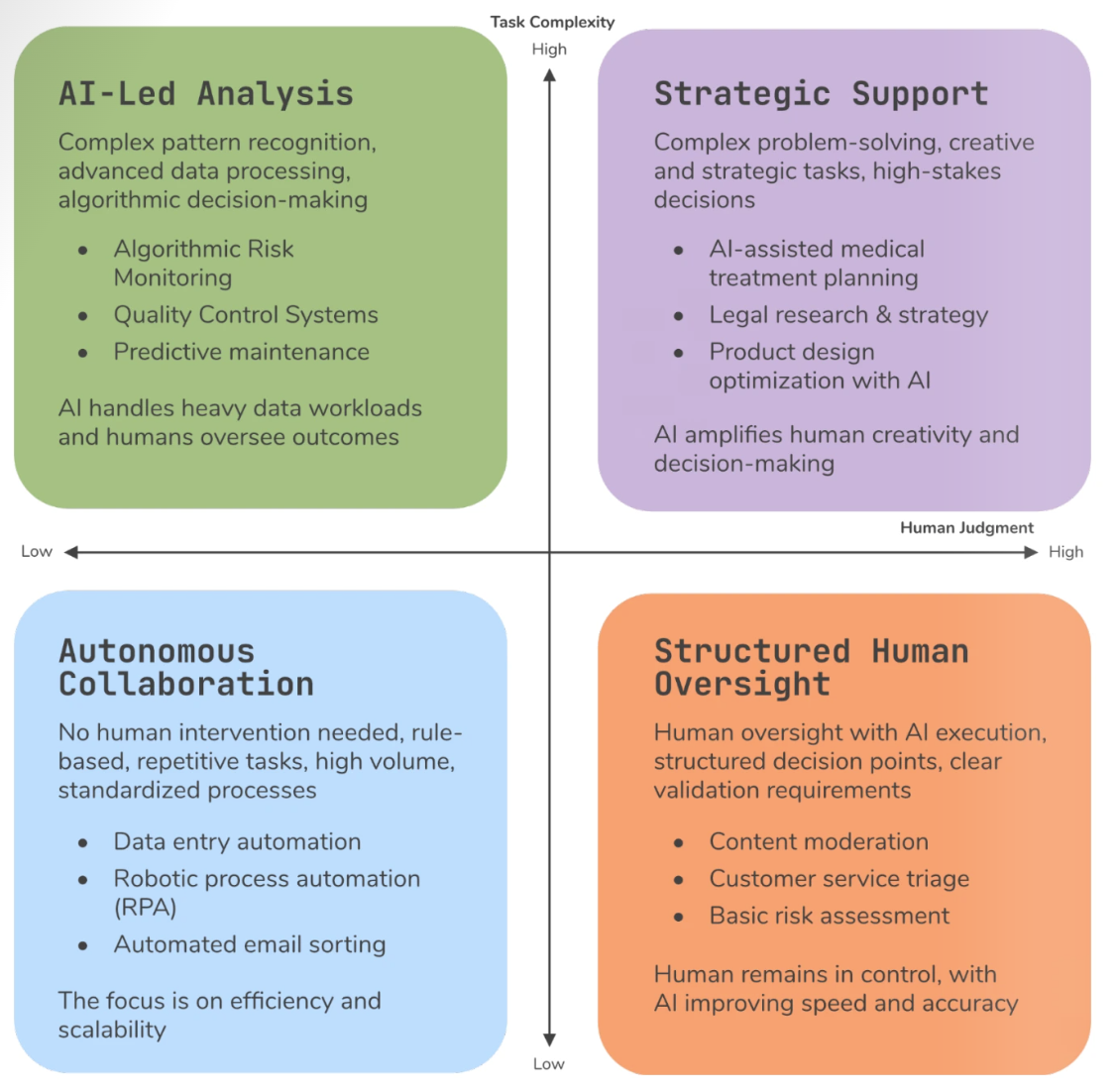
Bottom-left: low complexity, low judgment. The scheduling, the formatting, the data entry you pretend you've delegated but actually do at 11pm because it's easier than explaining the system. This is what AI automates. Let it.
Top-left: high complexity, low judgment. Pattern recognition across data sets too large for any human. AI leads, you oversee.
Bottom-right: low complexity, high judgment. AI handles the execution, you make the calls at the moments that count.
Top-right: high complexity, high judgment. AI expands your thinking, accelerates your research, pressure-tests your strategy. You bring the twenty years.
One quadrant is automation. Three are augmentation.
For most senior knowledge workers, the automation quadrant covers maybe 15-25% of what they actually do. The headlines are about that corner. The other 75% barely gets mentioned.
What you find when you actually look
I did this exercise on my own work about two years ago, which gives me enough distance to tell the honest version rather than the flattering one.
The flattering version: I boldly assessed my workflow and strategically reallocated my cognitive resources.
The honest version: I discovered that several tasks I was privately proud of were bottom-left quadrant work I'd been doing out of habit and mild vanity.
There is a very specific feeling when something you've spent years perfecting turns out to be trivially easy for a machine that doesn't even find it interesting. It isn't fear. It's more like being told your favorite party trick has been on YouTube for six years and has twelve views.
I compressed a three-day process into forty-five minutes. Good. Fine. Liberating, even.
But it also removed several comfortable excuses for not doing harder work. "I'm too busy" had been, it turned out, a very elaborate way of saying "I prefer the tasks where I already know I'm competent."
The part where it gets better
When you clear out the bottom-left, you don't end up with less of a job. You end up with a better one.
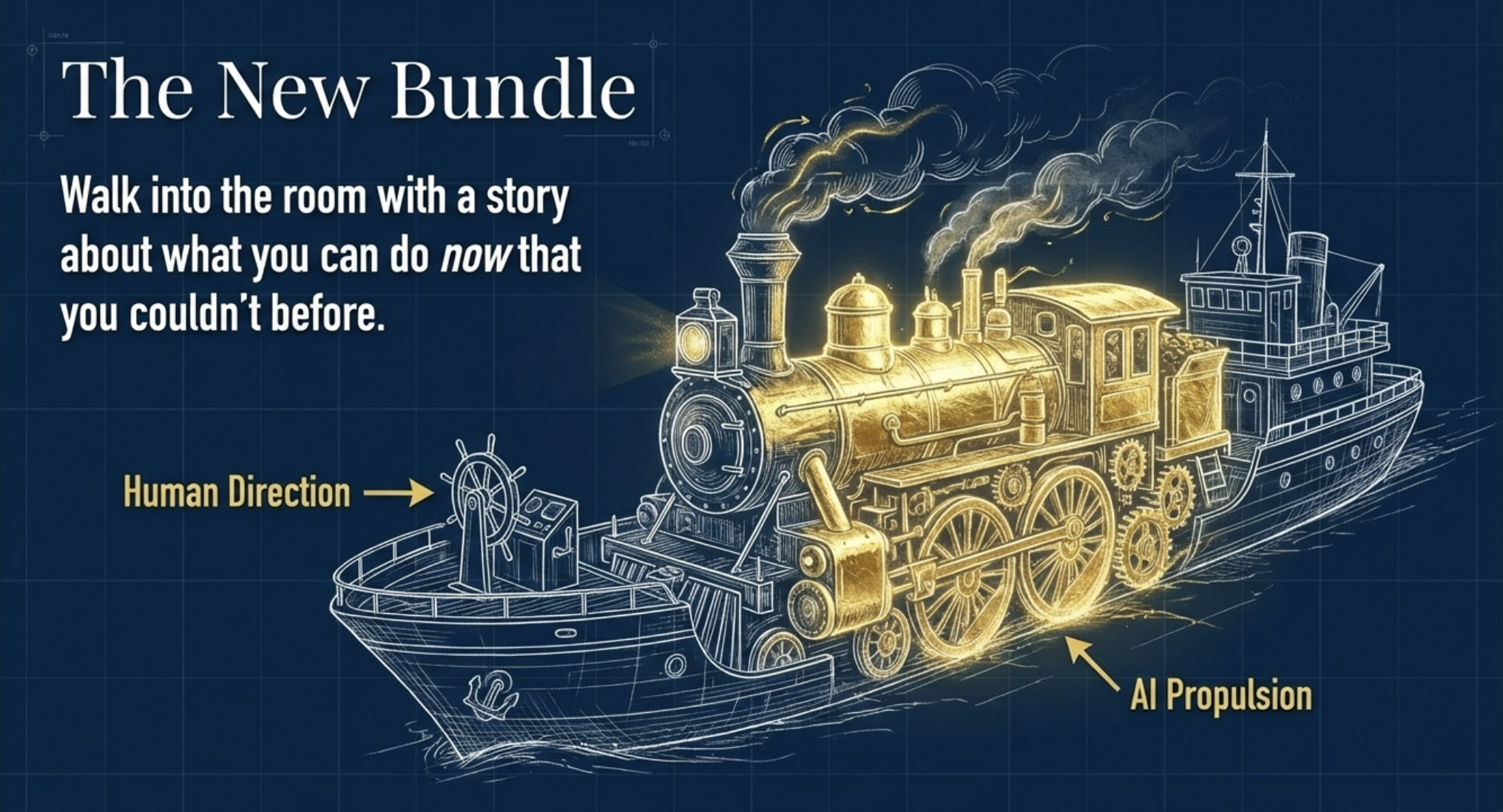
All that cognitive energy you were spending on work that didn't need your particular brain gets freed up for work that does. The client instinct. The creative leaps. The strategic judgment that took decades to build and cannot be downloaded.
Most of us have been doing our best work with whatever energy was left after the low-value tasks ate the day. Like training for a marathon but spending most of your hours filling out the gym's parking forms.
Why this matters right now
There are two versions of what happens next, and the difference between them is who does the thinking first.
In version one, someone with a cost-reduction slide deck looks at your role from the outside. They see the bottom-left quadrant. They write a business case for eliminating your position. They will not look for the other three quadrants. That is not what they were hired to find.
In version two, you've already done the decomposition. You know which tasks to hand off. You've started recomposing your role around the quadrants where you're irreplaceable. You walk into the room with a story about what you can do now that you couldn't before.
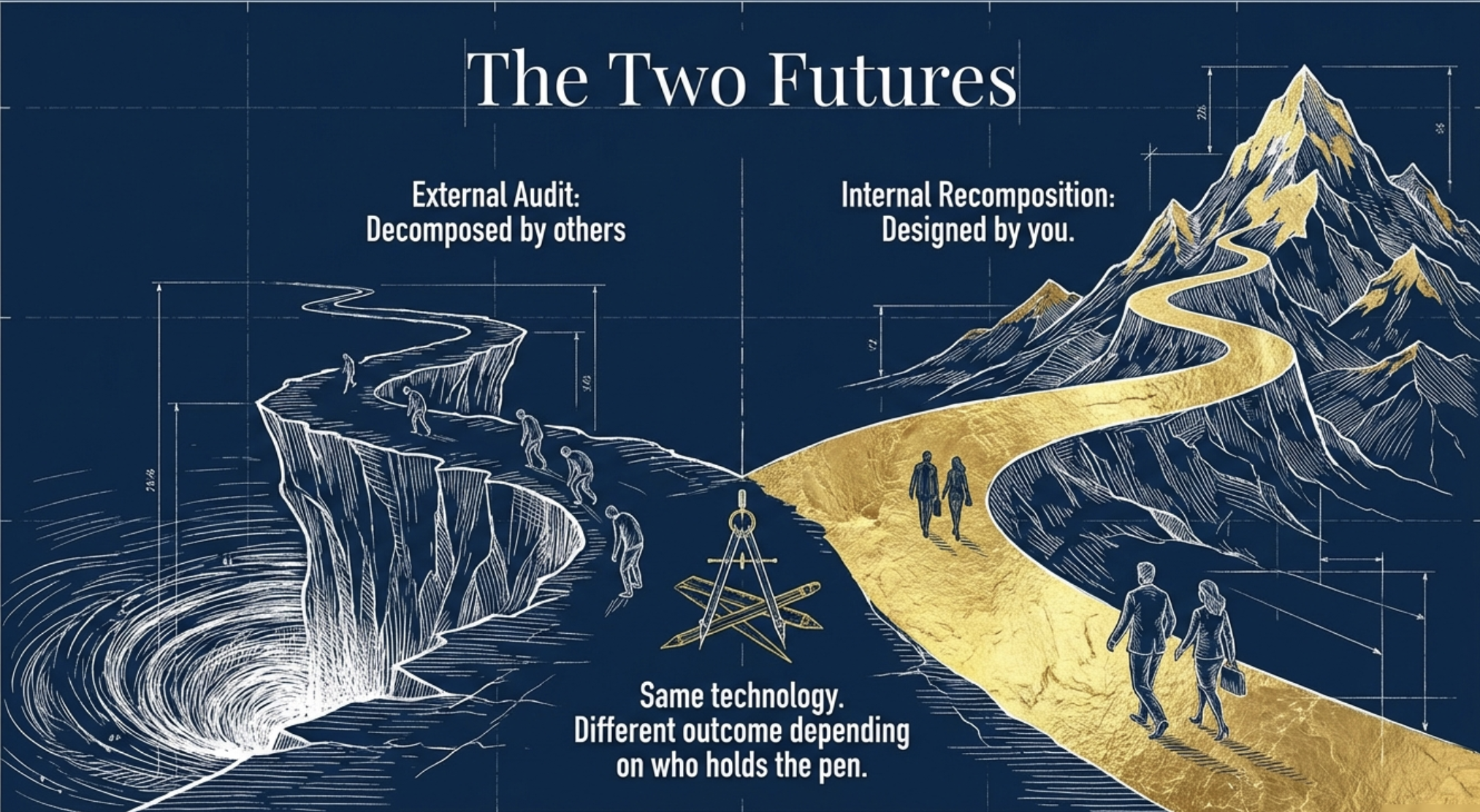
Same technology. Same quadrants. Different outcome depending on who holds the pen.
This, incidentally, is why 95% of AI projects aren't delivering results. Organizations are deploying a task-level technology through role-level thinking. Giving everyone a chatbot and calling it transformation. It is the corporate equivalent of handing someone an electric drill and then wondering why the house hasn't redesigned itself.
The survival guide, in the end, is three steps. Know your bundle. See the quadrants. Hold the pen.
The goats, I'm told, can wait.

