
There Is No Arrival
What a neuroscientist, a marriage, and my packed calendar have been trying to tell me
My wife looked at me one evening and said, "I want to live life now."
Not angry. Not dramatic. Just clear. The way someone speaks when they've been watching you miss the point for a long time and finally decide to say it out loud.
I'd been building. Always building. The next client, the next episode, the next version of the life that would finally feel like enough. I had a phrase for it, though I never said it out loud: happy in five to ten years. Once the business hits this number. Once we're living in that place. Once the pieces land.
She wasn't asking me to stop building. She was asking me to notice that I'd turned my entire life into a hallway. Every room I entered was just a passage to the next one. I never sat down.
I think most leaders live in that hallway. And I think we've been lied to about why we can't stop walking.
Rooms I Stood In and Felt Nothing
I've arrived at enough destinations to know the truth in my body. The number that was supposed to change everything. The deal that was supposed to prove something. The stage, the title, the yes from the person whose yes I thought I needed. I stood in every one of those rooms and felt the same thing: a brief flicker, then nothing. Then the next target already forming.
Every entrepreneur who sold their company and felt hollow knows this. Every leader who hit the number and immediately moved the goalpost knows it. We know it and we keep going. Because the alternative, stopping long enough to feel what's actually there, is more frightening than another decade in the hallway.
And here's what makes it worse. We don't even remember it honestly. We rewrite the story. We tell ourselves the promotion felt like we thought it would. That the milestone delivered what it promised. We fabricate the arrival. Fill in the memory with the satisfaction we were told would be there. Then use that invented memory to justify the next chase.
This is not a flaw in ambition. This is the architecture of a civilization that made us a promise it cannot keep.
The Promise That Cannot Be Kept
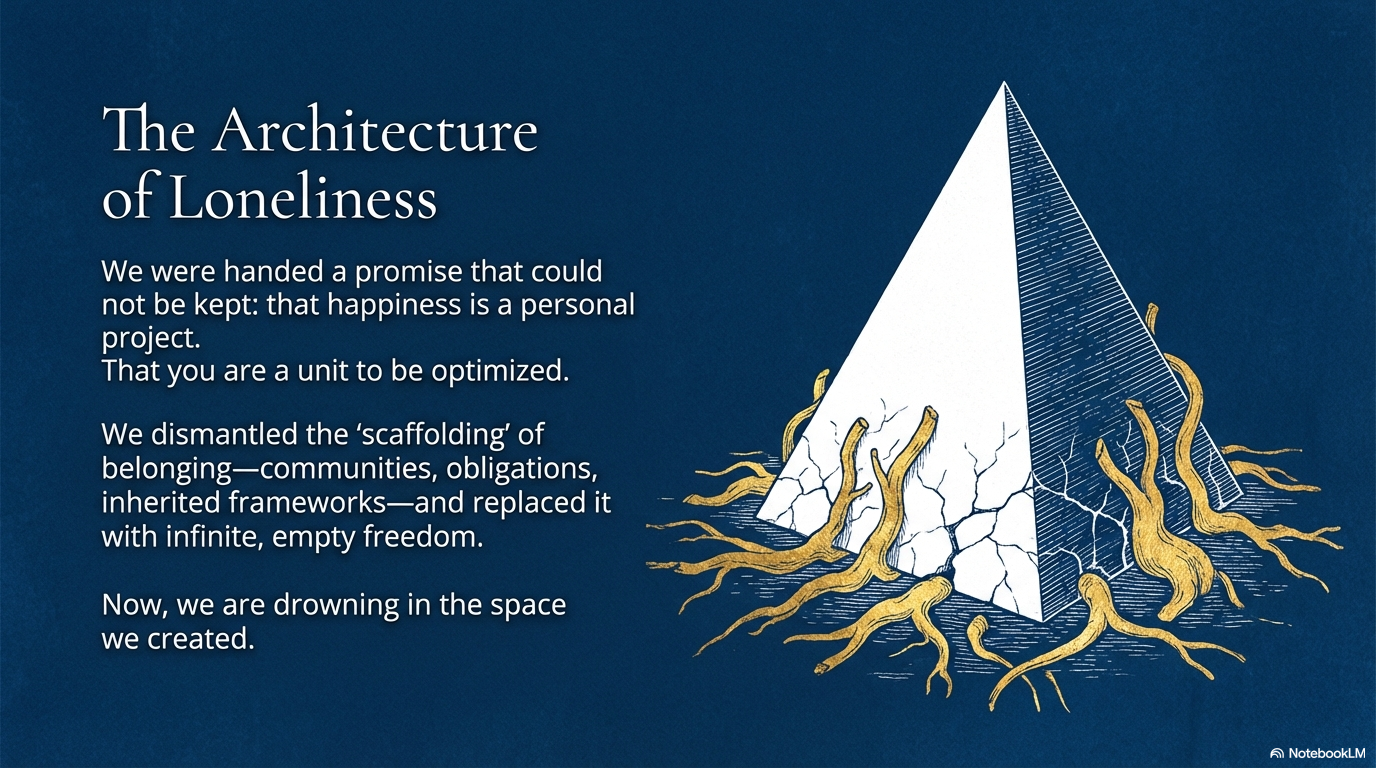
Sometime in the last fifty years, we collectively decided that happiness is a personal project. That meaning lives inside the individual. Find yourself. Optimize yourself. Express yourself. Arrive at yourself. The entire apparatus of modern life bends toward one message: you are the unit that needs to be perfected.
We taught it in schools. Built careers around it. Designed social platforms that reduce a human life to a performance of becoming. Even therapy, at its worst, became another optimization tool. Another hallway.
And for a while, it seemed to work. The generation that still had one foot in older structures, who grew up with communities and obligations and inherited frameworks for meaning, they're doing reasonably well. The system runs on borrowed capital from something it quietly dismantled.

But look at their children. I recently spent a few hours with Erik Fernholm, a cognitive neuroscientist whose honesty about this topic genuinely changed how I think. He put it with painful clarity: some of the happiest adults in the developed world are raising a generation drowning in anxiety, loneliness, and despair. Not because the parents failed. Because the scaffolding that held meaning in place, the collective structures, the sense of belonging to something you didn't choose and can't optimize, was taken apart. And in its place we offered unlimited freedom with no transmitted wisdom about what freedom is for.
This is the world we're leading inside. Organizations full of people trained from birth that the point of life is to become something. To arrive. And we wonder why they collapse when the arriving never comes. We wonder why engagement craters. Why the best people leave. Why performance reviews feel like theater.
They were promised a destination. There isn't one.
What I Actually Want
I should be honest about what happened after my wife said what she said.
I didn't have an epiphany. I had a fight. Then a series of difficult conversations. Then a slow, uncomfortable reckoning with the fact that I'd organized my entire identity around arriving somewhere, and the arriving was always five years away. Always.
So I did something embarrassingly simple. I blocked time in my calendar. Not for strategy. Not for calls. Just space. I wrote "strategic time, ask before booking." Nobody ever asked. The space just existed. And in those hours I discovered that my best thinking doesn't happen when I'm performing productivity. It happens when I'm doing nothing that looks like work.
Then I did something harder. I sat down and tried to separate what I actually wanted from what I'd been trained to want.
I expected the honest list to be smaller. Humbler. The kind of list that sounds like surrender.
It wasn't.
What I wanted was more, not less. But more of things that don't require arriving anywhere. Real conversation, the kind where someone tells you something they've never said out loud. Learning that rearranges how I see. Standing in front of a mountain and feeling the relief of my own smallness. My kids at our kitchen table, not because they have to be there but because they want to be. My wife and I refusing to save life for later.
That last one stopped me. Refusing to save life for later. That's what I'd been doing. Saving everything for a future version of myself who would finally be enough, finally have enough, finally deserve to sit down and be alive in his own life.
The desires weren't smaller. They were present tense. That was the entire difference.

The Self, Turned Inward, Eats Itself Alive
But presence alone doesn't save you. Not if it stays pointed at yourself.
This is where the civilization's lie completes its loop. First it tells you to chase. Then, when the chasing breaks you, it tells you to turn inward. Meditate. Journal. Find yourself. Another destination dressed in gentler language. Another hallway with better lighting.
Erik told me something I keep returning to. He said, "I started studying happiness, and as everyone who does that, I ended up obsessed with purpose instead." That sentence contains the whole problem and the whole answer. Happiness, pursued directly, evaporates. Purpose, discovered through contribution, sustains. He went looking for one thing and found that it only existed inside the other.
Give money away and you feel more than spending it on yourself. Every culture, every study, same result. The best treatment for despair isn't better self-care. It's caring for someone else. The more your inner monologue orbits around I, me, my, the smaller and more anxious your world becomes.
The self, turned inward, eats itself alive. Meaning requires surrender to something that isn't about you.

And this is why the destination mindset is so devastating. Not just because the destination doesn't exist. Because it trains you, day after day, year after year, to postpone the only thing that actually works. "I'll serve once I've arrived. I'll give back once I've built enough. I'll be present once I've earned the right."
But every day spent chasing arrival is a day spent training a nervous system for craving rather than care. The brain is plastic, not elastic. It holds the shape of whatever you practice. Three years of optimizing for personal accumulation builds a person who can no longer feel the thing they were accumulating for.
This Room
Alan Watts wrote that life is not a journey with a destination. It's music. And the point of music is not to reach the end of the song as fast as possible. Nobody who loves music says: let me skip to the final note, that's where the value lives.

But that is exactly how we're living. And leading. And building.
What if the whole project of leadership isn't building toward something? What if it's creating conditions where people can actually be here? Present to each other. Serving something beyond themselves. Building not because the building leads somewhere but because building together, in service of something real, is where meaning lives.
I want to tell you I've figured this out. I haven't. I still catch myself, most days, treating life like a proof of concept. Still performing enough-ness for an audience that doesn't exist. Still reaching for the next thing before I've felt this one. The hallway is deep in my wiring.
But I notice now. I course correct. I sit down and reflect where I used to just keep walking. And every week there are more moments, small and unremarkable, where I'm actually here. Not arrived. Not optimized. Just present. And grateful enough to recognize it.
That's not mastery. It's practice. And the practice, not the arriving, turns out to be the whole thing.
There was never a room at the end of the hallway. There's only this one. The one I kept walking past.
