The Delegation Problem

Why C-suite hands-off approaches will fail this time
Every decade brings a transformation pitch. Cloud. Mobile. Big data. Digital. The playbook is familiar: hire consultants, fund pilots, delegate to IT, check back in eighteen months.
That playbook will fail this time. Here's why.
The Technology of Intelligence
AI isn't another technology. It's the technology of intelligence itself.
That distinction changes everything.
If I make a breakthrough in rocketry, that doesn't advance medicine. Semiconductors don't automatically improve agriculture. Technologies are domain-specific. But intelligence does the thinking in every domain. Automate intelligence and you get capability explosion everywhere simultaneously.

More importantly: AI accelerates AI. Nuclear weapons don't invent better nuclear weapons. But AI can be pointed at chip design to make better chips. At code to write better code. At AI research itself to automate the researchers.
The thing improves itself.
This means you're not adopting a tool that holds still while you learn it. You're interfacing with a recursive capability that's changing faster than quarterly review cycles can track.
Why This Breaks Delegation
Here's the problem: you can only set strategy for capabilities you can imagine. And you can only imagine capabilities you've experienced.
I didn't know I wanted a fifteen-page research brief synthesized in 45 minutes until I'd done it. Didn't know decision quality could improve that much until my preparation got that deep. Before I experienced it, I couldn't have asked for it. The capability was outside my imagination.
This is why delegation fails here.
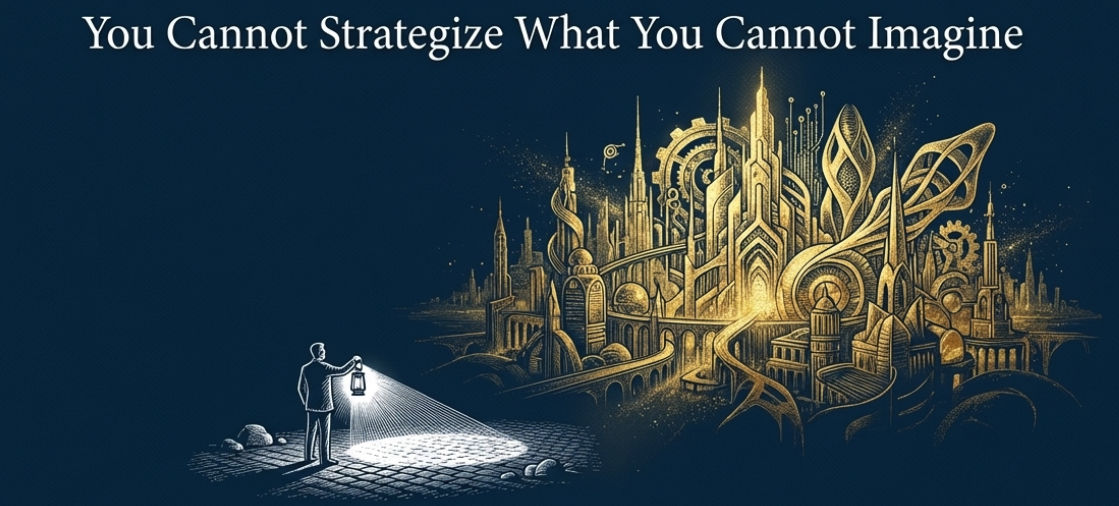
When a CEO delegates AI strategy to people who understand the technology while they don't, they're asking others to set the ambition. But the board doesn't approve strategies the CEO can't evaluate. The budget doesn't fund initiatives the CFO can't imagine. The organization moves at the speed of its least-experienced decision-maker.
Patrik Hedljung runs AI adoption at Scania. 55,000 employees. World-class process optimization. Lean methodology embedded for decades. He told me: "The leaders, the executives, they haven't used the technology enough themselves to see what's possible."
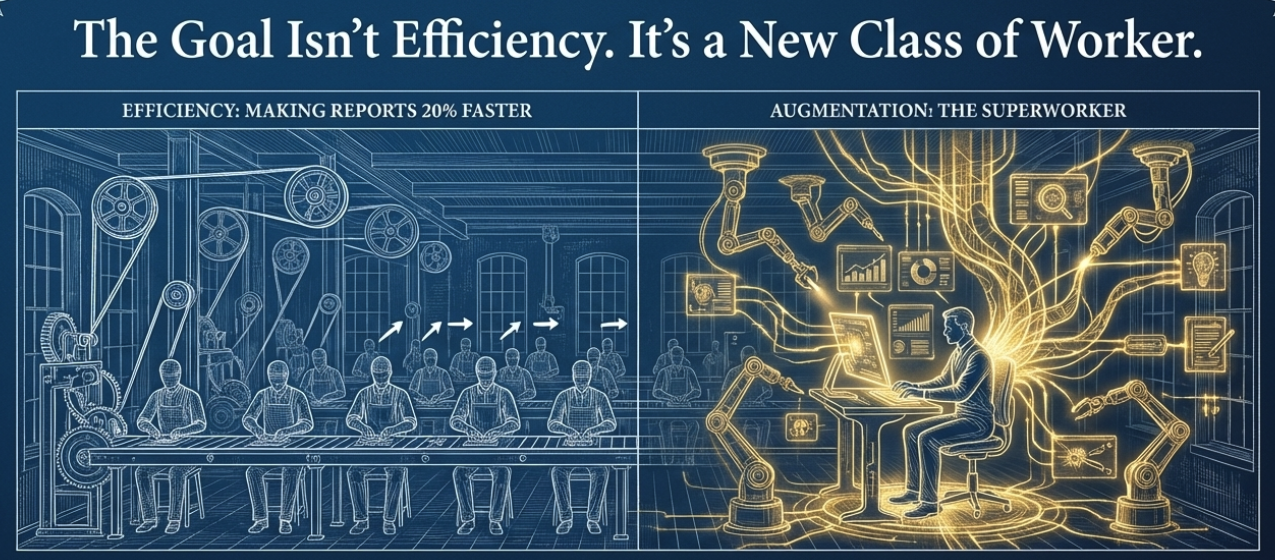
That sounds like a dig at his bosses. It's not. I see this in most organizations I work with. Leaders who aren't opposed to AI. Aren't skeptical. Just inexperienced. So when transformation proposals land on their desks, they default to what they can evaluate: efficiency gains, cost reduction, headcount rationalization.
Safe bets. Small ambitions. The exact opposite of what the technology makes possible.
The Math Problem
Jonathan Brill researches how long organizational transformation actually takes. His findings: deep capability rewirings need five to seven years. But the visible signals you're falling behind might not appear for three to four.
With recursive technology, this math gets brutal.
Exponential curves have a property: you either act too early or too late. There's no comfortable middle. The gap between where you are and where you need to be widens faster than your ability to close it.

I'm watching two populations form in real time. People using AI daily are building intuition that compounds weekly. They're developing judgment about what's possible that no training program transfers. Everyone else is practicing not-knowing. Both groups are becoming who they practice being.
The executives who spend 2025 delegating won't catch up by deciding to engage in 2027. Not because they're less capable. Because the intuitions take time to form, and the technology won't wait.
The First Question
I was terrified when I understood this. How do I stay relevant if I don't master the technology of intelligence? How do I guide transformation I can't feel?
The fear was useful. It made me stop delegating.
Most executives haven't hit that moment yet. Business continues. Disruption feels theoretical. The signals aren't loud enough.
But this isn't like cloud or mobile or digital, where you could wait and catch up. This is intelligence. It's recursive. It accelerates itself. And your ability to imagine what it enables determines your organization's ambition ceiling.
The question for senior leaders isn't "what should our AI strategy be?"
The first question is simpler: Have you personally experienced what this technology does to your own thinking?
If not, you're making strategy about intelligence without having upgraded your own.
The transformation starts with you. Or it caps at whatever you can currently imagine.