
You Are Reading the Wrong Room

The data senior leaders use to make their biggest decisions is structurally biased. And the silent majority isn't where you think it is.
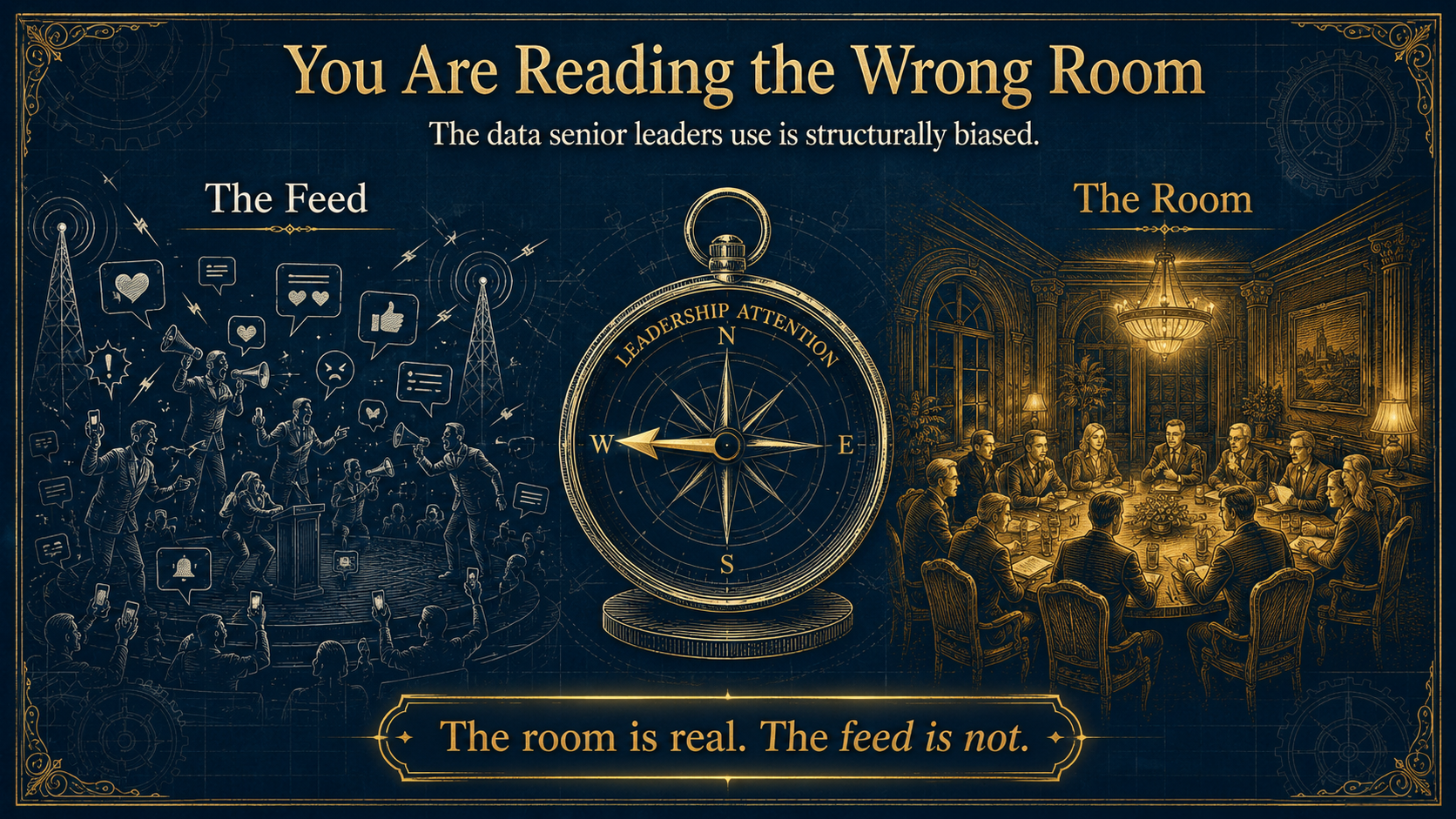
Spend an evening reading the news and you will become quietly convinced civilization is two missed paychecks from collapse. You eye the basement. You wonder if you should learn to keep chickens. You watch a video about water filtration and think, well, you never know.
Then you go to a customer dinner.
You expect to meet the apocalyptic version of your industry your LinkedIn feed has been previewing for a month. You meet, instead, eight people. They are tired but functional. Worried but reasonable. They eat the bread. They ask about your kids. They have plans for next year.
This happens to most senior leaders I know. It happens to me. It used to feel like a glitch in the room. I now suspect it's the most important pattern any of us encounters.
The room is real. The feed is not.
Two percent
Torbjörn Sjöström has run Sweden's most respected polling firm for fifteen years. He told me, recently, that two percent of Swedes don't accept human-driven climate change. I made him repeat it.
Two percent.
For most of a decade, Swedish climate policy has been argued as if that number were eighty-five. Election cycles spent persuading a sliver. Meanwhile the other ninety-eight percent arrived at private conclusions and, increasingly, suspected they were alone with them.
Same week, different number. Seventy-five percent of Swedes thought it was unreasonable to deport refugee teenagers who had grown up in Sweden since infancy and aged out of asylum protection at eighteen. Three quarters. A position no major party would voice aloud for weeks. Until Novus released the polling. Then one party finally said it. The only one whose brand survives saying obvious things.
These are not Swedish stories. They are the same story, told twice, in a country with comparatively functional institutions.
The story is this. The room sits somewhere none of the visible voices are pointing. It has been there the whole time. And almost nobody is asking it anything.
I have been turning this over since. Not as a political observation. As a question for anyone who runs a company, a board, or a portfolio. When you decide what your stakeholders actually want, what data are you using?
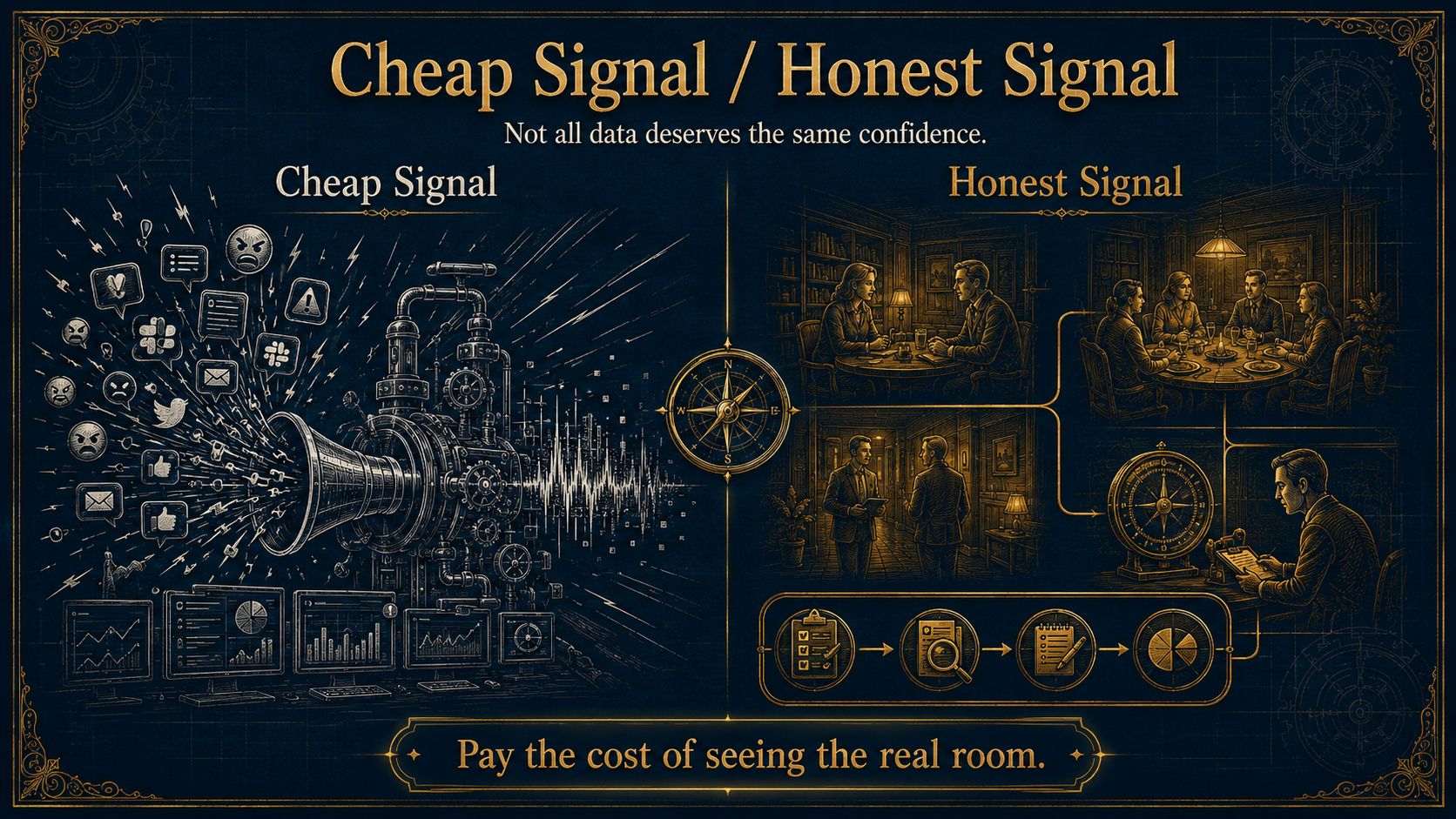
If we are honest, most of us are using something that arrives. The angry customer email that escalates. The Slack thread where the loud six post forty times. The LinkedIn quote-replies. The X reaction to a competitor's launch. The board member's pet topic this quarter. We treat these as proxies for the room because they have the texture of importance — recent, specific, emotional, urgent.
They are not the room. They are the part of the room that produces noise.
How each layer bends the compass
The three layers are not unique to customer surveys. They sit underneath every signal a senior leader uses to read the world.
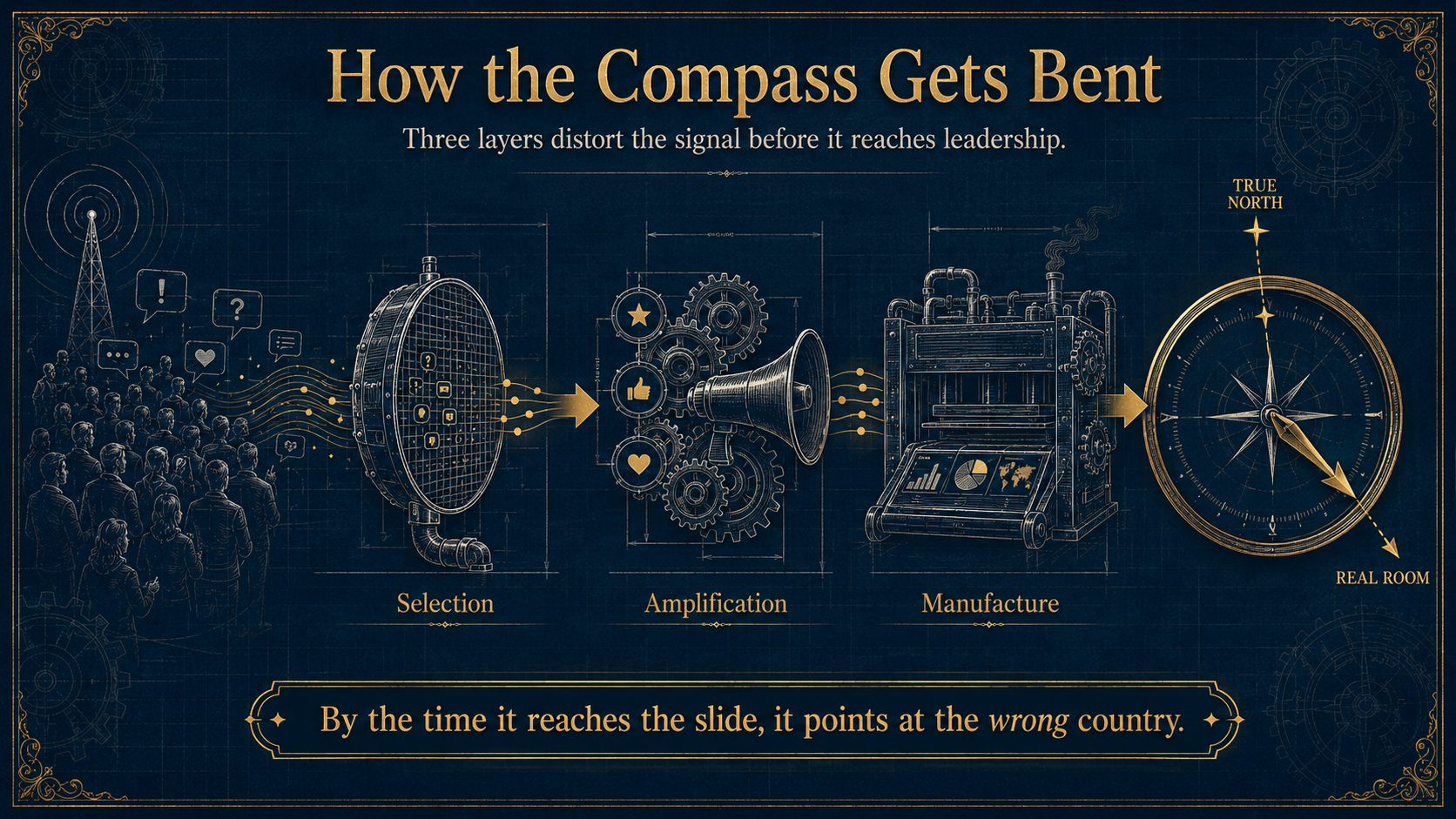
The first layer is selection. Every measurement system samples the people willing to be measured. Surveys sample the responsive. Dashboards sample the engaged. Social listening samples the loud. The disengaged, the busy, the satisfied, the merely competent: none of them produce signal. The five percent you can hear are not the ninety-five percent you cannot.
The second layer is amplification. Whatever sample you started with passes through a platform that ranks responses by an engagement formula. The platform optimizes for what produces events. You see what creates clicks more clearly than you see what creates value. By the time the data reaches your slide, the signal has been re-ordered to favor the vendor's metric, not yours.
The third layer is manufacture. Torbjörn is a programmer in his other life. He described how routine it has become to register ten thousand synthetic email addresses in an afternoon, and have them complete a panel survey for whoever is paying. He spoke about it the way an electrician describes faulty wiring. It was a description, not a warning.
By the time these three layers compose, you are not looking at a noisy version of reality. Selection has skewed your sample. Amplification has re-ordered it. Manufacture has, in places, partially invented it.
The compass isn't off by a few degrees. It is pointing at a different country.
Silent does not mean middle
This is the part most "silent majority" arguments miss, and the part I find genuinely unsettling.
We assume that if we can hear two visible extremes, the silent majority must sit somewhere politely between them. A midpoint. That assumption is doing enormous damage.
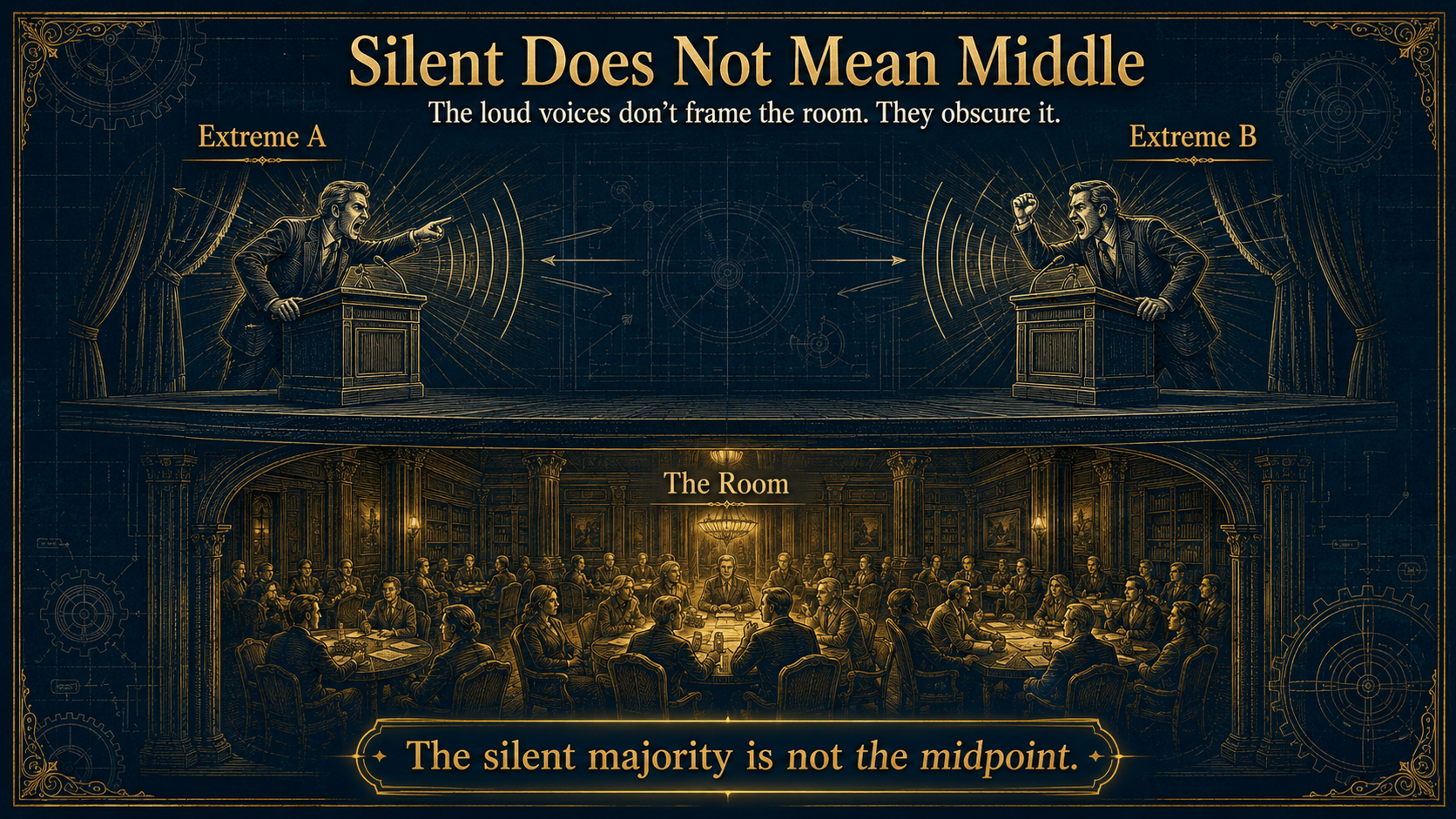
On the deportation question, the public's position was not between two competing party lines. It was a third position no party was occupying.
On climate, the public is not between believers and deniers. It is overwhelmingly with the believers, by a margin most Western politicians would find shocking. The conversation pretends otherwise.
The visible voices don't bracket reality. They obscure it.
This breaks the assumption most senior leadership pattern recognition is built on. We assume the loud are at least pointing at the right axis. They aren't. They're pointing at a stage they built. The room may not be on it.
Edmund Burke didn't say it, but the shape is right
Edmund Burke is supposed to have said that the only thing necessary for the triumph of evil is that good men do nothing. He probably did not. But the line has stuck because it captures a real shape. The shape is not quite right, though. Doing nothing is too strong. What actually happens is that good men do many things, all of them visible, none of them costly. The vacuum forms not from absence but from the absence of stake.
This is the senior leader's particular position. We didn't withdraw from public reasoning. We performed a more sophisticated retreat: present but uncommitted. Posting careful things on LinkedIn. Saying useful things in townhalls. Speaking to the room directly in front of us rather than the room beyond it. We have a thousand visible behaviors and almost no costly ones. And the algorithm, which can't tell the difference between absence and politeness, treats the result the same way.
I should admit my version. Two years ago I cut my news consumption hard. Stopped reading X. Turned off most push notifications. Started a routine of slow mornings before any feed touched my brain. The data I had been using to read "the world" was making me a worse leader, a worse father, a worse partner.
Torbjörn was clear with me. At the personal level, this is the smartest move available. It is also the source of the problem. The trade-off is the disconnect. The people I meet in client meetings bear no resemblance to the people I had been reading about online. Real management teams aren't paralyzed by the takes I had been marinating in. The disconnect, in retrospect, is embarrassing.
What the move actually is
It is not "post more on LinkedIn." That just adds another loud voice to the distortion. With the added indignity that you'll do it worse than the people who do it full-time.
The move is harder, slower, and has no engagement payoff.
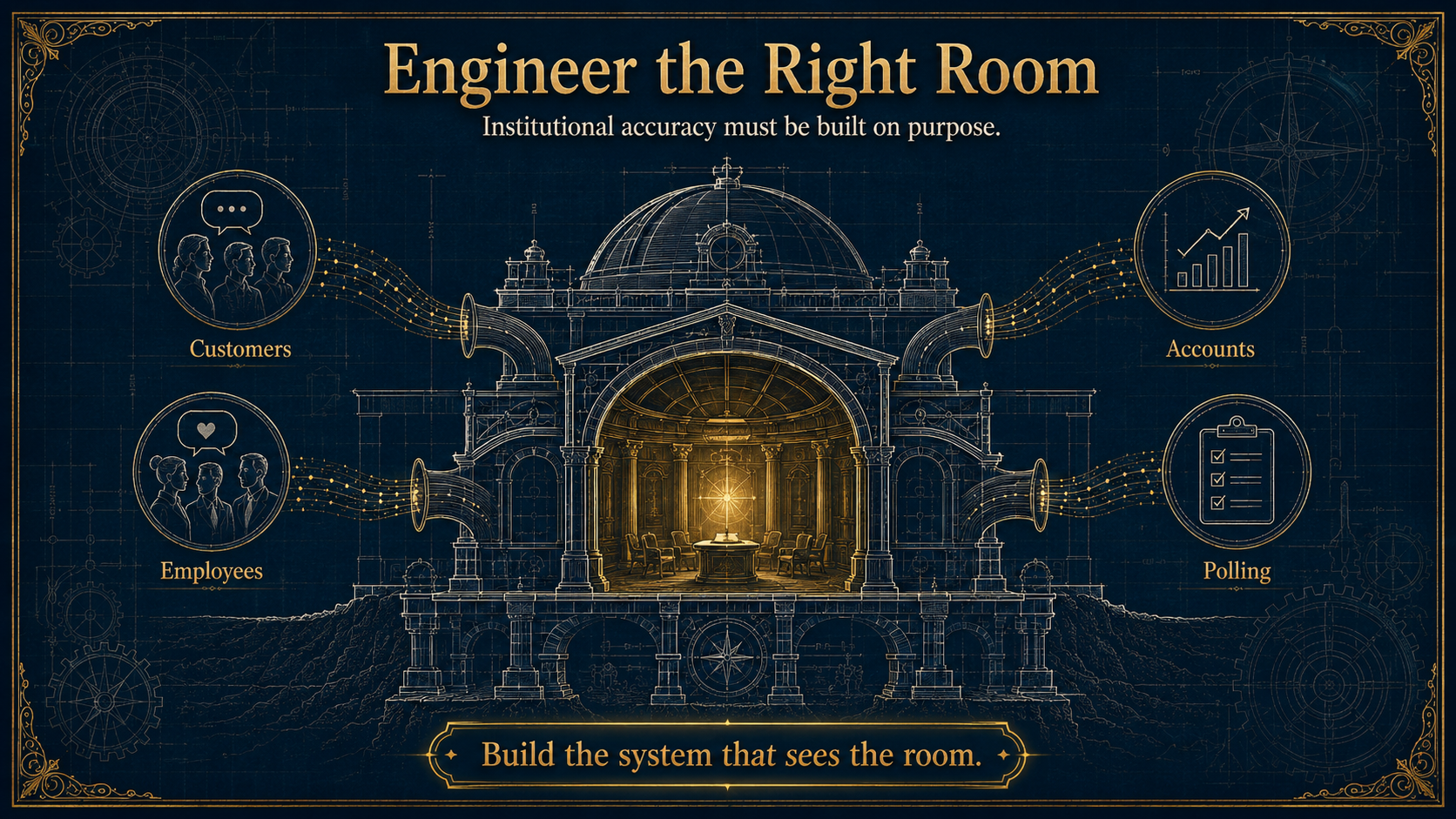
Engineer access to the people who don't generate signal. Qualitative research with the customers who haven't complained. Walking-the-floor conversations with employees who never speak in townhalls. Direct relationships with accounts that renew silently. Independent polling, where it's relevant. Any mechanism that gives you a representative read on the people the system is structurally hiding from you.
This is augmentation thinking applied to information. Automation thinking takes the cheap signal and calls it data. Augmentation thinking knows the cheap signal is biased and pays the cost of an honest one.
The first compounds, over years, into confident delusion. The second compounds, over the same years, into the rarest capability in our era: institutional accuracy.
Most organizations won't pay the cost. The few that do end up making decisions about a room their competitors literally cannot see.
There is no clever shortcut. The architecture that produces the wrong room is engineered. The architecture that produces the right one has to be engineered too.
The room you've stopped seeing
The engineer's question Torbjörn keeps returning to is the right one. What system would naturally produce this behavior?
In our case, the system rewards whoever shouts loudest. The silence in the middle isn't agreement. It isn't apathy. It's what happens when a sampling architecture treats intensity as truth.
The room you think you're reading is two percent. Maybe ten on a good day. The other ninety is doing what the silent majority always does. Getting on with things. Holding views you'd recognize as reasonable, if anyone bothered to ask.
The hard part isn't asking. It's noticing you've stopped.
