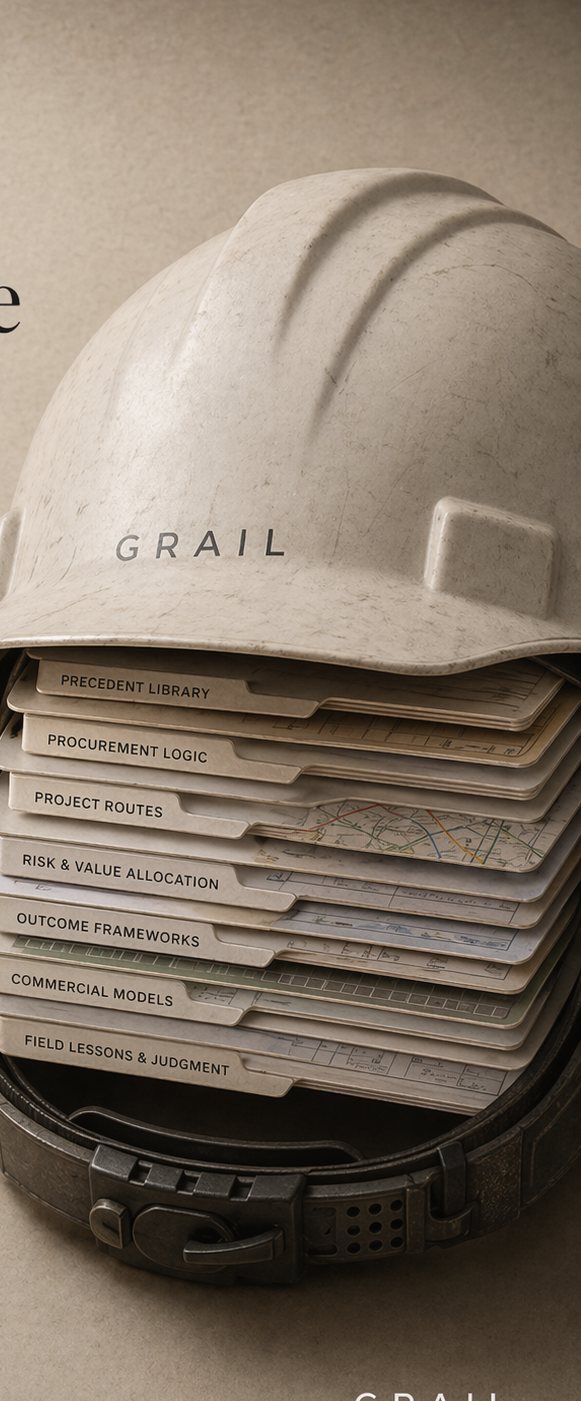
What's Changing Under Your Platform Stack
Your platform budget is two instruments pretending to be one. Autodesk, Bentley, and Oracle are absorbing the capability layer your team spent two years building. Your scorecard measures BIM adoption and Revit seats, and neither is the 2026 question. A briefing for Chiefs of Technology and Heads of Platform at mid-market European infrastructure and civil engineering groups.
Thursday 14:30, platform steering
Every Head of Platform at a mid-sized European infrastructure group has had the same Thursday. BIM adoption at seventy-eight percent across the regional offices. Autodesk Construction Cloud rollout complete. Clash detection running automatically on every project over ten million euros. Your VP Platform opens the review with the dashboard. He is mid-sentence when your phone buzzes. It is your CFO. One sentence: "Autodesk just announced native generative design in the next release. What does that do to the plugin suite we paid three engineers to build last year?" Your Head of BIM mentioned over coffee that the regional Consigli integrator called about senior openings. Your Group CEO has a slide from the last board deck open on his other screen. "AECOM and Consigli. What is our equivalent move?"
You have run this function for a decade. The pattern used to be simple. Standardise the Revit template library. Run the BIM rollout. Negotiate the Autodesk renewal. Meet the board on adoption percentages and platform cost per user. The platform strategy was understandable.
Something changed. What used to take a BIM coordinator two weeks now runs as an agent pass in an afternoon. That compression arrived faster than the discipline to absorb it. BCG's 2025 Nordic Construction survey of ninety executives: only one in four firms generates meaningful business impact from digital or AI, and zero qualify as future-built. Meanwhile AECOM paid $390M for Consigli because the design-automation layer is category-defining. Your VP Platform carries integration reasoning that has never been written down, and two of your senior BIM leads had recruiter calls from regional Autodesk partners last month.
You are not running one platform function. You are running two, and only one of them is on your scorecard. One funds keeping Autodesk, Bentley, Oracle, Primavera, and ProCore running across five hundred users at lower unit cost. The other funds what those platform vendors cannot absorb into their next two cloud releases: the project precedent graph across your firm's job history, the regulatory pathway encoding per region, the firm-specific design standards trained on your actual output, the procurement intelligence pulled from your win and loss record. On one hurdle rate the first wins every quarter. On one scorecard the second does not exist.
This briefing covers what is happening in your sector, what it means for the platform function you run, and the three questions your team should answer before the next platform-budget review.
Infrastructure just lost the pricing model that funded its platform stack
The AI-natives in your category are not experimenting. They are shipping into framework tenders. Consigli shipped into AECOM at a $390M acquisition price because the design-automation layer is category-defining. Togal.AI runs quantity takeoff at a fraction of the time a BIM coordinator takes on the same drawing set. Alice Technologies ships generative schedules that run against a Primavera file and produce sequencing options the planning team would take two weeks to draft. OpenSpace and Buildots pull reality capture off site and mark it up against the BIM automatically. Your client's procurement team watches the same trade press you do, and the procurement lead at your biggest public-sector client now asks whether you can price a framework response against output rather than hours.
Under public procurement frameworks that lock hourly rates for two to four years, the pricing model that funded your platform stack is running out of runway. Framework agreements built in 2022 assumed the pre-AI cost structure for tender response, design coordination, and technical submission. Those hours are compressing faster than the framework renews. The firm that writes the first credible outcome-based framework bid changes the procurement norm for everyone in the region, and takes the next two tender cycles of pricing power before the rest of the market follows. BCG's Nordic Construction survey puts every firm that waits in the bottom three quarters of the maturity curve, and zero firms have so far qualified as future-built.
The capability your team shipped in 2024 against a three-year Revit plugin roadmap is scheduled to ship native in the next Autodesk Construction Cloud release. The moat your firm runs on sits underneath the platform layer, not above it.
The industry's speed mismatch is the third force. AI-native startups build from scratch with no legacy integration debt, no ten-year framework agreements, no regional office politics about the Revit template library. Your firm has all three. You cannot pivot at their speed on their terms. What you can do is identify what is genuinely defensible in your platform posture, stop defending what the platform vendors will absorb anyway, and build the layer they cannot reach. The firms already moving are quiet about it. The ones running yet another BIM adoption campaign and calling it an AI strategy are the ones the board will replace in 2028.
Your platform function is feeling it every day
Your build engine. BIM adoption is at seventy-eight percent. Clash detection runs automatically on projects over ten million euros. Your VP Platform reports green on the dashboard every quarter. And your team pushed another three Revit plugin releases last quarter that the next Autodesk cloud update is going to ship native inside eighteen months. The foundational layer rots underneath the adoption metric. Twelve months in, the firm cannot execute a category rewrite when Consigli shows up on a framework bid. The review discipline that worked in 2022 is training the wrong practice on agent-generated volume now.
Your platform and data. Autodesk spent a decade building Construction Cloud. You cannot replicate a decade of vendor platform investment in eighteen months. You can buy the build-side discipline from the platform layer and redirect the compounding capital into the layer Autodesk and Bentley cannot sell you: site-telemetry data rights renegotiated across your next twenty-four months of framework renewals, a firm-owned project precedent graph portable across Autodesk, Bentley, Oracle, and Trimble, a regulatory pathway encoding per region maintained as structured metadata. The platform vendor absorbs the capability layer. The data layer compounds underneath it.
Your product thesis. Your board asked for the firm's tender posture last quarter. Your answer was the one from three years ago. Your rate card assumes framework agreements will price like 2022 frameworks. They will not. Consigli-assisted consortia are quoting output-priced on framework bids. You quote hourly. That is a capital-allocation question about where the moat gets built, not a rate-card one. Your CFO and commercial leader need a joint document with you before the first AI-assisted outcome-based bid in the region forces the conversation on their terms.
Your R&D bench. You stopped hiring junior BIM coordinators in 2024. The routine clash detection and coordination work that trained a junior into a senior principal over five years is now running on agents. No routine work, no training ground, no senior bench in 2030, no internal Head of Platform candidate the year after. The demographic clock runs faster in infrastructure than in software. Twenty-five percent of the construction workforce is over fifty-five. The firm that cuts for this year's number has a cheaper function in Q4 and an empty bench the same year the principal engineer who knows the regional water authority retires.
Your board-level authority. Thirty percent of European AI-strategy ownership sits with the CIO, twenty-three percent CDAO, twenty-one percent CAIO, one percent COO. You are not on the list. Not because platform leaders abandoned the mandate. You have not yet claimed it. Your Group CEO has a slide about AECOM and Consigli on his desk. Every month without a visible claim, the thesis drifts further from the seat that can defend it. Your Q1 boundary agreement with the CEO and the Head of Digital lands before the next platform-vendor renewal, not after.
What Autodesk cannot absorb is the only moat your firm has
Your sector is repricing from below because AI-native entrants are shipping outcomes-based on framework tenders at a fraction of your billable rate. Your function is compressing because a BIM coordinator running agents now produces what a team of five did two years ago, and the review bar that worked for five cannot hold the volume one produces with agents. Same force, two altitudes. But there is a third thing happening that most mid-market infrastructure CTOs have not named yet.
The moat that matters in 2028 is not above the platform layer. It is underneath it. The clash-detection capability your team wrote three Revit plugins to ship in 2024 is on an eighteen-month obsolescence curve, because Autodesk Construction Cloud is shipping it native in the next major release. What does not commoditise is the twenty years of project precedent your firm has built across the Nordic rail network and the regional water infrastructure portfolio, the regulatory pathway history your principal engineers walked through three planning-reform cycles, and the site-telemetry data your field crews pulled from two hundred construction sites in the last five years. Autodesk cannot absorb any of that into the next cloud release, because Autodesk does not have your job history or your regulatory relationships or your site-telemetry estate. A two-person AI-native cannot build it either, because they do not have the regional customer base that generates the signal.
In 2014, Autodesk told every civil firm that perpetual licenses were ending. Every custom plugin written against the perpetual-license install base was on borrowed time. Some firms spent two years defending the old integration stack and watched their senior engineers rebuild the same plugins against the cloud API. Other firms used the forced rebuild as the opportunity it was: rewrote the integration layer around what would stay theirs even under full cloud absorption. By 2020 the gap between the two camps was category-defining. The 2014 scorecard — perpetual-license count, Revit seats deployed — never turned red. It just stopped being the one the market was scoring. The job had not changed. The unit of judgment had.
You can tell which camp a firm is in from a single question. Is the platform budget you defended at the last board meeting a plateau budget, a compounding budget, or one budget pretending to be one when it is two? Most mid-market firms cannot answer. The ones that can have already made the shift.
You have eighteen to twenty-four months. The CTOs who claim authorship in Q1 author the decade. The ones who wait inherit a seat narrowed to platform uptime and user-count, and a scorecard that stopped mattering the quarter a consortium won its first framework bid on output-priced terms.
What most firms are doing. What the winners are doing instead.
Every infrastructure CTO has had the AI conversation. Most are making the same four decisions.
| The default path | The winners' path |
|---|---|
| Ship another Revit plugin suiteTeam builds what Autodesk ships native in the next release. Adoption dashboard green. Foundation rots under it. | Buy the platform layer, build the data moatRights renegotiated on framework renewals. Firm-owned precedent graph. Integration depth the vendor cannot reach. |
| Run AI budget through IT, sign the Autodesk renewalCIO owns the roadmap in eighteen months. CDO arrives. CTO seat narrows to platform uptime and user count. | Route platform capital through the M&A hurdleTwo budgets, two hurdle rates, two kill criteria. Plateau delivers margin. Compounding delivers the 2028 moat. |
| Price the next framework bid on hoursCompetitor consortium wins with an output-priced bid supported by AI-assisted precedent retrieval at your expense. | Stand one outcome-priced bid on protected P&LParallel tender-engine architecture with CFO and commercial. Hourly holds installed frameworks. Output wins the next round. |
| Cut the junior BIM layer for the Q1 headcount winCheaper function this quarter. Empty principal-engineer bench by 2031. External hire at a premium the firm cannot absorb. | Pair juniors with senior principals on compounding workPrecedent graph curation as the junior's apprenticeship. Eighteen-month judgment training, not five years of routine coordination. |
Same platform team. Same twelve months. Opposite outcomes. The difference is whether the CTO authors the capital allocation or signs the Autodesk renewal.
Build Velocity. Product Defensibility. Platform Capital Allocation.
Three questions every infrastructure CTO is tracking. The third is the crux. The first two are how you earn the right to answer it.
Is our platform speed shipping production-quality engineering, or outputs that fall over on site?
BIM adoption at seventy-eight percent. Clash detection automated. Your team pushed three Revit plugin releases the next Autodesk cloud update will ship native. Autodesk spent a decade building Construction Cloud. You cannot replicate a decade in eighteen months. Buy what the platform layer can carry. Own the discipline that makes it ship.
What does our firm build that a Consigli-inside-AECOM or a Togal.AI cannot copy in a year?
Your capability edge commoditises every cloud release when Autodesk ships it native. Your regulatory pathway history, project precedent graph, and site-telemetry estate compound. Your principal engineer carries twenty years of regional relationships that are not inside your platform in any form an agent can retrieve. The moat sits underneath the platform layer. The window is eighteen to twenty-four months.
Is our platform budget one instrument or two?
Plateau capital runs the Autodesk, Bentley, Oracle stack cheaper every year. Compounding capital builds the 2028 moat. On one hurdle rate the first wins every quarter. On one scorecard the second does not exist. The CTO who walks into the board with one platform budget runs the same programme every peer is running. The one who walks in with two, each defended separately, authors the decade.
What the firms winning this play are actually doing
Four concrete moves any infrastructure CTO can start this quarter. Each addresses one sub-function. Pulled together, they become one architecture the firm builds on.
Build engine: absorb agent-generated velocity without the BIM foundation rotting
Instrument review-time on agent-generated engineering outputs as a floor, not adoption. Mandatory engineering-decision records on every agent-generated structural, environmental, or coordination output above a complexity threshold: no record, no issue. Evaluation harness coverage as a first-class metric, with a golden set of correctly-engineered reference projects and an automated grading rubric. Rebalance the senior-principal-to-mid-tier ratio around the composite rather than preserving the 2022 team shape.
Platform and data: build the moat underneath the vendor release cycle
Three programmes that stack over eighteen months. Data rights audit across your framework contracts, with a renegotiation plan tied to the next twenty-four months of renewals: site-telemetry ownership, design-output rights, precedent access. A firm-owned project-precedent graph separated from any specific vendor's data model, portable across Autodesk, Bentley, Oracle, and Trimble. A regulatory pathway encoding per region, maintained as structured metadata the tender team can walk into a framework bid with. The platform commoditises. This layer compounds.
Product thesis: stand one outcome-priced framework bid on protected P&L
Do not migrate the whole book. Keep hourly for installed framework agreements. Ship outcome-priced on the next tender where the client is pre-qualified for the shift. Write the cannibalisation trigger and kill criteria in Q1. Your tender-engine tooling supports both pricing mechanics natively. The joint Pricing Architecture Document with your CFO and commercial leader is signed before the first outcome-based response goes out.
R&D bench: rebuild the principal-engineer pipeline around senior and agent pairing
Your 2024 decision to stop hiring junior BIM coordinators saves Q1. It empties the 2031 principal bench. Reverse it. Juniors in 2026 do not start on routine coordination. The agent layer absorbed that work. They start on audit, exception-handling, and paired composite work with a named senior principal for their first eighteen months. Knowledge-capture agents run in parallel on the principal's judgment as it is exercised, so the precedent graph compounds under active work.
The only firm that joins platform authorship to working infrastructure
The infrastructure CTO has four places to go. None can do what we do.
The big tech-transformation practices (Accenture Industry X, McKinsey Digital, BCG X, Deloitte) ship a standardised framework scaled across a sector book. Their cost structure requires reusability. Your seat is idiosyncratic. Governance theatre you cannot defend to the board.
The platform-vendor professional services arms (Autodesk, Bentley, Oracle Primavera, Trimble pro-serve) price the engagement as enablement for platform consumption. Their business model requires lock-in. Every build-or-buy decision routes through their pricing for three years.
The hyperscaler professional services arms (AWS, Azure, GCP) have a digital-twin quote on your desk. Their product is measured on cloud spend. Redirecting freed capacity to the precedent graph instead of expanded seats is structurally impossible for them to say.
An in-house or fractional CDO / CAIO splits the seat. Strategy CDO is revenue-measured; Platform CDO is adoption-measured. Two-thirds of newly-appointed Chief AI Officers spend year one compiling inventories instead of setting direction.
The four options you have already looked at. None can run the capital-allocation conversation the seat requires. GRAIL is the fifth.
- Senior advisory that speaks engineering-review, not transformation-deck
- Working infrastructure your team uses the same week
- Custom agents built on your projects, your regulations, your stack
- The start of a precedent-and-regulatory moat your firm owns
- No vendor lock-in at any phase of the engagement
- Founded by operators who have carried CPO-adjacent seats
- Business first, technology second
- Three weeks from first meeting to working infrastructure
- Your team keeps the infrastructure, you own the IP
- Every next step earned by what just shipped, never assumed
Three sessions with your platform leadership. Working infrastructure from week one.
We start with your platform leadership team because the change cannot outrun the team's personal understanding of what is possible. Three workshops. Each delivers standalone value. Each earns the right to the next.
How to think
Walk through what is happening in your sector and inside your platform function. Build the first piece of infrastructure in the room: a capital-allocation agent that takes your real platform budget, splits it two ways, and runs the alternatives analysis against your named AI-native and platform-vendor pressures. Your leadership team leaves with a shared view and the first working artefact already in hand.
Your platform infrastructure
A half-day build. Your VP Platform, Head of BIM, Head of Project Controls, and Head of Digital each leave with five to ten pieces of working infrastructure tuned to their function. Review-bar audit agent. Engineering-decision scaffolding. Precedent-retrieval prototype. Regulatory-pathway encoder. Infrastructure your team is using the same week, not decks about infrastructure.
Ready to run
Refined infrastructure based on real use. The board document that splits the platform budget into two instruments with two hurdle rates and two kill criteria. The boundary agreement with the CEO and Head of Digital on who authors the AI thesis. The joint Pricing Architecture Document with your CFO and commercial leader. The twenty-four-month moat build plan.
Three weeks. No IT project. No board approval needed to start. The infrastructure your platform function is already running on when we finish.
For your next platform-budget review
The questions where your platform leadership cannot agree on an answer are the ones worth an hour on the agenda.
Is your platform budget today one instrument or two? If one, what does the board see that splits plateau from compounding, and what is the kill criterion on each?
Name the AI-native in your category. What is their pricing mechanic, and at what fraction of your billable rate are they quoting on framework bids? If you cannot name the top three, that is the first thing the briefing changes.
If your three most senior principal engineers retired in the same quarter, how much of what makes your firm win framework tenders would survive in any system an agent can retrieve against?
BIM adoption is at seventy-eight percent. Cycle time has not moved on the tender-response side. Where did the freed hours go, and is your review bar still the one you want the foundation layer trained on?
Heidrick's February 2026 data: thirty percent CIO, twenty-three percent CDAO, twenty-one percent CAIO, one percent COO, zero percent CTO on the AI-strategy-ownership list. Is your Q1 boundary agreement with the CEO and Head of Digital written, or is it waiting until after the next Autodesk renewal lands?
If any of these produces a disagreement in your platform leadership, that is the conversation worth having before the board asks.
Continue reading
Sources and limitations
This briefing draws on GRAIL's engagement experience with leadership teams and on public company disclosures. Figures are illustrative unless a source is named beside them. A sourced edition is in preparation.