
Contents · 7 min read
01 / 05 · The shift
Why does the hardware quote carry less of the value?
In short
Buyers can now compare product specs with less work, while AI makes some standard work much faster. Your hardware still matters, but more of the sale now rests on what it does in the plant.
You see the shift when your sales team sends a hardware quote and the buyer compares its specs with another product, then compares its price with a service priced by uptime or output. AI now does some standard work much faster, so doing it by hand may leave you losing on price.
They can compare your specs with another product or an open-hardware build. Software-native competitors sell services priced by uptime or output, so buyers can compare that outcome price with your hardware quote.

Your hardware may still win, but the quote is no longer the whole case. The buyer also wants to know how the equipment will perform in the buyer’s plant.
02 / 05 · Plant value
What do customers pay for beyond the hardware?
In short
Your buyers pay for machines that work well in their own plants. That result rests on plant know-how and data your firm has the right to use.
Good hardware is still part of the answer because the plant needs it. But a product spec cannot show how each site will shape the result.
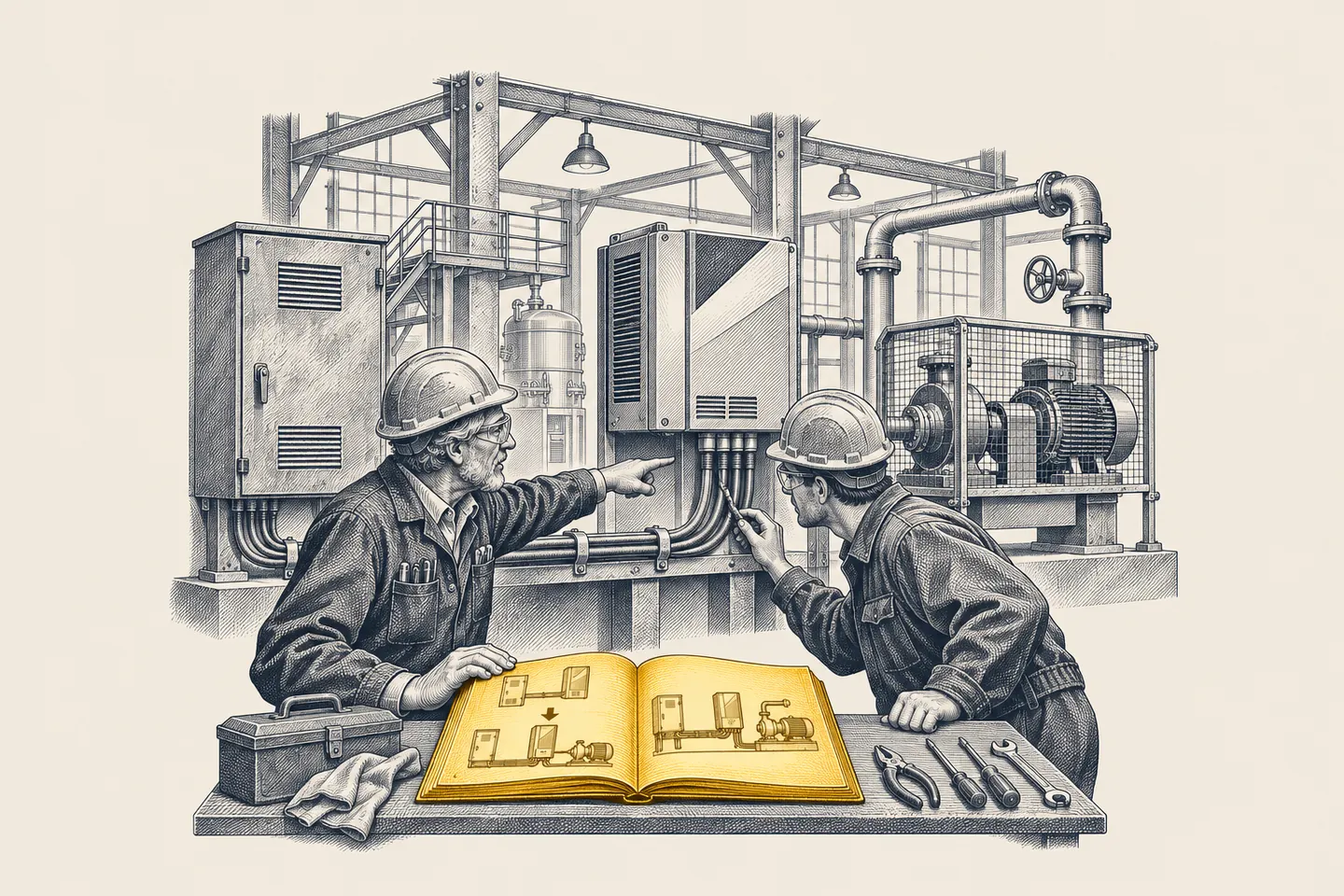
Your best engineers know where old systems fail and which fixes have worked. They also know why an odd setup must stay as it is.
You also need data from machines already in service. It shows what happens across your installed base, so your team can use the same facts in service work.
Your engineers hold the plant history and the fixes that have worked, while machines already in service provide the operating data. The product brief says plant know-how can hold as specs get easier to compare. Deep links to a customer’s control systems can also take years to build.
Your service deals may not give you rights to use the plant data. Have your legal lead check those rights before your team builds on them.
Once you know which inputs drive the result, you must decide who controls them.
03 / 05 · Control
What must your company keep under its control?
In short
Buy common AI tools when they save time, but keep your plant know-how in your firm and secure rights to use the data you need.
Buying a common AI tool can make sense because you do not need to build every part. Your engineers should use the best tool for the job.
The risk starts when its maker controls your know-how or access to the data your service needs. Your service would then depend on technology and data access the supplier controls.
The product and R&D brief makes the split clear. Buy common tools, but guard your plant know-how and your right to use plant data.
Use these steps to draw that line:
Have your CTO list the common tools your company should buy rather than build
Include common tools that make basic work faster.
Have your service lead map what the firm must keep
Record plant history and the fixes known by your best engineers.
Have your legal lead check data rights
Do not assume a sale or service deal gives your firm the access it needs.
Have your COO make sure the account record passes to the next engineer
Make sure the next senior engineer gets each key account’s plant record.
That last step matters because much of the know-how may sit with one person. The operations brief shows why the next engineer should get the account record instead of starting again.
04 / 05 · The price
How should you charge for the value that moves into software?
In short
Use a subscription when the buyer pays for ongoing software use. Use a fixed fee for a defined result in standard work, or a share of the improvement when the buyer pays for better start-up work or uptime.
Adding AI features to hardware may help you close a sale. The buyer gets more in one quote, so the offer looks easy to buy.
But if the rate stays flat, the AI gain has no price. Your team made the gain, yet the old hardware price gives it away.
The price should match what the customer buys:
| What the customer buys | What your company should control | How it can be priced |
|---|---|---|
| Product specs | The product and its fit with the plant | Existing hardware price |
| Basic PLC work | The way your team delivers the agreed output | Fixed fee for a defined result |
| Ongoing software access | Plant know-how and rights to use plant data | Subscription |
| Better start-up work or uptime | Data-use rights and the way the gain is measured | Share of measured improvement |
The finance brief sets out each price form. Charge a fixed fee for a defined result in basic PLC work and use a subscription for software. Use a share of the gain when start-up work or uptime can be measured.
Set the measure before you price the gain. Have your legal and finance leads agree the risk terms before you sign.
05 / 05 · First contract
Where should your company start?
In short
Start with one service deal tied to results and keep its sales and costs apart from the hardware sale. Use what it proves to change how sales and service work across your installed base.
Your team may want to place the new service inside a large hardware deal. That can ease the first sale because the buyer knows the product and account team.
A deal of its own lets your team see the price and cost of the work.

Run the first deal in five steps:
Have the CEO and CFO choose one account
Pick a case where start-up work or uptime can be measured.
Have the service lead set the start point
Agree what both sides will measure before the work starts.
Have the legal lead settle data rights
Put the data terms in the deal before your team relies on them.
Have the sales lead sell the result
Keep the service price outside the hardware rate card.
Have your team review the deal
Compare the gain for the buyer with your sales and delivery cost.
Keep the bid and service records from the first deal together, because the sales brief shows how those records can help with later retrofit sales.
Choose what you control
Your next task is to choose the plant result your company will price separately, then set the know-how and data rights it must control before the first service deal begins. The industrial automation CEO briefing places that decision within the wider shift from hardware value to AI-enabled software and services, so your management team can connect the first contract to the changes required across the company.
What AI changes in industrial automation, written for the CEO. Free to read, no form.
Questions CEOs ask about this
How should an industrial automation company respond when more of the customer's value moves from hardware into AI-enabled software and services?
Value in industrial automation is moving from the hardware quote to the plant results your know-how and data deliver. You must decide whether to price software use and measured gains separately, because a hardware rate card gives away the AI gain and lets a software supplier take the service margin. The stake is whether your company controls the know-how and data rights behind that revenue.
Which hardware advantages remain defensible?
Deep links to a customer’s control systems can hold because they take years to build. They gain more weight when you join them with plant records and know-how that a new software firm lacks.
Should intelligence be bundled, subscribed to or sold by outcome?
Use a subscription for paid software access. Use a fixed fee for a defined result in basic work, or a share of the improvement when both sides can measure it.
Who owns the operating data produced by the equipment?
Do not assume your firm has the right to use it because you sold the machine. Your current service deals may not grant those rights, so ask your legal lead to set the terms first.
How does the sales and service model need to change?
Sales must sell the plant result as an offer of its own. Service must keep a clear plant record, so the next bid or retrofit can use what your firm has learned.
Where could software partners capture our margin?
A software partner can gain control over a system your service depends on if its tool is the only way to use your plant know-how or data. Separately, your firm leaves the AI improvement unpriced when it includes that gain in the hardware rate card.

Founder, GRAIL
Johan has spent fifteen years in management consulting and executive leadership, including as Chief Product Officer of a SaaS company. He founded GRAIL to help European leadership teams work out what AI changes at the core of their business. He is the author of The Execution Revolution and the host of the ThinkRoom podcast.
Related reading
Sources
- Industrial automation CEO briefing: why standard work speeds up and client knowledge becomes more valuable. (accessed November 2, 2026)
- B2B industrial CTO and CPO briefing: which product strengths can hold as specifications become easier to compare. (accessed November 2, 2026)
- Industrial automation CTO and CPO briefing: why firms should protect their know-how and secure rights to use plant data. (accessed November 2, 2026)
- Industrial automation CFO briefing: how each pricing model fits a different form of value. (accessed November 2, 2026)
- Industrial automation COO briefing: why plant history and account knowledge must stay with the company. (accessed November 2, 2026)
- Industrial automation commercial director briefing: how data from bids and service work can support retrofit sales. (accessed November 2, 2026)
Next scheduled review: February 16, 2027